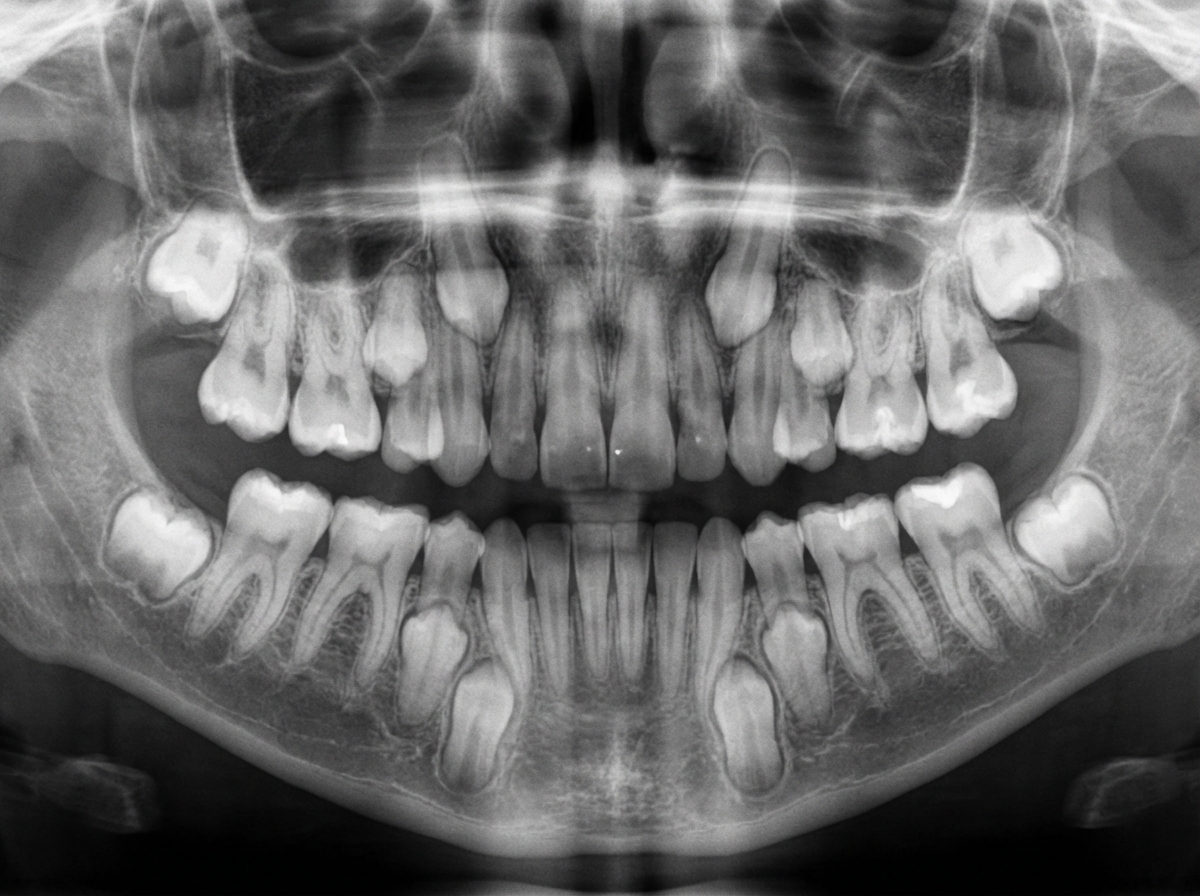
The term dilaceration refers to what?
According to the Federation Dentaire Internationale (FDI) notation, what is the designation for the lower left canine?
Which of the following is the most reliable criterion in Gustafson's method of identification?
Teeth bite marks are a type of:
Explanation: **Explanation:** **Dilaceration** refers to a developmental dental anomaly characterized by an abnormal angulation or a sharp bend in the root or crown of a tooth. This condition typically occurs due to **mechanical trauma** to the deciduous (milk) tooth, which displaces the calcified portion of the underlying permanent tooth germ relative to the uncalcified portion. As development continues, the tooth grows at an angle, resulting in a "hook-like" appearance. In forensic odontology, these unique dental signatures are vital for individual identification and age estimation. **Analysis of Options:** * **Option A (Correct):** Accurately describes the sharp bend in the root/crown resulting from developmental trauma. * **Option B (Incorrect):** Abrasions on tooth surfaces are usually related to mechanical wear (e.g., tooth brushing or occupational habits) and are not termed dilaceration. * **Option C (Incorrect):** A tooth split into two is referred to as **Gemination** (one root, two crowns) or **Fusion** (two roots joined), or simply a vertical root fracture. * **Option D (Incorrect):** A tooth fractured at multiple sites is a **comminuted fracture**, usually resulting from acute high-impact trauma, not a developmental bend. **High-Yield Clinical Pearls for NEET-PG:** * **Most Common Site:** Maxillary permanent incisors are most frequently affected by dilaceration due to their proximity to deciduous teeth. * **Clinical Significance:** It poses significant challenges during **root canal treatment (RCT)** and surgical extractions. * **Radiographic Feature:** It is best identified using an intraoral periapical (IOPA) radiograph or OPG. * **Related Term:** **Taurodontism** (bull-like teeth) is another high-yield dental anomaly where the pulp chamber is elongated vertically, often associated with Klinefelter syndrome.
Explanation: The **Federation Dentaire Internationale (FDI)** system is the most widely used dental notation method globally. It uses a two-digit system where the first digit represents the **quadrant** and the second digit represents the **tooth position** from the midline. ### 1. Why Option B (33) is Correct: * **Quadrant (First Digit):** The mouth is divided into four quadrants (clockwise from the patient's perspective): * 1: Upper Right * 2: Upper Left * **3: Lower Left** * 4: Lower Right * **Tooth Position (Second Digit):** Teeth are numbered 1 to 8 starting from the central incisor: * 1: Central Incisor | 2: Lateral Incisor | **3: Canine** | 4: 1st Premolar | 5: 2nd Premolar | 6: 1st Molar | 7: 2nd Molar | 8: 3rd Molar. * Combining these, the **Lower Left (3)** **Canine (3)** is designated as **33**. ### 2. Analysis of Incorrect Options: * **A. 32:** Represents the Lower Left Lateral Incisor (Quadrant 3, Position 2). * **C. 42:** Represents the Lower Right Lateral Incisor (Quadrant 4, Position 2). * **D. 43:** Represents the Lower Right Canine (Quadrant 4, Position 3). ### 3. High-Yield Clinical Pearls for NEET-PG: * **Deciduous Teeth:** In the FDI system, primary (milk) teeth use quadrant numbers **5 to 8** (5: Upper Right, 6: Upper Left, 7: Lower Left, 8: Lower Right). For example, the lower left deciduous canine is **73**. * **Gustafson’s Method:** The most reliable method for age estimation in adults using teeth, involving six parameters (Attrition, Periodontitis, Secondary dentin, Cementum apposition, Root resorption, and Transparency of dentin). * **Keiser-Nielsen Criteria:** Used for forensic dental identification, requiring at least 12 points of concordance between antemortem and postmortem records. * **Canine Index:** Used for sex determination; the mandibular canine is the most dimorphic tooth.
Explanation: **Explanation:** Gustafson’s Method (1950) is a widely used technique in forensic odontology for estimating the age of an individual based on age-related changes in the teeth. It utilizes a point system (0 to 3) across six specific parameters. **Why "Transparency of Root" is the correct answer:** Among the six criteria, **Root Transparency (Sclerosis)** is considered the **most reliable and accurate** indicator of age. This phenomenon occurs due to the gradual deposition of minerals within the dentinal tubules, starting from the apical end and moving coronally. Unlike other factors, it is least affected by external environmental factors, pathological conditions (like caries), or functional stress, making it a stable physiological marker of aging. **Analysis of Incorrect Options:** * **A. Attrition:** This refers to the wearing down of the occlusal surface. It is highly variable as it depends heavily on diet, chewing habits (bruxism), and the loss of opposing teeth. * **B. Cementum Apposition:** This is the continuous deposition of cementum at the root apex. While it increases with age, it can be pathologically altered by local inflammation or systemic metabolic disorders. * **D. Root Resorption:** This is the most variable and least reliable of the six parameters. It is often influenced by local pressure, orthodontic movements, or idiopathic factors rather than just chronological age. **High-Yield Facts for NEET-PG:** * **The Six Parameters (Mnemonic: ASCEND):** **A**ttrition, **S**econdary dentin deposition, **C**ementum apposition, **E**xternal root resorption, **N**eck retraction (Periodontosis), and **D**entinal transparency. * **Formula:** Age = 11.43 + 4.56 (Total Score). * **Secondary Dentin:** This is the second most reliable parameter after root transparency. * **Applicability:** This method is most accurate for individuals over the age of 21.
Explanation: **Explanation:** **Why Pressure Abrasion is Correct:** Bite marks are unique mechanical injuries caused by the teeth of humans or animals. When teeth are pressed against the skin without significant lateral movement, they cause a vertical crushing of the superficial layers of the epidermis. This results in a **pressure abrasion** (also known as a crush abrasion), which accurately mirrors the occlusal surfaces of the teeth. While bite marks often present as a complex injury (a combination of abrasions, contusions, and sometimes lacerations), the primary diagnostic feature used for forensic dental identification is the pressure abrasion. **Why Other Options are Incorrect:** * **Contusion (Bruise):** While suction or the impact of teeth can cause bruising (ecchymosis), a contusion alone lacks the sharp structural detail of the dental margins required for forensic matching. * **Graze (Sliding Abrasion):** This occurs when the skin surface is scraped by friction. In a bite mark, this would only occur if there was significant "slippage," which usually distorts the mark rather than defining it. * **Linear Abrasion:** These are "scratches" caused by a sharp point drawn across the skin. Teeth generally produce curved or patterned marks rather than simple linear ones. **High-Yield Clinical Pearls for NEET-PG:** * **Forensic Significance:** Bite marks are considered "individualistic" evidence, similar to fingerprints. * **Common Sites:** In females, they are most commonly found on the breasts and legs (sexual assault); in males, on the arms and shoulders (offensive/defensive). * **DNA Recovery:** Always swab the area for **salivary amylase** and epithelial cells for DNA profiling before cleaning the wound. * **Photography:** Use a **scale (ABFO No. 2)** to ensure 1:1 ratio for forensic comparison.
Dental Anatomy and Development
Practice Questions
Dental Records and Charting
Practice Questions
Bite Mark Analysis
Practice Questions
Age Estimation from Teeth
Practice Questions
Sex Determination from Dental Features
Practice Questions
Dental Identification in Mass Disasters
Practice Questions
Dental Trauma Analysis
Practice Questions
Dental Neglect and Abuse
Practice Questions
Dental Malpractice
Practice Questions
Digital Dental Forensics
Practice Questions
Comparison Techniques
Practice Questions
Legal Aspects of Forensic Dentistry
Practice Questions
Get full access to all questions, explanations, and performance tracking.
Start For Free