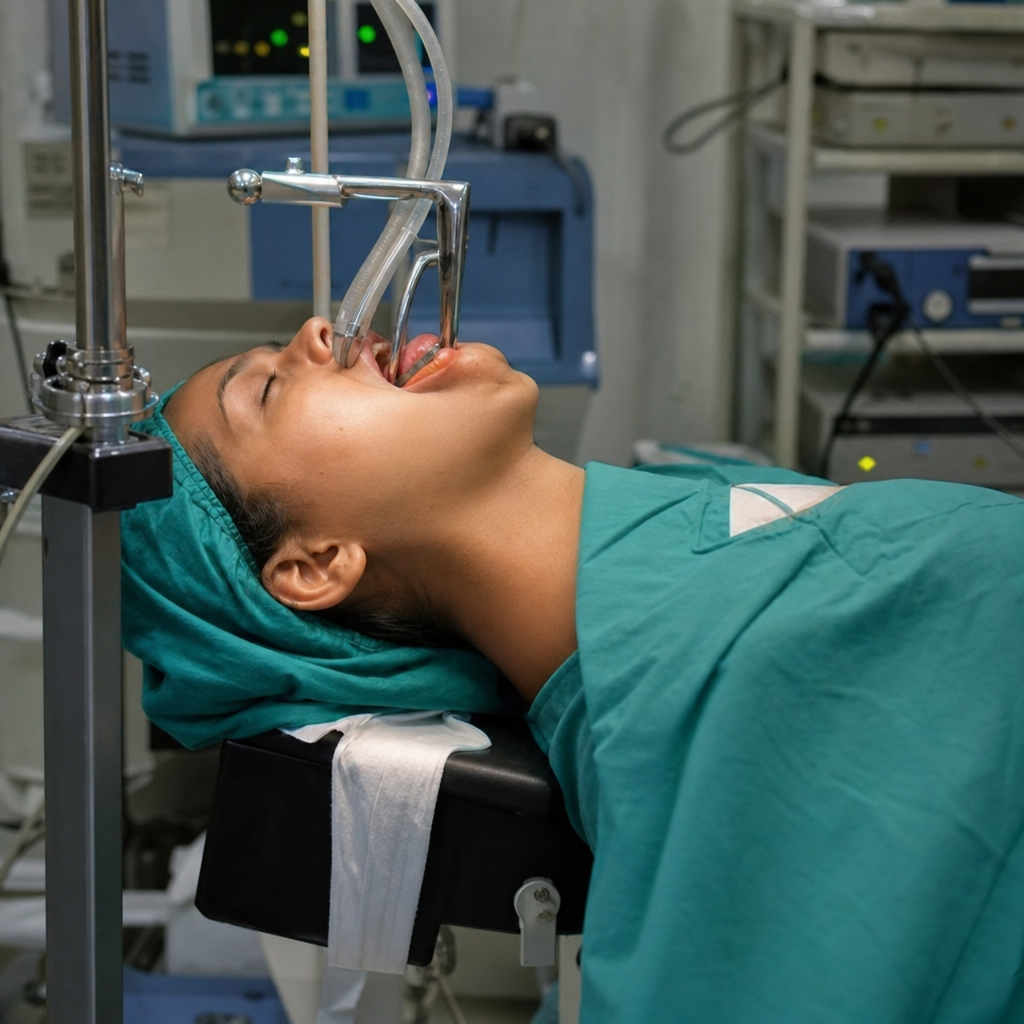
Palatine tonsils are lined by which type of epithelium?
Which of the following statements regarding adenoids is FALSE?
A 17-year-old woman is admitted to the hospital with tonsillitis. A tonsillectomy is performed and the patient complains postoperatively of ear pain. Which of the following nerves was most likely injured during the surgical procedure?
A 15-year-old boy presents with unilateral nasal blockage, a mass in the cheek, and epistaxis. What is the likely diagnosis?
Which of the following statements about pharyngeal diverticula is FALSE?
Which of the following does not constitute the triad of Plummer-Vinson syndrome?
Quinsy is also known as?
In which part of the esophagus does a foreign body most commonly lodge?
The epipharynx is also known as which of the following?
A 15-year-old male presents with hemorrhage 5 hours after tonsillectomy. What is the best treatment for this patient?
Explanation: **Explanation:** The palatine tonsils are paired masses of lymphoid tissue located in the lateral wall of the oropharynx, specifically within the tonsillar fossa between the palatoglossal and palatopharyngeal arches. **Why Option A is correct:** The oropharynx serves as a common passage for both air and food. To withstand the mechanical stress and friction caused by the passage of food boluses (deglutition), it requires a protective, multi-layered lining. Therefore, the palatine tonsils are lined by **non-keratinized stratified squamous epithelium**. A unique feature of this lining is that it invaginates into the tonsillar parenchyma to form 12–15 **tonsillar crypts**, which increase the surface area for antigen exposure. **Why the other options are incorrect:** * **B. Ciliated columnar epithelium:** This is characteristic of the respiratory tract (e.g., nasopharynx, trachea). While the pharyngeal tonsil (adenoid) has areas of ciliated epithelium, the palatine tonsil does not. * **C. Cuboidal epithelium:** This is typically found in glandular ducts or kidney tubules, not in areas subject to mechanical friction. * **D. Transitional epithelium:** This is specific to the urinary tract (urothelium), designed for stretching and distension. **High-Yield Clinical Pearls for NEET-PG:** * **Embryology:** The palatine tonsil develops from the **second pharyngeal pouch**. * **Blood Supply:** The main artery is the **tonsillar branch of the facial artery** (most common source of bleeding post-tonsillectomy). * **Tonsillar Crypts:** The largest crypt is called the **crypta magna**, a remnant of the second pharyngeal pouch. * **Histology:** Unlike lymph nodes, tonsils lack afferent lymphatics and have an incomplete capsule on their deep surface.
Explanation: **Explanation:** The correct answer is **D**. Adenoidectomy is not indicated for minor symptoms. Management typically begins with conservative measures, such as intranasal steroids or antibiotics for infection. Surgery is reserved for **absolute indications**, including obstructive sleep apnea (OSA), suspicion of malignancy, or craniofacial growth anomalies, and **relative indications** like recurrent otitis media or chronic sinusitis unresponsive to medical therapy. **Analysis of Options:** * **Option A (Failure to Thrive):** True. Severe adenoid hypertrophy can cause obstructive sleep apnea. The resulting nocturnal hypoxia, increased work of breathing (burning more calories), and disruption of growth hormone secretion (which occurs during deep sleep) can lead to growth retardation or failure to thrive. * **Option B (High-arched Palate):** True. Chronic mouth breathing due to adenoids leads to "Adenoid Facies." The lack of molding action from the tongue against the palate and the constant atmospheric pressure on the hard palate result in a narrow, high-arched palate and crowded teeth. * **Option C (Mouth Breathing):** True. Adenoids are the most common cause of nasopharyngeal obstruction in children, forcing them to switch from nasal to mouth breathing. **High-Yield Clinical Pearls for NEET-PG:** * **Adenoid Facies:** Characterized by an elongated face, open mouth, prominent upper incisors, short upper lip, and a pinched nose. * **Investigation of Choice:** X-ray soft tissue nasopharynx (lateral view) shows narrowing of the nasopharyngeal airway. * **Eustachian Tube Dysfunction:** Adenoids can block the torus tubarius, leading to **Otitis Media with Effusion (Glue Ear)**; this is a very common association. * **Regression:** Adenoids are present at birth, enlarge until age 6–7, and usually atrophy by puberty (age 12–14).
Explanation: **Explanation:** The correct answer is the **Glossopharyngeal nerve (CN IX)**. This is a classic example of **referred otalgia** (ear pain) following a tonsillectomy. **1. Why Glossopharyngeal nerve is correct:** The glossopharyngeal nerve provides sensory innervation to the **oropharynx** and the **palatine tonsils** via its tonsillar branches. It also provides sensory innervation to the **middle ear** via its tympanic branch (**Jacobson’s nerve**). During a tonsillectomy, the nerve (which lies in the tonsillar bed, deep to the superior constrictor muscle) can be irritated or injured. Due to the shared nerve supply, the brain perceives pain from the oropharynx as originating from the ear. **2. Why other options are incorrect:** * **Auriculotemporal nerve (Branch of V3):** Supplies the TMJ and external auditory canal. While it causes referred ear pain in dental or TMJ issues, it does not innervate the tonsillar fossa. * **Lesser petrosal nerve:** A preganglionic parasympathetic branch of CN IX involved in salivation (parotid gland); it does not carry general somatic sensation from the tonsil. * **Vagus nerve (CN X):** Provides sensation to the laryngopharynx and the external ear (Arnold’s nerve). It causes referred ear pain in cases of laryngeal or hypopharyngeal pathologies (e.g., malignancy), not tonsillitis. **NEET-PG High-Yield Pearls:** * **Tonsillar Bed Anatomy:** The glossopharyngeal nerve is the most common nerve injured during tonsillectomy. * **Referred Otalgia Rule:** Pain in the ear with a normal ear exam should prompt an evaluation of the "4 Ts": **T**ongue, **T**onsil, **T**eeth, and **T**MJ. * **Eagle’s Syndrome:** Elongated styloid process compressing the glossopharyngeal nerve, causing throat and ear pain.
Explanation: ### Explanation **Juvenile Nasopharyngeal Angiofibroma (JNA)** is the most likely diagnosis based on the classic clinical triad: **adolescent male, unilateral nasal obstruction, and recurrent epistaxis.** #### Why Angiofibroma is Correct: JNA is a benign but locally aggressive, highly vascular tumor that almost exclusively affects adolescent males (10–20 years). * **Epistaxis:** The tumor is composed of thin-walled blood vessels lacking a muscular coat, leading to profuse, spontaneous bleeding. * **Cheek Mass:** As the tumor grows, it spreads from the sphenopalatine foramen into the **pterygopalatine fossa** and then the **infratemporal fossa**, causing a characteristic swelling of the cheek (Frog-face deformity). #### Why Other Options are Incorrect: * **Nasopharyngeal Carcinoma:** Typically presents in older adults (bimodal peak) and is strongly associated with EBV. While it causes nasal block and epistaxis, a cheek mass is rare; it more commonly presents with cervical lymphadenopathy or cranial nerve palsies. * **Inverted Papilloma:** This is a benign epithelial tumor usually seen in older adults (40–60 years). It arises from the lateral nasal wall and rarely presents with a cheek mass or profuse epistaxis. #### High-Yield Clinical Pearls for NEET-PG: * **Origin:** Sphenopalatine foramen (near the posterior end of the middle turbinate). * **Holman-Miller Sign (Antral Sign):** Forward bowing of the posterior wall of the maxillary antrum seen on lateral X-ray/CT. * **Diagnosis:** Contrast-enhanced CT (CECT) is the investigation of choice. **Biopsy is contraindicated** due to the risk of torrential hemorrhage. * **Treatment:** Surgical excision (Pre-operative embolization is often done to reduce blood loss).
Explanation: ### Explanation The question refers to **Zenker’s Diverticulum** (Pharyngeal Pouch), which is a pulsion-type diverticulum. **1. Why Option B is the Correct (False) Statement:** While Zenker’s diverticulum originates in the posterior wall of the pharynx at **Killian’s Dehiscence** (a weak area between the thyropharyngeus and cricopharyngeus muscles), it does not remain strictly posterior. As the pouch enlarges, it is restricted by the vertebral column and is forced to deviate, usually to the **left side** of the neck. Therefore, stating it simply "lies in the posterior wall" is clinically inaccurate compared to its lateral presentation. **2. Analysis of Other Options:** * **Option A (True):** It results from **neuromuscular incoordination** where the cricopharyngeal sphincter fails to relax during swallowing, increasing intraluminal pressure. * **Option C (True):** Pharyngeal pouches are anatomical norms in certain animals like **pigs** and camels. * **Option D (True):** The pouch acts as a reservoir where **undigested food accumulates**, leading to symptoms like halitosis (bad breath), regurgitation, and nocturnal aspiration. ### NEET-PG High-Yield Pearls: * **Killian’s Dehiscence:** The site of origin; located between the oblique and transverse fibers of the inferior constrictor. * **Boyce’s Sign:** A gurgling sound heard on pressing the swelling in the neck. * **Investigation of Choice:** **Barium Swallow** (shows a "teapot" or "bag-like" appearance). * **Contraindication:** Rigid Esophagoscopy (high risk of perforation). * **Treatment:** Small pouches require Cricopharyngeal Myotomy; larger ones require **Dohlman’s Procedure** (Endoscopic Stapling).
Explanation: Plummer-Vinson Syndrome (also known as Paterson-Brown-Kelly Syndrome) is a classic triad frequently tested in NEET-PG. To answer this question correctly, one must distinguish between the **defining components** of the syndrome and the **general signs** of anemia. ### **Explanation of the Correct Answer** **D. Pallor:** While pallor is a common clinical sign of iron deficiency anemia, it is **not** considered a formal component of the diagnostic triad. The triad specifically consists of systemic and structural changes: Iron deficiency anemia, esophageal webs, and atrophic glossitis/cheilosis. Pallor is a non-specific finding and is therefore the "odd one out." ### **Analysis of Incorrect Options** * **A. Mucosal webs:** These are post-cricoid esophageal webs (sideropenic dysphagia) that cause painless, progressive dysphagia, primarily for solids. * **B. Cheilosis:** This refers to inflammatory lesions at the corners of the mouth (angular stomatitis). Along with glossitis (smooth, red tongue), it represents the epithelial changes associated with the syndrome. * **C. Iron deficiency anemia:** This is the primary hematological driver of the condition. Correcting the iron deficiency often leads to the resolution of the mucosal changes. ### **NEET-PG High-Yield Pearls** * **Demographics:** Most common in middle-aged females. * **Pre-malignant Potential:** It is a significant risk factor for **Post-cricoid Squamous Cell Carcinoma**. * **Clinical Feature:** Koilonychia (spoon-shaped nails) is a frequently associated finding. * **Diagnosis:** Barium swallow is the investigation of choice to visualize the web (seen as a translucent notch in the anterior aspect of the upper esophagus). * **Treatment:** Iron supplementation and endoscopic dilation of the web if dysphagia persists.
Explanation: **Explanation:** **1. Why Peritonsillar Abscess is Correct:** Quinsy is the clinical synonym for a **Peritonsillar Abscess**. It is a localized collection of pus in the potential space between the **capsule of the palatine tonsil** and the **superior constrictor muscle** (peritonsillar space). It usually occurs as a complication of acute follicular tonsillitis. The infection typically starts in the *crypta magna*. **2. Why Other Options are Incorrect:** * **Retropharyngeal Abscess:** This occurs in the space behind the pharynx, posterior to the buccopharyngeal fascia. It is characterized by a bulge in the posterior pharyngeal wall and is common in children due to suppuration of the **Nodes of Rouviere**. * **Parapharyngeal Abscess:** This involves the lateral pharyngeal space (cone-shaped). It presents with trismus and external swelling at the angle of the mandible, rather than a localized bulge of the tonsillar pillar. * **Paraepiglottic Abscess:** This is an extremely rare clinical entity involving the spaces adjacent to the epiglottis; it is not synonymous with Quinsy. **3. High-Yield Clinical Pearls for NEET-PG:** * **Clinical Presentation:** Severe throat pain (usually unilateral), odynophagia, **Trismus** (due to irritation of the medial pterygoid muscle), and a characteristic **"Hot Potato Voice."** * **Physical Exam:** The uvula is deviated to the **opposite side**, and there is congestion/bulging of the soft palate above the tonsil. * **Management:** The treatment of choice is **Incision and Drainage** at the point of maximum bulge (usually lateral to the junction of the anterior pillar and a horizontal line through the base of the uvula). * **Interval Tonsillectomy:** Performed 4–6 weeks after the abscess settles to prevent recurrence.
Explanation: **Explanation:** The esophagus has four anatomical constrictions where the lumen is naturally narrowed. These sites are the most common locations for foreign body (FB) entrapment, food bolus impaction, and caustic injury. **1. Why Option A is Correct:** The **cricopharyngeus muscle** (at the level of C6) represents the **first and narrowest constriction** of the esophagus. It is the junction between the pharynx and the esophagus (the upper esophageal sphincter). Because it is the very first point of resistance a swallowed object encounters, approximately **70-75% of all esophageal foreign bodies** lodge here. **2. Analysis of Incorrect Options:** * **Option B (Aortic Arch):** This is the second constriction (at the level of T4). While objects can lodge here, it is wider than the cricopharyngeus. * **Option C (Left Main Bronchus):** This is the third constriction (at the level of T5). It is a common site for physiological narrowing but a less frequent site for FB impaction compared to the inlet. * **Option D (Diaphragm):** This is the fourth constriction (at the level of T10), where the esophagus passes through the esophageal hiatus. While significant for hiatal hernias or reflux issues, it is the least common site for acute FB entrapment in adults without underlying strictures. **Clinical Pearls for NEET-PG:** * **Most common FB in children:** Coins. * **Most common FB in adults:** Meat bolus or fish bones. * **Radiology Tip:** On a PA/AP X-ray, a coin in the **esophagus** appears in the **coronal plane** (flat/circular), whereas a coin in the **trachea** appears in the **sagittal plane** (on edge). * **Management:** Rigid esophagoscopy is the gold standard for removal. The most dangerous complication of a missed FB is **perforation leading to mediastinitis**.
Explanation: ### Explanation The pharynx is a muscular tube that serves as a common passage for both air and food. It is anatomically divided into three distinct parts based on their location relative to the nasal cavity, oral cavity, and larynx. **1. Why Nasopharynx is Correct:** The **Nasopharynx** is the uppermost part of the pharynx, located behind the nasal cavity and above the soft palate. In clinical anatomy, it is frequently referred to as the **Epipharynx** (prefix *epi-* meaning "above"). It serves primarily a respiratory function and contains high-yield structures like the Eustachian tube opening, the Fossa of Rosenmüller (the most common site for Nasopharyngeal Carcinoma), and the adenoids. **2. Why Other Options are Incorrect:** * **Oropharynx (Mesopharynx):** This is the middle portion located behind the oral cavity, extending from the soft palate to the level of the hyoid bone. * **Laryngopharynx & Hypopharynx:** These terms are synonymous. This is the lowermost part of the pharynx, extending from the hyoid bone to the lower border of the cricoid cartilage (C6 level), where it continues as the esophagus. **Clinical Pearls for NEET-PG:** * **Epithelium:** The Nasopharynx is lined by **ciliated pseudostratified columnar epithelium** (respiratory epithelium), whereas the Oro- and Hypopharynx are lined by stratified squamous epithelium. * **Passavant’s Ridge:** A mucosal ridge formed by the palatopharyngeus muscle during swallowing, located at the junction of the nasopharynx and oropharynx. * **Waldeyer’s Ring:** A ring of lymphoid tissue at the entrance of the pharynx; the **Adenoids** (Pharyngeal tonsils) are located specifically in the roof of the nasopharynx.
Explanation: ### **Explanation** This patient is presenting with **Reactionary Hemorrhage**, a critical complication of tonsillectomy occurring within the first 24 hours (most commonly within 4–6 hours) post-surgery. **1. Why "Re-explore immediately" is correct:** Reactionary hemorrhage is usually caused by the slipping of a ligature or the opening of a vessel that was constricted by adrenaline during surgery. In a 15-year-old, the primary concern is the risk of aspiration and hypovolemic shock. The standard management protocol involves: * Moving the patient back to the **Operating Theater (OT)**. * Inducing anesthesia (with a cuffed endotracheal tube to protect the airway). * Removing the clot to identify the bleeding point and achieving hemostasis via ligation or diathermy. **2. Why other options are incorrect:** * **External gauze packing:** This is ineffective as the bleeding is internal (within the tonsillar fossa). It does not provide the necessary pressure to stop arterial bleeding. * **Antibiotics and mouth wash:** These are used to manage **Secondary Hemorrhage** (occurring 5–10 days post-op due to infection), not acute reactionary bleeding. * **Irrigation with cold saline:** While mild cold compresses or ice chips may be used for very minor oozing, they are insufficient for active hemorrhage requiring medical intervention. **3. Clinical Pearls for NEET-PG:** * **Primary Hemorrhage:** Occurs during surgery (managed by ligation/diathermy). * **Reactionary Hemorrhage (2–24 hours):** Due to slipping of ligatures or rise in BP post-anesthesia. **Management:** Re-exploration. * **Secondary Hemorrhage (5–10 days):** Due to infection of the surgical bed. **Management:** Conservative (Antibiotics); if severe, ligation may be needed. * **High-Yield Fact:** The most common vessel involved in tonsillectomy bleeding is the **Paratonsillar vein**. The main artery of the tonsil is the **Tonsillar branch of the Facial artery**.
Pharyngitis
Practice Questions
Tonsillitis
Practice Questions
Peritonsillar Abscess
Practice Questions
Retropharyngeal Abscess
Practice Questions
Adenoid Hypertrophy
Practice Questions
Sleep-Disordered Breathing
Practice Questions
Obstructive Sleep Apnea
Practice Questions
Nasopharyngeal Carcinoma
Practice Questions
Oropharyngeal Carcinoma
Practice Questions
Hypopharyngeal Carcinoma
Practice Questions
Dysphagia
Practice Questions
Globus Pharyngeus
Practice Questions
Get full access to all questions, explanations, and performance tracking.
Start For Free