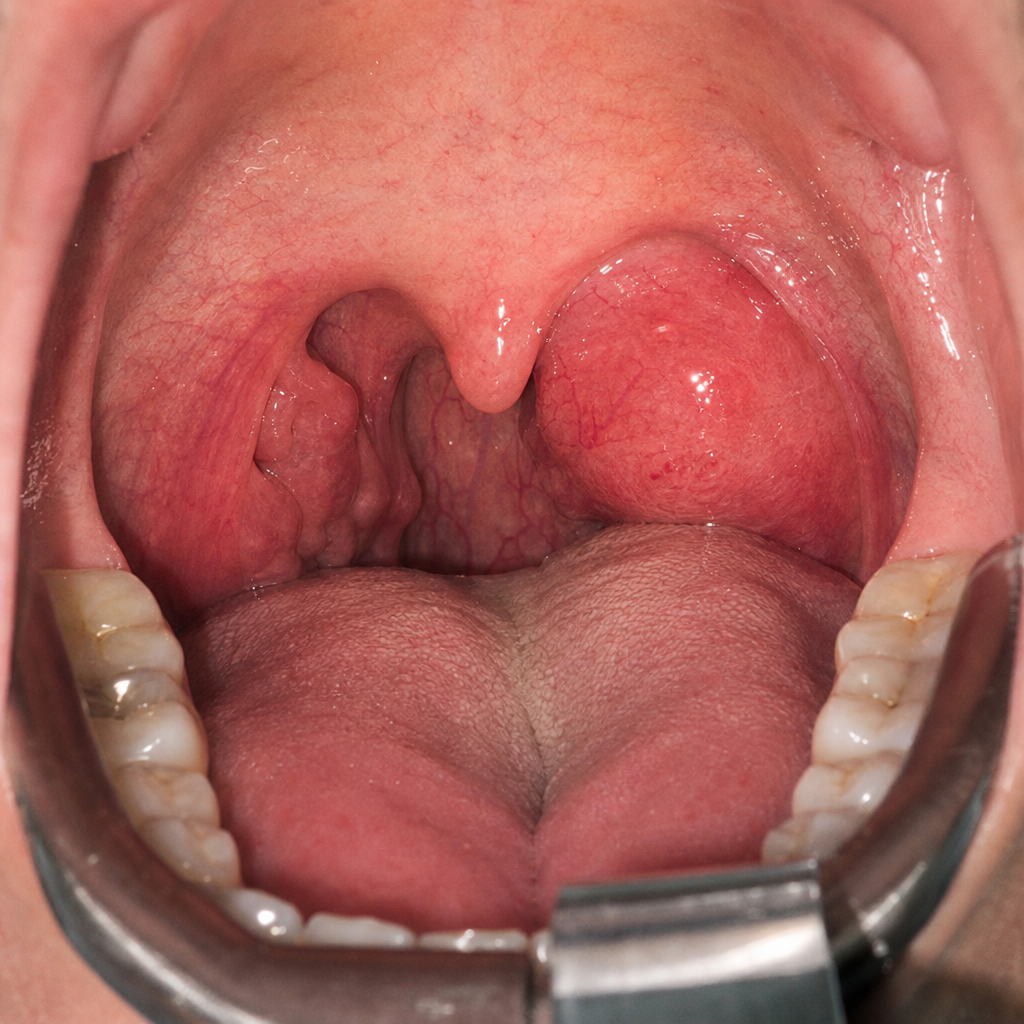
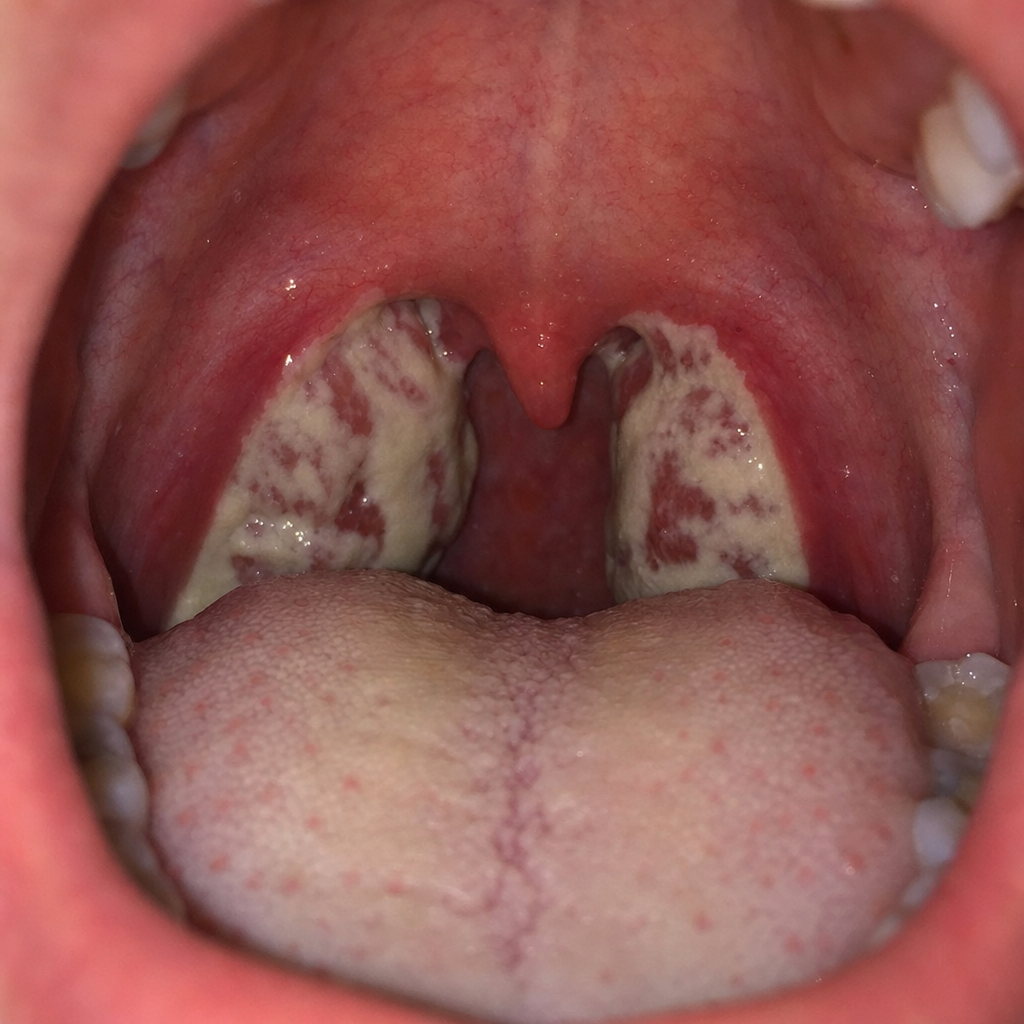
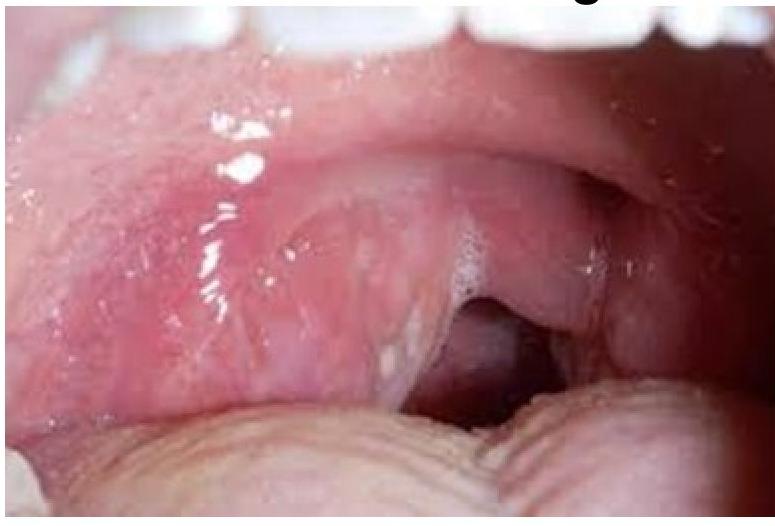
A 15 years old Male presented with history of fever since 2 days, unable to swallow the food with muffled voice. On examination it is noted right tonsil is shifted to midline. What is the diagnosis:
Type of speech seen in nasopharyngeal carcinoma -
Trismus is commonly seen in
Peritonsilar abscess is also called:
A 21-year-old college student presents with hot potato voice and trismus. Clinical diagnosis is?
Trotter's triad is seen with:
In Stylalgia, the most common nerve affected is:
Interval tonsillectomy is done how long after quinsy drainage?
Nasopharyngeal carcinoma causes deafness by:
A 25-year-old woman presents with severe throat pain, difficulty swallowing, and trismus. CT neck shows a peritonsillar fluid collection and inflammation. What is the next best step?
Explanation: ***Quincy (Peritonsillar abscess)*** - This patient's presentation with **fever**, **dysphagia**, **muffled voice** (hot potato voice), and **tonsil shifted to the midline** is classic for a **peritonsillar abscess (Quincy)**. - The affected tonsil is pushed **medially toward the midline** by the collection of pus between the tonsillar capsule and the superior constrictor muscle. - The uvula is typically deviated to the **contralateral side**, and patients often have **trismus** and difficulty opening the mouth. - This is the **most common deep neck space infection** and typically follows acute tonsillitis. *Parapharyngeal abscess* - A **parapharyngeal abscess** would present with **severe trismus**, **neck swelling**, **torticollis**, and **bulging of the lateral pharyngeal wall**. - While it can push the tonsil medially, it more characteristically causes **anterolateral displacement** of the entire pharyngeal wall rather than isolated tonsillar displacement. - Patients typically have more pronounced **systemic toxicity** and **neck involvement** than seen with peritonsillar abscess. *Acute tonsillitis* - **Acute tonsillitis** presents with **bilateral tonsillar enlargement**, exudates, and pharyngeal erythema. - It does not cause **displacement of the tonsil to the midline** or significant **muffled voice**. - While fever and dysphagia are present, the physical examination finding of tonsillar shift indicates a suppurative complication (abscess formation). *Acute retropharyngeal abscess* - An **acute retropharyngeal abscess** occurs in the retropharyngeal space behind the posterior pharyngeal wall. - It presents with **neck stiffness**, **stridor**, **drooling**, **bulging of the posterior pharyngeal wall**, and **reluctance to extend the neck**. - It would **not cause visible displacement of the tonsil to the midline** as the abscess is in a different anatomical space. - More common in **young children** (under 5 years) than adolescents.
Explanation: ***Rhinolalia clausa*** - This is also known as **hyponasal speech** or **closed nasality**, where there is insufficient nasal airflow during speech. - In **nasopharyngeal carcinoma**, the tumor can obstruct the nasopharynx, preventing air from flowing into the nasal cavity during vocalization, leading to this type of speech. *Hot potato voice* - This type of dysphonia is characterized by **muffled speech** as if the speaker is trying to talk with a hot object in their mouth. - It is typically associated with conditions causing **pharyngeal or tonsillar swelling** or peritonsillar abscess, which are distinct from nasopharyngeal carcinoma. *Hoarse voice* - **Hoarseness** results from abnormal vibration of the vocal cords, leading to a rough or breathy voice. - While possible in advanced nasopharyngeal carcinoma due to cranial nerve involvement affecting vocal cords, it is not the primary or most characteristic speech alteration from the tumor's location within the nasopharynx. *Rhinolalia aperta* - Also known as **hypernasal speech** or **open nasality**, this occurs when there is excessive nasal airflow during speech, making non-nasal sounds sound nasal. - This is typically caused by **velopharyngeal insufficiency** or defects that prevent proper closure between the oral and nasal cavities, such as a cleft palate, which is the opposite of the obstruction seen in nasopharyngeal carcinoma.
Explanation: ***Quinsy*** - **Quinsy (peritonsillar abscess)** is the **most common cause of trismus** among pharyngeal infections. - Trismus occurs due to **inflammation and reflex spasm of the pterygoid muscles** adjacent to the abscess. - The severe pain and swelling in the peritonsillar region directly limit **mandibular movement**, making it difficult or impossible to open the mouth. - **Trismus is one of the cardinal clinical features** of quinsy. *Parapharyngeal abscess* - A **parapharyngeal abscess** can also cause trismus due to direct inflammation and irritation of the muscles of mastication. - However, it is **less common than quinsy** and typically presents with other prominent symptoms like **neck swelling**, lateral pharyngeal bulging, and internal carotid artery involvement risk. *Ludwig's angina* - While Ludwig's angina is a severe infection of the **submandibular and sublingual spaces**, trismus is **less common** and less pronounced compared to peritonsillar abscess. - The primary concern in Ludwig's angina is **airway obstruction** due to tongue elevation and "bull neck" swelling, not typically severe trismus. *Retropharyngeal abscess* - A **retropharyngeal abscess** is located behind the pharynx and typically manifests with **dysphagia**, **odynophagia**, **neck stiffness**, and respiratory distress. - While indirect muscle spasm can occur, **trismus is not a characteristic or common symptom** of retropharyngeal abscess, which primarily affects swallowing and neck mobility.
Explanation: ***Quinsy*** - This is the traditional and **common medical term** used to refer to a peritonsillar abscess. - It describes a **collection of pus** located between the tonsillar capsule and the superior constrictor muscle. *Thornwaldt's abscess* - This refers to an abscess in **Thornwaldt's cyst**, which is a **pharyngeal bursa** located in the nasopharynx. - It is distinct from a peritonsillar abscess, which is located in the oropharynx. *Ludwig's angina* - This is a **severe cellulitis** of the **floor of the mouth**, often originating from an infected tooth. - It is a life-threatening condition involving deep neck spaces, not the peritonsillar region. *Vincent's angina* - This is also known as **necrotizing ulcerative gingivitis** or **trench mouth**. - It is an infection of the **gums and oral mucosa**, characterized by painful ulcers, necrosis, and halitosis, and is not an abscess in the peritonsillar space.
Explanation: ***Quinsy*** - **Quinsy**, or **peritonsillar abscess**, is characterized by a "hot potato" or muffled voice and **trismus** (difficulty opening the mouth) due to inflammation and muscle spasm. - The abscess typically forms adjacent to the palatine tonsil, causing severe unilateral throat pain and difficulty swallowing. *Chronic Tonsillitis* - **Chronic tonsillitis** is characterized by recurrent episodes of throat pain, fever, and enlarged tonsils, but does not typically present with acute **trismus** or a "hot potato" voice. - It results from persistent or repeated bacterial infections of the tonsils, often without significant abscess formation. *Epiglottitis* - **Epiglottitis** presents with rapid onset of severe sore throat, **dysphagia**, drooling, and inspiratory stridor, and can be life-threatening due to airway obstruction. - While it causes significant throat pain and difficulty swallowing, it does not typically present with a "hot potato" voice or **trismus**, but rather a muffled voice and tripod positioning. *Infectious mononucleosis* - **Infectious mononucleosis** leads to swollen tonsils with exudates, fatigue, and lymphadenopathy, but usually does not cause **trismus** or the distinctive "hot potato" voice. - It is caused by the **Epstein-Barr virus** and can lead to significant pharyngitis, but is not associated with peritonsillar abscess formation.
Explanation: ***Nasopharyngeal carcinoma*** - **Trotter's triad** is a classic presentation of nasopharyngeal carcinoma, particularly when the tumor involves the pharyngeal recess (fossa of Rosenmüller) and extends to involve surrounding structures. - The triad consists of: 1. **Unilateral conductive deafness** (due to Eustachian tube obstruction by the tumor) 2. **Ipsilateral trigeminal neuralgia** (usually V2 or V3 distribution, from mandibular nerve involvement) 3. **Ipsilateral palatal immobility** (due to involvement of the levator veli palatini muscle or its nerve supply) - This triad indicates advanced disease with invasion of adjacent structures. *Nasopharyngeal angiofibroma* - This is a **benign, highly vascular, locally aggressive tumor** typically found in adolescent males. - While it can cause nasal obstruction, epistaxis, and cranial nerve palsies due to extension, it does not specifically present with Trotter's triad. - The tumor arises from the sphenopalatine foramen region and extends differently than nasopharyngeal carcinoma. *Cancer tongue* - **Tongue cancer** typically presents with a **non-healing ulcer**, pain, dysphagia, and cervical lymphadenopathy. - It primarily affects the oral cavity and involves neck lymphatic drainage. - It does not involve the nasopharynx or Eustachian tube, so Trotter's triad would not occur. *Adenoid cystic carcinoma of parotid gland* - This is a malignant tumor of the salivary glands with characteristic **perineural invasion**, which can lead to pain and facial nerve palsy. - While it can involve cranial nerves (particularly CN VII), it does not affect the nasopharynx, Eustachian tube, or palatal muscles in the manner that produces Trotter's triad.
Explanation: ***Glossopharyngeal nerve*** - Stylalgia, also known as **Eagle syndrome**, classically involves pain that is commonly attributed to irritation of the **glossopharyngeal nerve**. - This is due to an elongated **styloid process** or calcification of the **stylohyoid ligament** compressing the nerve. *Greater petrosal nerve* - The greater petrosal nerve is primarily involved in **parasympathetic innervation** to the lacrimal gland and mucous glands of the nose and palate. - It is not typically implicated in the pain pathway of stylalgia. *Abducent nerve* - The abducent nerve is responsible for the **lateral rectus muscle** of the eye, controlling eye movement. - Its dysfunction would lead to **diplopia** or strabismus, not the throat or facial pain characteristic of stylalgia. *Auditory nerve* - The auditory nerve (vestibulocochlear nerve) is responsible for **hearing and balance**. - Problems with this nerve would cause **tinnitus**, hearing loss, or vertigo, and is not directly involved in stylalgia.
Explanation: ***4-6 weeks*** - This interval allows for complete resolution of acute inflammation and edema from the **quinsy (peritonsillar abscess)**, making the surgery safer and reducing operative risks such as increased bleeding and difficulty with tissue planes. - Waiting 4-6 weeks after drainage ensures that the patient is in a healthier state for an elective procedure and minimizes the risk of infection spread during surgery. *2-3 weeks* - This period is generally too short for the complete resolution of the significant inflammation and infection associated with a quinsy. - Performing tonsillectomy too early could lead to increased intraoperative bleeding, difficulty identifying anatomical structures, and a higher risk of complications. *4-6 months* - While this period would certainly allow for full recovery, it is unnecessarily long as the benefits of interval tonsillectomy for recurrent or complicated quinsy are best realized earlier to prevent further episodes. - Waiting this long increases the risk of another episode of quinsy or other related tonsillar infections during the extended waiting period. *12 months* - This is an excessively long waiting period for an interval tonsillectomy following quinsy drainage. - Delays of this magnitude increase the likelihood of additional episodes of tonsillitis or peritonsillar abscesses, defeating the purpose of elective surgery to prevent recurrence.
Explanation: ***Serous effusion*** - **Nasopharyngeal carcinoma** commonly obstructs the **Eustachian tube opening** in the nasopharynx - This obstruction prevents proper ventilation of the middle ear, leading to **accumulation of serous fluid** in the middle ear cavity - Results in **conductive hearing loss**, which is the **most common mechanism** of deafness from the tumor itself - This is often an **early presenting symptom** of nasopharyngeal carcinoma *Metastasis to temporal bone* - While nasopharyngeal carcinoma can metastasize, direct metastasis to the temporal bone is **much less common** than Eustachian tube obstruction - Would typically present with more severe neurological symptoms beyond isolated hearing loss *Radiation therapy* - Radiation therapy is a **treatment complication**, not a mechanism by which the **tumor itself** causes deafness - Can cause **sensorineural hearing loss** due to cochlear damage, but this is a side effect of treatment, not the carcinoma's direct effect *Direct infiltration of middle ear* - Direct tumor invasion of the middle ear occurs in **advanced stages** and is less common than functional Eustachian tube obstruction - **Early-stage hearing loss** from nasopharyngeal carcinoma is primarily due to Eustachian tube dysfunction, not direct infiltration
Explanation: ***Needle aspiration and antibiotics*** - The presence of a **peritonsillar fluid collection** on CT neck, along with severe throat pain, **dysphagia**, and **trismus**, is indicative of a **peritonsillar abscess (PTA)**. - **Needle aspiration** provides immediate relief by draining the pus and allows for culture-guided antibiotic therapy, while broad-spectrum **antibiotics** address the bacterial infection. *Immediate tonsillectomy* - **Tonsillectomy** is generally reserved for recurrent peritonsillar abscesses or chronic tonsillitis, not as the primary immediate treatment for an acute PTA. - Doing so acutely carries a higher risk of complications due to the **inflammation** and potential compromise of the airway. *Oral corticosteroids* - While corticosteroids can reduce inflammation and pain, they do not resolve the underlying bacterial infection or drain the **pus collection**. - Using **corticosteroids alone** risks worsening the infection by masking symptoms without treating the cause. *Empirical antibiotics alone* - Although antibiotics are crucial for treating the bacterial infection, they may not be sufficient on their own to resolve a **frank abscess**, especially one causing significant symptoms. - **Drainage** is often necessary to achieve clinical improvement and prevent complications such as airway obstruction or spread of infection.
Pharyngitis
Practice Questions
Tonsillitis
Practice Questions
Peritonsillar Abscess
Practice Questions
Retropharyngeal Abscess
Practice Questions
Adenoid Hypertrophy
Practice Questions
Sleep-Disordered Breathing
Practice Questions
Obstructive Sleep Apnea
Practice Questions
Nasopharyngeal Carcinoma
Practice Questions
Oropharyngeal Carcinoma
Practice Questions
Hypopharyngeal Carcinoma
Practice Questions
Dysphagia
Practice Questions
Globus Pharyngeus
Practice Questions
Get full access to all questions, explanations, and performance tracking.
Start For Free