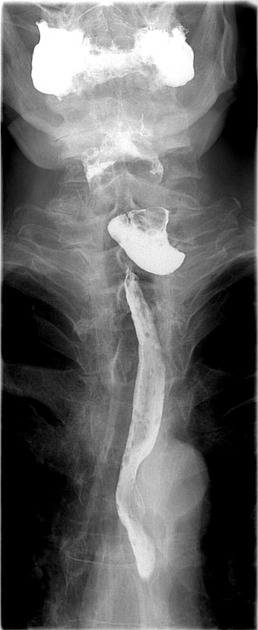
A 35-year-old man presents to the emergency department with a complaint of food stuck in his throat. On examination, a bone is seen in the left piriform recess. Which of the following is most likely to be impaired?
All are correct about the image shown below except:

All are correct about the condition except:

What is incorrect about the picture shown?

All are correct about the image shown except:

Name the instrument shown below:

A 3-year-old child presents with fever, unilateral throat pain and trismus. Throat examination shows:

All are indications for the procedure shown except:

Regarding "Quinsy" all of the following are correct EXCEPT:
A patient presented with 2 days history of fever. On examination there was a swelling in the neck and one side tonsil was pushed to midline. What is the most likely diagnosis:-
Explanation: ***Gag reflex*** - The **piriform recess (piriform fossa)** is located within the **hypopharynx**, lateral to the laryngeal opening, and is part of the pharyngeal space where the gag reflex is mediated. - A foreign body (bone) lodged in the piriform recess would **directly stimulate and affect** the **gag reflex** by irritating the pharyngeal mucosa innervated by the **glossopharyngeal nerve (CN IX)** (afferent limb) and **vagus nerve (CN X)** (efferent limb). - The **superior laryngeal nerve** (internal branch), which supplies sensation to the piriform fossa, contributes to triggering the gag reflex when this area is stimulated by a foreign body. - This makes the gag reflex the **most directly affected reflex** in this clinical scenario, as the foreign body is in direct contact with the pharyngeal structures that mediate this protective reflex. *Incorrect: Cough reflex* - The cough reflex is primarily mediated by sensory innervation from the **vagus nerve (CN X)** to the **larynx below the vocal cords, trachea, and bronchi**. - While the piriform recess is adjacent to the laryngeal inlet, a foreign body lodged here typically causes dysphagia and affects the gag reflex rather than primarily impairing the cough reflex. - The cough reflex would be more affected if the foreign body were aspirated into the larynx or trachea. *Incorrect: Mastication* - Mastication (chewing) is controlled by the **trigeminal nerve (CN V)**, which innervates the muscles of mastication (masseter, temporalis, pterygoids). - These structures are located in the oral cavity and are anatomically distant from the piriform recess. - A foreign body in the hypopharynx causes **dysphagia** (difficulty swallowing) and **odynophagia** (painful swallowing), not difficulty with chewing. *Incorrect: Salivation* - Salivation is controlled by parasympathetic innervation via the **facial nerve (CN VII)** (submandibular and sublingual glands) and **glossopharyngeal nerve (CN IX)** (parotid gland). - While pain or discomfort from a foreign body might reflexively affect salivation, this is an indirect effect and not the primary reflex associated with the piriform recess. - The neurological pathways controlling salivary secretion are not directly impaired by a foreign body in the pharynx.
Explanation: ***Uvula deviated to the affected side*** - In cases of **pharyngeal paralysis**, particularly involving the vagus nerve (CN X), the **uvula deviates *away* from the affected side** due to unopposed action of muscles on the healthy side. - Therefore, deviation to the affected side would be incorrect. *Nasal twang* - A **nasal twang** (or hypernasal speech) is a characteristic symptom of **palatal weakness**, where the soft palate cannot adequately close off the nasopharynx during speech, allowing air to escape through the nose. - This is consistent with a lesion affecting the ipsilateral vagus nerve. *Left-sided dropped palatopharyngeal arch* - The image clearly shows a **lower and more flattened appearance of the left palatopharyngeal arch** compared to the right, indicating weakness or paralysis of the muscles in that area. - This "dropped" appearance is a classic sign of **vagal nerve palsy**, affecting the muscles responsible for elevating the soft palate. *Ipsilateral loss of gag reflex* - The **gag reflex** is primarily mediated by the **glossopharyngeal nerve (CN IX)** for the afferent limb and the **vagus nerve (CN X)** for the efferent limb. - **Unilateral weakness of the soft palate**, as suggested by the dropped arch, is consistent with a lesion of the vagus nerve, which would result in loss of the gag reflex on the ipsilateral side.
Explanation: ***Biphasic stridor*** - The image shows **tonsillitis** with exudates, typically caused by bacterial (e.g., Group A Streptococcus) or viral infections. - **Biphasic stridor** (noise during both inspiration and expiration) indicates significant airway obstruction, usually at the **glottic or subglottic level**, which is **NOT a typical feature** of uncomplicated tonsillitis. - Biphasic stridor suggests more severe conditions like **epiglottitis, severe croup, or laryngeal obstruction**, which have different clinical presentations and management. *Penicillin is drug of choice* - For **Group A Streptococcus (GAS) pharyngitis/tonsillitis**, penicillin remains the **drug of choice** due to its efficacy, narrow spectrum, and low cost. - It effectively eradicates the bacteria and prevents complications like **acute rheumatic fever** and **post-streptococcal glomerulonephritis**. *Modified Centor criteria are used to diagnose the presence of Group A streptococcus infection* - The **Modified Centor criteria** (McIsaac score) are clinical decision tools used to assess the probability of **Group A Streptococcus pharyngitis** and guide further testing or antibiotic treatment. - Criteria include: tonsillar exudates, swollen tender anterior cervical nodes, absence of cough, history of fever, and age adjustment. *Tonsillectomy is advised if >5 episodes occur per year for 2 consecutive years* - Current guidelines for **tonsillectomy** commonly consider recurrent infections as an indication. - The **Paradise criteria** suggest tonsillectomy for **≥7 episodes in 1 year, ≥5 episodes per year for 2 consecutive years, or ≥3 episodes per year for 3 consecutive years**. - This option represents a reasonable threshold within these guidelines.
Explanation: ***Trendelenburg position*** - The image displays the **Rose position** (also known as the tonsillar position), characterized by neck extension and a pillow under the shoulders. - The **Trendelenburg position** involves placing the patient supine with the head lower than the feet, which is not depicted. *Rose position* - The patient's head is **extended** and the shoulders are elevated with a roll, which is characteristic of the Rose position. - This position is commonly used to improve surgical access and visualization for procedures involving the **oral cavity** and pharynx. *Contraindicated in atlantoaxial instability* - The **extreme neck extension** seen in the Rose position can place stress on the **cervical spine**. - This makes it **contraindicated** in conditions like **atlantoaxial instability**, where excessive neck movement could lead to spinal cord compression. *Used for tonsillectomy* - The Rose position is a standard position for **tonsillectomy** and adenoidectomy. - It provides optimal exposure of the **oropharynx** and allows for gravity to aid in drainage of blood away from the surgical site.
Explanation: ***Cervical esophagectomy and removal of radiopaque FB under GA is most preferred modality of treatment*** - **Cervical esophagectomy** is an extreme and highly invasive surgical procedure (removal of part or all of the esophagus) and is **never the primary treatment** for an esophageal foreign body impaction. - The standard of care for esophageal foreign body removal, particularly for radiopaque objects, is typically **endoscopic removal under general anesthesia**, not complex open surgery like esophagectomy. *Foreign body in esophagus* - The X-ray images, both anterior-posterior and lateral views, clearly show a **radiopaque, coin-shaped object** lodged in the cervical region of the neck, consistent with a foreign body. - The location and morphology of the object are consistent with impaction within the **esophagus**, as opposed to within the airway. *Most common site of impaction is cricopharynx* - The **cricopharyngeal muscle** (upper esophageal sphincter) is the narrowest part of the esophagus and is indeed the **most common site** for foreign body impaction in adults and children. - The image shows the foreign body at the level of the upper cervical spine, corresponding to the anatomical location of the cricopharynx. *Laryngeal edema* - While foreign bodies in the aerodigestive tract can potentially cause **inflammation or edema**, there is **no direct radiographic evidence of laryngeal edema** visible in these X-ray images. - Laryngeal edema would typically manifest as **soft tissue swelling** around the larynx or airway narrowing, which is not clearly depicted.
Explanation: ***La Force Adenotome*** - The image displays a **La Force Adenotome**, an instrument specifically designed for the removal of adenoid tissue. - It features a long shaft with a handle and an angled cutting blade at the tip, enclosed by a protective cage, allowing for precise and controlled adenoidectomy. *St. Clair Thomson Adenoid curette* - A St. Clair Thomson adenoid curette is typically a **smaller, scoop-shaped instrument** with a cutting edge, used for scraping adenoid tissue. - It does not have the elaborate hinged cage mechanism seen in the La Force adenotome. *Beckman adenoid curette* - The Beckman adenoid curette is another type of curette, similar in principle to the St. Clair Thomson, featuring a **sharp, often serrated, loop-shaped end** for adenoid removal. - It lacks the distinct design of a La Force adenotome, which is characterized by its guillotine-like action. *Sluder-Ballenger Tonsillectome* - A Sluder-Ballenger tonsillectome is used for **tonsillectomy**, not adenoidectomy, and has a different design altogether. - It typically consists of a loop or ring that encircles the tonsil, which is then removed by a cutting or crushing mechanism, making it distinct from an adenotome.
Explanation: ***Peritonsillar abscess*** - The image shows a **unilateral bulge** of the soft palate and displacement of the **uvula**, consistent with a peritonsillar abscess. - Clinical features of **fever, unilateral throat pain, and trismus** are classic symptoms of a peritonsillar abscess. *Ludwig's angina* - This is a **bilateral cellulitis of the submandibular and sublingual spaces**, typically presenting with **swelling of the floor of the mouth** and elevation of the tongue. - It does not primarily present with unilateral throat bulging or uvula deviation as depicted. *Retropharyngeal abscess* - An abscess in the **retropharyngeal space** would cause a bulge in the posterior pharyngeal wall, which is not shown in the image. - While it can cause fever and difficulty swallowing, **trismus** and a visible pharyngeal bulge as shown are less typical. *Parapharyngeal abscess* - A parapharyngeal abscess is located laterally to the pharynx and typically presents with **external neck swelling**, fever, and possibly trismus. - It would not cause the **uvula deviation** and **bulging of the soft palate** seen in the image within the oral cavity.
Explanation: ***Cardiac valvulitis*** - **Cardiac valvulitis** is a complication of **rheumatic fever**, which can occur after streptococcal pharyngitis. It is not an indication for tonsillectomy, but rather a potentially severe outcome that tonsillectomy might prevent in cases of recurrent strep throat. - While recurrent **streptococcal pharyngitis** (which can lead to rheumatic fever) is an *indication* for tonsillectomy, the valvulitis itself is a disease state and not a reason to perform the surgery. *More than 5 episodes per year for 2 years* - **Recurrent tonsillitis**, defined by frequent episodes (e.g., more than 5-7 episodes per year for several years), is a common indication for **tonsillectomy**. - This criterion is used to justify surgical intervention due to the significant impact on quality of life and potential for complications from chronic or recurrent infections. *Tonsillolithiasis* - **Tonsilloliths** (tonsil stones) can cause bad breath, throat irritation, and foreign body sensation. - If they are **symptomatic** and persistent despite conservative management, tonsillectomy can be performed to remove the source of the problem. *OSA due to hypertrophied tonsils* - **Obstructive sleep apnea (OSA)** in children (and sometimes adults) can be caused by enlarged tonsils and adenoids obstructing the airway during sleep. - When hypertrophied tonsils are a primary cause of **OSA**, tonsillectomy (often with adenoidectomy) is a common and effective treatment.
Explanation: ***Pus may be seen pointing underneath the thin mucosa in all cases and is diagnostic*** - While **pus** is present in a peritonsillar abscess, it is **not always visibly "pointing"** underneath the mucosa. - The diagnosis of quinsy relies on clinical presentation and physical examination findings like **uvular deviation** and **trismus**, not solely on visible pus pointing. *It is an abscess in the peritonsillar region* - **Quinsy** is indeed an alternative name for a **peritonsillar abscess**, which is a collection of pus located lateral to the tonsil. - This abscess typically forms due to an infection that spreads from the tonsil itself into the surrounding loose connective tissue. *In early stage, intravenous broad spectrum antibiotics may resolve it* - In the initial stages of a **peritonsillar abscess**, before significant pus collection, **intravenous broad-spectrum antibiotics** can sometimes successfully resolve the infection. - This approach aims to reduce inflammation and prevent further progression to a full-blown abscess requiring drainage. *Severe trismus is caused by spasm induced by pterygoid muscles* - **Trismus**, or difficulty opening the mouth, is a characteristic symptom of quinsy and is caused by irritation and **spasm of the pterygoid muscles**. - This muscle spasm occurs due to the close anatomical relationship between the **peritonsillar abscess** and the pterygoid muscles.
Explanation: ***Quinsy (Peritonsillar abscess)*** - **Quinsy** is a **peritonsillar abscess** that presents with fever, severe throat pain, and the pathognomonic sign of **unilateral tonsil pushed toward the midline**. - The abscess forms in the **peritonsillar space** (between the tonsillar capsule and superior constrictor muscle), causing **medial displacement of the tonsil** and **bulging of the soft palate**. - Patients typically have **trismus, dysphagia, "hot potato voice"** and may have visible neck swelling. - This clinical presentation exactly matches the description: tonsil pushed to midline is the **classic finding for peritonsillar abscess**. *Parapharyngeal abscess* - A **parapharyngeal abscess** involves the deep parapharyngeal space lateral to the pharynx. - While it can cause neck swelling and fever, it typically causes **fullness and induration of the lateral pharyngeal wall** rather than prominent medial displacement of the tonsil itself. - The **tonsil is usually NOT pushed to the midline** in parapharyngeal abscess; instead, there is lateral pharyngeal wall bulging. - Often presents with more prominent external neck swelling below the angle of mandible. *Retropharyngeal abscess* - A **retropharyngeal abscess** occurs in the retropharyngeal space behind the posterior pharyngeal wall. - Presents with **posterior pharyngeal wall bulge**, neck stiffness, and dysphagia. - Does **NOT cause medial displacement of the tonsil** as the abscess is posterior, not lateral to the tonsil. *Tonsillitis* - **Acute tonsillitis** causes bilateral tonsillar inflammation with erythema and exudates. - While both tonsils may be enlarged, there is **no unilateral medial displacement** of one tonsil. - Less likely to cause significant neck swelling compared to deep space infections.
Pharyngitis
Practice Questions
Tonsillitis
Practice Questions
Peritonsillar Abscess
Practice Questions
Retropharyngeal Abscess
Practice Questions
Adenoid Hypertrophy
Practice Questions
Sleep-Disordered Breathing
Practice Questions
Obstructive Sleep Apnea
Practice Questions
Nasopharyngeal Carcinoma
Practice Questions
Oropharyngeal Carcinoma
Practice Questions
Hypopharyngeal Carcinoma
Practice Questions
Dysphagia
Practice Questions
Globus Pharyngeus
Practice Questions
Get full access to all questions, explanations, and performance tracking.
Start For Free