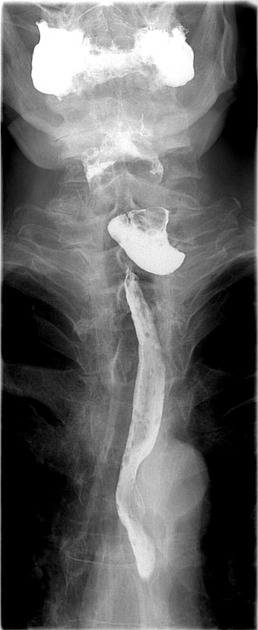
Dysphagia caused by Plummer-Vinson syndrome is due to which of the following?
All of the following statements about Zenker's diverticulum are true EXCEPT:
What anatomical space is often referred to as the "graveyard of an ENT surgeon"?
Tonsillectomy is indicated in which of the following conditions?
Which of the following is not a feature of chronic tonsillitis?
What is the treatment for adenoid hypertrophy?
Which age group is most commonly affected by nasopharyngeal carcinoma?
The tonsillar fossa is bounded anteriorly by which structure?
A patient presents with a fish bone stuck in the pyriform sinus. During the removal procedure, there is accidental nerve injury. Which nerve is most likely to be damaged?
A 6-year-old child presents with recurrent episodes of sore throat, fever, and difficulty swallowing for the past 2 years, with 7 documented episodes in the last year. Examination reveals enlarged, inflamed tonsils with exudate. The child has missed significant school days. What is the most appropriate management?
Explanation: **Explanation:** **Plummer-Vinson Syndrome (PVS)**, also known as Paterson-Brown-Kelly syndrome, is characterized by a classic triad of **iron-deficiency anemia, glossitis, and dysphagia**. 1. **Why 'Web' is correct:** The dysphagia in PVS is specifically caused by the formation of a **post-cricoid esophageal web**. This is a thin, eccentric, mucosal fold composed of squamous epithelium and connective tissue that protrudes into the upper esophagus. It typically occurs at the level of the cricopharyngeus muscle. The iron deficiency leads to mucosal atrophy and impaired cell regeneration, which predisposes the area to web formation. 2. **Why other options are incorrect:** * **Stenosis/Stricture:** These terms imply a circumferential narrowing of the lumen due to fibrosis or scarring (often seen in corrosive injuries or chronic GERD). While a web causes narrowing, it is a discrete, thin membrane rather than a long-segment fibrous contraction. * **Ulceration:** While PVS involves mucosal changes (like glossitis or cheilosis), the mechanical obstruction causing dysphagia is the structural web, not an active ulcer. **High-Yield Clinical Pearls for NEET-PG:** * **Demographics:** Most common in middle-aged females. * **Clinical Features:** Koilonychia (spoon-shaped nails), angular stomatitis, and achlorhydria. * **Diagnosis:** **Barium Swallow** is the investigation of choice (shows a characteristic "notch" or thin horizontal line in the post-cricoid region). * **Malignancy Risk:** PVS is a **precancerous condition**. It significantly increases the risk of **Squamous Cell Carcinoma** of the post-cricoid region and upper esophagus. * **Treatment:** Iron supplementation (which can sometimes resolve the web) and endoscopic dilatation if symptoms persist.
Explanation: **Explanation:** Zenker’s diverticulum (Pharyngeal Pouch) is a classic high-yield topic in ENT. The correct answer is **D** because Zenker’s diverticulum is an outpouching of the **posterior** pharyngeal wall, not the anterior wall. It occurs through a point of weakness known as **Killian’s dehiscence**, located between the thyropharyngeus and cricopharyngeus muscles (the two parts of the inferior constrictor). **Analysis of Options:** * **Option A (Acquired):** It is not congenital. It is a pulsion diverticulum caused by increased intraluminal pressure during swallowing, often due to incoordination or spasm of the cricopharyngeus muscle. * **Option B (Barium Swallow):** This is the **investigation of choice**. A lateral view clearly demonstrates the pouch originating posteriorly at the level of the C5-C6 vertebrae. * **Option C (False Diverticulum):** It is a "false" diverticulum because the herniation consists only of the **mucosa and submucosa**, lacking the muscular layer of the pharyngeal wall. **High-Yield Clinical Pearls for NEET-PG:** * **Clinical Presentation:** Characterized by dysphagia, **halitosis** (due to undigested food rotting in the pouch), and **regurgitation** of undigested food. * **Boyce’s Sign:** A gurgling sound heard on pressing the side of the neck. * **Contraindication:** Avoid **Rigid Esophagoscopy** or blind NG tube insertion, as there is a high risk of accidental perforation of the thin-walled pouch. * **Treatment:** Small pouches may require cricopharyngeal myotomy; larger ones are treated via **Dohlman’s procedure** (endoscopic staple-assisted diverticulotomy).
Explanation: **Explanation:** The **Tonsilolingual sulcus** is famously known as the "graveyard of an ENT surgeon" because it is a common site for occult or "hidden" primary malignancies. This anatomical groove, located between the base of the tongue and the palatine tonsil, is rich in lymphatics and possesses deep mucosal folds. Small, asymptomatic carcinomas can hide here for long periods, often presenting only when they have already metastasized to cervical lymph nodes. For a surgeon, missing a lesion in this area during a clinical examination can lead to a failure in diagnosing the primary source of a "neck lump." **Analysis of Incorrect Options:** * **Pyriform Fossa:** While this is a common site for malignancies (the "hidden area" of the laryngopharynx), it is not traditionally given this specific moniker. It is, however, associated with the "tea-pot sign" in laryngeal trauma. * **Bucco Labial sulcus:** This is an easily accessible area of the oral cavity. It is a common site for "snuff dipper’s carcinoma" but is not a hidden or surgically treacherous zone. * **Peritonsillar space:** This is the potential space between the tonsillar capsule and the superior constrictor muscle. It is the site for a peritonsillar abscess (Quinsy) but does not hide occult malignancies. **Clinical Pearls for NEET-PG:** * **Occult Primary:** When a patient presents with a metastatic squamous cell carcinoma in the neck with an unknown primary, the tonsilolingual sulcus, base of tongue, and nasopharynx must be biopsied. * **Examination:** Evaluation of this area often requires **indirect laryngoscopy** or **flexible fiberoptic endoscopy** to visualize the deep crevices. * **Lymphatic Drainage:** Malignancies here typically drain to the **Jugulodigastric (Level II)** lymph nodes.
Explanation: **Explanation:** Tonsillectomy is a surgical procedure with specific absolute and relative indications. The correct answer is **Chronic tonsillitis with complications** because it represents an absolute indication for surgery. **1. Why Option C is Correct:** Chronic tonsillitis that leads to systemic or local complications—such as **peritonsillar abscess (Quinsy)**, febrile seizures, or suspicion of malignancy—necessitates surgical removal. When the tonsils become a reservoir for infection that affects other systems (e.g., causing rheumatic fever or glomerulonephritis), they must be removed to prevent further morbidity. **2. Analysis of Incorrect Options:** * **A. Recurrent acute tonsillitis:** While this is a common reason for surgery, it is generally considered a **relative indication** unless it meets the **Paradise Criteria** (7 episodes in 1 year, 5 per year for 2 years, or 3 per year for 3 years). * **B. Aphthous ulcers:** These are painful, shallow ulcers of the mucosa, usually viral or idiopathic. They are not an indication for tonsillectomy as they do not involve the lymphoid tissue of the tonsils. * **C. Physiological tonsillar enlargement:** In children, tonsils naturally enlarge (peak age 3–6 years) as part of the immune system. Unless this causes **Obstructive Sleep Apnea (OSA)** or significant dysphagia, it is not an indication for surgery. **NEET-PG High-Yield Pearls:** * **Most common indication (Overall):** Recurrent acute tonsillitis. * **Most common indication (Children):** Obstructive Sleep Apnea (OSA) due to hypertrophy. * **Eagle’s Syndrome:** Elongated styloid process causing throat pain; tonsillectomy is part of the surgical approach (Styloidectomy). * **Post-tonsillectomy Hemorrhage:** * *Primary:* Within 24 hours (usually due to inadequate ligation). * *Secondary:* 5–10 days later (due to infection/sloughing of the scab).
Explanation: **Explanation:** Chronic tonsillitis is a state of persistent inflammation of the tonsils, usually resulting from unresolved acute infections. The diagnosis is primarily clinical, based on history and physical findings. **Why Fever is the correct answer:** Fever is a hallmark of **acute tonsillitis**, where systemic inflammatory responses are active. In **chronic tonsillitis**, the infection is low-grade and persistent rather than systemic. While a patient may have a history of past febrile episodes, fever is not a clinical feature of the chronic state itself. If a patient with chronic tonsillitis develops a fever, it indicates an "acute-on-chronic" exacerbation rather than the baseline chronic condition. **Analysis of other options:** * **Halitosis (Bad breath):** This is a classic feature caused by the accumulation of food particles, bacteria, and desquamated epithelium in the tonsillar crypts, forming foul-smelling **tonsilloliths** (tonsil stones). * **Recurrent attacks of sore throat:** This is the most common presenting symptom. Chronic inflammation makes the tonsils a reservoir for pathogens, leading to frequent symptomatic episodes. * **Choking spells at night:** In cases of **chronic hypertrophic tonsillitis**, the massive enlargement of the tonsils can cause mechanical airway obstruction, leading to snoring, sleep apnea, and nocturnal choking spells. **NEET-PG High-Yield Pearls:** * **Irwin Moore’s Sign:** Positive expression of cheesy material (pus/debris) from the crypts upon applying pressure to the anterior pillar—a diagnostic sign of chronic follicular tonsillitis. * **Most common organism:** *Streptococcus pyogenes* (Group A Beta-hemolytic Strep) is the most common bacterial cause. * **Complication:** Chronic tonsillitis is a common cause of **jugulodigastric lymphadenopathy** (the "tonsillar lymph node").
Explanation: **Explanation:** **Adenoid hypertrophy** refers to the physiological or pathological enlargement of the nasopharyngeal tonsils. In the context of medical management (non-surgical), the primary goal is to reduce nasal congestion and improve the airway. **Why Nasal Decongestants are correct:** Nasal decongestants (especially topical or systemic sympathomimetics) and nasal steroid sprays are the first-line medical treatments. They work by reducing the edema and vascular congestion of the nasal mucosa and the lymphoid tissue itself. This increases the patency of the nasopharyngeal airway and improves Eustachian tube function, alleviating symptoms like mouth breathing and snoring. **Analysis of Incorrect Options:** * **Antibiotics (B):** While used if there is secondary bacterial infection (Adenoiditis), they are not the primary treatment for hypertrophy itself, which is often a result of physiological growth or chronic allergy. * **B-blockers (C):** These are used for cardiovascular conditions (hypertension, arrhythmias) and have no role in treating lymphoid hypertrophy. * **B2-agonists (D):** These are bronchodilators used in asthma and COPD; they do not affect the lymphoid tissue of the nasopharynx. **High-Yield Clinical Pearls for NEET-PG:** * **Clinical Features:** "Adenoid Facies" (elongated face, open mouth, high arched palate, crowded teeth). * **Gold Standard Investigation:** Diagnostic Nasal Endoscopy (DNE). Lateral X-ray of the nasopharynx shows the soft tissue mass narrowing the airway. * **Definitive Treatment:** Adenoidectomy (Indications: Sleep apnea, persistent otitis media with effusion, or dental malocclusion). * **Age Factor:** Adenoids are present at birth, maximal size at 6–7 years, and usually atrophy by puberty (age 12–14).
Explanation: **Explanation:** Nasopharyngeal Carcinoma (NPC) is a unique malignancy with a distinct epidemiological pattern compared to other head and neck cancers. While most head and neck squamous cell carcinomas are strictly associated with elderly patients and heavy tobacco/alcohol use, NPC has a strong association with the **Epstein-Barr Virus (EBV)** and specific dietary factors (e.g., nitrosamines in salted fish). **Why the Fifth Decade is Correct:** Epidemiologically, NPC often demonstrates a **bimodal age distribution**. The first peak occurs in late adolescence/young adulthood (around age 15–25), but the **larger, primary peak** occurs in the **fifth to sixth decades of life (ages 40–60)**. In endemic regions (like Southern China and Southeast Asia) and in NEET-PG clinical scenarios, the "fifth decade" represents the most common age group for diagnosis. **Analysis of Incorrect Options:** * **A & B (Children/Adolescents):** While NPC is the most common nasopharyngeal malignancy in children, it is still rare in absolute numbers compared to the adult population. * **C (Third Decade):** This falls between the two peaks of the bimodal distribution. While cases occur, it is not the period of highest incidence. **High-Yield Clinical Pearls for NEET-PG:** * **Most Common Site:** Fossa of Rosenmüller (lateral nasopharyngeal recess). * **Most Common Histology:** WHO Type 3 (Undifferentiated carcinoma) is the most common and is highly radiosensitive. * **Trotter’s Triad:** 1. Conductive hearing loss (Eustachian tube blockage), 2. Ipsilateral palatal paralysis (CN X), 3. Trigeminal neuralgia (CN V). * **Classic Presentation:** A painless, upper deep cervical lymph node mass (level II) is the most common presenting symptom. * **Treatment of Choice:** Radiotherapy (it is highly radiosensitive; surgery is difficult due to the anatomical location).
Explanation: ### Explanation The **tonsillar fossa** (or tonsillar sinus) is the space between the diverging pillars of the soft palate that houses the palatine tonsil. Understanding its boundaries is high-yield for both anatomy and surgical procedures like tonsillectomy. **Correct Answer: D. Palatoglossal fold** The tonsillar fossa is bounded **anteriorly** by the **Palatoglossal arch (or fold)**, which contains the palatoglossus muscle. This fold marks the transition between the oral cavity and the oropharynx. **Analysis of Incorrect Options:** * **B. Palatopharyngeal fold:** This forms the **posterior boundary** of the tonsillar fossa. It contains the palatopharyngeus muscle. * **A. Pharyngobasilar fascia:** This forms the **immediate bed** (lateral boundary) of the tonsil, situated between the tonsil and the superior constrictor muscle. * **C. Buccopharyngeal fascia:** This covers the external surface of the superior constrictor muscle. It is lateral to the pharyngobasilar fascia and the muscular wall. **Clinical Pearls for NEET-PG:** 1. **The Tonsillar Bed:** From within outwards, the layers are: Tonsillar capsule → Loose areolar tissue (the site of dissection in tonsillectomy and where peritonsillar abscesses form) → Pharyngobasilar fascia → Superior constrictor muscle → Buccopharyngeal fascia. 2. **Blood Supply:** The main artery is the **Tonsillar branch of the Facial artery**. 3. **Nerve Supply:** Sensory supply is primarily via the **Glossopharyngeal nerve (CN IX)**. Referred otalgia (ear pain) during tonsillitis occurs because CN IX also supplies the middle ear via Jacobson’s nerve. 4. **Important Relation:** The **Glossopharyngeal nerve** and the **Facial artery** lie just lateral to the superior constrictor muscle, making them vulnerable during deep surgical dissection.
Explanation: ***Internal branch of the superior laryngeal nerve***- This nerve branch runs immediately beneath the **mucosa** of the pyriform sinus before piercing the thyrohyoid membrane, making it highly susceptible to injury during instrumentation or foreign body manipulation in this area.- It is the principal **sensory nerve** supply to the laryngeal cavity above the vocal cords; injury would result in loss of sensation in this region, often leading to laryngeal incompetence and aspiration.*Recurrent laryngeal nerve*- This nerve is located more inferiorly within the **tracheoesophageal groove**, supplying motor innervation to nearly all intrinsic muscles of the larynx.- Injury to the recurrent laryngeal nerve would cause **vocal cord paralysis** and hoarseness, which is less likely given the specific location of minimal trauma in the high hypopharynx.*Glossopharyngeal nerve*- The glossopharyngeal nerve (**CN IX**) supplies sensation to the posterior third of the tongue, tonsils, and **oropharynx**, and is not directly related to the pyriform sinus mucosa.- Injury would primarily manifest as loss of the **gag reflex** and sensory deficits in the posterior pharynx, which is topographically distant from the immediate site of endoscopic manipulation in the hypopharynx.*External branch of the superior laryngeal nerve*- This nerve primarily provides **motor innervation** to the **cricothyroid muscle**, responsible for lengthening and tensing the vocal cords (pitch control).- Anatomically, it descends alongside the **superior thyroid artery** and is situated deeper and more anteriorly, placing it at less risk of superficial mucosal trauma than the internal branch.
Explanation: ***Bilateral tonsillectomy*** - The child meets the **Paradise criteria** for tonsillectomy, which include **seven or more documented episodes** of tonsillitis in the preceding year. - Surgical intervention is the most appropriate management due to the high frequency of recurrence causing significant morbidity, including documented **school absenteeism** and difficulty swallowing. - Tonsillectomy provides definitive treatment by removing the chronically infected tonsillar tissue and significantly reduces future episodes. *Adenoidectomy alone* - While adenoid hypertrophy can contribute to upper airway obstruction and recurrent infections, the primary pathology in this case is **recurrent acute tonsillitis** with inflamed tonsils and exudate. - Adenoidectomy alone would not address the tonsillar pathology and would be insufficient management for this patient's condition. - Combined adenotonsillectomy might be considered if adenoid pathology coexists, but tonsillectomy is the essential component here. *Continue conservative management with antibiotics for each episode* - While treating each acute episode with antibiotics is appropriate for patients with **less frequent episodes** (typically <5 per year), this child has 7 documented episodes meeting surgical criteria. - Continued antibiotic use for recurrent episodes can promote **antibiotic resistance** and does not address the underlying chronically infected tonsillar tissue. - This approach results in ongoing morbidity, school absenteeism, and does not provide definitive management. *Wait and observe for spontaneous resolution* - Watchful waiting is suitable for patients with **less frequent episodes** (typically 3-5 per year) or when episodes do not cause significant quality of life impairment. - Given the high frequency (7 documented episodes) and functional impact (missed school days, difficulty swallowing), **Paradise criteria** are clearly met, making observation inappropriate. - While some children may experience spontaneous improvement with age, the current disease burden justifies surgical intervention.
Pharyngitis
Practice Questions
Tonsillitis
Practice Questions
Peritonsillar Abscess
Practice Questions
Retropharyngeal Abscess
Practice Questions
Adenoid Hypertrophy
Practice Questions
Sleep-Disordered Breathing
Practice Questions
Obstructive Sleep Apnea
Practice Questions
Nasopharyngeal Carcinoma
Practice Questions
Oropharyngeal Carcinoma
Practice Questions
Hypopharyngeal Carcinoma
Practice Questions
Dysphagia
Practice Questions
Globus Pharyngeus
Practice Questions
Get full access to all questions, explanations, and performance tracking.
Start For Free