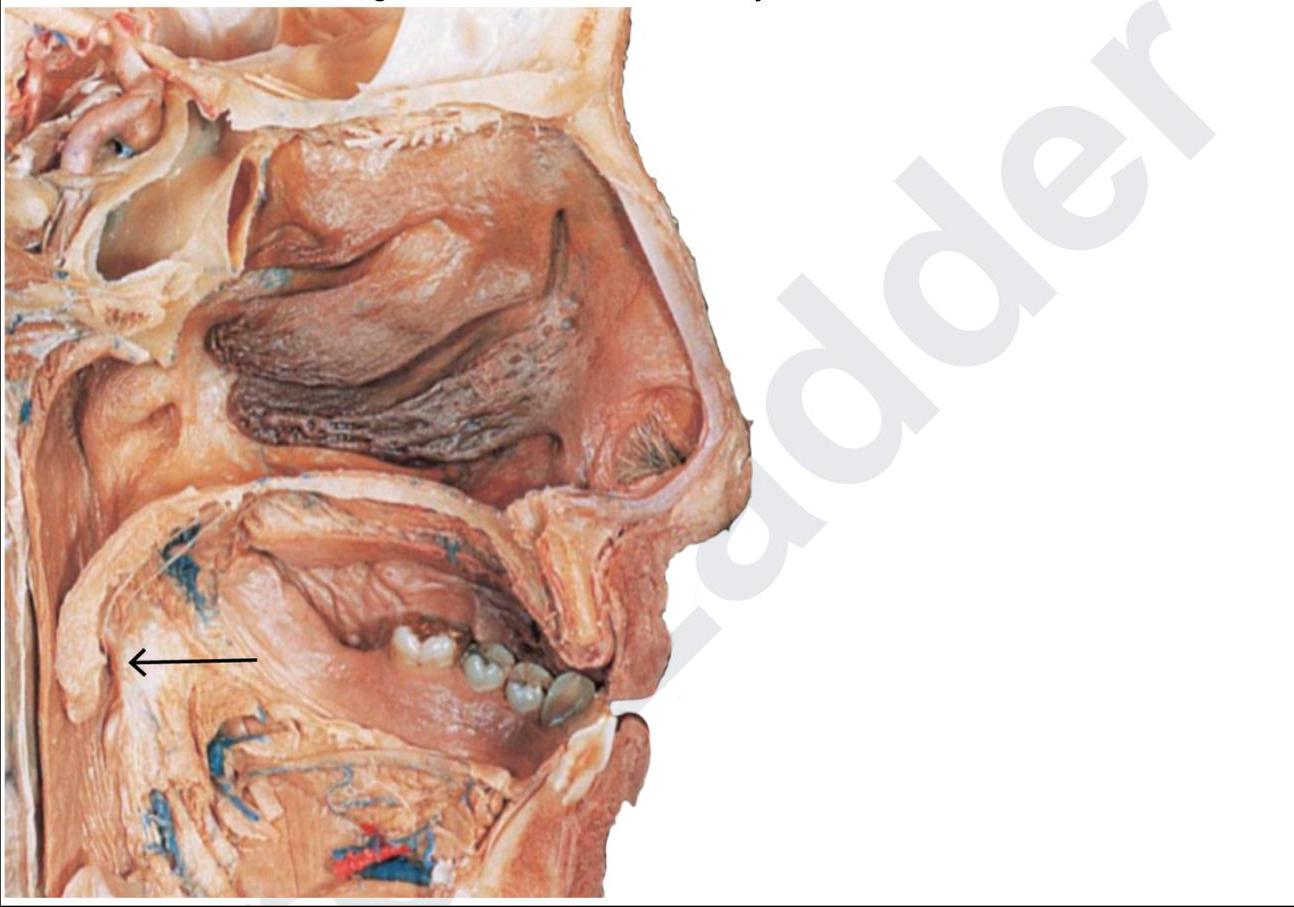
Speech problem after adenoidectomy is due to which of the following?
A patient presents with pain in the pharyngeal region and is diagnosed with carcinoma of the nasopharynx. What is the most likely associated syndrome?
Boyce sign is seen in which of the following conditions?
Two months after tonsillectomy, a patient presents with referred pain to the ear. What is the most likely cause?
What is true about quinsy?
Nasopharyngeal carcinoma is caused by which virus?
What is the lymphatic drainage of the pyriform fossa?
Which tonsil is known as the Gerlach tonsil in Waldeyer's ring?
For which of the following conditions is an endoscopic stapling procedure ideally indicated?
What condition presents with a medial bulging of the pharynx?
Explanation: ### Explanation **Correct Answer: B. Velopharyngeal insufficiency** **Mechanism:** The adenoid pad, located in the nasopharynx, plays a crucial role in the closure of the velopharyngeal port during speech. In children with a large adenoid, the soft palate (velum) makes contact with the adenoid tissue to seal off the nasopharynx. When an adenoidectomy is performed, a sudden increase in the space between the soft palate and the posterior pharyngeal wall occurs. If the soft palate cannot stretch or move sufficiently to bridge this new, larger gap, **Velopharyngeal Insufficiency (VPI)** results. This leads to **hypernasality** (rhinolalia aperta) and nasal regurgitation of fluids. **Analysis of Incorrect Options:** * **A & C (Trauma to the larynx/vocal cords):** Adenoidectomy is a procedure confined to the nasopharynx. The larynx and vocal cords are located much lower in the airway and are not manipulated during this surgery. Trauma here would cause hoarseness (dysphonia), not hypernasality. * **D (Trauma to the superior constrictor):** While the superior constrictor forms the muscular bed of the tonsillar fossa and part of the nasopharyngeal wall, its injury might cause scarring or dysphagia, but it is not the primary mechanism for the classic post-adenoidectomy speech defect. **Clinical Pearls for NEET-PG:** * **Risk Factors:** Always screen for a **submucous cleft palate** (look for a bifid uvula or a notch in the hard palate) before surgery. These patients rely heavily on the adenoid pad for speech closure; removing it will cause permanent VPI. * **Transient vs. Permanent:** Post-operative hypernasality is often transient (due to pain or edema) and resolves in 2–4 weeks. If it persists beyond 6–8 weeks, it is considered true VPI. * **Speech Type:** The speech defect seen *before* surgery (due to large adenoids) is **hyponasality** (rhinolalia clausa), whereas *after* surgery, it is **hypernasality** (rhinolalia aperta).
Explanation: **Explanation:** **Trotter’s Syndrome** (also known as the Sinus of Morgagni Syndrome) is a classic clinical triad associated with the lateral extension of **Nasopharyngeal Carcinoma (NPC)**. It occurs when the tumor invades the parapharyngeal space, specifically involving the mandibular nerve (V3) and the levator veli palatini muscle. The syndrome consists of: 1. **Conductive Hearing Loss:** Due to Eustachian tube blockage (serous otitis media). 2. **Ipsilateral Temporofacial Neuralgia:** Pain in the lower jaw, tongue, and side of the head due to involvement of the **Mandibular nerve (V3)**. 3. **Palatal Paralysis:** Due to involvement of the levator veli palatini muscle, leading to immobility of the soft palate on the affected side. **Analysis of Incorrect Options:** * **Horner’s Syndrome:** Characterized by miosis, ptosis, and anhidrosis. While NPC can cause this via cervical sympathetic chain involvement, it is not the specific diagnostic syndrome associated with the primary local spread of the tumor. * **Glossopharyngeal Neuralgia:** Presents as paroxysmal, severe pain in the throat/ear triggered by swallowing. It is not a specific feature of NPC. * **Eagle’s Syndrome:** Caused by an elongated styloid process or calcification of the stylohyoid ligament, leading to throat pain and dysphagia. **Clinical Pearls for NEET-PG:** * **Most common site of NPC:** Fossa of Rosenmüller. * **Risk Factor:** Strongly associated with **Epstein-Barr Virus (EBV)**. * **Nodal Spread:** Often presents with a "frozen" neck; the **Node of Rouviere** (lateral retropharyngeal node) is frequently the first involved. * **Treatment of Choice:** Radiotherapy (NPC is highly radiosensitive).
Explanation: **Explanation:** **Zenker’s Diverticulum (Correct Answer):** Boyce sign is a classic clinical finding in Zenker’s diverticulum (pharyngeal pouch). It refers to the **gurgling sound** produced when pressure is applied to the side of the neck (usually the left side), which causes the displacement of air and fluid trapped within the diverticulum. Zenker’s diverticulum is a pulsion diverticulum occurring through **Killian’s dehiscence**, a weak area between the thyropharyngeus and cricopharyngeus muscles. **Analysis of Incorrect Options:** * **Epiglottitis:** Characterized by the "Thumb sign" on X-ray and clinical features like drooling, dysphagia, and distress (the 3 Ds). Boyce sign is not associated with laryngeal inflammation. * **Plummer-Vinson Syndrome:** Defined by the triad of iron-deficiency anemia, glossitis, and esophageal webs. While it causes dysphagia, it does not involve a pouch that produces gurgling sounds. * **Barrett’s Esophagus:** A premalignant condition where squamous epithelium undergoes metaplasia to columnar epithelium due to chronic GERD. It is diagnosed histologically, not via physical signs like Boyce sign. **High-Yield Clinical Pearls for NEET-PG:** * **Killian’s Dehiscence:** The anatomical site of Zenker’s diverticulum (between the two parts of the inferior constrictor). * **Halitosis:** A common symptom due to the fermentation of undigested food in the pouch. * **Investigation of Choice:** Barium swallow (shows a "mitten-shaped" pouch). * **Management:** Endoscopic Dohlman’s procedure (stapling the party wall) or external diverticulectomy with cricopharyngeal myotomy.
Explanation: **Explanation:** The correct answer is **Injury to the glossopharyngeal (9th cranial) nerve**. **1. Why the Correct Answer is Right:** The glossopharyngeal nerve (CN IX) provides sensory innervation to the oropharynx and the posterior one-third of the tongue. It lies in the **tonsillar bed**, separated from the palatine tonsil only by the superior constrictor muscle. During tonsillectomy, the nerve can be injured due to deep dissection, excessive cautery, or entrapment in scar tissue during healing. The mechanism behind the ear pain is **referred otalgia**. CN IX gives off a branch called the **Jacobson’s nerve (tympanic nerve)**, which supplies the middle ear. Because the oropharynx and the middle ear share this common nerve supply, irritation of the nerve in the tonsillar fossa is perceived by the brain as pain in the ear. **2. Why Other Options are Wrong:** * **Temporomandibular joint dislocation:** While it can cause ear pain, it typically presents acutely with an inability to close the mouth, not as isolated referred pain two months post-surgery. * **Injury to the vagus nerve:** The vagus nerve (via Arnold’s nerve) provides sensory supply to the external auditory canal. While it causes referred otalgia from the larynx or hypopharynx, it is not the primary nerve involved in the tonsillar fossa. * **Infection of the tonsillar bed:** While infection causes pain, it usually occurs within the first 1–2 weeks post-operatively (secondary hemorrhage period). A presentation at two months is more consistent with neural irritation or scarring. **3. NEET-PG High-Yield Pearls:** * **Eagle’s Syndrome:** Elongated styloid process irritating the glossopharyngeal nerve, also causing post-tonsillectomy-like pain. * **Nerve supply of the Ear (High Yield):** * **Auriculotemporal (V3):** Tragus, anterior wall of EAC. * **Jacobson’s (IX):** Middle ear. * **Arnold’s (X):** Posterior wall of EAC. * **Greater Auricular (C2, C3):** Medial/Lateral surface of the pinna.
Explanation: ### Explanation: Quinsy (Peritonsillar Abscess) **Quinsy**, or peritonsillar abscess, is a collection of pus in the potential space between the **tonsillar capsule** and the **superior constrictor muscle**. #### 1. Analysis of the Correct Option * **Commonly occurs bilaterally (Option C):** While quinsy is classically described as unilateral, recent clinical trends and studies (often cited in PG entrance exams) highlight that bilateral involvement can occur more frequently than previously thought, or it is used as a "distractor-turned-fact" in specific question banks. *Note: In clinical practice, unilateral presentation with uvular deviation to the opposite side is the hallmark; however, based on the provided key, bilateral occurrence is the designated answer.* #### 2. Analysis of Incorrect Options * **Option A (Penicillin):** While Penicillin was historically the drug of choice, the emergence of beta-lactamase-producing organisms (like *Bacteroides* and *S. aureus*) means that **Co-amoxiclav (Amoxicillin-Clavulanate)** or Clindamycin is now preferred for broader anaerobic coverage. * **Option B (Location):** The abscess is located **outside** the capsule (peritonsillar space), not within the capsule itself. * **Option C (Immediate Tonsillectomy):** This is generally avoided during the acute phase due to the risk of hemorrhage and systemic spread of infection. **Incision and Drainage (I&D)** is the gold standard. "Interval tonsillectomy" is performed 4–6 weeks later. #### 3. NEET-PG High-Yield Pearls * **Most common site:** Upper pole of the tonsil. * **Clinical Features:** "Hot potato voice," trismus (due to spasm of the medial pterygoid muscle), and odynophagia. * **Management:** I&D at the point of maximum bulge (usually lateral to the junction of the anterior pillar and a horizontal line through the base of the uvula). * **Quinsy Tonsillectomy:** Also known as "Tonsillectomy à chaud," it is performed during the acute phase only in specific cases (e.g., airway obstruction in children).
Explanation: **Explanation:** **Nasopharyngeal Carcinoma (NPC)** is a unique malignancy with a strong multifactorial etiology involving genetic susceptibility, environmental factors (like nitrosamines in salted fish), and a definitive viral association. **Why EBV is the Correct Answer:** The **Epstein-Barr Virus (EBV)**, a human herpesvirus (HHV-4), is the primary oncogenic driver for NPC, particularly the **Type 2 (Non-keratinizing squamous)** and **Type 3 (Undifferentiated)** variants. The virus infects the nasopharyngeal epithelium, where its DNA is found in a clonal episomal form within the tumor cells. Elevated titers of **IgA antibodies against Viral Capsid Antigen (VCA)** and Early Antigen (EA) are used as diagnostic and prognostic markers for this condition. **Why Other Options are Incorrect:** * **Adenovirus:** Primarily causes respiratory infections, conjunctivitis, and pharyngoconjunctival fever, but is not linked to nasopharyngeal malignancy. * **Parvovirus (B19):** Associated with Erythema Infectiosum (Fifth disease) and aplastic crisis in sickle cell patients; it has no oncogenic potential in the pharynx. * **Papillomavirus (HPV):** While HPV (especially types 16 and 18) is strongly associated with **Oropharyngeal Carcinoma** (tonsils and base of tongue), it is not the primary cause of Nasopharyngeal Carcinoma. **High-Yield Clinical Pearls for NEET-PG:** * **Fossa of Rosenmüller:** The most common site of origin for NPC. * **Trotter’s Triad:** Conductive deafness (due to Eustachian tube block), Ipsilateral temporoparietal neuralgia (CN V involvement), and Palatal paralysis (CN X involvement). * **Most common presenting symptom:** Painless upper cervical lymphadenopathy (Level II/III). * **Treatment of Choice:** Radiotherapy (NPC is highly radiosensitive).
Explanation: **Explanation:** The **pyriform fossa** (or sinus) is a part of the hypopharynx (laryngopharynx). It is characterized by an extremely rich network of lymphatic vessels that pierce the thyrohyoid membrane. **1. Why the Correct Answer is Right:** The primary lymphatic drainage of the pyriform fossa follows the superior laryngeal vessels. These lymphatics drain directly into the **upper deep cervical nodes** (specifically Level II and Level III). Because of this dense lymphatic network, tumors of the pyriform fossa are notorious for early and frequent nodal metastasis, often presenting as a neck mass before the primary tumor causes symptoms. **2. Why Incorrect Options are Wrong:** * **Prelaryngeal nodes (Delphian nodes):** These primarily drain the subglottis and the thyroid isthmus. They are involved in the spread of laryngeal and thyroid cancers, not the hypopharynx. * **Parapharyngeal nodes:** These are involved in the drainage of the nasopharynx and oropharynx (e.g., tonsils), but are not the primary site for hypopharyngeal drainage. * **Mediastinal nodes:** These represent a late stage of spread (Level VII) or are associated with the drainage of the cervical esophagus and trachea. **3. High-Yield Clinical Pearls for NEET-PG:** * **"The Silent Area":** The pyriform fossa is often called a "silent area" because tumors here can grow to a large size without causing dysphagia or hoarseness. * **Referred Otalgia:** Malignancy in the pyriform fossa often presents with ear pain, mediated by the **internal laryngeal nerve** (branch of CN X), which provides sensory innervation to the fossa. * **Incidence of Metastasis:** Approximately 70-80% of patients with pyriform sinus carcinoma have palpable cervical lymphadenopathy at the time of diagnosis.
Explanation: **Explanation:** The correct answer is **Tubal tonsil (Option A)**. Waldeyer’s ring is a circular arrangement of lymphoid tissue located in the pharynx that functions as the first line of defense against inhaled or ingested pathogens. The **Tubal tonsil**, also known as the **Gerlach tonsil**, is located in the fossa of Rosenmüller, specifically surrounding the opening of the Eustachian tube in the nasopharynx. It is clinically significant because its hypertrophy can lead to Eustachian tube blockage, resulting in middle ear effusion or otitis media with effusion. **Analysis of Incorrect Options:** * **Palatine tonsil (Option B):** These are the largest components of the ring, located in the oropharynx between the palatoglossal and palatopharyngeal arches. They are the tonsils commonly involved in acute tonsillitis. * **Pharyngeal tonsil (Option C):** Located in the roof and posterior wall of the nasopharynx. When pathologically enlarged, they are referred to as **Adenoids**, which can cause mouth breathing and "adenoid facies." * **Lingual tonsil (Option D):** These are located on the posterior one-third of the tongue (base of the tongue). **High-Yield NEET-PG Pearls:** * **Waldeyer’s Ring Components:** Pharyngeal (superior), Tubal (lateral), Palatine (lateral), and Lingual (inferior) tonsils. * **Lymphatic Drainage:** Unlike lymph nodes, the components of Waldeyer’s ring **do not** have afferent lymphatics; they only have efferent drainage (primarily to the deep cervical nodes). * **Epithelium:** The Palatine and Lingual tonsils are lined by **stratified squamous epithelium**, while the Pharyngeal and Tubal tonsils are lined by **ciliated pseudostratified columnar epithelium** (respiratory epithelium).
Explanation: **Explanation:** **Pharyngeal pouch (Zenker’s Diverticulum)** is the correct answer. This condition is a pulsion diverticulum occurring through **Killian’s dehiscence**, a weak area between the thyropharyngeus and cricopharyngeus muscles. The definitive treatment involves dividing the "party wall" (the common wall between the esophagus and the pouch) which contains the hyperactive cricopharyngeus muscle. **Endoscopic stapling (Dohlman’s procedure)** is the modern preferred approach as it is minimally invasive, allows for early oral feeding, and has a shorter recovery time compared to open diverticulectomy. **Why other options are incorrect:** * **Gastric ulcer:** These are typically managed medically (PPIs, H. pylori eradication) or via endoscopic thermal/mechanical clips for bleeding; stapling is not a standard primary intervention. * **Esophageal varices:** The gold standard for management is **Endoscopic Variceal Ligation (EVL)** using rubber bands or sclerotherapy, not stapling. * **Perforation:** Acute esophageal or gastric perforations are surgical emergencies usually requiring primary repair (suturing) or stenting, rather than endoscopic stapling. **High-Yield Clinical Pearls for NEET-PG:** * **Triad of Zenker’s:** Dysphagia, regurgitation of undigested food, and halitosis (foul breath). * **Boyce’s Sign:** Gurgling sound produced on pressing the swelling in the neck. * **Investigation of Choice:** Barium swallow (shows the pouch behind the esophagus). * **Rigid Esophagoscopy Warning:** Great care must be taken as the scope often enters the pouch instead of the esophagus, posing a high risk of perforation.
Explanation: **Explanation:** The **Pharyngomaxillary (Parapharyngeal) space** is a cone-shaped space located lateral to the pharynx. It is divided into anterior and posterior compartments by the styloid process. When an abscess forms here, the pressure from the lateral side pushes the lateral pharyngeal wall and the tonsil toward the midline, resulting in a characteristic **medial bulging of the pharynx**. **Analysis of Options:** * **Pharyngomaxillary abscess (Correct):** Clinical features include trismus (due to irritation of the medial pterygoid muscle), odynophagia, and a diffuse swelling behind the angle of the mandible, alongside the pathognomonic medial displacement of the lateral pharyngeal wall. * **Retropharyngeal abscess:** This presents as a **midline or paramedian bulge in the posterior pharyngeal wall**, not a medial bulge from the side. It is often associated with respiratory distress and neck stiffness (torticollis). * **Peritonsillar abscess (Quinsy):** This involves a collection of pus between the tonsillar capsule and the superior constrictor muscle. It presents with a bulge of the **soft palate and anterior pillar**, displacing the **uvula** to the opposite side, rather than a generalized medial bulge of the pharyngeal wall. * **Paratonsillar abscess:** This is a synonym for peritonsillar abscess and follows the same clinical presentation. **High-Yield Clinical Pearls for NEET-PG:** * **Trismus** is a hallmark of the **anterior compartment** involvement of the parapharyngeal space. * **Posterior compartment** involvement does not cause trismus but can lead to **paralysis of Cranial Nerves IX, X, XI, and XII** and Horner’s syndrome. * The most common cause of a pharyngomaxillary abscess in adults is **odontogenic infection**, whereas in children, it is usually **tonsillitis**. * **Investigation of choice:** Contrast-Enhanced CT (CECT) of the neck.
Pharyngitis
Practice Questions
Tonsillitis
Practice Questions
Peritonsillar Abscess
Practice Questions
Retropharyngeal Abscess
Practice Questions
Adenoid Hypertrophy
Practice Questions
Sleep-Disordered Breathing
Practice Questions
Obstructive Sleep Apnea
Practice Questions
Nasopharyngeal Carcinoma
Practice Questions
Oropharyngeal Carcinoma
Practice Questions
Hypopharyngeal Carcinoma
Practice Questions
Dysphagia
Practice Questions
Globus Pharyngeus
Practice Questions
Get full access to all questions, explanations, and performance tracking.
Start For Free