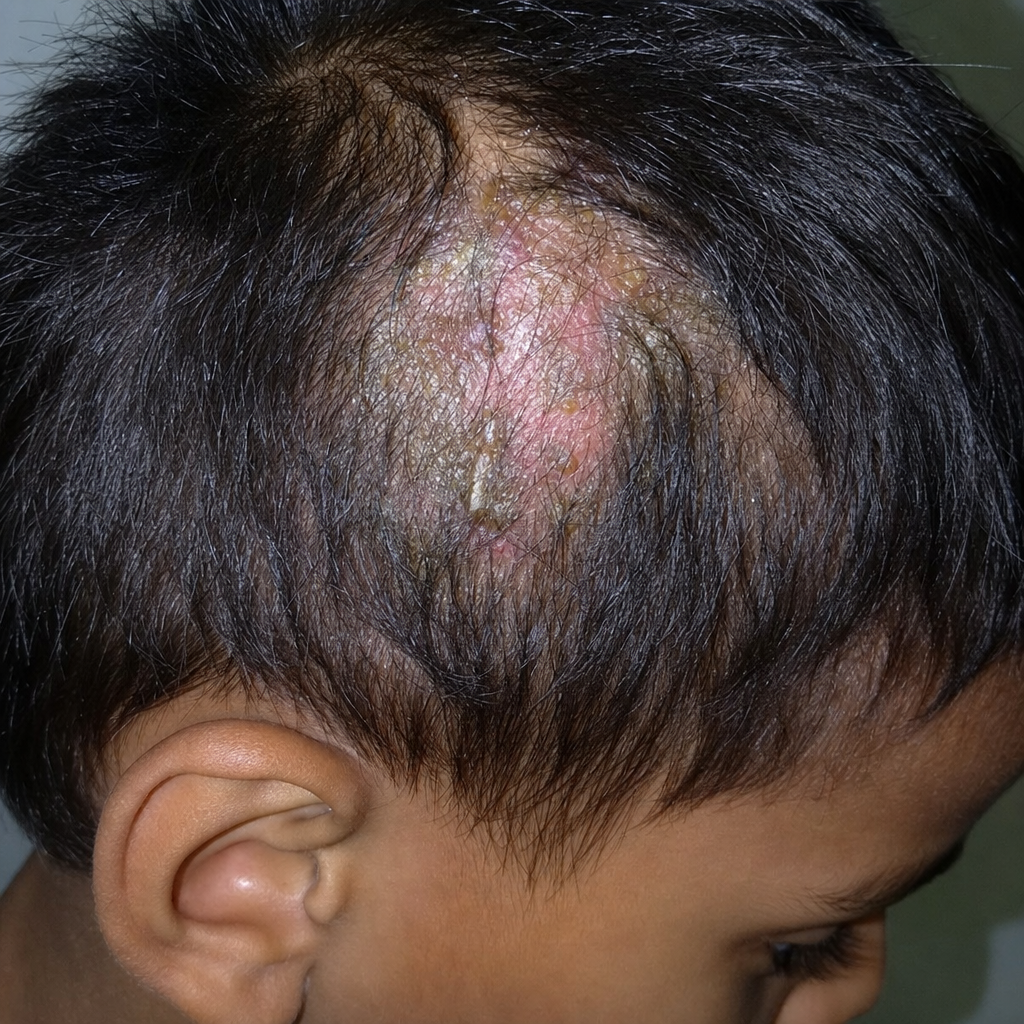
A 12-year-old boy presents with a boggy swelling and easily pluckable hair. What is the probable diagnosis?
Which of the following statements about pityriasis versicolor is FALSE?
The 'spaghetti and meatballs' appearance on microscopy is characteristic of which dermatological condition?
What is the most common organism causing Tinea capitis?
Which of the following is NOT a true statement regarding Tinea capitis?
An 8-year-old boy presents with a boggy scalp swelling and easily pluckable hair. Which of the following is the investigation of choice?
Tinea capitis is caused by which of the following fungi, except?
Kerion is a type of:
Dermatophytoses is caused by which of the following organisms?
Which structures can be infected by Trichophyton species?
Explanation: ### Explanation **Correct Answer: B. Tinea capitis** The clinical presentation of a **boggy, inflammatory swelling** with **easily pluckable hair** is the classic description of a **Kerion**, which is a severe inflammatory form of **Tinea capitis**. * **Pathophysiology:** Tinea capitis is a dermatophyte infection of the scalp, most common in children. A Kerion represents a delayed-type hypersensitivity reaction to the fungus (commonly *Trichophyton verrucosum* or *T. mentagrophytes*). * **Clinical Features:** The "boggy" nature refers to the soft, pus-filled, abscess-like consistency. Hair follicles are damaged by the intense inflammation, leading to hair that can be pulled out without pain (easily pluckable). **Why other options are incorrect:** * **Lichen planus:** Specifically, Lichen Planopilaris causes scarring alopecia with perifollicular scaling and erythema, but it does not present as a boggy, acute inflammatory mass. * **Epidermophytosis:** While *Epidermophyton* is a dermatophyte, it typically affects the skin (Tinea corporis/cruris) and nails, but **never** infects the hair. * **Alopecia areata:** This presents as non-scarring, non-inflammatory smooth patches of hair loss. The characteristic finding is "exclamation mark hair," not a boggy swelling. **High-Yield NEET-PG Pearls:** 1. **Kerion Management:** Do **not** incise and drain (it is not a bacterial abscess). Treat with systemic antifungals (Griseofulvin is the gold standard) and sometimes oral steroids to reduce scarring. 2. **Black Dot Tinea:** Caused by endothrix organisms (e.g., *T. tonsurans*); hair breaks at the surface. 3. **Favus:** Caused by *T. schoenleinii*; characterized by **scutula** (cup-shaped crusts) and a "mousy odor." 4. **Wood’s Lamp:** *Microsporum* species show a brilliant green fluorescence, while most *Trichophyton* species (except *T. schoenleinii*) do not fluoresce.
Explanation: ### Explanation **Pityriasis Versicolor (Tinea Versicolor)** is a superficial fungal infection caused by the lipophilic yeast *Malassezia*. **Why Option D is the Correct (False) Statement:** Corticosteroids are **contraindicated** in fungal infections. They are immunosuppressive agents that can worsen the infection, lead to its spread, or mask symptoms (Tinea Incognito). The mainstay of treatment for Pityriasis Versicolor includes **topical antifungals** (e.g., Ketoconazole shampoo, Ciclopirox olamine) or oral antifungals (e.g., Fluconazole, Itraconazole) for extensive cases. **Analysis of Other Options:** * **Option A:** While *Malassezia furfur* was historically cited, **_Malassezia globosa_** is now recognized as the most common causative agent. * **Option B:** A KOH mount of skin scrapings reveals short, thick hyphae and clusters of spores, classically described as a **"spaghetti and meatball"** or "banana and grapes" appearance. * **Option C:** *Malassezia* is lipophilic and requires the addition of olive oil to SDA for growth. The resulting colonies are creamy/yellowish and often exhibit a characteristic **"fried egg"** morphology. **High-Yield Clinical Pearls for NEET-PG:** * **Wood’s Lamp Examination:** Shows a characteristic **yellowish-gold or pale-yellow fluorescence**. * **Clinical Presentation:** Hypopigmented or hyperpigmented macules with fine scaling (**Besnier’s sign** or "scratch sign"—scaling becomes visible upon scratching the lesion). * **Pathogenesis:** The hypopigmentation is due to **azelaic acid** produced by the fungus, which inhibits tyrosinase, thereby interfering with melanin synthesis. * **Common Site:** Upper trunk and back (seborrheic areas).
Explanation: **Explanation:** The "spaghetti and meatballs" appearance is a classic histopathological description for **Tinea versicolor** (also known as Pityriasis versicolor). This appearance is seen on a **KOH (Potassium Hydroxide) mount** of skin scrapings. * **The Concept:** Tinea versicolor is caused by the lipophilic yeast ***Malassezia furfur***. Under the microscope, the "spaghetti" represents the short, thick, blunt **hyphae**, while the "meatballs" represent the clusters of **spherical yeast cells** (spores). **Analysis of Incorrect Options:** * **Pityriasis rosea:** This is an inflammatory condition characterized by a "Herald patch" and a "Christmas tree" distribution. It is not fungal; microscopy shows non-specific features like parakeratosis and spongiosis. * **Tinea capitis & Tinea corporis:** These are true dermatophyte infections (e.g., *Trichophyton*, *Microsporum*). On KOH mount, they typically show **branching, septate hyphae** without the characteristic globular yeast clusters seen in *Malassezia*. **Clinical Pearls for NEET-PG:** * **Wood’s Lamp:** Tinea versicolor shows a characteristic **yellowish-gold or pale-orange fluorescence**. * **Clinical Sign:** **Besnier’s sign** (or the "scratch sign")—scaling becomes more apparent when the lesion is stroked with a finger or curette. * **Appearance:** Presents as hypo- or hyperpigmented macules with fine scaling (pityriasis), usually on the chest and back. * **Culture:** If required, *Malassezia* requires media enriched with lipids (e.g., **Dixon’s agar** or olive oil overlay on SDA).
Explanation: **Explanation:** **Tinea capitis** is a fungal infection of the scalp and hair shafts, primarily affecting children. Globally and historically, the most common genus causing this condition is **Microsporum**, specifically *Microsporum canis* (zoophilic). While the epidemiology is shifting in some Western countries toward *Trichophyton tonsurans*, for the purpose of standard medical examinations like NEET-PG, **Microsporum** remains the classic and most frequent answer, particularly in the context of ectothrix infections. **Analysis of Options:** * **Microsporum (Correct):** It is the leading cause of "Gray Patch" tinea capitis. *M. canis* is the most common species worldwide. These infections typically show **ectothrix** involvement (spores outside the hair shaft) and exhibit bright green fluorescence under **Wood’s lamp**. * **Trichophyton tonsurans (Incorrect):** While it is the leading cause of tinea capitis in the USA and UK (causing "Black Dot" tinea), it is not the most common genus globally. It causes **endothrix** infection and does *not* fluoresce under Wood’s lamp. * **Epidermophyton (Incorrect):** This genus (specifically *E. floccosum*) commonly causes Tinea cruris and Tinea pedis but **never** involves the hair or hair follicles. * **Candida albicans (Incorrect):** This is a yeast, not a dermatophyte. It causes candidiasis (e.g., oral thrush, intertrigo) but is not a cause of classic tinea capitis. **High-Yield Clinical Pearls for NEET-PG:** 1. **Wood’s Lamp:** Microsporum species (except *M. gypseum*) fluoresce **bright green**; Trichophyton species do not. 2. **Black Dot Tinea:** Characterized by *T. tonsurans* and *T. violaceum*; the hair breaks at the surface. 3. **Kerion:** An inflammatory, boggy mass caused by a hypersensitivity reaction to zoophilic fungi (e.g., *M. canis* or *T. verrucosum*). 4. **Drug of Choice:** **Oral Griseofulvin** remains the gold standard for Tinea capitis, especially for Microsporum. Terbinafine is often preferred for Trichophyton.
Explanation: **Explanation** The question refers to **Favus**, a specific clinical variant of Tinea capitis. **Why Option D is the correct answer (The False Statement):** Option D describes **Black Piedra**, a superficial fungal infection caused by *Piedraia hortae*. Black Piedra is characterized by hard, dark nodules firmly attached to the hair shaft, primarily on the scalp. It is distinct from Tinea capitis, which involves fungal invasion of the hair follicle and shaft rather than just surface colonization. **Analysis of Incorrect Options (True Statements about Favus):** * **Option A:** Favus is indeed a chronic, severe form of Tinea capitis. * **Option B:** It is primarily caused by the anthropophilic dermatophyte ***Trichophyton schoenleinii***. * **Option C:** Unlike other forms of Tinea capitis, Favus is highly inflammatory and leads to follicular destruction, resulting in **cicatricial (scarring) alopecia**. **High-Yield Clinical Pearls for NEET-PG:** * **Scutula:** The hallmark of Favus is the presence of "scutula"—yellow, cup-shaped crusts composed of fungal hyphae and keratin debris around the hair follicle. * **Mousy Odor:** Patients often present with a characteristic "mousy" or "musty" smell. * **Wood’s Lamp:** Favus shows a **dull green fluorescence** under Wood’s lamp (due to *T. schoenleinii*). * **Godet:** The individual cup-like crust is also known as a "godet." * **Differential:** Do not confuse "Black Piedra" (nodules on shaft) with "Black Dot Tinea Capitis" (hair breakage at the surface caused by *T. tonsurans*).
Explanation: ### Explanation **Diagnosis: Kerion (Inflammatory Tinea Capitis)** The clinical presentation of a **boggy, painful scalp swelling** with **easily pluckable hair** and associated lymphadenopathy is classic for **Kerion**. This is a severe inflammatory cell-mediated immune response to a dermatophyte infection (most commonly *Trichophyton mentagrophytes* or *T. verrucosum*). **Why KOH Smear is the Correct Answer:** * **Investigation of Choice:** In any suspected fungal infection of the skin, hair, or nails, a **10%–20% KOH (Potassium Hydroxide) smear** is the initial and most important investigation. * **Mechanism:** KOH dissolves keratin, allowing the visualization of fungal elements. In Kerion, microscopic examination of the plucked hair will show fungal hyphae or spores (ectothrix or endothrix invasion), confirming the dermatophytic origin. **Why Other Options are Incorrect:** * **A. Biopsy:** Rarely indicated for tinea capitis. It is invasive and usually reserved for cases where inflammatory conditions like discoid lupus or lichen planopilaris are suspected. * **B. X-ray Skull:** Kerion is a soft tissue fungal infection; it does not involve the bone. X-rays have no diagnostic value here. * **D. Tzanck Smear:** This is used for the rapid diagnosis of **Herpes Simplex or Varicella-Zoster** (looking for multinucleated giant cells), not fungal infections. **High-Yield Clinical Pearls for NEET-PG:** * **Treatment:** Oral **Griseofulvin** is the gold standard for Tinea Capitis (Kerion). Topical antifungals are ineffective as they do not penetrate the hair follicle. * **Complication:** If untreated, Kerion leads to **cicatricial (permanent) alopecia**. * **Wood’s Lamp:** Useful for screening; *Microsporum* species show a brilliant green fluorescence, while most *Trichophyton* species (common in Kerion) do not fluoresce.
Explanation: **Explanation:** The correct answer is **Epidermophyton**. Dermatophytes are classified into three genera based on their tissue predilection: *Trichophyton*, *Microsporum*, and *Epidermophyton*. The genus **Epidermophyton** (specifically *E. floccosum*) is unique because it infects only the **skin and nails**. It lacks the ability to invade hair follicles; therefore, it **never causes Tinea capitis**. **Analysis of Options:** * **Microsporum (Option B):** This genus infects both **hair and skin**. It is a common cause of ectothrix infections (where spores form on the outside of the hair shaft) and often presents with fluorescence under Wood’s lamp. * **Trichophyton violaceum (Option C):** This is a classic cause of **Endothrix** Tinea capitis (spores inside the hair shaft), leading to "Black Dot" Tinea capitis due to hair breakage at the surface. * **Trichophyton schoenleinii (Option D):** This is the primary causative agent of **Tinea favosa (Favus)**, characterized by yellowish cup-shaped crusts called scutula and permanent scarring alopecia. **High-Yield NEET-PG Pearls:** 1. **Rule of Three:** * *Trichophyton:* Infects Skin, Hair, and Nails. * *Microsporum:* Infects Skin and Hair (NOT nails). * *Epidermophyton:* Infects Skin and Nails (NOT hair). 2. **Most common cause of Tinea capitis worldwide:** *Trichophyton tonsurans*. 3. **Wood’s Lamp:** *Microsporum* species typically fluoresce (bright green), while most *Trichophyton* species (except *T. schoenleinii*) do not. 4. **Ectothrix vs. Endothrix:** Endothrix (e.g., *T. violaceum*) results in "Black dots"; Ectothrix (e.g., *Microsporum*) results in "Grey patches."
Explanation: **Explanation:** **Kerion** is a highly inflammatory, boggy, and painful swelling of the scalp. It represents a severe **delayed-type hypersensitivity reaction (Type IV)** to a dermatophyte infection, most commonly caused by zoophilic species like *Trichophyton mentagrophytes* or *Trichophyton verrucosum*. It is a clinical variant of **Tinea Capitis**. * **Why Option D is Correct:** Kerion is a fungal infection. It occurs when the body reacts intensely to the fungal antigens, leading to an inflammatory mass studded with pustules and "honeycomb" crusting. If left untreated, it can lead to permanent scarring (cicatricial) alopecia. * **Why Options A, B, and C are Incorrect:** * **Bacterial (A):** While Kerion may resemble a bacterial abscess or carbuncle, it is primarily fungal. Secondary bacterial infection can occur, but the etiology is dermatophytic. * **Prion (B):** Prion diseases (like Creutzfeldt-Jakob disease) are neurodegenerative disorders caused by misfolded proteins, unrelated to skin pathology. * **Viral (C):** Viral skin infections (like Herpes or Molluscum) present with vesicles or umbilicated papules, not boggy inflammatory masses. **High-Yield Clinical Pearls for NEET-PG:** * **Clinical Sign:** The **"Lustreless hair"** sign and easily pluckable hair are characteristic. * **Diagnosis:** KOH mount shows fungal hyphae/spores; Wood’s lamp may show fluorescence depending on the species. * **Management:** Oral **Griseofulvin** is the gold standard (DOC) for Tinea Capitis. Systemic steroids are often added to reduce inflammation and prevent scarring alopecia. * **Differential Diagnosis:** Always differentiate from a bacterial carbuncle; a Kerion is usually less painful than its appearance suggests and does not respond to antibiotics alone.
Explanation: **Explanation:** **Dermatophytoses** (commonly known as Tinea or Ringworm) are fungal infections of the keratinized tissues, including the skin, hair, and nails. They are caused by a specific group of fungi called **Dermatophytes**, which have the unique ability to metabolize keratin using the enzyme keratinase. 1. **Why Trichophyton is correct:** Dermatophytes are classified into three genera: **Trichophyton**, **Microsporum**, and **Epidermophyton**. *Trichophyton* is the most common genus and is responsible for infecting skin, hair, and nails (e.g., *T. rubrum* is the most common cause of Tinea corporis and Tinea pedis worldwide). 2. **Why other options are incorrect:** * **Herpes simplex:** This is a DNA virus causing vesicular eruptions (Cold sores/Genital herpes), not a fungus. * **Papillomavirus (HPV):** This virus causes various types of warts (Verruca) and is associated with cervical cancer. * **Candida:** While *Candida* is a fungus (yeast), it is not a dermatophyte. It causes **Candidiasis**, which typically involves mucosal surfaces and intertriginous areas (skin folds) and is characterized by "satellite lesions," which are absent in dermatophytosis. **High-Yield Clinical Pearls for NEET-PG:** * **Most common dermatophyte worldwide:** *Trichophyton rubrum*. * **Tinea Capitis:** Most common cause in children; *T. tonsurans* (non-fluorescent) is common in the US, while *M. audouinii* (fluorescent) was historically significant. * **Diagnosis:** The gold standard for screening is **KOH mount**, which shows branching septate hyphae. Culture is done on **Sabouraud’s Dextrose Agar (SDA)**. * **Wood’s Lamp:** Microsporum species show a bright green fluorescence, whereas most Trichophyton species (except *T. schoenleinii*) do not fluoresce.
Explanation: ### Explanation The correct answer is **A. Skin, hair, and nails.** **1. Underlying Medical Concept** Dermatophytes are a group of fungi that require keratin for growth and are classified into three genera based on the structures they infect: **Trichophyton, Microsporum, and Epidermophyton.** * **Trichophyton** is the most versatile genus; it possesses proteolytic enzymes (keratinases) capable of breaking down keratin in all three keratinized tissues: **skin, hair, and nails.** * Common species include *T. rubrum* (the most common cause of dermatophytosis worldwide) and *T. mentagrophytes*. **2. Analysis of Incorrect Options** * **Option B (Skin and nails):** This pattern is characteristic of **Epidermophyton** (specifically *E. floccosum*). It notably **does not** infect hair. * **Option C & D:** These are incomplete. While Trichophyton *can* infect these structures, it is not limited to them. **Microsporum** species typically infect **skin and hair**, rarely involving the nails. **3. Clinical Pearls for NEET-PG** To remember the tissue tropism, use this high-yield table: | Genus | Skin | Hair | Nails | | :--- | :---: | :---: | :---: | | **Trichophyton** | Yes | Yes | Yes | | **Microsporum** | Yes | Yes | No (Rarely) | | **Epidermophyton**| Yes | No | Yes | * **Mnemonic:** *Trichophyton* = "Tri" (infects all 3). *Epidermophyton* = "No Hair" (E**p**idermophyton lacks **p**ilary involvement). * **Wood’s Lamp:** *Microsporum* species often show bright green fluorescence, whereas most *Trichophyton* species (except *T. schoenleinii*) do not fluoresce. * **T. rubrum** is the most common cause of Tinea pedis, Tinea cruris, and Onychomycosis.
Dermatophytoses
Practice Questions
Tinea Versicolor
Practice Questions
Candidiasis
Practice Questions
Onychomycosis
Practice Questions
Subcutaneous Mycoses
Practice Questions
Systemic Mycoses with Cutaneous Manifestations
Practice Questions
Opportunistic Fungal Infections
Practice Questions
Mycetoma
Practice Questions
Tropical Fungal Infections
Practice Questions
Diagnosis of Fungal Infections
Practice Questions
Antifungal Therapy
Practice Questions
Preventive Strategies
Practice Questions
Get full access to all questions, explanations, and performance tracking.
Start For Free