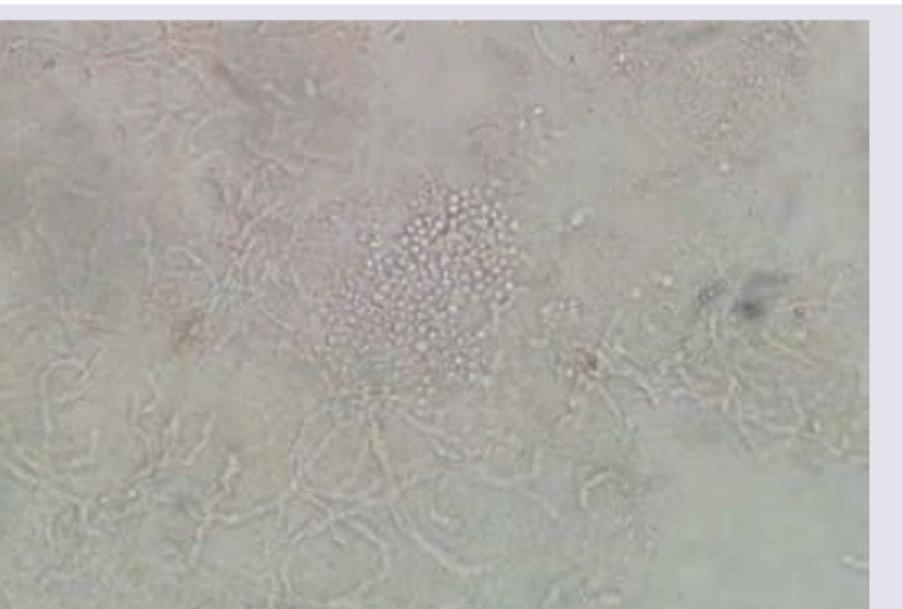
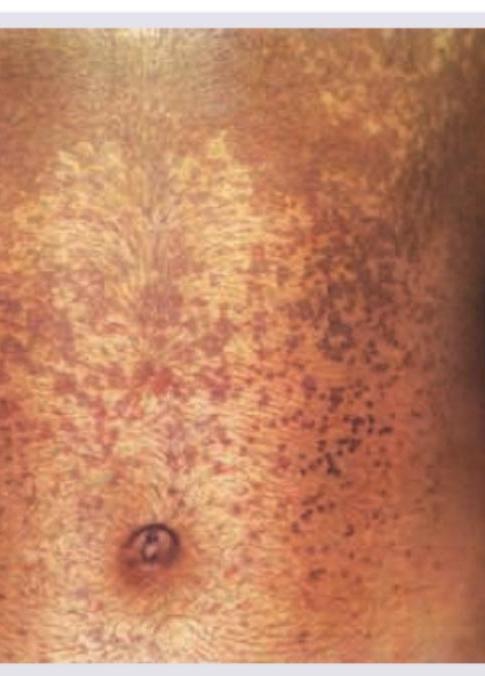
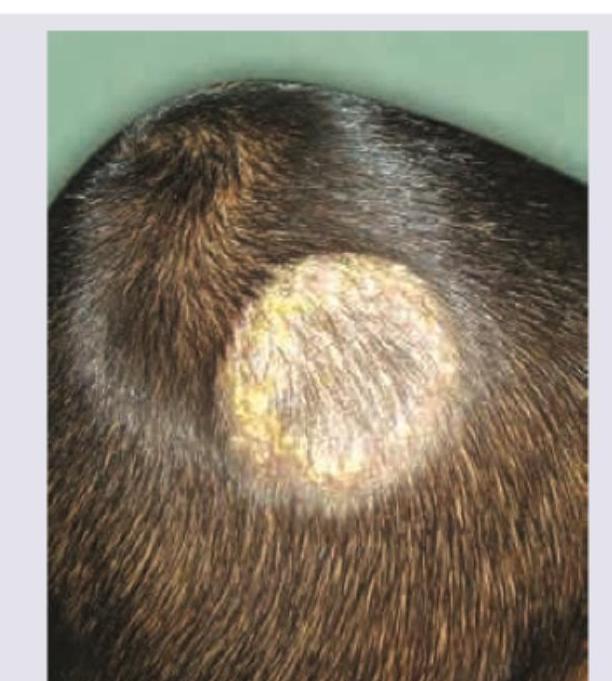
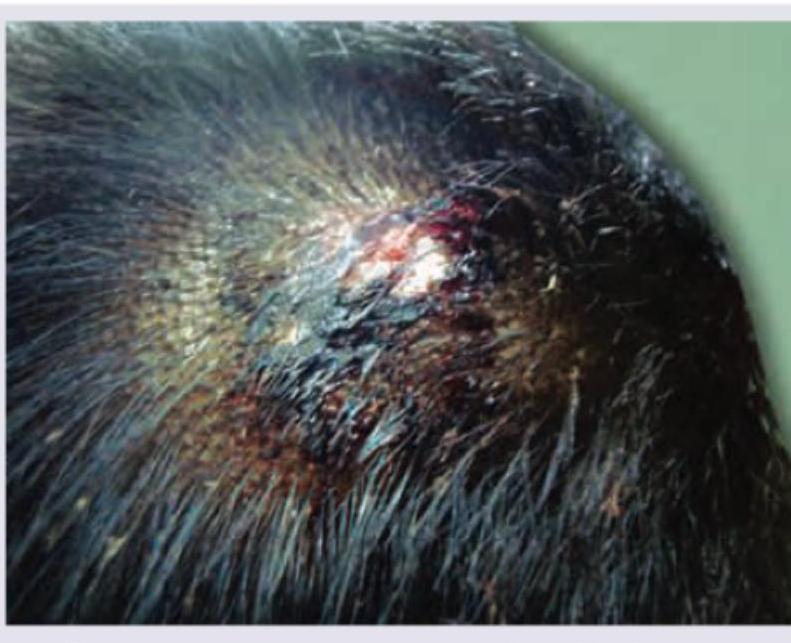
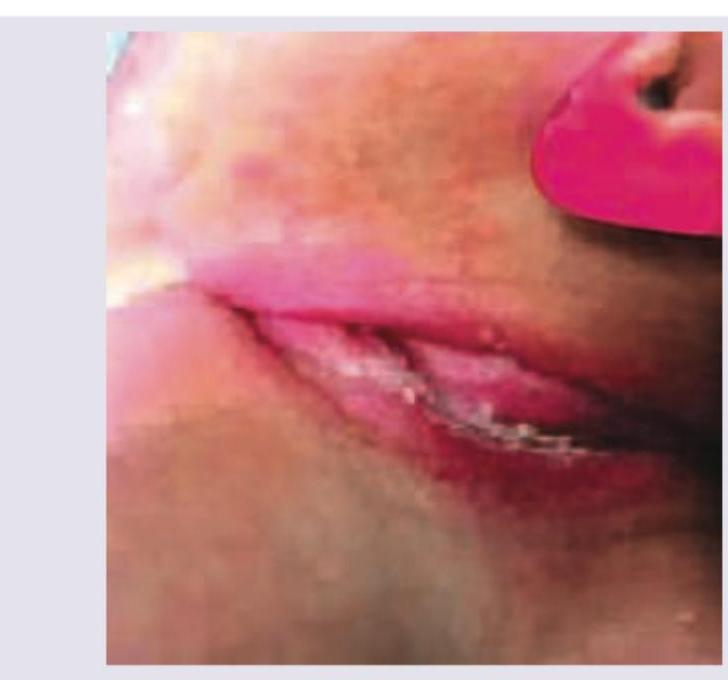
A 60-year old male presented with discoloration, thickening, and tunneling of 2 fingernails and one toenail. Which of the following investigations will clinch the diagnosis at the earliest?
A 30-year-old factory worker developed itchy, annular, scaly plaques in both groins that are extending peripherally. What is the most likely diagnosis?
Which of the following is the drug of choice for sporotrichosis?
What condition is detected by green fluorescence during a Wood's lamp examination?
A 6-year-old girl presents with scaly patches on the scalp. Initial diagnostic smears and cultures were negative. Following a few weeks, she developed inflammatory lesions. Examination revealed hair that fluoresced under Wood's light, and subsequent smears showed septate hyphae. The family owns several pets. Which of the following is the most likely causative agent?
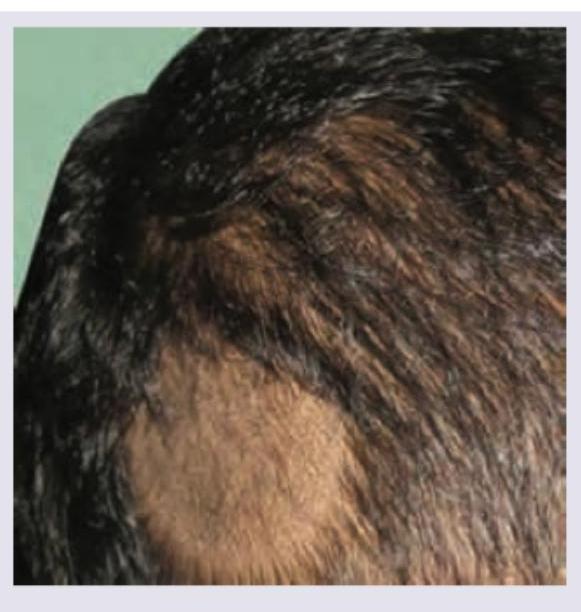
A 26-year-old male presents to the OPD complaining of hair loss and itching on the scalp. Physical examination reveals moderate patchy hair loss from the central portion of the scalp, and the lesions have a ring-like configuration with central clearing. Which of the following drugs can be used to treat this patient's condition?
All of the following cause sulfur granules except?
Wood's lamp is used in the diagnosis of which of the following conditions?
Which of the following is NOT a feature of Tinea capitis?
What is the treatment of choice for fungal skin infections?
Explanation: **Explanation:** The clinical presentation of nail discoloration, thickening (subungual hyperkeratosis), and tunneling (onycholysis) in an elderly patient is highly suggestive of **Onychomycosis** (Tinea unguium). **1. Why KOH Mount is correct:** Potassium Hydroxide (KOH) mount is the **gold standard initial investigation** for fungal skin and nail infections. KOH acts as a keratolytic agent, dissolving the keratin (skin/nail debris) and allowing for the clear visualization of fungal elements like hyphae, spores, or pseudohyphae under a microscope. It is rapid, cost-effective, and provides immediate confirmation of a fungal etiology, making it the investigation that clinches the diagnosis at the earliest. **2. Why other options are incorrect:** * **Wood’s Lamp:** Primarily used for diagnosing certain superficial infections like Tinea versicolor (golden yellow fluorescence) or Erythrasma (coral red). It is not useful for onychomycosis as most dermatophytes causing nail infections do not fluoresce. * **Slit Smear:** This is the diagnostic test for **Leprosy** (to detect *M. leprae*) and Leishmaniasis. It has no role in fungal nail pathology. * **Gram Stain:** Used for identifying **bacteria** (Gram-positive/negative). While it can occasionally show *Candida*, it is not the standard or most efficient method for diagnosing dermatophytic nail infections. **Clinical Pearls for NEET-PG:** * **Most common cause of Onychomycosis:** *Trichophyton rubrum*. * **Culture:** Sabouraud Dextrose Agar (SDA) is used for definitive species identification but takes 2–3 weeks (not the "earliest"). * **Treatment of Choice:** Oral **Terbinafine** is the first-line systemic agent for dermatophytic onychomycosis. * **Periodic Acid-Schiff (PAS) stain:** If KOH is negative but clinical suspicion is high, a nail clip biopsy with PAS stain is the most sensitive diagnostic method.
Explanation: ### Explanation **Correct Answer: C. Tinea cruris** **Why it is correct:** The clinical presentation of **itchy, annular (ring-shaped), scaly plaques** in the groin is classic for **Tinea cruris** (Jock itch). This is a dermatophyte infection, most commonly caused by *Trichophyton rubrum*. The hallmark of tinea is the **active border**—where the inflammation and scaling are most prominent at the periphery while the center shows "central clearing." The groin is a high-risk site due to heat, friction, and maceration, especially in manual laborers. **Why the other options are incorrect:** * **Granuloma annulare:** While annular, these lesions are typically **non-scaly** and asymptomatic. They are dermal papules arranged in a ring, often associated with diabetes mellitus. * **Annular lichen planus:** This presents as violaceous, flat-topped, polygonal papules. While it can be annular, it lacks the characteristic fine scaling of a fungal infection and usually shows **Wickham striae**. * **Erythema annulare centrifugum (EAC):** This is a reactive erythema. While it features "trailing scale" (scaling inside the advancing edge), it is less common than Tinea and usually lacks the intense pruritus and specific groin localization seen here. **NEET-PG High-Yield Pearls:** 1. **Diagnostic Gold Standard:** Potassium Hydroxide (**KOH**) mount showing translucent, branching, septate hyphae. 2. **The "Two Feet-One Hand" Syndrome:** Tinea cruris is often associated with Tinea pedis; always check the feet to prevent recurrence. 3. **Treatment:** Topical antifungals (e.g., Clotrimazole, Terbinafine) are first-line. **Avoid topical steroids**, as they lead to *Tinea incognito* (loss of typical features). 4. **Differential:** Erythrasma (caused by *Corynebacterium minutissimum*) also affects the groin but shows **coral-red fluorescence** under Wood’s lamp and lacks a central clearing.
Explanation: **Explanation:** **Sporotrichosis**, also known as "Rose Gardener’s Disease," is a subcutaneous mycosis caused by the dimorphic fungus *Sporothrix schenckii*. It typically presents as a linear chain of nodules following lymphatic drainage (lymphocutaneous type) after traumatic inoculation from soil or plants. **1. Why Itraconazole is the Correct Answer:** **Itraconazole** is the current **drug of choice** for all forms of cutaneous and lymphocutaneous sporotrichosis. It is preferred due to its high efficacy, superior safety profile, and better tolerability compared to older treatments. The standard regimen is 200 mg daily for 3–6 months (continued for 2–4 weeks after lesions resolve). **2. Why the Other Options are Incorrect:** * **Ketoconazole & Miconazole:** These are older azoles. Ketoconazole is rarely used systemically due to risks of hepatotoxicity and inhibition of steroidogenesis (leading to gynecomastia). Miconazole is primarily used topically and is ineffective for systemic subcutaneous infections. * **Amphotericin B:** While highly potent, it is reserved only for **disseminated or systemic sporotrichosis** and cases involving pregnancy, as it is too toxic for localized cutaneous disease. **3. High-Yield Clinical Pearls for NEET-PG:** * **Historical Drug of Choice:** Saturated Solution of Potassium Iodide (**SSKI**) was the traditional treatment. While still an option (especially in resource-limited settings), it has been replaced by Itraconazole due to side effects like iodism and metallic taste. * **Asteroid Bodies:** Histopathology often shows the "Splendore-Hoeppli phenomenon" (eosinophilic material surrounding the yeast). * **Culture:** The gold standard for diagnosis. At 25°C, it shows a characteristic "flowerette" or "daisy-like" arrangement of conidia. * **Fixed Cutaneous Sporotrichosis:** A variant presenting as a single ulcerated plaque at the site of inoculation without lymphatic spread.
Explanation: **Explanation:** The correct answer is **Pseudomonas**. Wood’s lamp examination is a diagnostic tool that uses ultraviolet light (365 nm) to detect specific skin conditions based on their characteristic fluorescence. **Why Pseudomonas is correct:** *Pseudomonas aeruginosa* produces a pigment called **pyoverdin** (also known as fluorescein). When skin infected with Pseudomonas (such as in burn wounds or "hot tub folliculitis") is exposed to a Wood’s lamp, it emits a characteristic **apple-green fluorescence**. This is a high-yield clinical marker for identifying the colonization of this gram-negative bacterium in clinical settings. **Analysis of Incorrect Options:** * **Corynebacterium diphtheriae:** Does not show fluorescence. However, *Corynebacterium minutissimum* (the causative agent of **Erythrasma**) is a classic Wood's lamp favorite, showing a **coral-red fluorescence** due to porphyrin production. * **Pneumococcus:** This bacterium does not possess fluorophores and does not exhibit fluorescence under UV light. * **Microsporum canis:** While this fungal species *does* fluoresce, it typically produces a **bright blue-green** fluorescence. In the context of this specific question, Pseudomonas is the classic association for distinct green fluorescence. **High-Yield Clinical Pearls for NEET-PG:** 1. **Tinea Capitis:** *Microsporum* species (e.g., *M. canis, M. audouinii*) show **Blue-Green** fluorescence. *Trichophyton schoenleinii* shows **Dull Green**. 2. **Pityriasis Versicolor:** Caused by *Malassezia furfur*, it shows **Yellowish-white or Copper-orange** fluorescence. 3. **Erythrasma:** Shows **Coral-red** fluorescence. 4. **Porphyria Cutanea Tarda:** Urine shows **Pink-orange** fluorescence. 5. **Vitiligo:** Shows **milky-white** fluorescence (due to total loss of melanin), helping to distinguish it from pityriasis alba.
Explanation: ### Explanation The clinical presentation of scaly patches progressing to inflammatory lesions (Kerion) in a child, combined with a history of pet contact and positive Wood’s light fluorescence, is classic for **Tinea Capitis** caused by **Microsporum canis**. **Why Microsporum canis is correct:** * **Zoophilic Nature:** *M. canis* is a zoophilic fungus commonly transmitted from pets (cats/dogs) to humans. * **Fluorescence:** It produces a characteristic **bright blue-green fluorescence** under Wood’s light due to the metabolite pteridine. * **Inflammatory Response:** While it starts as non-inflammatory, it frequently progresses to inflammatory lesions like a Kerion (a boggy, painful inflammatory mass). * **Ectothrix Infection:** It causes an ectothrix pattern (spores outside the hair shaft), which is associated with fluorescence. **Why other options are incorrect:** * **Microsporum audouinii:** An anthropophilic fungus (human-to-human). While it fluoresces, it is less likely given the specific mention of pets and the high inflammatory response. * **Trichophyton rubrum:** The most common cause of Tinea Corporis and Pedis, but it **rarely** causes Tinea Capitis. Furthermore, *Trichophyton* species (except *T. schoenleinii*) do **not** fluoresce under Wood’s light. * **Epidermophyton floccosum:** This fungus affects the skin and nails (Tinea Cruris/Pedis) but **never** infects the hair. **High-Yield Clinical Pearls for NEET-PG:** * **Wood’s Light Fluorescence:** Remember the mnemonic **"M.A.C."** for green fluorescence in Tinea Capitis: *M. audouinii*, *M. canis*, and *M. distortum*. * **Drug of Choice:** Oral **Griseofulvin** remains the gold standard for Tinea Capitis, especially for *Microsporum* species. * **Endothrix vs. Ectothrix:** *Trichophyton tonsurans* (most common cause of Tinea Capitis worldwide) causes **Endothrix** infection, does not fluoresce, and presents as "Black Dot" Tinea Capitis.
Explanation: **Explanation:** **Diagnosis:** The clinical presentation of patchy hair loss, itching, and ring-like lesions with central clearing on the scalp is characteristic of **Tinea Capitis** (a dermatophyte infection). **Why Terbinafine is Correct:** Tinea capitis requires **systemic antifungal therapy** because topical agents cannot penetrate the hair follicle deeply enough to eradicate the fungus. **Terbinafine** is a first-line systemic antifungal (an allylamine) that inhibits the enzyme *squalene epoxidase*, leading to a deficiency in ergosterol and a toxic buildup of squalene, which is fungicidal. While Griseofulvin was historically the gold standard, Terbinafine is now preferred for *Trichophyton* species. **Why Other Options are Incorrect:** * **A. Local Corticosteroids:** These are contraindicated. Applying steroids to a fungal infection can lead to *Tinea Incognito*, where the inflammation is suppressed but the fungus flourishes, worsening the infection. * **B. Progesterone:** This is a hormone with no role in treating fungal infections or standard hair loss. * **C. Finasteride:** This is a 5-alpha-reductase inhibitor used for **Androgenetic Alopecia** (male pattern baldness). It does not treat infectious causes of hair loss and would not address the itching or ring-like lesions. **Clinical Pearls for NEET-PG:** * **Drug of Choice:** Griseofulvin is still often considered the DOC for *Microsporum* species, while Terbinafine is superior for *Trichophyton* (the most common cause worldwide). * **Black Dot Tinea:** Caused by endothrix organisms (e.g., *T. tonsurans*), where hair breaks at the surface. * **Grey Patch Tinea:** Caused by ectothrix organisms (e.g., *M. audouinii*), showing scaling and dull grey hair. * **Kerion:** A painful, inflammatory boggy swelling; requires systemic antifungals plus/minus steroids to prevent scarring.
Explanation: **Explanation:** The presence of **sulfur granules** is a hallmark histopathological and clinical finding in specific chronic granulomatous infections. These "granules" are actually organized micro-colonies of the causative organism surrounded by an eosinophilic host reaction (Splendore-Hoeppli phenomenon). **Why Chromoblastomycosis is the correct answer:** Chromoblastomycosis is a chronic fungal infection caused by dematiaceous (pigmented) fungi like *Fonsecaea pedrosoi*. It is characterized by the presence of **Sclerotic bodies** (also known as Medlar bodies, Copper-colored bodies, or Muriform bodies) in tissue sections. It **does not** produce sulfur granules. **Analysis of other options:** * **Actinomycosis:** Classically associated with "sulfur granules" (yellowish specks) in the pus draining from sinuses. These are composed of filamentous *Actinomyces israelii*. * **Mycetoma:** Both Eumycetoma (fungal) and Actinomycetoma (bacterial) present with a triad of tumefaction, draining sinuses, and the discharge of **grains/granules**. The color of the granule (black, white, or yellow) helps identify the specific species. * **Botryomycosis:** Despite the name, this is a chronic **bacterial** infection (most commonly *Staphylococcus aureus*) that mimics a fungal infection by forming granules in the tissue. **NEET-PG High-Yield Pearls:** 1. **Sclerotic Bodies:** Pathognomonic for Chromoblastomycosis; they represent the intermediate stage between yeast and hyphae and look like "copper pennies." 2. **Splendore-Hoeppli Phenomenon:** The eosinophilic material surrounding the granules in Actinomycosis and Botryomycosis. 3. **Actinomycosis:** Gram-positive, non-acid-fast, anaerobic branching filaments. 4. **Nocardia:** Often causes Actinomycetoma; it is Gram-positive and **weakly acid-fast** (modified Ziehl-Neelsen stain).
Explanation: **Explanation:** **Wood’s lamp** (ultraviolet light filtered through a Wood’s filter, emitting light at a wavelength of **365 nm**) is a classic diagnostic tool in dermatology used to detect specific fungal and bacterial infections, as well as pigmentary disorders. **Why Tinea capitis is correct:** Wood’s lamp is primarily used to screen for **Tinea capitis** caused by **Ectothrix** species. The fluorescence is produced by pteridine metabolites produced by the fungi. Specifically: * **Microsporum species** (e.g., *M. audouinii, M. canis*): Emit a brilliant **bright green/blue-green** fluorescence. * **Trichophyton schoenleinii**: Emits a **dull whitish-blue** fluorescence (favus). * *Note:* Most *Trichophyton* species (like *T. tonsurans*, the most common cause of Tinea capitis currently) do **not** fluoresce. **Why the other options are incorrect:** * **B. Candida albicans:** Candidal infections do not exhibit fluorescence under Wood’s lamp. Diagnosis is typically clinical or via KOH mount showing pseudohyphae. * **C & D. Histoplasmosis and Cryptococcosis:** These are deep/systemic fungal infections. Wood’s lamp is a tool for **superficial** skin and hair infections and has no utility in diagnosing systemic mycoses. **High-Yield Clinical Pearls for NEET-PG:** * **Erythrasma (*Corynebacterium minutissimum*):** Shows characteristic **Coral Red** fluorescence (due to coproporphyrin III). * **Pityriasis Versicolor:** Shows **Yellowish-white/Copper-orange** fluorescence. * **Pseudomonas (in burns/wounds):** Shows **Apple Green** fluorescence (due to pyoverdin). * **Porphyria Cutanea Tarda:** Urine shows **Pink-red** fluorescence. * **Vitiligo:** Shows **milky white** fluorescence (helps distinguish from stable depigmentation).
Explanation: **Explanation:** **Tinea capitis** is a fungal infection of the scalp hair and skin. The correct answer is **Option B** because Tinea capitis is primarily a disease of **children** (pre-pubertal age). It is rarely seen in adults/elderly because post-pubertal sebum contains **fungistatic medium-chain fatty acids** that inhibit dermatophyte growth. **Analysis of other options:** * **Option A (Boggy swelling):** This refers to **Kerion**, an inflammatory variant of Tinea capitis caused by a hypersensitivity reaction to zoophilic fungi. It presents as a painful, boggy, inflammatory mass with pustules and crusting. * **Option C (Black dot):** This is a characteristic clinical presentation where the hair breaks off at the scalp surface due to **endothrix** infection (e.g., *T. tonsurans*), leaving behind "black dots" (the distal ends of broken hair shafts). * **Option D (Causative organisms):** Tinea capitis is caused by species of **Trichophyton** and **Microsporum**. Crucially, **Epidermophyton floccosum** does NOT cause Tinea capitis as it does not invade hair (it only affects skin and nails). **High-Yield Clinical Pearls for NEET-PG:** * **Most common cause worldwide:** *Trichophyton tonsurans* (Endothrix). * **Most common cause in India:** *Trichophyton violaceum*. * **Wood’s Lamp Examination:** *Microsporum* species show a **bright green** fluorescence, while *Trichophyton* (except *T. schoenleinii*) usually does not fluoresce. * **Drug of Choice:** **Oral Griseofulvin** remains the gold standard for Tinea capitis (Terbinafine is also used, especially for *Trichophyton*). Topical antifungals are ineffective as they do not penetrate the hair follicle.
Explanation: **Explanation:** The treatment of choice for localized superficial fungal skin infections (Dermatophytosis) is **topical antifungal therapy**. **1. Why Clotrimazole Paint is Correct:** Clotrimazole is a broad-spectrum **imidazole** antifungal. It works by inhibiting the enzyme *lanosterol 14-demethylase*, which is essential for synthesizing ergosterol—a key component of the fungal cell membrane. The "paint" or topical solution formulation is particularly effective for skin infections as it ensures high local concentration of the drug with minimal systemic absorption, leading to the resolution of the infection. **2. Why Other Options are Incorrect:** * **Antihistamines:** These are symptomatic treatments used to relieve itching (pruritus) but have no effect on the underlying fungal pathogen. * **Steroids:** These are **contraindicated** as monotherapy for fungal infections. While they reduce inflammation, they suppress local immunity, leading to a "Tinea Incognito" presentation where the fungus flourishes while the typical clinical features are masked. * **Selenium Sulphide:** This is an antifungal/antiseborrheic agent specifically used for **Tinea Versicolor** (Pityriasis versicolor) or Seborrheic Dermatitis, but it is not the first-line choice for general dermatophytic skin infections (like Tinea Corporis or Cruris). **Clinical Pearls for NEET-PG:** * **DOC for Tinea Capitis:** Oral Griseofulvin (Terbinafine is also used). * **DOC for Onychomycosis:** Oral Terbinafine. * **Tinea Incognito:** Occurs due to the irrational use of topical steroids on a fungal infection. * **Most common dermatophyte:** *Trichophyton rubrum*. * **Diagnostic Test:** KOH mount (shows branching hyphae).
Dermatophytoses
Practice Questions
Tinea Versicolor
Practice Questions
Candidiasis
Practice Questions
Onychomycosis
Practice Questions
Subcutaneous Mycoses
Practice Questions
Systemic Mycoses with Cutaneous Manifestations
Practice Questions
Opportunistic Fungal Infections
Practice Questions
Mycetoma
Practice Questions
Tropical Fungal Infections
Practice Questions
Diagnosis of Fungal Infections
Practice Questions
Antifungal Therapy
Practice Questions
Preventive Strategies
Practice Questions
Get full access to all questions, explanations, and performance tracking.
Start For Free