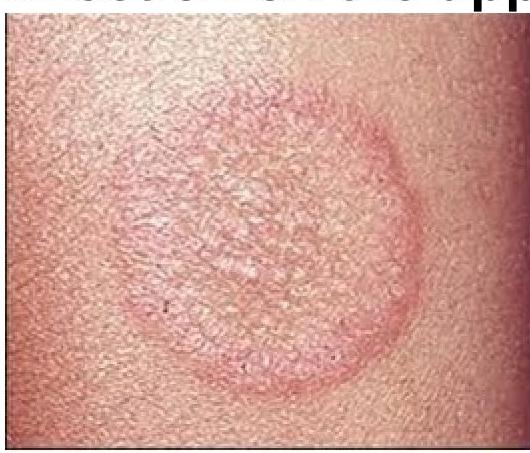
A young male presents with the following itchy lesion for one month. All of the following genera can cause this kind of lesion except:

A 30-year-old washerwoman presents with the following lesion. All are correct except:

A 20-year-old patient presents with an extremely itchy lesion on one arm. Diagnosis is:

The given KOH mount of patient shows:

The given KOH mount of a patient shows:

A 25-year-old construction worker presents with following skin lesions. All are true about the image shown except: (Recent NEET Pattern 2016-17)

All are true about the skin disease shown except:

All are true about the infection shown in the image EXCEPT:

The image shows a KOH mount suggestive of diagnosis of:

Which of the following is not effective against this condition?

Explanation: ***Aspergillus*** - *Aspergillus* species are opportunistic fungi commonly causing **invasive aspergillosis** in immunocompromised patients, affecting lungs, sinuses, and other organs. - While *Aspergillus* can cause cutaneous infections, these are typically **secondary to systemic disease** or trauma and do **not commonly present as localized, itchy, ring-like lesions** on otherwise healthy skin. *Trichophyton* - *Trichophyton* is a common genus of dermatophytes responsible for various types of **tinea (ringworm)**, including tinea corporis, pedis, and cruris. - The presented lesion, characterized by its **itchy, erythematous, and circinate (ring-like) appearance** with central clearing, is highly consistent with a dermatophyte infection caused by *Trichophyton*. *Microsporum* - *Microsporum* is another significant genus of dermatophytes that primarily causes **tinea capitis (ringworm of the scalp)** and **tinea corporis**. - Its infections also manifest as **itchy, annular, and scaly lesions** on the skin, similar to the one depicted, making it a plausible cause. *Epidermophyton* - *Epidermophyton floccosum* is the sole species in this genus of dermatophytes and is a common cause of **tinea cruris (jock itch)** and **tinea pedis (athlete's foot)**. - Like *Trichophyton* and *Microsporum*, infections by *Epidermophyton* present as **red, intensely itchy, scaling patches**, often with a well-demarcated, expanding border, fitting the clinical description.
Explanation: ***Tinea unguium*** - **Tinea unguium** (onychomycosis) is a **dermatophyte infection** of the nail plate, typically caused by *Trichophyton* species, not *Candida*. - The image shows **chronic paronychia** caused by *Candida* affecting the nail fold, which is a completely different condition from tinea unguium. *Caused by normal commensal of GIT* - *Candida albicans* is indeed a **normal commensal** of the gastrointestinal tract and can cause chronic paronychia in washerwomen. - Constant **water exposure** allows this opportunistic organism to colonize and infect the periungual tissues. *Rule out diabetes mellitus in recurrent episodes* - **Recurrent candidal infections** warrant screening for **diabetes mellitus** due to impaired immune function and elevated glucose levels. - Diabetic patients have increased susceptibility to **opportunistic fungal infections** including chronic paronychia. *Deformed nail plate* - The image clearly shows **nail dystrophy** with irregular, discolored, and thickened nail plate secondary to chronic inflammation. - **Chronic paronychia** affects the nail matrix, leading to **abnormal nail growth** and permanent deformation.
Explanation: ***Tinea imbricata*** - The **concentric, overlapping scales forming prominent rings** or "imbricated" patterns are **pathognomonic** for *Tinea imbricata*, caused by **Trichophyton concentricum**. - This **rare dermatophytosis** is geographically restricted to **tropical regions of the Pacific, Southeast Asia, and Central/South America** and causes **intensely itchy lesions** with distinctive overlapping scale patterns. *Tinea corporis* - Typically presents as a **single red, annular lesion with raised, scaly border** and central clearing, not the extensive overlapping concentric rings seen in this case. - While it can be itchy, the **morphology lacks the pathognomonic imbricated scale pattern** characteristic of the correct diagnosis. *Tinea incognito* - Refers to dermatophyte infections **modified by inappropriate topical steroid use**, leading to **suppressed inflammation** and atypical morphology. - The distinctive **classical imbricated pattern** shown excludes this diagnosis, as steroids would obscure such well-defined morphological features. *Tinea manuum* - Specifically affects the **hands**, presenting with **unilateral scaling, erythema, and hyperkeratosis** on palms and fingers. - The **arm location** and **concentric ring morphology** are inconsistent with typical hand involvement patterns seen in this condition.
Explanation: ***Spaghetti and meatball appearance*** - This description refers to the characteristic microscopic appearance of *Malassezia* species on a **KOH mount**, showing short hyphae ("spaghetti") and spherical yeast cells ("meatballs"). - This finding is typical of **tinea versicolor** and sometimes seborrheic dermatitis. *Budding yeasts and pseudohyphae* - This appearance is characteristic of *Candida albicans*, which causes conditions like candidiasis or thrush. - While yeasts are present, the hyphae in the image are short and fragmented, unlike the continuous pseudohyphae of *Candida*. *Clusters of pigmented cells* - This description would be more indicative of conditions like **tinea nigra** or certain bacterial infections. - The image clearly shows fungal elements (yeasts and hyphae), not pigmented cellular clusters. *Septate hyphae* - While the image shows some hyphae, the dominant feature is a mix of short hyphae and round yeast forms, which is specific to *Malassezia*. - **Septate hyphae** alone are a general characteristic of many dermatophytes (e.g., *Tinea corporis*), but not the hallmark of *Malassezia* when combined with spherical yeasts.
Explanation: ***Budding yeasts and pseudohyphae*** - The image clearly displays structures characteristic of **budding yeast cells** and elongated forms consistent with **pseudohyphae**, which are typical findings in candidiasis. - This morphology is a hallmark of *Candida* species, commonly seen in KOH mounts from samples like vaginal swabs or skin scrapings for diagnosing fungal infections. *Spaghetti and meat ball appearance* - This description refers to the characteristic appearance of *Malassezia furfur* in KOH preparations, associated with **tinea versicolor**, showing short, curved hyphae and spherical yeast forms. - The image provided does not show the distinctive short, curved hyphae and clusters of yeast cells indicative of **Spaghetti and meat ball appearance**. *Clusters of pigmented cells* - This description would suggest the presence of **melanocytes** or possibly **pigmented fungi** (phaeohyphomycosis), which can be seen in certain fungal infections but are not what is depicted here. - The structures in the image appear to be fungal elements and are not distinctly pigmented cells formed in clusters. *Septate hyphae* - **Septate hyphae** are long, filamentous structures with regular cross-walls, characteristic of dermatophytes like *Trichophyton* or *Microsporum* species, causing ringworm. - While there are filamentous structures, they are primarily **pseudohyphae** (constricted at the septa, resembling a chain of elongated budding cells) rather than true septate hyphae, and are accompanied by distinct budding yeast forms.
Explanation: ***Correct Answer: Oral terbinafine is drug of choice*** - **Oral terbinafine is NOT the drug of choice** for tinea versicolor, making this the correct answer to the "EXCEPT" question - **Malassezia species lack the enzyme** (squalene epoxidase) necessary to convert terbinafine into its active form - Terbinafine is primarily used for **dermatophyte infections** (tinea corporis, cruris, pedis), not Malassezia infections - **Drug of choice for tinea versicolor**: Topical azoles (ketoconazole shampoo, selenium sulfide) or oral azoles (fluconazole, itraconazole) for extensive disease *Incorrect: Wood's lamp will produce yellow fluorescence* - This statement is TRUE, so it is not the exception - Wood's lamp examination reveals characteristic **yellow-gold to coppery-orange fluorescence** in tinea versicolor - The fluorescence is due to production of **porphyrins (malassezin)** by the *Malassezia* organism *Incorrect: KOH mount shows spaghetti and meat ball appearance* - This statement is TRUE, so it is not the exception - **KOH mount** of skin scrapings shows short, stubby **hyphae** (spaghetti) and round **spores** (meatballs) - This is the **pathognomonic microscopic finding** for *Malassezia furfur* *Incorrect: Caused by Malassezia furfur* - This statement is TRUE, so it is not the exception - The image shows **hypopigmented and hyperpigmented patches** on the trunk, characteristic of tinea versicolor - Caused by dimorphic yeast ***Malassezia furfur*** (also *M. globosa*, *Pityrosporum ovale*) - Normal skin commensal that becomes pathogenic in hot, humid conditions
Explanation: ***Paronychia*** - Paronychia refers to inflammation of the **nail folds**, which is not depicted in the image. The image shows blistering skin lesions typical of a bullous dermatosis. - This condition is commonly due to infection (bacterial or fungal) or irritation around the nails, distinct from the generalized blistering seen here. *Bulla spread sign* - The image depicts a **positive Nikolsky's sign**, also known as the bulla spread sign, where gentle lateral pressure on unbroken skin near a blister causes the blister to extend. - This sign is characteristic of **pemphigus vulgaris**, indicating intraepidermal blistering due to loss of cell-to-cell adhesion. *IgG antibodies along keratinocyte cell membrane give fish net appearance* - Pemphigus vulgaris is characterized by the presence of **IgG autoantibodies** targeting desmoglein 1 and 3, components of desmosomes between keratinocytes. - On direct immunofluorescence, these antibodies appear as a **"fish-net" pattern** of IgG deposition around individual keratinocytes, a hallmark finding for pemphigus. *Acantholysis on histopathology* - **Acantholysis** is the loss of intercellular connections (desmosomes) between keratinocytes, resulting in separation of epidermal cells. - This is a **hallmark histopathologic feature of pemphigus vulgaris**, with keratinocytes appearing rounded and separated, forming intraepidermal blisters with a characteristic "tombstone" appearance of basal cells at the blister base.
Explanation: ***Absence of any inflammatory response or pain*** - Fungal infections like candidiasis typically elicit an **inflammatory response**, leading to symptoms such as **erythema, pruritus, and pain or discomfort**, especially in intertriginous areas. - The image shows clear signs of inflammation, including **redness and maceration**, which would be associated with discomfort. *Satellite pustules* - Cutaneous candidiasis, particularly in intertriginous areas, is often characterized by a main erythematous patch with surrounding smaller lesions known as **satellite pustules or papules**. - These satellite lesions are a classic diagnostic feature, indicating the spread of the fungal infection beyond the main lesion. *Caused by normal saprophytic inhabitants of the gut* - *Candida albicans*, the primary cause of cutaneous candidiasis, is a **normal commensal organism** found in the gastrointestinal tract and on mucous membranes. - Under conditions such as warmth, moisture, immunosuppression, or antibiotic use, *Candida* can overgrow and become pathogenic. *Involves intertriginous areas* - The image clearly depicts an infection in an **intertriginous area**, specifically between the fingers (likely the web space). - These areas are prone to candidiasis due to their **warm, moist environment**, which favors fungal growth.
Explanation: ***Pityriasis versicolor*** - The image clearly shows a KOH mount with **short, curved hyphae** and **clusters of round yeast cells**, characteristic of **spaghetti and meatballs** appearance, which is pathognomonic for *Malassezia furfur*, the causative agent of pityriasis versicolor. - This common superficial fungal infection presents as hypo- or hyperpigmented patches, primarily on the trunk, neck, and arms, and is diagnosed by this distinctive microscopic finding. *Tinea imbricata* - This is a rare form of tinea corporis caused by *Trichophyton concentricum*, characterized by **concentric, scaly rings**. - A KOH mount would show **long, branching hyphae** without the characteristic yeast clusters seen in the image. *Pompholyx* - **Pompholyx** (dyshidrotic eczema) is an endogenous eczematous condition characterized by **deep-seated vesicles** and bullae on the palms, soles, and sides of the fingers. - It is a non-infectious condition, and a KOH mount would show **no fungal elements**; instead, it would reveal inflammatory cells if any scraping were done. *Tinea capitis* - **Tinea capitis** is a dermatophyte infection of the scalp and hair, primarily affecting children. - A KOH mount from hair or scalp scrapings would show **arthrospores** (either endothrix or ectothrix) and **hyphae within or around the hair shaft**, not the yeast and short hyphae clusters characteristic of *Malassezia*.
Explanation: ***Griseofulvin*** - The image shows **Pityriasis Versicolor**, characterized by hyperpigmented or hypopigmented patches with fine scaling, caused by *Malassezia furfur*. - Griseofulvin is an oral antifungal primarily used for **dermatophyte infections** (tinea infections) of the skin, hair, and nails, and is not effective against *Malassezia furfur*. *Topical Ketoconazole* - **Ketoconazole** is a broad-spectrum azole antifungal that is highly effective against a wide range of fungi, including *Malassezia furfur*. - It works by inhibiting the synthesis of **ergosterol**, a crucial component of fungal cell membranes, leading to cell death. *Topical selenium sulphide* - **Selenium sulfide** is an effective antifungal agent commonly used in shampoos and lotions to treat conditions like dandruff and **Pityriasis Versicolor**. - It works by reducing the growth of *Malassezia furfur* and has **keratolytic** properties, helping to shed the affected skin cells. *Topical sulfur preparations* - **Sulfur** has antifungal, antibacterial, and keratolytic properties, making it useful in treating various skin conditions. - Topical sulfur preparations are effective in treating **Pityriasis Versicolor** by inhibiting fungal growth and promoting exfoliation of the affected epidermis.
Dermatophytoses
Practice Questions
Tinea Versicolor
Practice Questions
Candidiasis
Practice Questions
Onychomycosis
Practice Questions
Subcutaneous Mycoses
Practice Questions
Systemic Mycoses with Cutaneous Manifestations
Practice Questions
Opportunistic Fungal Infections
Practice Questions
Mycetoma
Practice Questions
Tropical Fungal Infections
Practice Questions
Diagnosis of Fungal Infections
Practice Questions
Antifungal Therapy
Practice Questions
Preventive Strategies
Practice Questions
Get full access to all questions, explanations, and performance tracking.
Start For Free