Hexokinase is classified as which type of enzyme?
Which of the following is a mitochondrial marker enzyme?
What is true about reversible non-competitive inhibitors?
Which of the following is a selenium-dependent enzyme?
Allopurinol specifically inhibits which enzyme?
Which of the following is NOT a rate-limiting enzyme?
Which enzyme in leucocytes is required for the production of hypochlorite?
Which statement is false about covalent modification?
Which of the following enzymes contains Zinc?
Which drugs form complexes with pyridoxal?
Explanation: **Explanation:** **Why Transferase is Correct:** Enzymes are classified into six major classes by the IUBMB (International Union of Biochemistry and Molecular Biology). **Hexokinase** belongs to **Class 2: Transferases**. These enzymes catalyze the transfer of a functional group (other than hydrogen) from one substrate to another. Specifically, Hexokinase transfers a phosphate group from ATP (the donor) to a six-carbon sugar like glucose (the acceptor) to form Glucose-6-Phosphate. This is the first, irreversible, rate-limiting step of glycolysis. **Why Other Options are Incorrect:** * **Oxidoreductases (Class 1):** These enzymes catalyze oxidation-reduction reactions (transfer of H atoms or electrons). This category includes **Oxidases** (which use oxygen as an electron acceptor) and **Reductases**. Hexokinase does not involve a change in the oxidation state of glucose; it only adds a phosphate group. **High-Yield NEET-PG Clinical Pearls:** * **Hexokinase vs. Glucokinase:** Hexokinase is found in most extrahepatic tissues, has a **low Km** (high affinity for glucose), and is inhibited by its product (Glucose-6-P). Glucokinase (Hexokinase IV) is found in the liver and pancreatic beta cells, has a **high Km** (low affinity), and is *not* inhibited by Glucose-6-P. * **Mnemonic for Enzyme Classes (OTH LIL):** 1. **O**xidoreductases 2. **T**ransferases (e.g., Kinases, Transaminases) 3. **H**ydrolases (e.g., Digestive enzymes) 4. **L**yases (e.g., Aldolase, Decarboxylase) 5. **I**somerases (e.g., Mutases) 6. **L**igases (e.g., Carboxylases) * **Key Fact:** All **Kinases** are Transferases because they transfer a phosphate group from a high-energy phosphate donor (usually ATP).
Explanation: **Explanation:** The correct answer is **Succinic dehydrogenase (SDH)**. Marker enzymes are specific enzymes used to identify and assess the integrity of particular cellular organelles. **Why Succinic Dehydrogenase is the correct answer:** Succinic dehydrogenase is a key enzyme of the **TCA cycle** and is uniquely located in the **inner mitochondrial membrane** (where it also functions as Complex II of the Electron Transport Chain). Because it is structurally bound to the mitochondrial membrane, it serves as a reliable marker for mitochondria in subcellular fractionation studies. **Analysis of Incorrect Options:** * **Aldolase:** This is a glycolytic enzyme located in the **cytosol**. It is used as a clinical marker for muscle damage (e.g., dermatomyositis). * **Amylase:** This is a digestive enzyme secreted by the **pancreas and salivary glands** into the extracellular space. It is a marker for acute pancreatitis, not a specific intracellular organelle. * **Pyruvate dehydrogenase (PDH):** While PDH is located within the mitochondrial matrix, it is a multi-enzyme complex rather than a standard membrane marker. SDH is the more classically cited "marker enzyme" in biochemistry textbooks for mitochondrial identification. **High-Yield Clinical Pearls for NEET-PG:** * **Mitochondrial Markers:** Inner Membrane (Succinic dehydrogenase), Matrix (Glutamate dehydrogenase), Outer Membrane (Monoamine oxidase). * **Lysosome Marker:** Acid phosphatase. * **Golgi Apparatus Marker:** Galactosyltransferase. * **Cytosol Marker:** Lactate dehydrogenase (LDH). * **Peroxisome Marker:** Catalase. * **Endoplasmic Reticulum Marker:** Glucose-6-phosphatase.
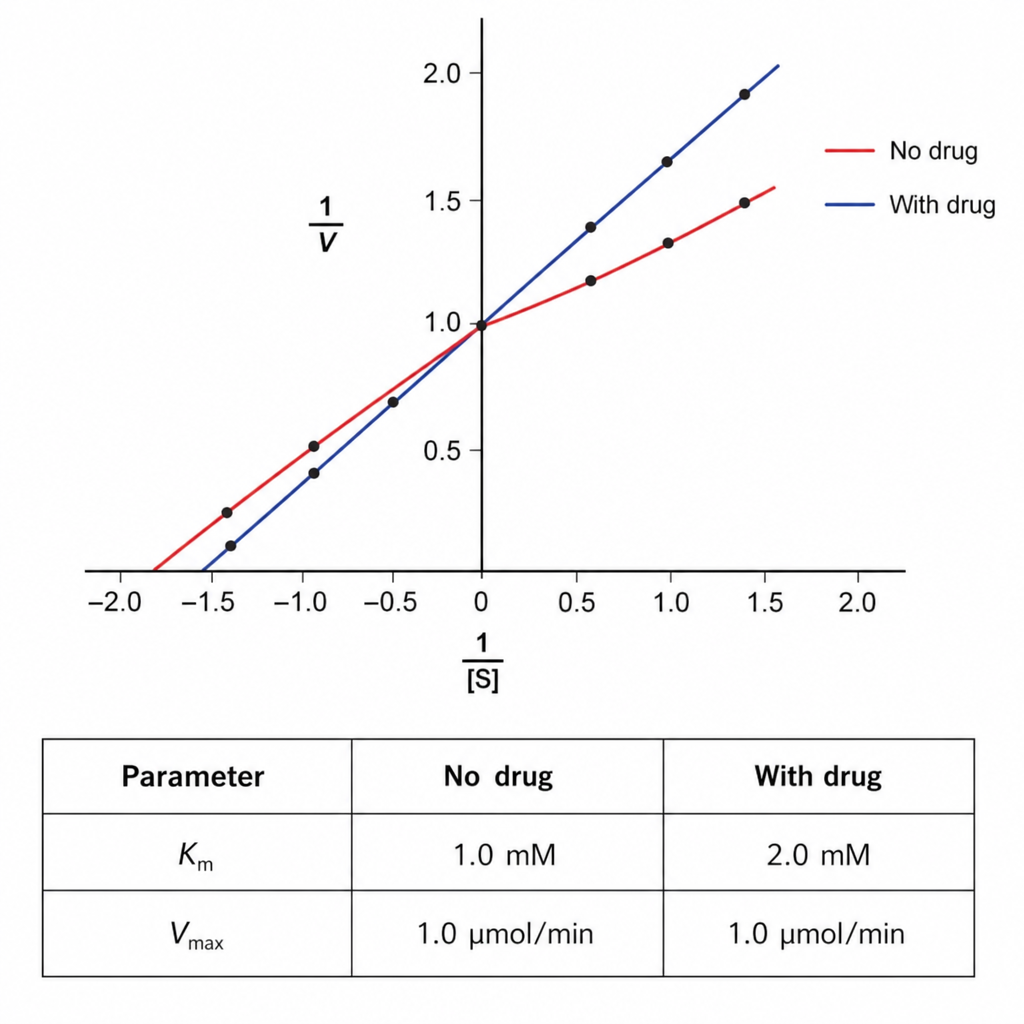
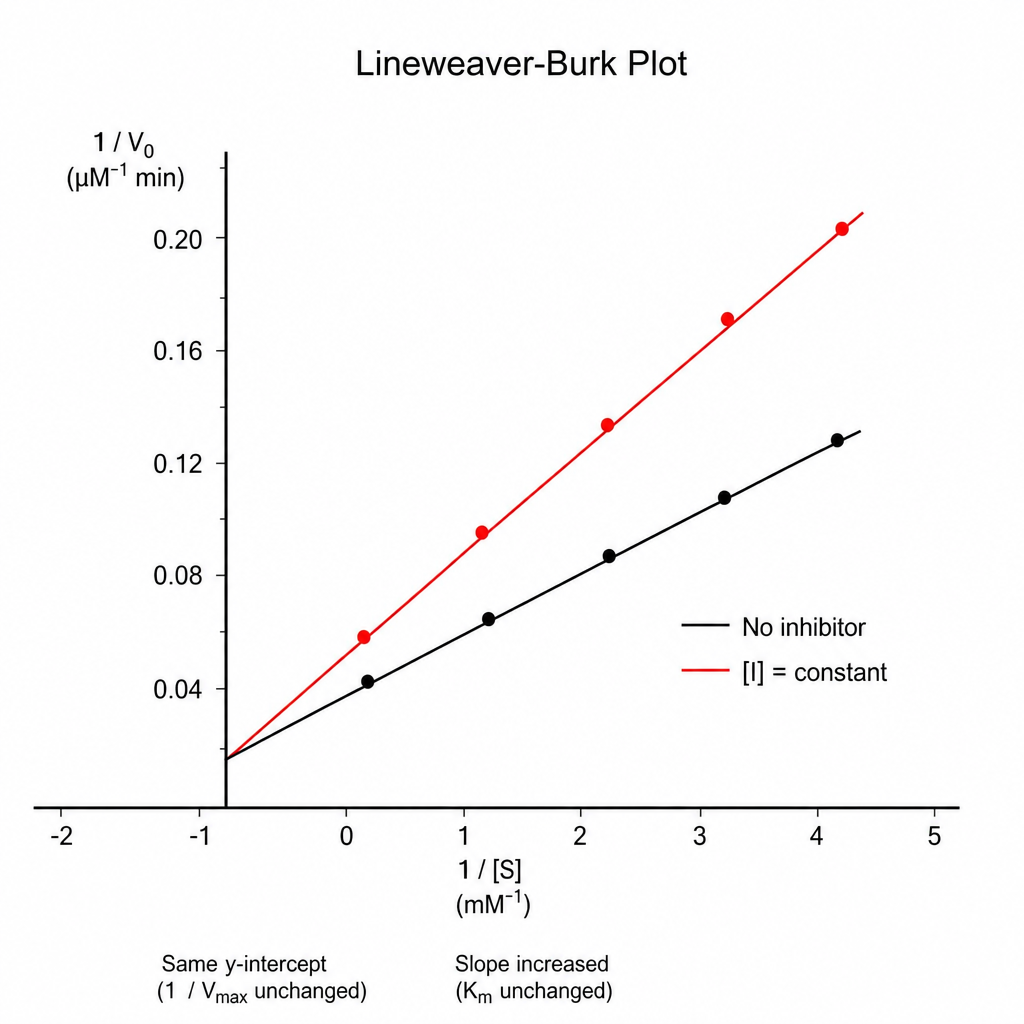
Explanation: In enzyme kinetics, **Non-competitive inhibition** occurs when an inhibitor binds to an allosteric site (a site other than the active site) on either the free enzyme or the enzyme-substrate (ES) complex. ### Why Option A is Correct Because the inhibitor binds to a site different from the active site, it does not prevent the substrate from binding. However, it renders the enzyme catalytically inactive. Since the inhibitor effectively "takes enzymes out of commission" regardless of how much substrate is added, the **Vmax (Maximum Velocity) decreases**. No amount of substrate can displace a non-competitive inhibitor. ### Why Other Options are Incorrect * **Option B & C:** In pure non-competitive inhibition, the inhibitor has the same affinity for the free enzyme and the ES complex. Therefore, the binding of the inhibitor does not interfere with the binding of the substrate to the active site. Consequently, the **Km (Michaelis constant) remains unchanged**. (Note: While Option C is technically a true statement, in NEET-PG, if both "Vmax decreases" and "Km is unchanged" are present, the primary defining characteristic is the effect on Vmax). * **Option D:** This is incorrect because Vmax must decrease; if Vmax were unaffected while Km increased, it would describe Competitive Inhibition. ### High-Yield Clinical Pearls for NEET-PG * **Competitive Inhibition:** Vmax stays the same, Km increases (e.g., Statins, Methotrexate). * **Non-competitive Inhibition:** Vmax decreases, Km stays the same (e.g., Cyanide poisoning of Cytochrome oxidase, Fluoride inhibition of Enolase). * **Uncompetitive Inhibition:** Both Vmax and Km decrease (e.g., Lithium, Hydrazine). * **Lineweaver-Burk Plot:** In non-competitive inhibition, the plots intersect on the **negative X-axis** (same -1/Km).
Explanation: **Explanation:** **Glutathione peroxidase (GPx)** is the correct answer because it contains **Selenocysteine** at its active site. This enzyme plays a critical role in the cellular antioxidant defense system by reducing hydrogen peroxide ($H_2O_2$) and lipid hydroperoxides to water and alcohols, respectively, using reduced glutathione (GSH) as a donor. The selenium atom is essential for the catalytic activity of the enzyme; without it, the enzyme cannot neutralize reactive oxygen species (ROS). **Analysis of Incorrect Options:** * **Glucokinase (Option A):** This is a monomeric enzyme in the liver and pancreas that phosphorylates glucose. It does not require selenium; its primary regulation is through the Glucokinase Regulatory Protein (GKRP). * **Aminotransferase (Option B):** These enzymes (e.g., ALT, AST) catalyze the transfer of amino groups. They are strictly dependent on **Pyridoxal Phosphate (Vitamin B6)** as a coenzyme, not selenium. * **Lysyl hydroxylase (Option D):** This enzyme is involved in collagen synthesis (post-translational modification). It requires **Vitamin C (Ascorbic acid)**, $Fe^{2+}$, and $\alpha$-ketoglutarate for its activity. **High-Yield Clinical Pearls for NEET-PG:** * **Selenium-dependent enzymes:** Other key examples include **Thioredoxin reductase** and **Iodothyronine deiodinase** (which converts $T_4$ to $T_3$). * **Keshan Disease:** A cardiomyopathy caused by Selenium deficiency. * **Kashin-Beck Disease:** An osteoarthropathy associated with Selenium deficiency. * **Selenocysteine** is often referred to as the **21st amino acid**, encoded by the stop codon **UGA** when a specific insertion sequence (SECIS) is present in the mRNA.
Explanation: **Explanation:** **1. Why Xanthine Oxidase is Correct:** Allopurinol is a structural analog of hypoxanthine. It acts as a **suicide inhibitor** (mechanism-based irreversible inhibition) of **Xanthine Oxidase (XO)**. In the body, XO converts allopurinol into its active metabolite, **oxypurinol** (alloxanthine). Oxypurinol binds tightly to the molybdenum-sulfide complex at the enzyme's active site, effectively "locking" it. This prevents the conversion of hypoxanthine to xanthine and xanthine to **uric acid**, thereby lowering serum urate levels. **2. Why the Other Options are Incorrect:** * **Arginase:** This is a key enzyme in the **Urea Cycle** that converts Arginine into Ornithine and Urea. It is not targeted by allopurinol. * **Carbamoyl Transferase (OTC):** Also part of the Urea Cycle, it catalyzes the reaction between carbamoyl phosphate and ornithine. Deficiency leads to hyperammonemia and orotic aciduria. * **Urease:** This enzyme is produced by certain bacteria (like *H. pylori* and *Proteus*) to convert urea into ammonia and CO₂. It is not a human metabolic enzyme and is not inhibited by allopurinol. **3. Clinical Pearls for NEET-PG:** * **Drug of Choice:** Allopurinol is the first-line agent for **chronic gout** and prophylaxis against **Tumor Lysis Syndrome**. * **Drug Interaction:** Since **6-Mercaptopurine (6-MP)** and **Azathioprine** are metabolized by Xanthine Oxidase, co-administration with Allopurinol leads to toxic levels of these drugs. Reduce their dose by 75%. * **Alternative:** **Febuxostat** is a non-purine selective inhibitor of XO used if patients are intolerant to allopurinol. * **Side Effect:** Watch for **Stevens-Johnson Syndrome (SJS)**, especially in patients with the HLA-B*5801 allele.
Explanation: **Explanation:** In metabolic pathways, **rate-limiting enzymes** catalyze the slowest, usually irreversible step that determines the overall flux of the pathway. These enzymes are typically regulated by hormones and allosteric effectors. **Why Glyceraldehyde-3-phosphate dehydrogenase (G3PDH) is the correct answer:** G3PDH is an enzyme involved in **Glycolysis**. It catalyzes the reversible conversion of Glyceraldehyde-3-phosphate to 1,3-bisphosphoglycerate. Because this reaction is **reversible** and exists in near-equilibrium, it does not serve as a regulatory or rate-limiting checkpoint. The rate-limiting step of glycolysis is actually catalyzed by **Phosphofructokinase-1 (PFK-1)**. **Analysis of Incorrect Options:** * **HMG-CoA Reductase:** This is the well-known rate-limiting enzyme for **Cholesterol synthesis**. It converts HMG-CoA to Mevalonate and is the primary target for Statin drugs. * **HMG-CoA Synthase:** This is the rate-limiting enzyme for **Ketogenesis** (specifically the mitochondrial isoform). It condenses Acetoacetyl-CoA with Acetyl-CoA to form HMG-CoA. * **Acetyl-CoA Carboxylase (ACC):** This is the rate-limiting enzyme for **De novo Fatty Acid synthesis**. It converts Acetyl-CoA to Malonyl-CoA and requires Biotin as a cofactor. **High-Yield Clinical Pearls for NEET-PG:** * **Statins:** Competitive inhibitors of HMG-CoA Reductase; they are the first-line treatment for hypercholesterolemia. * **Biotin (B7) Dependency:** Remember the mnemonic **"ABC"** for carboxylases (Acetyl-CoA, Propionyl-CoA, Pyruvate carboxylase)—they all require **A**TP, **B**iotin, and **C**O₂. * **G3PDH Inhibition:** Iodoacetate inhibits G3PDH, while Arsenate can uncouple the reaction, leading to the bypass of ATP synthesis at this step.
Explanation: ### Explanation The production of hypochlorite is a critical step in the **Respiratory Burst** (oxidative burst), a process used by phagocytes (neutrophils and monocytes) to kill ingested pathogens. **1. Why Myeloperoxidase (MPO) is correct:** Myeloperoxidase is a heme-containing enzyme found in the **azurophilic granules** of neutrophils. During the respiratory burst, it catalyzes the reaction between **hydrogen peroxide (H₂O₂)** and **chloride ions (Cl⁻)** to produce **hypochlorous acid (HOCl)**, commonly known as bleach. HOCl is the most potent bactericidal agent produced by neutrophils. **2. Analysis of Incorrect Options:** * **A. NADPH Oxidase:** This is the *initiating* enzyme of the respiratory burst. It converts molecular oxygen into **superoxide radicals ($O_2^{\cdot-}$)**. A deficiency in this enzyme leads to **Chronic Granulomatous Disease (CGD)**. * **C. Catalase:** This enzyme breaks down hydrogen peroxide into water and oxygen ($2H_2O_2 \rightarrow 2H_2O + O_2$). It actually acts as a protective mechanism for cells against oxidative damage and is used by "catalase-positive" bacteria to neutralize the host's H₂O₂. * **D. Superoxide Dismutase (SOD):** This enzyme converts the superoxide radical into hydrogen peroxide ($2O_2^{\cdot-} + 2H^+ \rightarrow H_2O_2 + O_2$). It precedes the action of MPO. ### High-Yield Clinical Pearls for NEET-PG: * **MPO Deficiency:** Usually asymptomatic because neutrophils can still kill bacteria using superoxide and H₂O₂, though the process is slower. However, patients may have increased susceptibility to *Candida* infections. * **Green Sputum:** The green color of pus and phlegm is attributed to the heme pigment in Myeloperoxidase. * **CGD Diagnosis:** Diagnosed via the **Nitroblue Tetrazolium (NBT) test** (negative/colorless in CGD) or the more modern **Dihydrorhodamine (DHR) flow cytometry** test.
Explanation: ### Explanation **1. Why Option C is the Correct Answer (The False Statement):** Covalent modification involves the addition or removal of a chemical group (most commonly a phosphate) to alter an enzyme's activity. Crucially, this process is **reciprocal but mediated by two different enzymes**. For example, in phosphorylation, a **Kinase** adds a phosphate group, while a **Phosphatase** removes it. Using the same enzyme for both directions would create a futile cycle and prevent effective metabolic switching. **2. Analysis of Incorrect Options (True Statements):** * **Option A (Reversible):** Unlike proteolytic cleavage (e.g., pepsinogen to pepsin), covalent modifications like phosphorylation, methylation, or adenylation are reversible, allowing the cell to toggle enzymes "on" and "off" as needed. * **Option B (Slower than Allosteric):** Allosteric regulation occurs almost instantaneously (milliseconds) via conformational changes. Covalent modification is slightly slower (seconds to minutes) as it requires an enzymatic reaction to occur. * **Option D (Phosphorylation):** This is the most common and high-yield example of covalent modification in human metabolism (e.g., Glycogen Phosphorylase). **3. High-Yield NEET-PG Clinical Pearls:** * **The "Rule of Phosphorylation":** In the **fasting state** (Glucagon/Epinephrine), key regulatory enzymes are usually **phosphorylated**. In the **fed state** (Insulin), they are **dephosphorylated**. * **Exception:** Most enzymes are *inactivated* by phosphorylation, but **Glycogen Phosphorylase** and **Hormone Sensitive Lipase** are *activated* by it. * **Amino Acids involved:** Phosphorylation typically occurs on the hydroxyl (-OH) groups of **Serine, Threonine, or Tyrosine** residues.
Explanation: **Explanation:** **1. Why Carboxypeptidase is correct:** Carboxypeptidase (specifically Carboxypeptidase A and B) is a classic example of a **metalloenzyme** that requires **Zinc ($Zn^{2+}$)** for its catalytic activity. Zinc acts as a Lewis acid, coordinating with the carbonyl oxygen of the peptide bond to facilitate its cleavage. Zinc is a crucial cofactor for several other enzymes, including Carbonic anhydrase, Alcohol dehydrogenase, and Alkaline phosphatase. **2. Analysis of Incorrect Options:** * **Cytochrome oxidase (Option A):** This is a complex enzyme (Complex IV of the ETC) that contains **Copper ($Cu$)** and **Iron ($Fe$ in heme)**. It is responsible for the final reduction of oxygen to water. * **Glutathione peroxidase (Option B):** This is a high-yield enzyme because it contains the rare amino acid **Selenocysteine**, making **Selenium ($Se$)** its essential cofactor. It plays a vital role in protecting cells from oxidative damage. * **Catalase (Option C):** This enzyme, found in peroxisomes, contains **Iron ($Fe$)** in the form of a heme group. It decomposes hydrogen peroxide into water and oxygen. **3. Clinical Pearls & High-Yield Facts for NEET-PG:** * **Zinc Deficiency:** Presents as **Acrodermatitis enteropathica**, characterized by alopecia, dermatitis (periorificial and acral), and diarrhea. It also causes poor wound healing and hypogeusia (decreased taste). * **Zinc Finger Motifs:** Zinc is essential for the structure of "Zinc fingers," which are common DNA-binding domains in transcription factors (e.g., Steroid hormone receptors). * **Mnemonic for Zinc Enzymes:** "**A**lcoholic **C**ats **C**an **C**limb **R**eally **H**igh" — **A**lcohol dehydrogenase, **C**arbonic anhydrase, **C**arboxypeptidase, **C**u-Zn SOD, **R**NA polymerase, **H**istone deacetylase.
Explanation: **Explanation:** The correct answer is **Both Isoniazid and Penicillamine (Option D)**. This question tests the knowledge of drug-nutrient interactions involving **Vitamin B6 (Pyridoxine)**. **1. Why Isoniazid and Penicillamine are correct:** Both drugs contain functional groups that chemically react with the aldehyde group of **Pyridoxal Phosphate (PLP)**, the active form of Vitamin B6. * **Isoniazid (INH):** This anti-tubercular drug reacts with pyridoxal to form **pyridoxal-hydrazone complexes**. This not only inactivates the vitamin but also inhibits the enzyme *pyridoxal kinase*, preventing the formation of PLP. * **Penicillamine:** Used in Wilson’s disease and rheumatoid arthritis, it reacts with PLP to form a stable **thiazolidine derivative**, effectively depleting the body's functional B6 pool. **2. Why Rifampicin is incorrect:** Rifampicin is an enzyme inducer (Cytochrome P450) and is associated with hepatotoxicity and orange-colored secretions, but it does not chemically complex with or interfere with the metabolism of Pyridoxal. **Clinical Pearls & High-Yield Facts for NEET-PG:** * **Sideroblastic Anemia:** B6 deficiency leads to impaired heme synthesis (as PLP is a cofactor for ALA synthase), resulting in microcytic hypochromic anemia with ringed sideroblasts. * **Peripheral Neuropathy:** The most common clinical manifestation of INH-induced B6 deficiency. It is standard practice to co-administer **10–50 mg/day of Pyridoxine** with Isoniazid. * **GABA Synthesis:** PLP is a cofactor for *Glutamate Decarboxylase*. Deficiency reduces GABA levels, which can lead to **seizures** (especially in acute INH toxicity). * **Other B6 Antagonists:** Hydralazine (antihypertensive) and Cycloserine (second-line ATT) also act as B6 antagonists.
Enzyme Classification and Nomenclature
Practice Questions
Enzyme Kinetics and Michaelis-Menten Equation
Practice Questions
Enzyme Inhibition: Competitive and Non-competitive
Practice Questions
Allosteric Regulation
Practice Questions
Coenzymes and Cofactors
Practice Questions
Isoenzymes and Clinical Significance
Practice Questions
Enzyme Regulation: Covalent Modification
Practice Questions
Enzyme Regulation: Zymogen Activation
Practice Questions
Enzyme Induction and Repression
Practice Questions
Ribozymes and Catalytic RNA
Practice Questions
Enzyme Diagnostic Applications
Practice Questions
Enzyme Therapy and Inhibitors as Drugs
Practice Questions
Get full access to all questions, explanations, and performance tracking.
Start For Free