In which stage of anesthesia does the patient become hyperactive?
Regarding gantacurium, which of the following statements is true?
All of the following are causes of increased heart rate except:
Which of the following has the maximum analgesic action?
Which of the following barbiturates is used for induction of anesthesia?
Presence of trifluoroacetic acid (TFA) in urine indicates that the volatile anesthetic agent used was:
What is the lowest concentration of an anesthetic agent in the alveoli that is needed to produce immobility in response to a painful stimulus in 50% of individuals?
Which of the following muscle relaxants can cause pain at the IV injection site?
During general anesthesia, shivering is abolished by suppression of which part of the brain?
Which of the following is NOT a true statement regarding sevoflurane?
Explanation: This question refers to **Guedel’s Classification of Anesthesia**, which describes the clinical signs observed during induction with volatile anesthetics (originally ether). ### **Explanation of the Correct Answer** **Stage 2 (Stage of Delirium/Excitement):** This stage begins with the loss of consciousness and ends with the onset of a regular breathing pattern. It is characterized by **cortical inhibition**, leading to uninhibited subcortical activity. * **Clinical Features:** The patient becomes **hyperactive**, may struggle, shout, or show purposeless movements. * **Autonomic Activity:** There is increased sympathetic tone leading to tachycardia, hypertension, and pupillary dilation. * **Risks:** This is the most dangerous stage due to the risk of laryngospasm, vomiting, and cardiac arrhythmias. Modern anesthesia aims to bypass this stage quickly using rapid-acting intravenous agents (like Propofol). ### **Why Other Options are Incorrect** * **Stage 1 (Stage of Analgesia):** From the start of induction to the loss of consciousness. The patient is conscious, can follow commands, and experiences reduced pain perception, but is not hyperactive. * **Stage 3 (Stage of Surgical Anesthesia):** Extends from the onset of regular breathing to the cessation of spontaneous respiration. This is the stage where surgery is performed; the patient is quiet, and reflexes are gradually lost. * **Stage 4 (Stage of Medullary Paralysis):** Occurs due to anesthetic overdose. It involves respiratory and vasomotor center failure, leading to circulatory collapse and death if not managed. ### **High-Yield Clinical Pearls for NEET-PG** * **Guedel’s Stages** are best seen with slow-acting agents like **Ether**. They are often bypassed or obscured by rapid IV induction agents and muscle relaxants. * **Pupillary Signs:** Pupils are dilated in Stage 2 (due to excitement) and Stage 4 (due to paralysis), but they are constricted in Stage 3 (Plane 1 & 2). * **Laryngospasm:** Most likely to occur if the airway is manipulated during **Stage 2**. * **Eyelash Reflex:** Loss of the eyelash reflex typically marks the transition from Stage 1 to Stage 2.
Explanation: **Explanation:** **Gantacurium** is a novel, ultra-short-acting **non-depolarizing** neuromuscular blocking agent (NMBA) belonging to the **chlorofumarate** class of asymmetric bis-benzylisoquinolinium compounds. 1. **Why Option C is Correct:** Gantacurium’s unique chemical structure contains an **oxime chloro fumarate group**. This specific structure allows the drug to undergo rapid degradation via two non-enzymatic pathways: **adduct formation with L-cysteine** and **pH-dependent alkaline hydrolysis**. This chemical design is responsible for its ultra-short duration of action. 2. **Why Other Options are Incorrect:** * **Option A:** Gantacurium is a **non-depolarizing** blocker (competitive antagonist at nicotinic receptors), not a depolarizing one like succinylcholine. * **Option B:** While L-cysteine is used to *accelerate* the degradation of gantacurium (exogenous reversal), it is technically a **chemical antagonist** or a "degrading agent" rather than a standard pharmacological reversal agent like Neostigmine or Sugammadex. However, in the context of this question, the chemical structure (Option C) is the definitive identifying characteristic. * **Option D:** Gantacurium was specifically designed to mimic the rapid onset and ultra-short duration of **succinylcholine**. Its clinical duration is roughly equivalent to or slightly shorter than succinylcholine (approx. 5–10 minutes), making this statement false. **High-Yield Clinical Pearls for NEET-PG:** * **Metabolism:** It does not depend on organ (renal/hepatic) elimination or plasma cholinesterase. * **Reversal:** Rapidly antagonized by **L-cysteine** (within 1-2 minutes). * **Side Effects:** Rapid bolus administration may cause **histamine release**, leading to transient cardiovascular changes (hypotension/tachycardia). * **Comparison:** It is often cited as the potential "non-depolarizing replacement" for succinylcholine due to its rapid offset without the risk of malignant hyperthermia or hyperkalemia.
Explanation: **Explanation:** The correct answer is **Halothane** because, unlike modern volatile anesthetics, it does not typically cause an increase in heart rate; in fact, it often causes **bradycardia** or maintains a stable heart rate. **1. Why Halothane is the correct answer:** Halothane increases vagal (parasympathetic) tone and inhibits the baroreceptor reflex. This leads to a decrease in heart rate (bradycardia). Furthermore, Halothane is unique because it **sensitizes the myocardium to catecholamines**, which increases the risk of arrhythmias (especially ventricular) if epinephrine is administered concurrently, but the baseline effect is not tachycardia. **2. Why the other options are incorrect:** * **Isoflurane:** It is a potent vasodilator that causes a decrease in systemic vascular resistance (SVR). This triggers a **reflex tachycardia** via the baroreceptor mechanism. * **Desflurane:** Known for causing a transient but significant increase in heart rate and blood pressure, especially during a rapid increase in inspired concentration, due to **sympathetic nervous system stimulation**. * **Sevoflurane:** While it has the least effect on heart rate at low concentrations (making it ideal for pediatric induction), it can still cause increases in heart rate at deeper levels of anesthesia (concentrations >1.5 MAC). **Clinical Pearls for NEET-PG:** * **"Halothane Hepatitis":** A rare but classic boards-style complication. * **Arrhythmogenic potential:** Halothane + Adrenaline = High risk of PVCs/Ventricular Tachycardia. * **Pungency:** Isoflurane and Desflurane are pungent (irritate airways), whereas **Halothane and Sevoflurane are non-pungent**, making them suitable for inhalation induction. * **Speed of Induction:** Desflurane (lowest blood-gas solubility) is the fastest; Halothane is the slowest among the options.
Explanation: **Explanation:** **Ketamine** is the correct answer because it is a unique intravenous anesthetic agent that provides **profound analgesia** even at sub-anesthetic doses. Its primary mechanism of action is the non-competitive antagonism of **NMDA (N-methyl-D-aspartate) receptors** in the brain and spinal cord. Unlike most other induction agents, ketamine produces "dissociative anesthesia," characterized by a sensory-dissociative state where the patient appears awake but is unresponsive to pain. **Analysis of Incorrect Options:** * **Propofol:** While it is the most commonly used induction agent due to its rapid onset and recovery, it has **no analgesic properties**. In fact, it may occasionally cause hyperalgesia (increased sensitivity to pain) at low doses. * **Thiopentone Sodium:** This barbiturate is a potent hypnotic but is notorious for being **anti-analgesic**. It lowers the pain threshold, meaning patients may react more intensely to painful stimuli under light levels of thiopentone anesthesia. * **Catecholamines:** These are endogenous signaling molecules (like Adrenaline/Noradrenaline) or exogenous vasopressors. While they affect hemodynamics and the sympathetic nervous system, they are not classified as anesthetic or primary analgesic agents. **High-Yield Clinical Pearls for NEET-PG:** * **Ketamine** is the drug of choice for induction in **hypovolemic shock** (due to sympathetic stimulation) and **bronchial asthma** (due to bronchodilation). * It is the only induction agent that **increases** intracranial pressure (ICP), intraocular pressure (IOP), and heart rate/blood pressure. * **Emergence delirium** is a common side effect of ketamine, which can be mitigated by co-administering benzodiazepines like Midazolam. * **Thiopentone** is the drug of choice for rapid sequence induction in patients with increased ICP (neuroprotection).
Explanation: **Explanation:** **1. Why Thiopentone is Correct:** Thiopentone (Thiopental sodium) is an ultra-short-acting barbiturate that has been the "gold standard" for the induction of anesthesia for decades. Its rapid onset of action (within 30–45 seconds) is due to its high lipid solubility, allowing it to cross the blood-brain barrier almost instantly. The rapid recovery from its anesthetic effect is not due to metabolism, but rather **redistribution** from the brain to less vascular tissues like skeletal muscle and fat. **2. Why the Other Options are Incorrect:** * **Naloxone (Option B):** This is a competitive **opioid antagonist** used specifically to reverse opioid overdose and respiratory depression. It has no anesthetic properties. * **Naltrexone (Option C):** Similar to Naloxone, this is a long-acting opioid antagonist primarily used in the management of alcohol and opioid dependence. * **Phenobarbitone (Option D):** While this is a barbiturate, it is a **long-acting** agent. Due to its slow onset and prolonged duration, it is used as an antiepileptic (especially in neonatal seizures) rather than for the induction of anesthesia. **3. High-Yield Clinical Pearls for NEET-PG:** * **Mechanism of Action:** Facilitates GABA-A receptors by increasing the **duration** of chloride channel opening. * **Contraindication:** Absolutely contraindicated in **Porphyria** (induces ALA synthetase). * **Side Effects:** Causes dose-dependent respiratory depression and hypotension. It is a potent **venodilator**. * **Protective Effect:** It decreases Cerebral Blood Flow (CBF) and Cerebral Metabolic Rate of Oxygen ($CMRO_2$), making it **neuroprotective**. * **Accidental Intra-arterial Injection:** Can cause severe spasm and gangrene. Treatment includes injecting vasodilators like **Papaverine** or performing a **Stellate ganglion block**.
Explanation: **Explanation:** The correct answer is **Halothane**. **1. Why Halothane is correct:** Halothane undergoes significant hepatic metabolism (approximately 20%). It is metabolized by the cytochrome P450 system (specifically CYP2E1) via oxidative pathways. The primary end-product of this oxidative metabolism is **Trifluoroacetic acid (TFA)**, which is excreted in the urine. TFA is clinically significant because it can covalently bind to hepatic proteins, forming "TFA-protein adducts." In susceptible individuals, these adducts act as haptens, triggering an immune response that leads to **Halothane Hepatitis**. **2. Why other options are incorrect:** * **Methoxyflurane:** Its metabolism primarily releases **inorganic fluoride ions** and oxalic acid. High levels of fluoride ions are associated with dose-dependent nephrotoxicity (high-output renal failure). * **Trichloroethylene:** It is metabolized into **Trichloroethanol** and **Trichloroacetic acid**. It is no longer used in modern anesthesia due to its potential to react with soda lime to form neurotoxic dichloroacetylene. **3. High-Yield Clinical Pearls for NEET-PG:** * **Metabolism Ranking:** Halothane (20%) > Sevoflurane (2-5%) > Isoflurane (0.2%) > Desflurane (0.02%). * **Other TFA producers:** Isoflurane and Desflurane also produce TFA, but in much smaller, negligible quantities compared to Halothane. * **Halothane Shivering:** Halothane is known to cause post-operative shivering due to its effect on the hypothalamus. * **Catecholamine Sensitivity:** Halothane sensitizes the myocardium to catecholamines, increasing the risk of arrhythmias if epinephrine is administered concurrently.
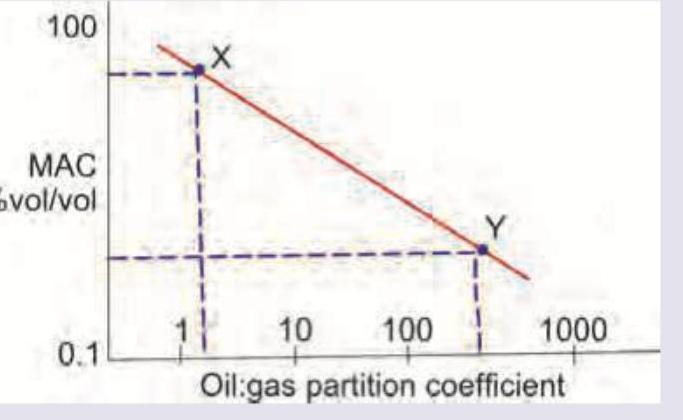
Explanation: **Explanation:** The correct answer is **Minimum Alveolar Concentration (MAC)**. **1. Why it is correct:** MAC is the standard measure of potency for inhalation anesthetics. It is defined as the concentration of the vapor in the lungs (alveoli) that is needed to prevent movement (immobility) in 50% of subjects in response to a surgical (painful) stimulus, such as a skin incision. It is analogous to the $ED_{50}$ (median effective dose) of a drug. MAC is inversely proportional to potency; therefore, an agent with a lower MAC is more potent. **2. Why the other options are incorrect:** * **Minimal analgesic concentration:** This is not a standard pharmacological term in anesthesia. While sub-anesthetic doses provide analgesia, MAC specifically measures the motor response (immobility). * **Minimal anesthetic concentration:** This is a distractor term. While it sounds similar, the formal scientific nomenclature specifically uses the word "Alveolar" because alveolar concentration reflects the partial pressure of the gas in the brain at equilibrium. * **Maximum alveolar concentration:** This term does not exist in anesthesia. MAC always refers to the "Minimum" required dose to achieve the desired effect. **3. High-Yield Clinical Pearls for NEET-PG:** * **MAC-Awake:** The concentration at which 50% of patients will respond to simple verbal commands (usually ~0.3–0.4 MAC). * **MAC-BAR:** The concentration required to "Blunt Autonomic Response" to surgical incision (usually ~1.7–2.0 MAC). * **Factors increasing MAC (Need more drug):** Hyperthermia, hypernatremia, chronic alcohol abuse, and increased central neurotransmitters (e.g., cocaine/amphetamine use). * **Factors decreasing MAC (Need less drug):** Hypothermia, hyponatremia, pregnancy, old age, acute alcohol intoxication, and concurrent use of opioids or benzodiazepines. * **Meyer-Overton Hypothesis:** States that the potency of an anesthetic (1/MAC) is directly proportional to its lipid solubility (Oil:Gas partition coefficient).
Explanation: **Explanation:** **Rocuronium** is a non-depolarizing neuromuscular blocking agent (NMBA) frequently associated with **pain on injection**, occurring in up to 50–80% of patients when administered in an awake state. The underlying mechanism is attributed to the **low pH (acidic nature)** of the solution (pH ~4) and the release of local mediators like kinins, which irritate the venous nociceptors. This is a high-yield clinical point because the pain can cause "withdrawal movements" of the limb, which may be mistaken for inadequate anesthesia depth. **Analysis of Options:** * **Succinylcholine (Option A):** While it causes postoperative **myalgia** (muscle soreness) due to fasciculations, it does not typically cause acute pain at the IV site during the injection itself. * **Vecuronium (Option B):** It is nearly pH-neutral when reconstituted and is not associated with significant injection site pain or histamine release. * **Pancuronium (Option D):** A long-acting NMBA that is generally painless on injection. Its primary side effect is tachycardia due to its vagolytic action. **High-Yield Clinical Pearls for NEET-PG:** * **Mitigation:** Injection pain from Rocuronium can be reduced by pre-administering IV Lidocaine or using a larger vein. * **Rocuronium** has the fastest onset among non-depolarizing NMBAs, making it the drug of choice for **Rapid Sequence Induction (RSI)** when Succinylcholine is contraindicated. * **Sugammadex** is the specific reversal agent for Rocuronium and Vecuronium. * **Histamine Release:** Unlike Rocuronium, older agents like **Atracurium** and **Mivacurium** are more likely to cause systemic histamine release (flushing, hypotension, bronchospasm).
Explanation: **Explanation:** **1. Why Hypothalamus is Correct:** The **Hypothalamus** is the primary thermoregulatory center of the body. It acts as a biological thermostat, receiving sensory input from peripheral and central thermoreceptors. Specifically, the **Pre-optic area** of the anterior hypothalamus coordinates the body's response to cold. Shivering is an involuntary myogenic oscillation intended to increase heat production. General anesthetics (and neuraxial anesthesia) significantly impair thermoregulation by inhibiting the hypothalamus, lowering the threshold for shivering, and causing vasodilation. Therefore, the suppression of hypothalamic function is the direct cause of abolished or altered shivering responses during anesthesia. **2. Why Other Options are Incorrect:** * **B. Thalamus:** Acts as the primary relay station for sensory information (except smell) to the cerebral cortex but does not coordinate autonomic thermoregulatory responses like shivering. * **C. Cerebral Cortex:** Responsible for higher-order functions, consciousness, and voluntary motor control. While it mediates voluntary responses to cold (e.g., putting on a jacket), it does not control the involuntary shivering reflex. * **D. Medulla:** Contains vital centers for respiratory and cardiovascular control (vasomotor center) but is not the primary site for temperature regulation. **3. Clinical Pearls for NEET-PG:** * **Post-Anesthetic Shivering (PAS):** The most common cause is intraoperative hypothermia. The drug of choice for treating PAS is **Pethidine (Meperidine)**, as it lowers the shivering threshold more than other opioids. * **Inhalational Anesthetics:** All potent volatile agents (e.g., Sevoflurane, Isoflurane) produce a dose-dependent decrease in the threshold for vasoconstriction and shivering. * **Hypothermia Triad:** Remember the "Triad of Death" in trauma/surgery: Hypothermia, Acidosis, and Coagulopathy. Control of the hypothalamus via warming measures is crucial to prevent this.
Explanation: **Explanation:** **1. Why Option C is the correct answer (The "NOT" statement):** Sevoflurane, like all potent volatile halogenated inhalational anesthetics (e.g., Halothane, Isoflurane, Desflurane) and the depolarizing muscle relaxant Succinylcholine, is a **known trigger for Malignant Hyperthermia (MH)**. In genetically susceptible individuals with a mutation in the ryanodine receptor (RYR1), sevoflurane causes an uncontrolled release of calcium from the sarcoplasmic reticulum, leading to a hypermetabolic state. Therefore, it is **absolutely contraindicated** in patients with a history of MH. **2. Analysis of Incorrect Options:** * **Option A:** Sevoflurane is the **agent of choice for pediatric induction** because it has a non-pungent odor, is non-irritating to the airway (low risk of laryngospasm), and has a low blood-gas partition coefficient (0.65), allowing for rapid induction and recovery. * **Option B:** When sevoflurane reacts with dry carbon dioxide absorbents (specifically those containing Potassium or Sodium Hydroxide like Sodalime), it undergoes degradation to form **Compound A** (fluoromethyl-2,2-difluoro-1-(trifluoromethyl) vinyl ether), which is nephrotoxic in rat models. * **Option D:** While sevoflurane is generally cardiovascularly stable, it can cause a dose-dependent decrease in blood pressure and a **reflex increase in heart rate (tachycardia)**, especially at higher concentrations (>1.5 MAC). **High-Yield NEET-PG Pearls:** * **Blood-Gas Partition Coefficient:** 0.65 (Fast induction/emergence). * **MAC (Minimum Alveolar Concentration):** ~2% in oxygen. * **Metabolism:** Approximately 5-8% (higher than Isoflurane/Desflurane), releasing inorganic fluoride ions. * **Clinical Caution:** To prevent Compound A accumulation, it is recommended to maintain a fresh gas flow of at least **1-2 Liters/min**.
History of Anesthesia
Practice Questions
Preoperative Evaluation
Practice Questions
Pharmacology of Inhalational Anesthetics
Practice Questions
Pharmacology of Intravenous Anesthetics
Practice Questions
Neuromuscular Blocking Agents
Practice Questions
Airway Management
Practice Questions
Endotracheal Intubation
Practice Questions
Difficult Airway Algorithms
Practice Questions
Intraoperative Monitoring
Practice Questions
Depth of Anesthesia Monitoring
Practice Questions
Emergence from Anesthesia
Practice Questions
Postoperative Care
Practice Questions
Get full access to all questions, explanations, and performance tracking.
Start For Free