Which type of anesthesia is preferred for nasal septoplasty?
Which of the following drugs inhibits the enzyme 11-beta-hydroxylase responsible for cortisol synthesis?
Which intravenous anesthetic agent has a high incidence of psychomimetic reactions during the early recovery period?
Propofol causes pain on injection. Which of the following statements is incorrect?
The action of intravenous thiopentone is terminated by which mechanism?
Which of the following neuromuscular blocking agents can be safely administered to a patient with combined hepatic and renal failure?
Which of the following is associated with highly lipid-soluble anesthetic agents?
All of the following except one affect the minimum alveolar concentration (MAC)?
Which agent potentiates the action of succinylcholine?
Which of the following inhalational anesthetics is known for smooth induction?
Explanation: **Explanation:** **General Anesthesia (GA)** is the preferred choice for nasal septoplasty primarily due to **airway protection**. The nasal cavity is highly vascular; during surgery, there is a significant risk of blood, bone fragments, or irrigation fluid trickling down into the oropharynx. GA with a **cuffed endotracheal tube** and a **throat pack** prevents pulmonary aspiration and ensures a secure, controlled airway. Additionally, GA allows for controlled hypotension if needed to minimize intraoperative bleeding and provides a motionless field for the surgeon. **Why other options are incorrect:** * **Local Infiltration:** While local anesthesia (with vasoconstrictors like adrenaline) is almost always used *in conjunction* with GA to reduce bleeding and provide post-operative analgesia, it is rarely used alone. It does not protect the airway from aspiration and can be distressing for the patient due to the sensation of bone manipulation. * **Propofol Sedation:** Conscious sedation or Monitored Anesthesia Care (MAC) is risky for endonasal surgeries. Sedation can depress laryngeal reflexes without providing a sealed airway, significantly increasing the risk of **laryngospasm** or aspiration of blood. * **No Anesthesia:** Septoplasty involves the manipulation of sensitive mucosal tissues and the resection of cartilaginous/bony structures, making it impossible to perform without anesthesia. **High-Yield Clinical Pearls for NEET-PG:** * **Cocaine 4%:** Often used topically in nasal surgery for its unique dual property of being a potent local anesthetic and a vasoconstrictor (blocks NE reuptake). * **Moffett’s Solution:** A common cocktail used for nasal decongestion/analgesia (includes Cocaine, Adrenaline, and Sodium Bicarbonate). * **Post-op Care:** Always remember to **remove the throat pack** before extubation to prevent acute airway obstruction. * **Extubation:** Patients should be extubated when fully awake to ensure the return of protective airway reflexes.
Explanation: ### Explanation **Correct Answer: C. Etomidate** **Mechanism of Action:** Etomidate is a carboxylated imidazole derivative used for the induction of general anesthesia. Its most characteristic side effect is the **dose-dependent inhibition of the enzyme 11-beta-hydroxylase**. This enzyme is essential for converting 11-deoxycortisol to cortisol and 11-deoxycorticosterone to aldosterone in the adrenal cortex. Even a single induction dose can suppress adrenocortical function for 6–24 hours, making it potentially hazardous for patients with sepsis or those requiring a sustained stress response. **Analysis of Incorrect Options:** * **A. Thiopentone:** A barbiturate that acts by increasing the duration of GABA-A receptor opening. It does not interfere with steroidogenesis but is known for causing histamine release and dose-dependent cardiovascular depression. * **B. Propofol:** An isopropylphenol that enhances GABAergic transmission. While it causes significant hypotension (vasodilation), it has no inhibitory effect on adrenal enzymes. * **C. Ketamine:** A phencyclidine derivative that acts as an NMDA receptor antagonist. It is unique for its sympathomimetic effects (increasing BP and HR) and does not inhibit cortisol synthesis. **High-Yield Clinical Pearls for NEET-PG:** * **Drug of Choice:** Etomidate is the induction agent of choice for **hemodynamically unstable patients** (e.g., shock, severe cardiovascular disease) because it has minimal effects on heart rate and blood pressure. * **Myoclonus:** Etomidate is frequently associated with excitatory movements (myoclonus) during induction, which can be prevented by premedication with opioids or benzodiazepines. * **PONV:** It has a high incidence of Postoperative Nausea and Vomiting (PONV). * **Avoidance:** Due to adrenal suppression, it is generally avoided as a continuous infusion in the ICU.
Explanation: **Explanation:** **Ketamine** is the correct answer because it is a "dissociative anesthetic" that acts primarily as an NMDA receptor antagonist. The high incidence of psychomimetic reactions (10–30%) during the early recovery period is known as **Emergence Delirium**. Patients may experience vivid dreams, hallucinations, sensory distortions, and feelings of floating or detachment. These reactions occur because ketamine depresses the thalamocortical system while stimulating parts of the limbic system. **Analysis of Incorrect Options:** * **Thiopentone:** A short-acting barbiturate that primarily causes CNS depression via GABA-A receptors. Its recovery is usually smooth, though it can cause a "hangover" effect due to its high lipid solubility and redistribution. * **Propofol:** Known for its "anti-emetic" properties and rapid, clear-headed recovery. It often produces a sense of well-being or euphoria, making it the drug of choice for day-care surgery. * **Etomidate:** An imidazole derivative used for hemodynamically unstable patients. Its main side effects are pain on injection, myoclonus, and adrenocortical suppression, rather than psychomimetic reactions. **High-Yield Clinical Pearls for NEET-PG:** * **Prevention:** Emergence delirium from Ketamine can be significantly reduced by pre-medicating the patient with **Benzodiazepines** (e.g., Midazolam). * **Contraindications:** Ketamine should be avoided in patients with schizophrenia, uncontrolled hypertension, and increased intraocular pressure. * **The "L" Effect:** Ketamine is the only IV anesthetic that is a potent **analgesic**, causes **bronchodilation**, and stimulates the **sympathetic** nervous system (increasing HR and BP).
Explanation: **Explanation:** Propofol is a highly lipophilic drug formulated in an emulsion (10% soybean oil, 2.25% glycerol, and 1.2% egg lecithin). Pain on injection is a common side effect, occurring in 30–70% of patients. **Why Option B is Incorrect (The Correct Answer):** The pain associated with propofol is **not** due to crystallization or the egg lecithin component. Egg lecithin serves as an emulsifying agent to keep the drug in solution. The actual mechanism of pain is two-fold: 1. **Immediate phase:** Direct activation of **TRPA1 receptors** (transient receptor potential vanilloid 1) on nociceptors. 2. **Delayed phase:** Activation of the **Kallikrein-Kinin system**, which releases bradykinin, causing vasodilation and hyperpermeability, thereby increasing the contact between the aqueous phase propofol and free nerve endings. **Analysis of Other Options:** * **Option A:** Correct statement. As mentioned above, the release of bradykinin via the kallikrein pathway is a primary mediator of delayed injection pain. * **Option C:** Correct statement. Adding **1% preservative-free lignocaine** (0.1 mg/kg) to the propofol syringe or pre-treating the vein with lignocaine is a standard clinical practice to reduce pain by stabilizing the nerve membrane. * **Option D:** Correct statement. Injecting into **larger, more proximal veins** (e.g., antecubital fossa) rather than small hand veins significantly reduces the incidence of pain due to rapid dilution and less contact time with the vessel wall. **High-Yield Clinical Pearls for NEET-PG:** * **Propofol Infusion Syndrome (PRIS):** Characterized by metabolic acidosis, rhabdomyolysis, hyperkalemia, and cardiac failure (associated with high doses >4mg/kg/hr). * **Egg/Soy Allergy:** While propofol contains egg lecithin (derived from yolk), most egg allergies are to egg albumin (white). However, caution is traditionally advised. * **Other methods to reduce pain:** Cooling the propofol, using Fospropofol (a prodrug), or prior administration of opioids (Fentanyl).
Explanation: **Explanation:** The termination of action of intravenous **Thiopentone Sodium** (an ultra-short-acting barbiturate) is primarily due to **Redistribution**, not metabolism or excretion. **1. Why Redistribution is Correct:** Thiopentone is highly lipid-soluble. Upon intravenous injection, it rapidly reaches the brain (a vessel-rich organ), leading to the rapid induction of anesthesia (within 30–60 seconds). However, as plasma levels fall, the drug quickly moves out of the brain and "redistributes" into less vascular but high-capacity tissues like **skeletal muscle** and eventually **adipose tissue**. This drop in brain concentration causes the patient to regain consciousness within 5–10 minutes, long before the drug is actually metabolized. **2. Why Incorrect Options are Wrong:** * **Oxidation & Conjugation (B & D):** While Thiopentone is eventually metabolized by the liver (via oxidation), this process is slow (approx. 10–15% per hour). Metabolism is responsible for the ultimate clearance of the drug from the body, but not for the initial recovery from anesthesia. * **Rapid Renal Excretion (A):** Thiopentone is highly protein-bound and lipid-soluble; it undergoes extensive tubular reabsorption. Very little is excreted unchanged in the urine. **High-Yield Clinical Pearls for NEET-PG:** * **Context-Sensitive Half-life:** Thiopentone has a long elimination half-life. With repeated doses or continuous infusion, the "buffer" tissues (muscle/fat) become saturated, leading to a prolonged recovery time (Hangover effect). * **Storage:** It is stored as a yellow powder in an atmosphere of **Nitrogen**; it is mixed with **6% Sodium Carbonate** to prevent precipitation by atmospheric $CO_2$. * **Contraindication:** Absolutely contraindicated in **Porphyria** (induces ALA synthetase). * **Accidental Intra-arterial Injection:** Leads to intense vasoconstriction and gangrene. Treatment includes Heparin, Papaverine, and Lidocaine (to vasodilate) or a Brachial plexus block.
Explanation: ### Explanation The correct answer is **Atracurium**. #### Why Atracurium is the Correct Choice The primary challenge in patients with combined hepatic and renal failure is the inability to metabolize and excrete drugs through traditional organ-dependent pathways. Atracurium (and its isomer Cisatracurium) is unique because it undergoes **Hofmann Elimination** and **Ester Hydrolysis**. * **Hofmann Elimination:** A spontaneous, non-enzymatic degradation that occurs at physiological pH and temperature. * **Ester Hydrolysis:** Breakdown by non-specific plasma esterases. Because these processes are independent of liver and kidney function, the duration of action remains predictable even in multi-organ failure. #### Why Other Options are Incorrect * **Vecuronium:** Primarily undergoes hepatic metabolism and biliary excretion (approx. 40-50%) with significant renal clearance. Its duration is prolonged in both liver and kidney disease. * **Pancuronium:** A long-acting relaxant primarily excreted unchanged by the kidneys (up to 80%). It is strictly contraindicated in renal failure due to the risk of profound "recurarization." * **Mivacurium:** While metabolized by plasma cholinesterase, its clearance is significantly delayed in patients with liver disease (due to decreased enzyme production) and renal failure. #### High-Yield Clinical Pearls for NEET-PG * **Cisatracurium** is more potent than atracurium and produces less **Laudanosine** (a metabolite of atracurium that can cause CNS excitation/seizures) and less histamine release. * **Drug of Choice:** For renal/hepatic failure, Cisatracurium is often preferred over Atracurium due to its better side-effect profile, though both use Hofmann elimination. * **Temperature/pH Sensitivity:** Since Hofmann elimination is temperature and pH-dependent, the block may last longer in patients with **hypothermia** or **acidosis**.
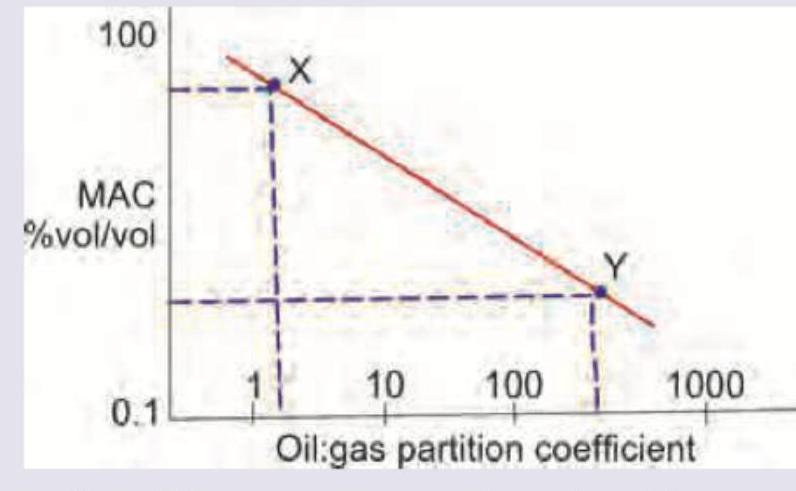
Explanation: ### Explanation The correct answer is **A. Potent anesthetic action**. This question is based on the **Meyer-Overton Hypothesis**, which states that the potency of an anesthetic agent is directly proportional to its lipid solubility. 1. **Why Option A is correct:** The primary site of action for general anesthetics is the lipid bilayer of neuronal membranes or hydrophobic pockets of membrane proteins. Agents with high lipid solubility (measured by the **Oil:Gas Partition Coefficient**) can easily cross the blood-brain barrier and concentrate in the neuronal lipids. Therefore, the higher the lipid solubility, the lower the **Minimum Alveolar Concentration (MAC)** required to produce anesthesia, signifying higher potency. 2. **Why other options are incorrect:** * **B. Potent analgesic action:** Analgesia is a specific component of anesthesia. While some potent agents (like Methoxyflurane) have analgesic properties, others (like Halothane) are potent anesthetics but poor analgesics. * **C. Excellent muscle relaxant action:** Most volatile anesthetics provide some degree of skeletal muscle relaxation, but this is not directly proportional to lipid solubility. Neuromuscular blockers are required for "excellent" relaxation. * **D. Least respiratory depression:** In fact, most potent inhalational anesthetics (except Ketamine and Ether) typically cause dose-dependent respiratory depression. ### High-Yield NEET-PG Pearls: * **Potency ∝ Lipid Solubility** (Meyer-Overton Rule). * **Potency ∝ 1 / MAC** (Lower MAC = Higher Potency). * **Speed of Induction ∝ 1 / Blood:Gas Partition Coefficient** (Lower solubility in blood = Faster induction and recovery). * **Most Potent Inhalational Agent:** Methoxyflurane (Lowest MAC). * **Least Potent Inhalational Agent:** Nitrous Oxide (Highest MAC).
Explanation: **Explanation:** The **Minimum Alveolar Concentration (MAC)** is the concentration of an inhaled anesthetic at 1 atmosphere (760 mmHg) that prevents skeletal muscle movement in response to a noxious stimulus in 50% of patients. It is a measure of anesthetic **potency**. **Why Altitude is the Correct Answer:** Altitude (barometric pressure) does **not** affect the MAC of an inhalational agent. While the *partial pressure* required to achieve anesthesia remains constant, the *percentage* concentration (MAC) does not change with changes in ambient pressure. For example, if an agent has a MAC of 1% at sea level, it remains 1% at high altitude, even though the total barometric pressure is lower. **Analysis of Other Options:** * **Age (B):** MAC is highest at 6 months of age and decreases progressively with increasing age (decreases by ~6% per decade after age 20). * **Premedication (A) & Drugs (D):** Most CNS depressants decrease MAC. This includes opioids, benzodiazepines, alpha-2 agonists (clonidine, dexmedetomidine), and acute ethanol ingestion. Conversely, drugs that increase central neurotransmitters (like cocaine or amphetamines) increase MAC. **High-Yield Clinical Pearls for NEET-PG:** * **Factors Increasing MAC:** Hyperthermia, hypernatremia, chronic alcohol abuse, and red hair (MC1R gene mutation). * **Factors Decreasing MAC:** Hypothermia, hyponatremia, pregnancy (decreases by 30-40%), anemia (Hb <5g/dL), and metabolic acidosis. * **Factors with NO effect on MAC:** Duration of anesthesia, gender, thyroid status (hypo/hyper), and **altitude/barometric pressure**. * **MAC-awake:** Usually 0.3–0.5 MAC; **MAC-BAR** (Blunt Autonomic Response): Usually 1.5–2.0 MAC.
Explanation: ### Explanation The correct answer is **Nitrous oxide (A)**. **Why Nitrous Oxide is Correct:** Succinylcholine is a depolarizing neuromuscular blocker (DNMB) that works by mimicking acetylcholine at the nicotinic receptors of the motor endplate. While most volatile anesthetic agents (like Sevoflurane, Isoflurane, and Halothane) significantly potentiate **non-depolarizing** muscle relaxants (NDMRs) by decreasing post-junctional membrane sensitivity, they have a negligible or even antagonistic effect on succinylcholine. In contrast, **Nitrous oxide ($N_2O$)** is known to potentiate the neuromuscular blockade produced by succinylcholine. This occurs primarily through a synergistic effect on the muscle spindle and a slight enhancement of the depolarizing block at the motor endplate, although the clinical significance is often less pronounced than the potentiation seen with NDMRs. **Why Other Options are Incorrect:** * **B, C, and D (Sevoflurane, Isoflurane, Halothane):** These are potent volatile halogenated ethers/alkanes. Their primary interaction with muscle relaxants is the potentiation of **Non-Depolarizing** agents (e.g., Vecuronium, Rocuronium) by approximately 20-30%. They do not significantly potentiate the initial phase of a succinylcholine block; in some clinical scenarios, they may even slightly shorten the duration of action of succinylcholine. **NEET-PG High-Yield Pearls:** * **Order of Potentiation of NDMRs:** Desflurane > Sevoflurane > Isoflurane > Halothane > $N_2O$. * **Succinylcholine Metabolism:** It is metabolized by **Pseudocholinesterase** (Butyrylcholinesterase). * **Phase II Block:** Prolonged exposure to succinylcholine can lead to a Phase II block, which resembles a non-depolarizing block and can be reversed by anticholinesterases (though this is risky). * **Contraindication:** Succinylcholine is strictly contraindicated in patients with burns, massive trauma, or upper motor neuron lesions due to the risk of **hyperkalemia**.
Explanation: **Explanation:** The smoothness of induction with an inhalational anesthetic is primarily determined by its **irritability to the airways** (pungency) and its **blood-gas solubility**. **Why Isoflurane is the Correct Answer:** Isoflurane is characterized by its relatively low blood-gas partition coefficient (1.4), which allows for a faster rise in alveolar concentration compared to older agents. While it has a mildly pungent odor, in the context of this specific question (comparing it to Ether, Halothane, and Enflurane), it is clinically favored for its stability and predictable induction profile. *Note: In modern practice, Sevoflurane is the gold standard for smooth mask induction due to its non-pungency; however, among the provided options, Isoflurane is the preferred choice.* **Analysis of Incorrect Options:** * **A. Ether:** Highly irritating to the respiratory tract. It causes significant salivation, coughing, and laryngospasm, making induction prolonged and "stormy." * **B. Halothane:** While non-pungent and historically used for pediatric induction, it is associated with "Halothane Hepatitis" and sensitizes the myocardium to catecholamines, leading to arrhythmias. It is no longer the first choice for "smooth" induction in modern exams. * **D. Enflurane:** It is pungent and can trigger seizure-like activity (epileptiform EEG) at high concentrations, making it unsuitable for a smooth, safe induction. **High-Yield NEET-PG Pearls:** * **Sevoflurane:** The agent of choice for **pediatric mask induction** (sweet-smelling, non-pungent). * **Desflurane:** The most pungent agent; cannot be used for induction as it causes breath-holding and laryngospasm. * **Nitrous Oxide:** Has the lowest potency (MAC 104%) but the fastest induction due to the **Second Gas Effect**. * **Induction Speed:** Inversely proportional to the blood-gas solubility (Lower solubility = Faster induction).
History of Anesthesia
Practice Questions
Preoperative Evaluation
Practice Questions
Pharmacology of Inhalational Anesthetics
Practice Questions
Pharmacology of Intravenous Anesthetics
Practice Questions
Neuromuscular Blocking Agents
Practice Questions
Airway Management
Practice Questions
Endotracheal Intubation
Practice Questions
Difficult Airway Algorithms
Practice Questions
Intraoperative Monitoring
Practice Questions
Depth of Anesthesia Monitoring
Practice Questions
Emergence from Anesthesia
Practice Questions
Postoperative Care
Practice Questions
Get full access to all questions, explanations, and performance tracking.
Start For Free