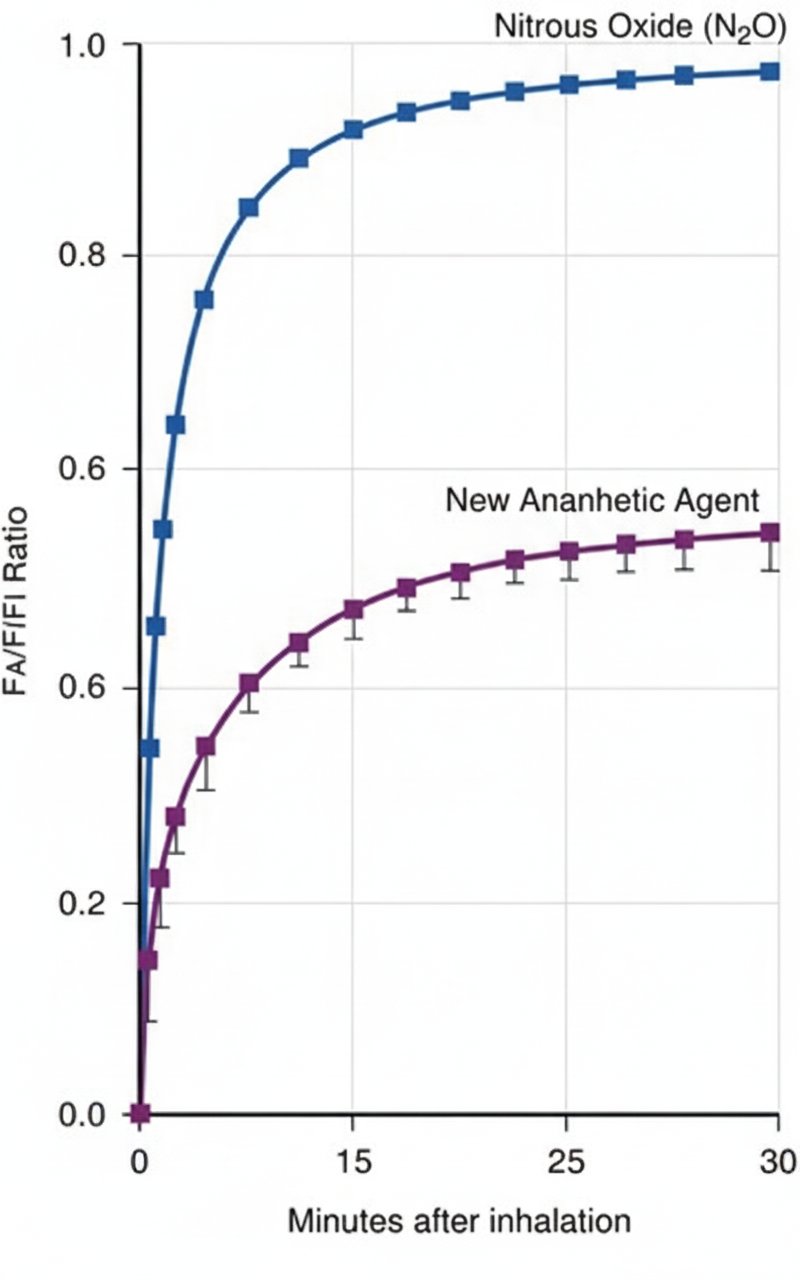
Which of the following increases the speed of induction with an inhalational agent?
True regarding Nitrous oxide is:
Which of the following is a contraindication in closed-system anesthesiology?
What is the typical percentage of thiopentone used for induction?
What is the recommended dose of thiopentone to prevent arterial spasm following intra-arterial injection?
All of the following factors decrease the minimum alveolar concentration (MAC) of an inhalational anesthetic agent except?
Which of the following is NOT a side effect of succinylcholine?
Which of the following is the neuromuscular blocking agent with the shortest onset of action?
Which intravenous anesthetic agent is metabolized by pseudocholinesterase?
Dextran is a good plasma expander, but what is its disadvantage?
Explanation: **Explanation:** The speed of induction of an inhalational anesthetic is determined by the rate at which the **alveolar partial pressure (PA)** approaches the **inspired partial pressure (PI)**. The faster PA rises, the faster the blood and brain partial pressures equilibrate, leading to anesthesia. **Why Option B is Correct:** **Increased Alveolar Ventilation (VA)** rapidly replaces the functional residual capacity (FRC) with the anesthetic gas. By continuously replenishing the alveoli with fresh gas, it offsets the uptake of the drug into the blood, maintaining a high concentration gradient. This accelerates the rise in $F_A/F_I$ ratio, thereby increasing the speed of induction. This effect is most pronounced for agents with **high blood solubility** (e.g., Halothane). **Analysis of Incorrect Options:** * **A. Opiate Premedication:** While opiates reduce the MAC (Minimum Alveolar Concentration) and provide analgesia, they cause **respiratory depression**. Decreased ventilation slows the delivery of the agent to the alveoli, thereby slowing induction. * **C. Increased Cardiac Output (CO):** An increase in CO removes more anesthetic from the alveoli into the systemic circulation. This "washes away" the agent from the lungs, slowing the rise of alveolar partial pressure and **delaying induction**. (Conversely, low CO/shock speeds up induction). * **D. Reduced $FIO_2$:** Reducing the fraction of inspired oxygen does not directly increase the rate of rise of anesthetic partial pressure. In fact, the **Concentration Effect** and **Second Gas Effect** (usually involving Nitrous Oxide) are what accelerate induction, not hypoxia. **High-Yield Clinical Pearls for NEET-PG:** * **Solubility Rule:** The speed of induction is **inversely proportional** to the blood-gas partition coefficient. (Desflurane = Fastest; Halothane = Slowest). * **Ventilation Effect:** Most significant for **soluble** agents. * **Cardiac Output Effect:** Most significant for **soluble** agents. * **V/Q Mismatch:** A right-to-left shunt slows induction because it dilutes the arterial concentration of the anesthetic.
Explanation: **Explanation:** **Nitrous Oxide ($N_2O$)** is a commonly used inhalational anesthetic with unique pharmacological properties. **1. Why Option B is Correct:** Nitrous oxide significantly **blunts the peripheral chemoreceptor response to arterial hypoxia**. Even at sub-anesthetic concentrations (0.1 MAC), it can reduce the ventilatory drive to hypoxia by up to 50-70%. This is clinically significant during recovery (emergence), as patients may not increase their breathing adequately if they become hypoxic. **2. Why the other options are Incorrect:** * **Option A:** $N_2O$ is stored in **blue cylinders** as a **liquid under pressure** (745 psi/51 bar). It is not stored as a gas at room temperature within the cylinder; it only vaporizes as it is released. * **Option C:** $N_2O$ is **non-inflammable and non-explosive**. However, it is a **supporter of combustion** (like oxygen), meaning it can intensify an existing fire. * **Option D:** $N_2O$ is an **incomplete anesthetic**. It has a very high MAC (Minimum Alveolar Concentration) of **104%**, meaning it cannot produce surgical anesthesia on its own at atmospheric pressure without causing hypoxia. It is primarily used for its potent analgesic properties and as an adjunct to other agents. **High-Yield Clinical Pearls for NEET-PG:** * **Second Gas Effect:** $N_2O$ speeds up the induction of a co-administered volatile anesthetic. * **Diffusion Hypoxia (Fink Effect):** Occurs at the end of surgery when $N_2O$ rushes out of the blood into the alveoli, diluting oxygen. Prevented by giving **100% $O_2$ for 5-10 minutes** after stopping $N_2O$. * **Closed Spaces:** $N_2O$ is 34 times more soluble than Nitrogen; it diffuses into air-filled cavities (e.g., pneumothorax, middle ear, bowel obstruction), causing them to expand. It is **contraindicated** in these conditions. * **Vitamin B12:** Chronic exposure inhibits **Methionine Synthase**, leading to megaloblastic anemia and peripheral neuropathy.
Explanation: **Explanation:** The correct answer is **Sevoflurane**. **Why Sevoflurane is the correct answer:** In a closed-system anesthesia setup, exhaled gases are recirculated through a carbon dioxide (CO2) absorber (containing Soda Lime or Baralyme). Sevoflurane is chemically unstable in the presence of strong bases found in these absorbers. It undergoes degradation to form a haloalkene derivative known as **Compound A**. In animal studies, Compound A has been shown to be **nephrotoxic**. While its clinical significance in humans remains debated, the risk increases with low fresh gas flows (FGF), high concentrations of Sevoflurane, and dry/warm CO2 absorbers. Therefore, Sevoflurane is generally contraindicated or restricted in strictly closed-circuit systems (FGF < 1 L/min). **Why other options are incorrect:** * **Methoxyflurane:** While it is nephrotoxic due to the release of inorganic fluoride ions, its toxicity is dose-dependent and not specifically related to the CO2 absorber interaction in a closed circuit. * **Isoflurane and Desflurane:** These are highly stable agents. They do not react with CO2 absorbers to produce toxic metabolites like Compound A. However, they can produce **Carbon Monoxide (CO)** if the soda lime is completely desiccated (dry), but they are not contraindicated in standard closed systems. **High-Yield NEET-PG Pearls:** * **Compound A:** Produced by Sevoflurane + Soda Lime. * **Carbon Monoxide (CO):** Produced by Desflurane > Enflurane > Isoflurane when used with **dry** soda lime. * **Soda Lime Composition:** 94% Calcium hydroxide, 5% Sodium hydroxide, and 1% Potassium hydroxide (the main catalyst for Compound A formation). * **Safety Tip:** To minimize Compound A, the FDA recommends a minimum fresh gas flow of 1 L/min for up to 2 exposure hours and 2 L/min for longer durations when using Sevoflurane.
Explanation: **Explanation:** Thiopentone sodium is a short-acting barbiturate used primarily for the induction of general anesthesia. The standard concentration used for intravenous induction in clinical practice is **2.5%**. **Why 2.5% is the Correct Answer:** At a 2.5% concentration, thiopentone provides a reliable and rapid onset of unconsciousness (within 30–45 seconds) while maintaining a pH that is alkaline (pH ~10.5). This specific concentration is chosen to balance efficacy with safety. It is prepared by dissolving 500 mg of thiopentone powder in 20 ml of sterile water (500mg/20ml = 25mg/ml, which equals 2.5%). **Analysis of Incorrect Options:** * **0.5% and 1.5% (Options A & B):** These concentrations are too dilute for standard induction. Using such low concentrations would require injecting a very large volume of fluid to achieve the induction dose (3–5 mg/kg), which is clinically impractical. * **4.5% or 5% (Option D):** Historically, a 5% concentration was used. However, it was abandoned because it is highly hypertonic and strongly alkaline. Higher concentrations significantly increase the risk of severe tissue necrosis and gangrene if accidental intra-arterial injection occurs, and they cause a higher incidence of thrombophlebitis. **High-Yield Clinical Pearls for NEET-PG:** * **Mechanism:** Acts on the GABA-A receptor complex, increasing the duration of chloride channel opening. * **Metabolism:** Rapid awakening after a single bolus is due to **redistribution** from the brain to muscle and fat, not metabolism. * **Contraindication:** Absolutely contraindicated in **Porphyria** (induces ALA synthetase). * **Management of Intra-arterial Injection:** If accidental injection occurs, leave the needle in place and inject vasodilators (e.g., Papaverine, Lidocaine, or Priscoline) or perform a Stellate Ganglion block to prevent vasospasm and gangrene.
Explanation: Thiopentone sodium is an ultra-short-acting barbiturate used for the induction of anesthesia. The standard clinical concentration used is **2.5%**. ### **Why 2.5% is the Correct Answer** Accidental intra-arterial injection of thiopentone is a medical emergency. Thiopentone is highly alkaline (pH 10.5). When injected into an artery, it reacts with blood to form **crystals**, which cause intense chemical endarteritis, severe vasospasm, and subsequent thrombosis. * **The 2.5% concentration** is the maximum recommended clinical concentration because it is less likely to cause permanent tissue damage or gangrene compared to higher concentrations. It is isotonic and less irritating to the vessel wall. ### **Analysis of Incorrect Options** * **Option A (5%):** Historically, 5% thiopentone was used, but it was abandoned because it is highly hypertonic and significantly increases the risk of severe arterial spasm, thrombosis, and limb gangrene if accidentally injected intra-arterially. * **Options C & D (2% and 1.5%):** While lower concentrations are safer, they are not the standard clinical preparation for thiopentone induction. 2.5% is the established "gold standard" concentration that balances efficacy with safety. ### **High-Yield Clinical Pearls for NEET-PG** * **Management of Intra-arterial Thiopentone:** 1. **Leave the needle in situ** to administer drugs. 2. Inject **Vasodilators** (e.g., Papaverine, Procaine, or Lidocaine) to relieve spasm. 3. Perform a **Stellate Ganglion Block** or Brachial Plexus block to cause sympathetic washout and vasodilation. 4. **Heparinization** to prevent thrombosis. * **Storage:** Thiopentone is stored under **Nitrogen** to prevent reaction with atmospheric CO₂ (which would lower the pH and cause the drug to precipitate). * **Contraindication:** Absolute contraindication in **Porphyria** (induces ALA synthetase).
Explanation: **Explanation:** Minimum Alveolar Concentration (MAC) is the concentration of an inhalational anesthetic at 1 atmosphere that prevents skeletal muscle movement in response to a noxious stimulus in 50% of patients. It is an index of anesthetic potency; factors that **decrease MAC** make the patient more sensitive to anesthesia, while factors that **increase MAC** make them more resistant. **Why Hypocalcemia is the Correct Answer:** Serum calcium levels (whether hypercalcemia or hypocalcemia) do **not** significantly affect MAC. While calcium is vital for neurotransmitter release and muscle contraction, clinical studies have shown that alterations in calcium levels do not consistently alter the requirement for inhalational anesthetics. **Analysis of Incorrect Options (Factors that DO decrease MAC):** * **Hypothermia (A):** For every 10°C drop in core temperature, MAC decreases by approximately 50%. Reduced temperature slows metabolic rate and increases the solubility of the gas. * **Hyponatremia (B):** Low serum sodium levels decrease MAC. Sodium plays a critical role in action potential generation; its depletion reduces neuronal excitability, thereby potentiating anesthesia. * **Anemia (D):** Severe anemia (Hemoglobin < 5 g/dL) decreases MAC because reduced oxygen delivery to the brain enhances the sedative effects of anesthetics. **High-Yield Clinical Pearls for NEET-PG:** * **Factors Increasing MAC:** Hyperthermia, Hypernatremia, Chronic alcoholism, and drugs that increase CNS catecholamines (e.g., Cocaine, Ephedrine, MAO inhibitors). * **Factors Decreasing MAC:** Pregnancy (due to progesterone), Acute alcohol intoxication, Old age, Lithium, and Opioids. * **No Effect on MAC:** Gender, Duration of anesthesia, Thyroid status (unless severely hypothyroid/myxedema), and Hyper/Hypokalemia.
Explanation: **Explanation:** Succinylcholine is a depolarizing neuromuscular blocker that acts as an agonist at the nicotinic acetylcholine receptors (nAChR) at the motor endplate. **Why Tachycardia is the correct answer:** Succinylcholine typically causes **bradycardia**, not tachycardia. This occurs because succinylcholine is structurally two molecules of acetylcholine joined together; it stimulates muscarinic receptors in the sinus node of the heart. This effect is particularly pronounced in children and after a second dose in adults. **Analysis of Incorrect Options:** * **Hyperkalemia:** During prolonged depolarization, potassium ions leak out of the muscle cells into the extracellular fluid. A typical dose increases serum potassium by 0.5 mEq/L, which can be life-threatening in patients with burns, crush injuries, or denervation. * **Increased Intracranial Pressure (ICP):** Succinylcholine causes a transient rise in ICP, likely due to increased muscle afferent activity and cerebral blood flow. This requires caution in patients with head injuries. * **Increased Intragastric Pressure:** Fasciculations of the abdominal wall muscles lead to an increase in intragastric pressure. However, it also increases lower esophageal sphincter tone, usually preventing aspiration. **High-Yield NEET-PG Pearls:** * **Drug of Choice:** Still preferred for **Rapid Sequence Induction (RSI)** due to its rapid onset (30–60s) and short duration (5–10 mins). * **Metabolism:** Metabolized by **Pseudocholinesterase** (Plasma cholinesterase). * **Malignant Hyperthermia:** Succinylcholine is a known triggering agent. * **Masseter Spasm:** An early warning sign of Malignant Hyperthermia. * **Dual Block (Phase II Block):** Occurs with high doses or continuous infusion, where the block takes on characteristics of a non-depolarizing block.
Explanation: **Explanation:** The onset of action of a neuromuscular blocking agent (NMBA) is primarily determined by its **potency** (inverse relationship) and the dose administered. Among the options provided, **Succinylcholine** is traditionally known for the fastest onset (30–60 seconds); however, in the context of non-depolarizing agents or specific comparative MCQ patterns, **Mivacurium** is often highlighted for its unique profile. 1. **Why Mivacurium is the correct answer:** Mivacurium is a short-acting non-depolarizing NMBA. While its onset (2–3 minutes) is slower than Succinylcholine, it is frequently tested as the non-depolarizing agent with a relatively rapid onset and the shortest duration of action (15–20 minutes) because it is metabolized by plasma cholinesterase. 2. **Succinylcholine (Option D):** It is a depolarizing agent with the absolute fastest onset (30–60s). If the question implies non-depolarizing agents or specific clinical scenarios where Succinylcholine is contraindicated, Mivacurium becomes the choice. 3. **Atracurium (Option B):** An intermediate-acting agent with an onset of 3–5 minutes. It is metabolized via Hofmann elimination and ester hydrolysis. 4. **Rapacuronium (Option C):** This was a rapid-onset non-depolarizing agent (60–90s) designed to replace Succinylcholine, but it was withdrawn from the market due to severe bronchospasm. **High-Yield Clinical Pearls for NEET-PG:** * **Fastest Onset (Overall):** Succinylcholine (Depolarizer). * **Fastest Onset (Non-depolarizer):** Rocuronium (at 0.9–1.2 mg/kg dose, it rivals Succinylcholine). * **Shortest Duration:** Succinylcholine, followed by Mivacurium. * **Drug of Choice in Renal/Hepatic Failure:** Atracurium or Cisatracurium (due to Hofmann elimination). * **Mivacurium Metabolism:** Like Succinylcholine, it is metabolized by **Pseudocholinesterase**; hence, its action is prolonged in patients with atypical plasma cholinesterase.
Explanation: **Explanation:** **Correct Answer: A. Propanidid** Propanidid is a derivative of phenylacetic acid and is unique among intravenous induction agents because it is metabolized by **plasma pseudocholinesterase** (butyrylcholinesterase). The ester linkage in its structure is rapidly hydrolyzed, leading to an extremely short duration of action. While it was used for short procedures, it was largely withdrawn from clinical practice due to a high incidence of anaphylactic reactions. **Analysis of Incorrect Options:** * **B. Althesin:** This was a steroidal anesthetic mixture (alphaxalone and alphadolone). It was metabolized primarily by the **liver** (glucuronidation). Like propanidid, it was withdrawn due to Cremophor EL-induced anaphylaxis. * **C. Eltanolone:** Also known as pregnanolone, this is a steroidal anesthetic (a metabolite of progesterone). It undergoes **hepatic metabolism** and was never widely adopted due to side effects like excitatory movements. * **D. Clonidine:** This is an **alpha-2 adrenergic agonist**, not a primary intravenous anesthetic agent. It is metabolized by the **liver** (cytochrome P450 system) and excreted by the kidneys. **High-Yield Clinical Pearls for NEET-PG:** * **Pseudocholinesterase Dependency:** Apart from Propanidid, the most famous drugs metabolized by this enzyme are **Succinylcholine** (depolarizing muscle relaxant) and **Mivacurium** (non-depolarizing relaxant), as well as ester local anesthetics (e.g., Procaine). * **Clinical Significance:** Patients with **pseudocholinesterase deficiency** (atypical enzyme) will show prolonged recovery and apnea when given these drugs. * **Propanidid vs. Thiopental:** Unlike Thiopental, which terminates its action via **redistribution**, Propanidid terminates its action via **rapid metabolism**.
Explanation: **Explanation:** Dextran is a synthetic polysaccharide used as a colloid for volume expansion. The correct answer is **Interference with blood group matching (Option A)**. **Why Option A is correct:** Dextran molecules coat the surface of red blood cells (RBCs). This coating alters the surface charge and physical properties of the RBCs, leading to **pseudo-agglutination**. This phenomenon interferes with the cross-matching process and blood grouping (specifically the Coombs test), making it difficult to find compatible blood for transfusion. Therefore, it is a standard clinical recommendation to draw a blood sample for cross-matching *before* administering Dextran. **Analysis of Incorrect Options:** * **Option B (Thrombocytopenia):** Dextran does not typically cause a decrease in platelet count. However, it does impair platelet *function* (adhesiveness) and reduces Factor VIII/vWF levels, which can lead to increased bleeding tendencies at high doses (>1.5g/kg). * **Option C (Decreases microcirculation):** This is incorrect. Dextran (especially Dextran-40) actually **improves microcirculation** by reducing blood viscosity and preventing RBC aggregation. * **Option D (Promotes rouleaux formation):** This is incorrect. Dextran is known to **decrease rouleaux formation** and sludging of blood, which is why it is used to improve flow in peripheral vascular surgeries. **High-Yield Clinical Pearls for NEET-PG:** * **Anaphylaxis:** Dextran is notorious for causing severe anaphylactoid reactions (due to pre-existing anti-dextran antibodies). * **Renal Failure:** Dextran-40 can precipitate in renal tubules, causing "Dextran-induced acute renal failure," especially in dehydrated patients. * **Maximum Dose:** Limit to 20 ml/kg/day to avoid coagulopathy. * **Dextran-70 vs. Dextran-40:** Dextran-70 is a better volume expander; Dextran-40 is better for improving microcirculation.
History of Anesthesia
Practice Questions
Preoperative Evaluation
Practice Questions
Pharmacology of Inhalational Anesthetics
Practice Questions
Pharmacology of Intravenous Anesthetics
Practice Questions
Neuromuscular Blocking Agents
Practice Questions
Airway Management
Practice Questions
Endotracheal Intubation
Practice Questions
Difficult Airway Algorithms
Practice Questions
Intraoperative Monitoring
Practice Questions
Depth of Anesthesia Monitoring
Practice Questions
Emergence from Anesthesia
Practice Questions
Postoperative Care
Practice Questions
Get full access to all questions, explanations, and performance tracking.
Start For Free