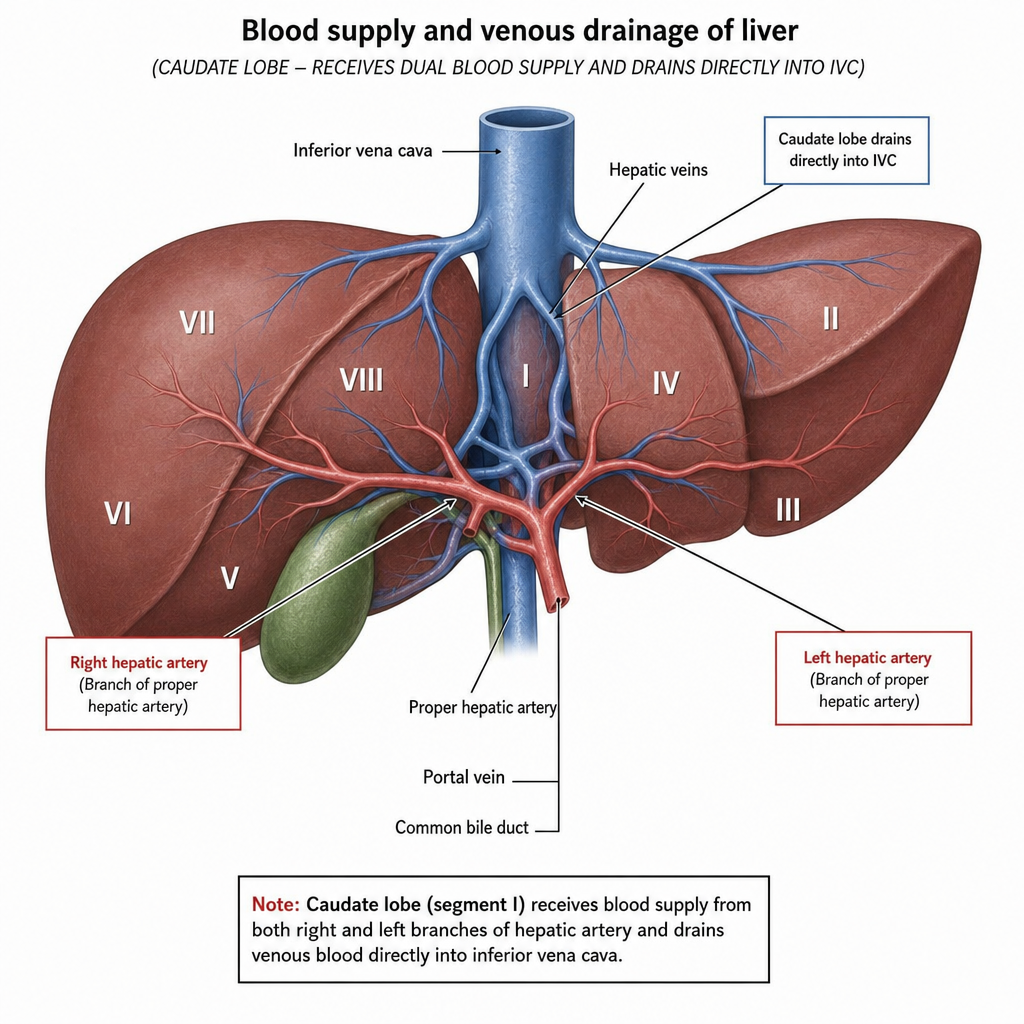
Which one of the following characterizes a portal system of blood vessels?
The mastoid process is which type of epiphysis?
Which of the following muscles with parallel fibers is the exception?
Which of the following statements is NOT TRUE about sesamoid bones?
How many bones constitute the skull?
All of the following statements about the vagus nerve are true EXCEPT:
All of the following statements are true for the metaphysis of bone except:
Which of the following is not a recognised form of epiphysis?
Which of the following is NOT a peripheral lymphoid organ?
What is an example of a syndesmosis type of joint?
Explanation: ### Explanation **Concept Overview:** In a standard circulatory circuit, blood flows from an artery to a capillary bed and then directly into a vein that returns to the heart. A **portal system** is a specialized vascular arrangement where blood passes through **two capillary beds** in series, connected by a larger "portal" vessel, before returning to the systemic venous circulation. **Why Option C is Correct:** The defining feature of a portal system is the presence of a connecting vessel (vein or artery) between two distinct capillary networks. This allows for the direct transport of specific substances (hormones or nutrients) from one organ to another in high concentrations without being diluted in the general circulation. **Analysis of Incorrect Options:** * **Option A:** Describes an **Arteriovenous (AV) Anastomosis** or shunt, where blood bypasses capillaries entirely [1]. * **Option B:** Describes a general vascular pattern but lacks the "serial" capillary bed requirement that defines a portal system. * **Option D:** Capillary beds are organ-specific and do not physically "extend" as a continuous network across different organs; they are linked by larger conducting vessels [1]. **High-Yield NEET-PG Facts:** There are three primary portal systems in the human body: 1. **Hepatic Portal System (Venous):** Connects the intestinal capillaries to the hepatic sinusoids (second capillary bed). *Function: Nutrient processing and detoxification.* 2. **Hypophyseal Portal System (Venous):** Connects the hypothalamus to the anterior pituitary. *Function: Transport of releasing hormones.* 3. **Renal Portal System (Arterial):** The efferent arteriole connects the glomerular capillaries to the peritubular capillaries/vasa recta. *Note: This is an arterial portal system.*
Explanation: **Explanation:** The **mastoid process** is a classic example of a **traction epiphysis**. In anatomy, epiphyses are classified based on their functional role and developmental origin. 1. **Why Traction Epiphysis is Correct:** A traction epiphysis is non-articular and does not contribute to the length of the bone. It develops due to the **mechanical pull (traction) of attached tendons or muscles**. The mastoid process develops postnatally due to the constant pull of the **Sternocleidomastoid muscle** as an infant begins to hold their head up and move. Other common examples include the trochanters of the femur and the tubercles of the humerus. 2. **Analysis of Incorrect Options:** * **Pressure Epiphysis (A):** These are articular and found at the ends of long bones (e.g., head of the femur, lower end of the radius). They transmit the weight of the body and contribute to longitudinal bone growth. * **Atavistic Epiphysis (C):** These represent bones that were phylogenetically independent in lower animals but have become fused to other bones in humans (e.g., the coracoid process of the scapula or the os trigonum of the talus). * **Aberrant Epiphysis (B):** These are deviations from the norm and are not always present (e.g., epiphysis at the head of the first metacarpal or the base of other metacarpals). **High-Yield Clinical Pearls for NEET-PG:** * **Mastoid Development:** The mastoid process is absent at birth. It starts appearing around the **2nd year of life** as the child begins to hold their head up and move. * **Antrum vs. Process:** While the mastoid process is absent at birth, the **mastoid antrum** is present and is almost adult-sized at birth. * **Muscle Attachment:** The primary muscle responsible for the traction on the mastoid process is the **Sternocleidomastoid**, followed by the splenius capitis and longissimus capitis.
Explanation: **Explanation:** The classification of muscles based on fascicular architecture is a high-yield topic in Anatomy. Muscles are categorized by the arrangement of their fibers relative to the axis of force generation. **Why Tibialis Anterior is the Correct Answer:** The **Tibialis Anterior** is a **circumpennate** (or multipennate) muscle, not a parallel-fibered muscle. In pennate muscles, fibers run obliquely to the tendon, similar to the barbs of a feather. This arrangement allows for a higher density of muscle fibers, prioritizing power over the range of motion. **Analysis of Incorrect Options (Parallel-fibered Muscles):** Parallel muscles have fibers that run parallel to the long axis of the muscle, allowing for a greater range of movement. * **Sartorius:** A classic example of a **strap-like** parallel muscle. It is the longest muscle in the body. * **Rectus Abdominis:** A parallel muscle characterized by **tendinous intersections**, which divide the muscle into segments (the "six-pack" appearance). * **Sternohyoid:** A **strap-like** parallel muscle located in the infrahyoid region of the neck. **NEET-PG High-Yield Pearls:** * **Parallel Muscles:** Best for range of motion (e.g., Sartorius, Gracilis). * **Pennate Muscles:** Best for force/power. * *Unipennate:* Flexor Pollicis Longus. * *Bipennate:* Rectus Femoris. * *Multipennate:* Deltoid (acromial fibers). * *Circumpennate:* Tibialis Anterior. * **Convergent Muscles:** Triangular shape where fibers converge to a single tendon (e.g., Pectoralis Major). * **Cruciate Muscles:** Fibers cross each other (e.g., Masseter, Sternocleidomastoid).
Explanation: **Explanation:** Sesamoid bones are specialized small, rounded bones embedded within tendons or joint capsules. The correct answer is **C (Found since birth)** because sesamoid bones are **not** present at birth; they develop through endochondral ossification in response to mechanical stress and friction as a child grows [1]. For example, the patella (the largest sesamoid bone) typically begins to ossify between ages 3 and 6. **Analysis of Options:** * **A. Devoid of periosteum:** This is **true**. Since sesamoid bones are embedded within tendons, they lack a true periosteal covering. Instead, they are covered by the fibers of the tendon or by articular cartilage. * **B. Devoid of Haversian canals:** This is **true**. Unlike long bones, sesamoid bones consist of cortical bone on the periphery and cancellous bone internally, but they lack a formal Haversian system (osteons). * **D. Develops within a tendon:** This is the **defining characteristic** of sesamoid bones [1]. They develop where tendons cross the ends of long bones to protect the tendon from excessive wear and to change the angle of pull (increasing mechanical advantage). **High-Yield Clinical Pearls for NEET-PG:** * **Largest Sesamoid Bone:** Patella (embedded in the Quadriceps tendon). * **Smallest Sesamoid Bone:** Pisiform (embedded in the Flexor Carpi Ulnaris tendon). * **Common Locations:** Head of the first metatarsal (Hallux), head of the first metacarpal (Pollex), and the Fabella (lateral head of Gastrocnemius). * **Function:** They act as "pulleys," reducing friction and altering the direction of muscle pull [1].
Explanation: **Explanation:** The human skull is anatomically divided into two main groups of bones: the **Cranium (Neurocranium)** and the **Facial Skeleton (Viscerocranium)**. 1. **Cranium (8 bones):** These protect the brain and include the Frontal (1), Parietal (2), Temporal (2), Occipital (1), Sphenoid (1), and Ethmoid (1). 2. **Facial Skeleton (14 bones):** These form the structure of the face and include the Maxilla (2), Zygomatic (2), Nasal (2), Lacrimal (2), Palatine (2), Inferior Nasal Conchae (2), Vomer (1), and Mandible (1). The sum of these two groups is **22 bones**. **Analysis of Options:** * **Option A (20):** Incorrect. This number does not correspond to any standard anatomical grouping of the skull. * **Option C (24):** Incorrect. This may be confused with the number of ribs in the human body. * **Option D (28):** This is a common point of confusion. While the skull consists of 22 bones, if you include the **6 auditory ossicles** (Malleus, Incus, Stapes—3 in each ear), the total count for the
Explanation: The **vagus nerve (CN X)** is the longest cranial nerve and the primary component of the parasympathetic nervous system. [2] ### **Why Option B is the Correct Answer (The False Statement)** The vagus nerve carries **preganglionic** parasympathetic fibers, not postganglionic. [1] In the parasympathetic system, preganglionic fibers are long and travel all the way to terminal ganglia located within or near the walls of the target organs. It is only at these terminal ganglia that they synapse with short **postganglionic** neurons. [2] Therefore, the nerve trunk itself consists of preganglionic axons. ### **Analysis of Other Options** * **Option A (Supplies heart and lungs):** This is true. The vagus gives off cardiac branches (forming the cardiac plexus) to slow the heart rate and bronchial branches to the pulmonary plexus for bronchoconstriction. [1] * **Option C (Innervates right 2/3 of transverse colon):** This is true. The vagus provides parasympathetic supply to the foregut and midgut. Its influence ends at the **Cannon-Böhm point** (the junction of the proximal 2/3 and distal 1/3 of the transverse colon). Beyond this point, the pelvic splanchnic nerves (S2-S4) take over. * **Option D (Stimulates peristalsis and relaxes sphincters):** This is true. The general rule for parasympathetic action in the GI tract is "Rest and Digest"—it increases motility (peristalsis) and relaxes sphincters (except the upper esophageal sphincter). [1] ### **High-Yield NEET-PG Pearls** * **Nucleus Ambiguus:** Provides motor supply to the muscles of the pharynx and larynx (via recurrent laryngeal nerve). [1] * **Dorsal Motor Nucleus:** Provides the secretomotor/parasympathetic supply to the viscera. [1] * **Left vs. Right:** In the abdomen, the Left Vagus becomes the **Anterior Vagal Trunk**, and the Right Vagus becomes the **Posterior Vagal Trunk**. * **Vagal Maneuvers:** Carotid sinus massage stimulates the vagus to slow down Supraventricular Tachycardia (SVT).
Explanation: The **metaphysis** is the region of a long bone between the epiphysis and the diaphysis. Understanding its unique structural and vascular properties is crucial for NEET-PG. ### **Explanation of Options** * **Option A (Correct Answer):** The metaphysis is **not** the strongest part of the bone; it is actually structurally weak. It consists of a thin cortex and a lattice of cancellous (spongy) bone [2]. The strongest part of a long bone is the **diaphysis**, which is composed of thick, dense compact bone designed to resist mechanical stress. * **Option B:** This is true. The metaphysis is highly vascular, receiving a rich blood supply from nutrient arteries, periosteal arteries, and metaphyseal arteries [2]. * **Option C:** This is true. The metaphysis is adjacent to the epiphyseal plate (growth plate). It is the site where new bone is deposited (ossification), making it the zone of maximum growth activity [1]. * **Option D:** This is true. In children, the metaphyseal arteries end in **"hairpin loops"** near the growth plate. This leads to sluggish blood flow, which allows bacteria to settle, making it the most common site for **acute hematogenous osteomyelitis**. ### **Clinical Pearls for NEET-PG** * **Osteomyelitis:** In children, infection starts in the metaphysis due to the hairpin loop arrangement. In adults (after growth plate closure), the infection can spread to the epiphysis and joint space. * **Tumors:** Many primary bone tumors (e.g., **Osteosarcoma**, Giant Cell Tumor) preferentially involve the metaphysis because of high cellular turnover and vascularity [3]. * **Fractures:** In children, the metaphysis is prone to "Buckle" or "Torus" fractures due to its porous nature [4].
Explanation: In anatomy, an **epiphysis** is the end part of a long bone that ossifies from a secondary center [1]. There are four recognized types of epiphyses based on their functional and evolutionary roles. **Friction** is not a recognized type, making it the correct answer. ### Why "Friction" is Correct There is no such anatomical classification as a "friction epiphysis." While friction occurs at joints, it does not dictate the development or classification of ossification centers. ### Explanation of Recognized Epiphyses * **Pressure Epiphysis (Option D):** These are articular and located at the ends of long bones. They transmit the body weight and are subjected to pressure. Examples include the **Head of the femur** and the **Lower end of the radius**. * **Traction Epiphysis (Option A):** These are non-articular and do not take part in weight transmission. They are formed due to the "tug" or pull of tendons/muscles. Examples include the **Greater and Lesser trochanters** of the femur and the **Tubercles of the humerus**. * **Atavistic Epiphysis (Option B):** These represent bones that were independent in lower animals but have become fused to other bones in humans during evolution. Examples include the **Coracoid process** of the scapula and the **Os trigonum** (posterior tubercle of the talus). * **Aberrant Epiphysis:** (Not listed but relevant) These are deviations from the norm, such as an epiphysis at the head of the first metacarpal (usually only at the base). ### NEET-PG High-Yield Pearls * **Pressure epiphyses** ossify earlier than traction epiphyses. * The **Law of Ossification** states that the epiphysis which starts ossifying first is the last to fuse with the shaft (except for the lower end of the fibula). * **Clinical Correlation:** Osgood-Schlatter disease involves the traction epiphysis of the tibial tuberosity.
Explanation: ### Explanation Lymphoid organs are categorized into two types based on their function in lymphocyte development: **Primary (Central)** and **Secondary (Peripheral)** lymphoid organs. **1. Why Thymus is the Correct Answer:** The **Thymus** and **Bone Marrow** are **Primary Lymphoid Organs**. These are the sites where lymphocytes are produced (lymphopoiesis) and undergo maturation/differentiation into antigen-sensitive cells [1]. In the thymus, T-lymphocytes undergo "thymic education" to become immunocompetent. Because the question asks for which is *NOT* a peripheral organ, the Thymus is the correct choice. **2. Why the other options are incorrect (Secondary Lymphoid Organs):** Secondary (Peripheral) lymphoid organs are sites where mature lymphocytes reside, encounter antigens, and initiate an immune response [2]. * **Lymph Nodes (A):** Filter lymph and are the main sites for T and B cell activation against tissue-borne antigens [1], [2]. * **Spleen (B):** The largest lymphoid organ; it filters blood and responds to blood-borne antigens [2]. * **MALT (C):** Includes Peyer’s patches, tonsils, and appendix. These protect mucosal surfaces (respiratory, GI, and urogenital tracts). **Clinical Pearls & High-Yield Facts for NEET-PG:** * **Hassall’s Corpuscles:** Characteristic histological feature of the Thymic medulla. * **Blood-Thymus Barrier:** Exists in the cortex of the thymus to prevent premature exposure of developing T-cells to blood-borne antigens. * **Involution:** The thymus is largest at puberty and undergoes fatty infiltration (atrophy) with age. * **Waldeyer’s Ring:** A ring of MALT in the pharynx consisting of palatine, lingual, pharyngeal, and tubal tonsils.
Explanation: ### Explanation **Concept Overview:** A **syndesmosis** is a type of **fibrous joint** where two adjacent bones are linked by a strong interosseous membrane or ligament. Unlike sutures (which are narrow), a syndesmosis allows for slight, functional movement (amphiarthrosis), providing stability to weight-bearing structures. **Why Option B is Correct:** The **inferior tibiofibular joint** is the classic example of a syndesmosis. It is formed by the rough surfaces of the lower ends of the tibia and fibula, held together by the anterior and posterior tibiofibular ligaments and the interosseous ligament. This joint is crucial for maintaining the integrity of the "ankle mortise." **Analysis of Incorrect Options:** * **A. Sacroiliac Joint:** This is a complex joint. The anterior part is a **synovial joint**, while the posterior part is a syndesmosis. However, in standard anatomical classification for exams, it is primarily categorized as a synovial joint. * **C. Superior Tibiofibular Joint:** Unlike its inferior counterpart, this is a **plane synovial joint** between the head of the fibula and the lateral condyle of the tibia. * **D. Mid-tarsal Joint:** These are **synovial joints** (specifically plane joints) between the tarsal bones (e.g., calcaneocuboid and talonavicular joints). **High-Yield NEET-PG Pearls:** 1. **Other Examples:** The **middle radio-ulnar joint** (interosseous membrane) is also a syndesmosis. 2. **Clinical Correlation:** A "High Ankle Sprain" involves an injury to the inferior tibiofibular syndesmosis. 3. **Classification Tip:** Remember the three types of fibrous joints: **Sutures** (skull), **Gomphosis** (teeth in sockets), and **Syndesmosis** (tibiofibular/radioulnar). 4. **The Rule of Two:** The superior tibiofibular is synovial; the inferior is fibrous (syndesmosis). This is a common trap in MCQ exams.
Skeletal System
Practice Questions
Articular System
Practice Questions
Muscular System
Practice Questions
Cardiovascular System
Practice Questions
Lymphatic System
Practice Questions
Nervous System
Practice Questions
Respiratory System
Practice Questions
Digestive System
Practice Questions
Urinary System
Practice Questions
Reproductive System
Practice Questions
Endocrine System
Practice Questions
Integumentary System
Practice Questions
Get full access to all questions, explanations, and performance tracking.
Start For Free