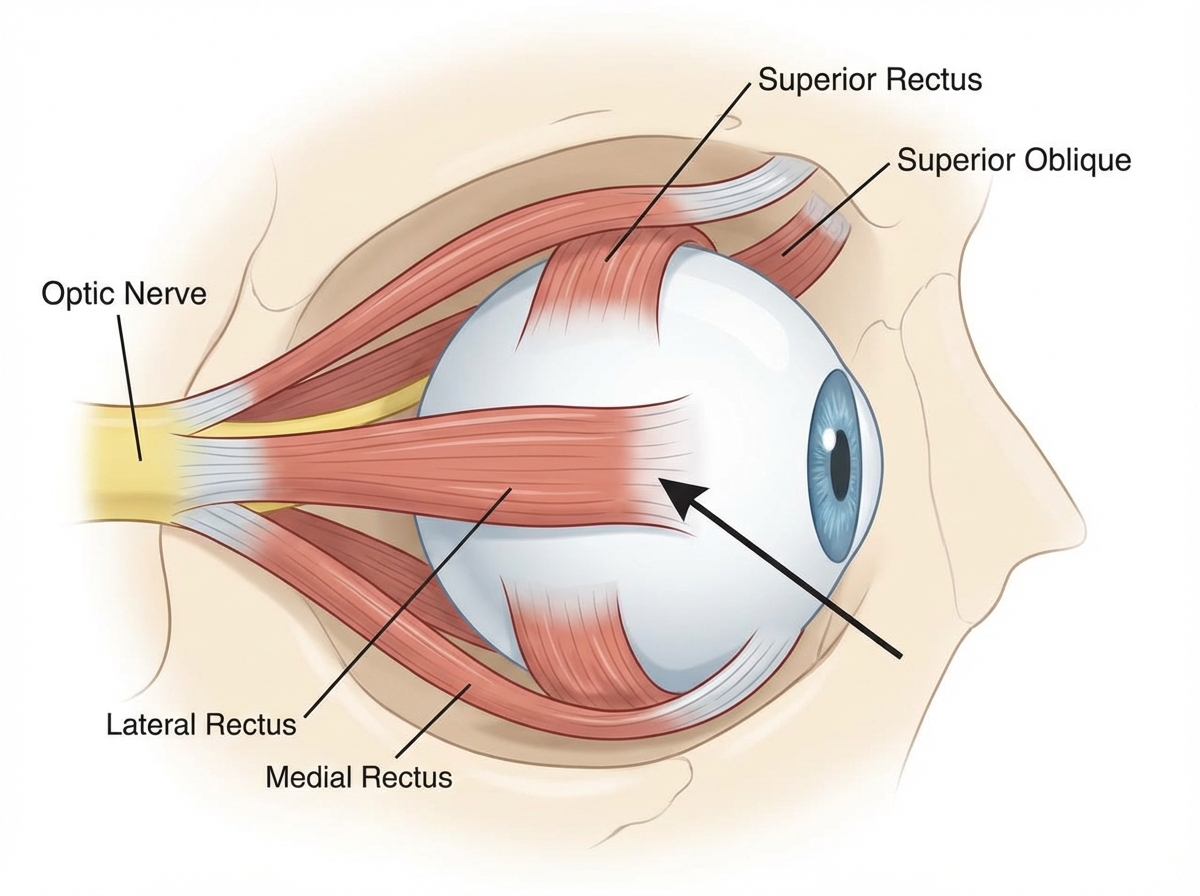
The cranial nerve nucleus supplying the marked muscle lies at the level of:
Which of the following is not included in Jones major criteria for Rheumatic Fever?
Which of the following immunoglobulins does not fix complement?
What is the most common cause of delayed umbilical cord separation?
Transection of the anterolateral spinothalamic tract results in what kind of sensory deficit?
Which of the following are components of the cytoskeleton?
Which type of Ehlers-Danlos syndrome is considered the catastrophic variant?
Which of the following are affected in graft versus host reaction?
What is the earliest physical sign of sexual maturation in females?
In which nucleus does the dorsal column relay occur?
Explanation: ***Superior colliculus*** - The **oculomotor nucleus (CN III)** is located at the level of the **superior colliculus** in the midbrain, supplying most extraocular muscles including **medial rectus**, **inferior rectus**, **superior rectus**, **inferior oblique**, and **levator palpebrae superioris**. - This anatomical relationship is a key landmark for identifying the **rostral midbrain** level in neuroanatomy. *Inferior colliculus* - The **trochlear nucleus (CN IV)** is located at the level of the **inferior colliculus** in the caudal midbrain, not CN III. - CN IV supplies only the **superior oblique muscle**, which is not the muscle referenced in this question. *Facial colliculus* - The **facial colliculus** is formed by **CN VII fibers** looping around the **abducens nucleus (CN VI)** in the **rostral pons**. - CN VI supplies the **lateral rectus muscle**, while CN VII supplies **facial muscles**, neither being CN III-innervated extraocular muscles. *Olive* - The **olive** is located in the **rostral medulla**, where the **hypoglossal nucleus (CN XII)** is found. - CN XII supplies **tongue muscles**, not extraocular muscles, and is anatomically distant from the midbrain CN III nucleus.
Explanation: The diagnosis of Acute Rheumatic Fever (ARF) is based on the **Revised Jones Criteria**, which categorizes clinical and laboratory findings into **Major** and **Minor** criteria. ### Why Option D is Correct **Elevated Erythrocyte Sedimentation Rate (ESR)** is a **Minor Criterion**, not a Major one. Minor criteria represent non-specific indicators of inflammation or systemic illness and include: * **Clinical:** Fever, Polyarthralgia. * **Laboratory:** Elevated acute phase reactants (ESR ≥ 60 mm/h or CRP ≥ 3.0 mg/dL). * **ECG:** Prolonged PR interval (unless carditis is a major criterion). ### Why Other Options are Incorrect Options A, B, and C are all **Major Criteria**. The mnemonic **J♥NES** is commonly used: * **J (Joints):** Migratory Polyarthritis (in low-risk populations) or Monoarthritis/Polyarthralgia (in high-risk populations). * **♥ (Carditis):** Clinical or subclinical **Pancarditis** (Endocarditis, Myocarditis, and Pericarditis). * **N (Nodules):** **Subcutaneous nodules** (painless, firm, usually over bony prominences). * **E (Erythema Marginatum):** Evanescent, non-pruritic pink rings. * **S (Sydenham’s Chorea):** Involuntary, purposeless movements; often a late manifestation. ### High-Yield Clinical Pearls for NEET-PG * **Prerequisite:** Evidence of a preceding Group A Streptococcal (GAS) infection (e.g., positive throat culture, rapid antigen test, or elevated ASO titer) is mandatory for diagnosis, except in isolated Chorea or Carditis. * **Diagnosis:** 2 Major OR 1 Major + 2 Minor criteria are required. * **Most Common Manifestation:** Arthritis is the most common, while Carditis is the most serious. * **Arthritis Characteristic:** It is typically "migratory" and involves large joints (knees, ankles, elbows). It responds dramatically to salicylates.
Explanation: The ability of an immunoglobulin to "fix" complement refers to its capacity to activate the **Classical Pathway** of the complement system. This process is initiated when the C1q component binds to the Fc portion of an antibody that is already bound to an antigen [1]. **Why IgE is the correct answer:** **IgE** (and IgD) does not possess the specific binding sites on its Fc region required to activate the classical complement pathway. Its primary physiological role is to bind to high-affinity receptors on mast cells and basophils, triggering degranulation during Type I hypersensitivity reactions and parasitic infections. **Analysis of incorrect options:** * **IgM:** This is the **most potent** activator of the complement system [1]. Due to its pentameric structure, a single molecule of IgM bound to an antigen can provide the multiple Fc binding sites necessary to activate C1q. * **IgG:** This is a strong activator of complement. Among its subclasses, **IgG3** is the most effective, followed by IgG1 and IgG2. IgG4, however, does not fix complement. * **IgA:** While IgA does not activate the *Classical* pathway, it can activate the **Alternative pathway**. However, in the context of standard medical examinations, "fixing complement" typically refers to the Classical pathway, making IgA an incorrect choice compared to IgE. **NEET-PG High-Yield Pearls:** * **Mnemonic for Complement Fixation:** **"GM makes Classic cars"** (Ig**G** and Ig**M** fix the **Classic**al pathway). * **Order of potency:** IgM > IgG3 > IgG1 > IgG2. * **IgA & Alternative Pathway:** Remember that IgA (specifically aggregated IgA) is unique for its association with the alternative pathway, not the classical one. * **Placental Transfer:** Only IgG crosses the placenta (IgG1, 3, and 4; IgG2 crosses poorly).
Explanation: The separation of the umbilical cord is a physiological process that typically occurs within 1–2 weeks after birth. This process is mediated by **neutrophil infiltration** at the site of the cord, which causes enzymatic degradation of the attachment. **1. Why Leukocyte Adhesion Deficiency (LAD) is correct:** LAD (specifically Type 1) is a primary immunodeficiency caused by a defect in the **CD18 subunit of β2-integrins**. This defect prevents neutrophils from adhering to the vascular endothelium and migrating into the tissues (diapedesis). Because neutrophils cannot reach the umbilical stump to initiate the necrotic process, the cord remains attached for a prolonged period (often >30 days). This is a classic "textbook" presentation for LAD. **2. Why the other options are incorrect:** * **Raspberry tumor:** This is a clinical term for an **umbilical adenoma** (a remnant of the vitellointestinal duct). It appears as a firm, red vascular mass but does not delay cord separation. * **Patent urachus:** This is a failure of the allantois to involute, resulting in a direct communication between the bladder and the umbilicus. The primary symptom is the leakage of urine from the umbilicus, not delayed separation. * **Umbilical granuloma:** This is the most common cause of an umbilical mass in neonates, appearing as pink, friable granulation tissue *after* the cord has already separated. **Clinical Pearls for NEET-PG:** * **Triad of LAD:** Delayed umbilical cord separation, recurrent bacterial infections (without pus formation), and persistent peripheral blood **leukocytosis** (neutrophils are stuck in the blood). * **Normal Cord Separation:** Usually occurs by day 7–10. Separation after **3 weeks** is the threshold to investigate for LAD. * **Urachus Remnant:** A patent urachus is a remnant of the **allantois**, whereas a Vitellointestinal duct remnant leads to Meckel’s diverticulum.
Explanation: The **Anterolateral System (Spinothalamic Tract)** is the primary ascending pathway responsible for transmitting **pain (nociception) and temperature** sensation from the periphery to the thalamus [1]. ### Why the Correct Answer is Right: The spinothalamic tract consists of second-order neurons that originate in the dorsal horn, decussate (cross over) in the **anterior white commissure** within 1–2 spinal segments of entry, and ascend in the anterolateral column of the spinal cord [1]. Therefore, a transection of this tract leads to the loss of pain and temperature sensation. Notably, because the fibers cross almost immediately, a unilateral lesion results in **contralateral** sensory loss below the level of the lesion [1]. ### Why the Other Options are Wrong: * **Areflexia (A):** This refers to the absence of deep tendon reflexes, typically seen in Lower Motor Neuron (LMN) lesions or during the acute phase of "spinal shock." It is not a sensory tract deficit. * **Cerebellar Incoordination (B):** This results from damage to the cerebellum or the **spinocerebellar tracts**, which carry unconscious proprioception. The spinothalamic tract does not mediate coordination. * **Complete Flaccid Paralysis (C):** This is a motor deficit resulting from LMN damage (e.g., anterior horn cell destruction). Sensory tract lesions do not cause paralysis. ### High-Yield Clinical Pearls for NEET-PG: * **Brown-Séquard Syndrome:** Hemisection of the spinal cord results in **contralateral** loss of pain/temperature (Spinothalamic) and **ipsilateral** loss of vibration/position sense (Dorsal Columns) and motor function (Corticospinal). * **Syringomyelia:** A classic "cape-like" distribution of dissociated sensory loss (loss of pain/temp but preserved touch) occurs due to a syrinx compressing the **anterior white commissure** where spinothalamic fibers decussate. * **Crude Touch:** While the anterior spinothalamic tract carries crude touch, "fine touch" is carried by the Dorsal Column-Medial Lemniscus (DCML) pathway.
Explanation: The cytoskeleton is a dynamic network of protein filaments extending throughout the cytoplasm, providing structural integrity, facilitating cell motility, and acting as a highway for intracellular transport [1]. ### **Explanation of the Correct Answer** The correct answer is **D (All of the above)** because the cytoskeleton is composed of three primary structural elements—microtubules, microfilaments, and intermediate filaments—along with their associated motor proteins [1]. * **Tubulin (Option C):** This is the fundamental structural protein that polymerizes to form **microtubules**. Microtubules are essential for maintaining cell shape, forming the mitotic spindle during cell division, and serving as tracks for organelle movement [1]. * **Dynein and Kinesin (Options A & B):** These are **molecular motor proteins** that interact with microtubules [1]. They are considered functional components of the cytoskeleton. * **Kinesin:** Moves cargo (vesicles, organelles) toward the **plus end** of the microtubule (Anterograde transport; away from the cell body). * **Dynein:** Moves cargo toward the **minus end** (Retrograde transport; toward the cell body) [1]. ### **Clinical Pearls for NEET-PG** 1. **Axonal Transport:** In neuroanatomy, kinesin is responsible for transporting neurotransmitter vesicles to the synapse, while dynein carries recycled materials and trophic factors (like Nerve Growth Factor) back to the soma. 2. **Kartagener Syndrome:** Caused by a defect in **dynein arms** within cilia, leading to bronchiectasis, sinusitis, and situs inversus. 3. **Chemotherapy Targets:** Drugs like **Vincristine/Vinblastine** inhibit tubulin polymerization, while **Paclitaxel** prevents depolymerization, both disrupting the mitotic spindle. 4. **Chédiak-Higashi Syndrome:** A defect in microtubule polymerization that impairs phagosome-lysosome fusion.
Explanation: **Explanation:** **Type IV Ehlers-Danlos Syndrome (EDS)**, also known as the **Vascular type**, is termed the "catastrophic variant" because it is associated with spontaneous, life-threatening ruptures of medium and large-sized arteries (e.g., aorta), the bowel, and the gravid uterus. It is caused by a mutation in the **COL3A1 gene**, which leads to a deficiency in **Type III Collagen**. Since Type III collagen is a major structural component of hollow organs and blood vessels, its deficiency results in extreme fragility of these tissues. **Analysis of Incorrect Options:** * **Type I & II (Classical EDS):** These are characterized by skin hyperextensibility, atrophic "cigarette paper" scars, and joint hypermobility. While they cause significant morbidity, they lack the high immediate mortality rate of the vascular type. They involve mutations in **Type V Collagen** (COL5A1, COL5A2). * **Type III (Hypermobility EDS):** This is the most common subtype. It primarily presents with generalized joint hypermobility and chronic pain but does not typically involve the life-threatening vascular complications seen in Type IV. **High-Yield Clinical Pearls for NEET-PG:** * **Collagen Types:** Remember the mnemonic "Vascular is Three" (Type IV EDS = Type III Collagen). * **Clinical Signs:** Patients often have thin, translucent skin with visible underlying veins and a characteristic facial appearance (pinched nose, thin lips, prominent eyes). * **Inheritance:** Most EDS types are Autosomal Dominant. * **Differential:** Unlike Marfan syndrome, EDS Type IV patients are usually of normal stature but share the risk of aortic dissection.
Explanation: **Explanation:** Graft-versus-host disease (GVHD) occurs when donor T-lymphocytes (the graft) recognize the recipient’s (the host) HLA antigens as foreign and initiate an immune attack. While GVHD is a systemic condition, it is classically categorized into **Acute** and **Chronic** forms based on the organs involved and the timing. **Why Lung is the Correct Answer (in the context of this specific question):** In the context of NEET-PG and standard pathology textbooks, the "classic triad" of **Acute GVHD** involves the **Skin, GI tract, and Liver**. However, **Chronic GVHD** (occurring >100 days post-transplant) frequently involves the **Lungs**, manifesting most characteristically as *Bronchiolitis Obliterans*. *Note on Question Context:* In many competitive exams, if a question asks which organ is "affected" and includes the classic triad (Skin, GI, Liver) alongside the Lung, it is often testing the student's ability to identify the organ associated with **Chronic GVHD** or the organ that is *less* commonly involved in the acute phase but significantly impacted in the chronic phase. **Analysis of Options:** * **A, B, and C (Skin, GI Tract, Liver):** These constitute the **Classic Triad of Acute GVHD**. The skin usually presents with a maculopapular rash; the GI tract presents with diarrhea and abdominal pain; the liver presents with cholestatic jaundice and elevated alkaline phosphatase. * **D (Lung):** This is a hallmark of **Chronic GVHD**. It is often the "target" organ mentioned in advanced clinical scenarios involving respiratory failure post-bone marrow transplant. **High-Yield Clinical Pearls for NEET-PG:** * **Classic Triad (Acute):** Dermatitis (Skin), Enteritis (GI), Hepatitis (Liver). * **Chronic GVHD:** Resembles autoimmune disorders like Scleroderma or Sicca syndrome; **Bronchiolitis Obliterans** is the specific pulmonary manifestation. * **Prerequisite:** GVHD requires an immunocompromised host and a graft containing immunologically competent T-cells. * **Prevention:** Depletion of donor T-cells before transfusion/transplant [1] (though this increases the risk of graft failure and leukemia recurrence).
Explanation: **Explanation:** The correct answer is **Thelarche**. Puberty in females is a coordinated sequence of physiological changes driven by the activation of the Hypothalamic-Pituitary-Gonadal (HPG) axis. **1. Why Thelarche is correct:** Thelarche, the development of breast buds, is typically the **earliest physical sign** of puberty in females [1]. It usually occurs between ages 8 and 13 and is mediated by the rise in circulating estrogens [2]. In the Tanner Staging system, this corresponds to Stage 2 [1]. **2. Analysis of Incorrect Options:** * **Menarche (A):** This is the onset of menstruation [2]. It is a **late event** in puberty, usually occurring 2–2.5 years after thelarche (Tanner Stage 4). * **Pubarche (C):** This refers to the appearance of pubic hair, driven by adrenal androgens (adrenarche). While it often follows thelarche closely, it is generally the second sign of maturation. * **Genital maturation (D):** This is a broad term. In females, changes to the labia and vagina occur concurrently with estrogen rise but are not the primary landmark used to define the onset of puberty. **3. NEET-PG High-Yield Pearls:** * **Sequence of Puberty (Mnemonic: T-P-A-M):** **T**helarche → **P**ubarche → **A**drenarche/Growth spurt → **M**enarche. * **Precocious Puberty:** Defined as the appearance of secondary sexual characteristics before age 8 in girls and age 9 in boys [1]. * **Delayed Puberty:** Absence of thelarche by age 13 or absence of menarche by age 15 (if secondary traits are present) or age 13 (if absent). * **Growth Spurt:** In girls, the peak height velocity occurs early (Tanner Stage 2-3), whereas in boys, it occurs late (Tanner Stage 4).
Explanation: **Explanation:** The **Dorsal Column-Medial Lemniscus (DCML) pathway** is responsible for transmitting fine touch, conscious proprioception, and vibration sense. The first-order neurons (pseudounipolar neurons in the dorsal root ganglion) ascend ipsilaterally in the spinal cord via the **Fasciculus Gracilis** (medial; carrying fibers from lower limbs/T6 and below) and **Fasciculus Cuneatus** (lateral; carrying fibers from upper limbs/above T6). These fibers reach the lower medulla, where they relay (synapse) in the **Gracile nucleus** and **Cuneate nucleus**, respectively [1]. Therefore, the Gracile nucleus is a primary relay station for this pathway. **Analysis of Incorrect Options:** * **Substantia gelatinosa (Rexed Lamina II):** Located in the dorsal horn of the spinal cord, it primarily processes pain and temperature (Lateral Spinothalamic tract) [1]. * **Nucleus proprius (Rexed Lamina III & IV):** Located in the dorsal horn, it serves as a relay for crude touch and pressure (Anterior Spinothalamic tract). * **Accessory cuneate nucleus:** This nucleus receives unconscious proprioceptive fibers from the upper limbs and relays them to the cerebellum via the **Cuneocerebellar tract**, not the conscious DCML pathway. **High-Yield Facts for NEET-PG:** * **Decussation:** Second-order neurons from the Gracile/Cuneate nuclei cross as **Internal Arcuate Fibers** to form the Medial Lemniscus [1]. * **Somatotopy:** In the Medial Lemniscus (Medulla), the "little man" stands upright (sacral fibers are ventral), but in the Pons/Midbrain, he "lies down" (sacral fibers move lateral) [1]. * **Clinical Correlation:** Lesions of the dorsal columns result in **Tabes Dorsalis** (syphilis) or Subacute Combined Degeneration (B12 deficiency), leading to sensory ataxia and a positive Romberg’s sign.
Organization of the Nervous System
Practice Questions
Spinal Cord Anatomy
Practice Questions
Brainstem Anatomy
Practice Questions
Cerebellum
Practice Questions
Diencephalon
Practice Questions
Cerebral Cortex
Practice Questions
Basal Ganglia
Practice Questions
Limbic System
Practice Questions
Cranial Nerves
Practice Questions
Autonomic Nervous System
Practice Questions
Neural Pathways and Tracts
Practice Questions
Neurovascular Anatomy
Practice Questions
Get full access to all questions, explanations, and performance tracking.
Start For Free