Which of the following parts of the ear is derived from all three germ layers?
Spinal muscular atrophy is seen in lesions of which of the following structures?
Mature finger grip comes at the age of ___ months.
Which of the following are components of microfilaments?
A false negative tuberculin reaction may be obtained in all of the following situations except?
Besnier-Boeck-Schaumann disease is also known as which of the following?
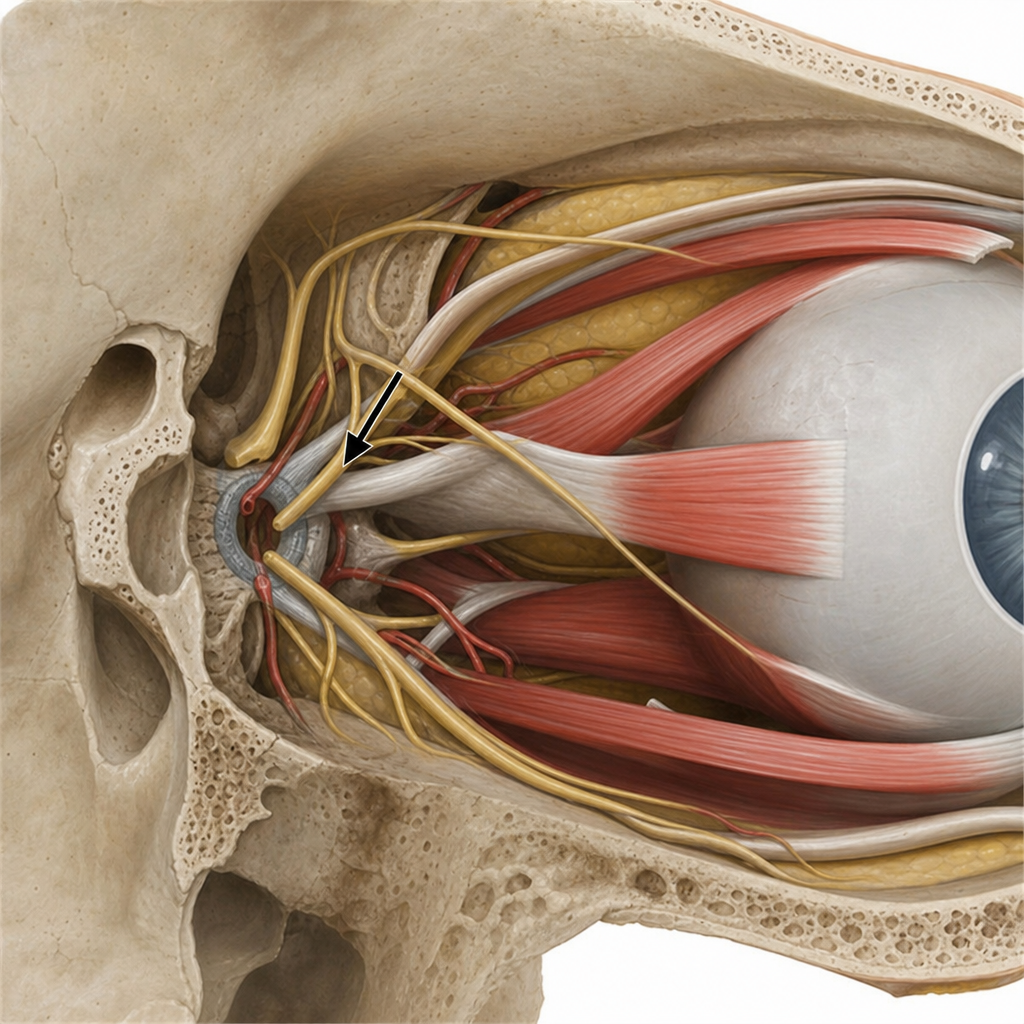
Which of the following statements is true regarding the nuclei of the 3rd cranial nerve?
Myosin is attached to the M-line by which protein?
What is the equilibrium potential for sodium?
Which of the following cell types are found in human intestinal glands?
Explanation: The **tympanic membrane (eardrum)** is a unique anatomical structure because it serves as the interface between the external and middle ear, incorporating derivatives from all three embryonic germ layers [1]: 1. **Ectoderm:** The outer cuticular layer is derived from the surface ectoderm of the first pharyngeal cleft. 2. **Mesoderm:** The middle fibrous layer (lamina propria) is derived from the mesenchyme of the first and second pharyngeal arches. 3. **Endoderm:** The inner mucous layer is derived from the endoderm of the tubotympanic recess (first pharyngeal pouch). ### Analysis of Incorrect Options: * **External Auditory Canal:** Derived solely from the **surface ectoderm** of the first pharyngeal cleft [1]. * **Ear Ossicles:** These are mesenchymal in origin. The Malleus and Incus develop from the **mesoderm** of the 1st pharyngeal arch (Meckel’s cartilage), while the Stapes develops from the 2nd pharyngeal arch (Reichert’s cartilage). * **Ear Muscles:** The Tensor tympani (1st arch) and Stapedius (2nd arch) are derived from **mesoderm**. ### NEET-PG High-Yield Pearls: * **Nerve Supply:** Because it spans multiple layers, the tympanic membrane has a complex nerve supply. The external surface is supplied by the **Auriculotemporal nerve (V3)** and the **Auricular branch of Vagus (X)**. The internal surface is supplied by the **Tympanic plexus (CN IX)**. * **Cone of Light:** In a healthy membrane, the
Explanation: **Explanation:** **Spinal Muscular Atrophy (SMA)** is a genetic neuromuscular disorder [1] characterized by the progressive degeneration of **Lower Motor Neurons (LMNs)** [2]. **Why Option A is correct:** The pathology of SMA specifically involves the **Anterior Horn Cells (AHCs)** of the spinal cord. These cells are the cell bodies of lower motor neurons [2]. Their degeneration leads to muscle denervation, resulting in symmetric muscle weakness and profound atrophy [1]. Since the primary lesion is at the level of the spinal cord's gray matter (anterior horn), it is classified as a "neuronopathy" [1]. **Why other options are incorrect:** * **Option B (Peripheral nerve):** Lesions here cause peripheral neuropathies (e.g., Guillain-Barré Syndrome). While they also show LMN signs [2], the primary pathology in SMA is the cell body itself, not the axonal projection. * **Option C (Neuromuscular junction):** Disorders here (e.g., Myasthenia Gravis) typically present with fatigable weakness without significant muscle atrophy or fasciculations [3]. * **Option D:** SMA is etiologically specific to the anterior horn; therefore, "any of the above" is incorrect. **High-Yield Clinical Pearls for NEET-PG:** * **Genetics:** SMA is most commonly caused by a mutation/deletion in the **SMN1 gene** (Survival Motor Neuron 1) on chromosome **5q**. * **Clinical Features:** Presents with "floppy infant" syndrome (hypotonia) [1], tongue fasciculations, and absent deep tendon reflexes. * **Classification:** * Type 1 (Werdnig-Hoffmann): Most severe, onset <6 months. * Type 3 (Kugelberg-Welander): Milder, juvenile onset. * **Differential Diagnosis:** Polio also affects the Anterior Horn Cells but is viral and usually presents with asymmetrical paralysis, unlike the symmetrical weakness in SMA.
Explanation: **Explanation:** The development of hand function follows a predictable cephalocaudal and proximo-distal neurological maturation pattern. The transition from a primitive reflex to a purposeful, mature grip is a key milestone in fine motor development. **1. Why 9 months is correct:** At **9 months**, an infant develops the **Mature Pincer Grasp** (also known as the fine pincer grasp). This involves the precise coordination of the distal pads of the thumb and index finger to pick up small objects (like a pea or pellet). This milestone signifies advanced corticospinal tract maturation and the ability to inhibit the ulnar side of the hand in favor of radial precision. **2. Analysis of Incorrect Options:** * **5 Months:** At this stage, the infant uses a **Cylindrical/Palmar Grasp**. They use the whole hand to scoop objects against the palm without thumb involvement. * **7 Months:** This is the age of the **Radial Palmar Grasp**. The infant begins to use the thumb to help press objects against the palm, but the movement is still clumsy and lacks finger-tip precision. * **12 Months:** By one year, the pincer grasp is well-established, and the infant moves toward more complex tasks like releasing objects voluntarily into a container or attempting to use a spoon. **Clinical Pearls for NEET-PG:** * **Crude Pincer Grasp:** Occurs at **8 months** (using the pads of the fingers rather than the tips). * **Hand-to-hand transfer:** Occurs at **6 months**. * **Hand Preference (Dominance):** Usually becomes apparent by **18–24 months**. If it appears before 12 months, it may pathologically indicate hemiplegia in the contralateral limb. * **Palmar Grasp Reflex:** Disappears by **2–3 months**; persistence beyond 4 months suggests cerebral palsy.
Explanation: **Explanation:** The cytoskeleton of a cell is composed of three main structural elements: microtubules, intermediate filaments, and microfilaments [1]. **Microfilaments** (also known as actin filaments) are the thinnest components, measuring approximately 6–7 nm in diameter [1]. **Why the correct answer is right:** While **Actin** is the primary structural protein that polymerizes to form the double-helical strands of microfilaments, **Myosin** is the essential motor protein associated with them [2]. In the context of the cytoskeleton, microfilaments are not just static structures; they interact with myosin to facilitate cellular movements, endocytosis, exocytosis, and cytokinesis (via the contractile ring) [2]. In muscle cells, these filaments are highly organized, but even in non-muscle cells, the functional unit of "microfilaments" involves the interaction between actin and myosin. Therefore, both are considered integral components of the microfilament system [3]. **Analysis of incorrect options:** * **Option A (Actin only):** While actin is the major building block, selecting it alone ignores the functional motor component (myosin) that defines microfilament activity. * **Option B (Myosin only):** Myosin cannot form microfilaments independently; it requires the actin scaffold to exert force. * **Option D (Neither):** Incorrect, as both are the fundamental proteins of this system. **High-Yield Facts for NEET-PG:** * **Microtubules:** Largest (25 nm), made of tubulin; involved in mitosis (spindle fibers) and ciliary movement. * **Intermediate Filaments:** (10 nm) Provide mechanical strength. Examples include **Keratin** (epithelium), **Vimentin** (mesenchyme), **Desmin** (muscle), and **GFAP** (astrocytes) [1]. * **Clinical Correlation:** Drugs like **Cytochalasins** inhibit actin polymerization, while **Phalloidin** (from poisonous mushrooms) stabilizes them, preventing depolymerization.
Explanation: ### Explanation The Tuberculin Skin Test (TST) or Mantoux test relies on a **Type IV (Delayed-Type) Hypersensitivity reaction**. A false negative occurs when the body fails to mount an immune response despite being infected with *Mycobacterium tuberculosis*. **Why Option A is the Correct Answer:** Children previously tested with a tuberculin test will **not** show a false negative. In fact, repeated testing often leads to the **"Booster Effect."** In individuals whose delayed hypersensitivity has waned over time, the initial test "reminds" the immune system, causing a subsequent test to show a larger, positive reaction. Therefore, prior testing increases (rather than suppresses) the likelihood of a positive result. **Analysis of Incorrect Options (Causes of False Negatives):** * **Post-measles test:** Viral infections like measles, mumps, and varicella cause temporary **anergy** (suppression of cell-mediated immunity), leading to false negatives. * **Corticosteroid therapy:** Immunosuppressive drugs inhibit T-cell function and the cytokine release necessary to produce the characteristic induration of a positive TST. * **Miliary tuberculosis:** In overwhelming infections like miliary or disseminated TB, the immune system is "overloaded" or exhausted, resulting in a failure to react to the antigen (anergy). **High-Yield Clinical Pearls for NEET-PG:** * **Reading the test:** The result is read at **48–72 hours**. Only the **induration** (palpable hardness) is measured, not the erythema. * **Cut-off:** In India, an induration of **≥10 mm** is generally considered positive. * **Other causes of False Negatives:** Malnutrition (low protein), Sarcoidosis, Hodgkin’s Lymphoma, and very young age (<6 months) due to immature immunity. * **False Positives:** Most commonly caused by **BCG vaccination** or infection with Non-Tuberculous Mycobacteria (NTM).
Explanation: **Besnier-Boeck-Schaumann disease** is the eponym for **Sarcoidosis**. It is a multisystem, chronic inflammatory condition characterized by the formation of **non-caseating granulomas**. The name honors the dermatologists and internists (Ernest Besnier, Caesar Boeck, and Jörgen Schaumann) who first described the skin manifestations and systemic nature of the disease. * **Why Sarcoidosis is Correct:** In the context of neuroanatomy and neurology (Neurosarcoidosis), this disease frequently affects the cranial nerves—most commonly the **Facial nerve (CN VII)**—and can present as bilateral Bell’s palsy. It also involves the hypothalamus and pituitary gland. **Analysis of Incorrect Options:** * **B. Crohn’s Disease:** A type of inflammatory bowel disease (IBD) characterized by transmural inflammation and "skip lesions." While it also features non-caseating granulomas, it is not associated with the Besnier-Boeck-Schaumann eponym. * **C. Whipple’s Disease:** A systemic infection caused by *Tropheryma whipplei*. It typically presents with malabsorption, arthralgia, and CNS involvement (e.g., oculomasticatory myorhythmia), but is distinct from sarcoidosis. * **D. Hodgkin’s Disease:** A type of lymphoma characterized by the presence of **Reed-Sternberg cells**. While it can cause lymphadenopathy similar to sarcoidosis, the pathology is neoplastic rather than granulomatous. **High-Yield Clinical Pearls for NEET-PG:** * **Radiology:** Look for "Bilateral Hilar Lymphadenopathy" and "Panda sign" or "Gallium-67" uptake on scans. * **Pathology:** Presence of **Schaumann bodies** (calcium and protein inclusions) and **Asteroid bodies** within giant cells. * **Biomarker:** Elevated **Serum ACE** (Angiotensin-Converting Enzyme) levels. * **Löfgren Syndrome:** A specific acute triad of Sarcoidosis consisting of erythema nodosum, bilateral hilar lymphadenopathy, and polyarthritis.
Explanation: ### Explanation **1. Why Option A is Correct:** The Oculomotor nerve (CN III) contains two distinct types of nuclei: the **Main Motor Nucleus** (Somatic Efferent) and the **Edinger-Westphal (EW) Nucleus** (General Visceral Efferent/Parasympathetic). The EW nucleus provides preganglionic parasympathetic fibers that synapse in the **ciliary ganglion** [1]. Postganglionic fibers (short ciliary nerves) then supply the **constrictor pupillae** muscle (causing miosis) and the **ciliaris** muscle (facilitating accommodation) [1]. **2. Why the Other Options are Incorrect:** * **Option B:** The nuclei are situated in the **ventral part of the periaqueductal gray matter**, not on the dorsal side. They lie anterior to the cerebral aqueduct. * **Option C:** The EW nucleus receives **bilateral** afferent fibers from the pretectal nuclei [1]. This anatomical arrangement is the basis for the **consensual light reflex**, where shining light in one eye causes pupillary constriction in both [1]. * **Option D:** The CN III nuclei are located at the level of the **superior colliculus**. The Trochlear nerve (CN IV) nuclei are located at the level of the inferior colliculus. **3. NEET-PG High-Yield Clinical Pearls:** * **Rule of Pupil:** In surgical compression (e.g., P-com artery aneurysm), parasympathetic fibers (located peripherally in the nerve) are affected first, leading to a **dilated, fixed pupil**. In medical causes (e.g., Diabetes), central motor fibers are affected, causing "pupil-sparing" ophthalmoplegia. * **Weber’s Syndrome:** A midbrain stroke affecting the CN III fascicles and the cerebral peduncle [2], resulting in ipsilateral CN III palsy and contralateral hemiplegia. * **Levator Palpebrae Superioris:** Supplied by a single midline subnucleus that serves both eyes.
Explanation: **Explanation:** The sarcomere is the functional unit of skeletal muscle, organized by a complex framework of structural proteins that maintain the precise alignment of thick (myosin) and thin (actin) filaments [1]. **1. Why Myomesin is correct:** The **M-line** (from the German *Mittelscheibe*, "middle disc") is the central point of the sarcomere located in the middle of the H-zone [1]. **Myomesin** is the primary structural protein that cross-links adjacent thick filaments (myosin) to each other at the M-line. It acts as an anchor, ensuring that myosin filaments remain centered and stabilized during muscle contraction and relaxation. **2. Analysis of Incorrect Options:** * **Alpha-actinin:** This protein is located at the **Z-line** (Z-disk). Its primary function is to anchor the plus ends of thin (actin) filaments to the Z-disk, not myosin to the M-line [1]. * **Titin:** Known as the largest protein in the body, Titin acts as a molecular spring. It connects the **Z-line to the M-line**, providing elasticity and preventing overextension of the sarcomere. While it reaches the M-line, it is not the specific protein responsible for the lateral attachment of myosin filaments to one another at that site. **High-Yield Clinical Pearls for NEET-PG:** * **Nebulin:** Acts as a "molecular ruler" to regulate the length of actin filaments. * **Dystrophin:** Links the cytoskeleton of a muscle fiber to the surrounding extracellular matrix through the cell membrane. Mutations lead to **Duchenne Muscular Dystrophy**. * **Desmin:** An intermediate filament that integrates the sarcolemma, Z-disk, and nuclear envelope, ensuring structural integrity between myofibrils. * **H-Zone:** Contains only thick filaments (myosin); it shortens during contraction [1].
Explanation: ### Explanation The equilibrium potential of an ion is the membrane voltage at which the electrical gradient exactly balances the chemical concentration gradient, resulting in no net movement of that ion across the membrane [1]. This is calculated using the **Nernst Equation** [1]. **1. Why +60 mV is correct:** Sodium ($Na^+$) is the primary extracellular cation. Because its concentration is much higher outside the cell (~142 mEq/L) than inside (~14 mEq/L), the chemical gradient pushes $Na^+$ into the cell. To oppose this entry, the inside of the cell must become positively charged. At **+60 mV** (range +60 to +65 mV), the electrical repulsion is strong enough to stop the net influx of $Na^+$ [2]. **2. Why the other options are incorrect:** * **-70 mV:** This represents the typical **Resting Membrane Potential (RMP)** of a large neuron. It is negative because the membrane at rest is far more permeable to Potassium than to Sodium. * **-90 mV:** This is the **Equilibrium Potential for Potassium ($K^+$)** [3]. Since $K^+$ is the major intracellular cation, it tends to leak out of the cell, leaving behind a negative charge [3]. * **All of the above:** This is incorrect as equilibrium potentials are specific to the concentration gradients of individual ions. **High-Yield Clinical Pearls for NEET-PG:** * **RMP Determinant:** The RMP is closest to the equilibrium potential of the ion with the highest permeability (Potassium). * **Action Potential:** The "overshoot" phase of an action potential approaches, but rarely reaches, the $Na^+$ equilibrium potential [2]. * **Goldman-Hodgkin-Katz Equation:** Unlike the Nernst equation (one ion), this equation calculates the membrane potential by considering the permeability and concentration of all major ions ($Na^+$, $K^+$, and $Cl^-$).
Explanation: **Explanation:** The intestinal glands, also known as **Crypts of Lieberkühn**, are simple tubular glands found in the mucosal epithelium of both the small and large intestines. These crypts serve as the "proliferation compartment" of the gut and contain a diverse population of specialized cells [1]. 1. **Stem Cells:** Located at the base of the crypts, these undifferentiated cells undergo rapid mitosis to replenish the entire intestinal epithelium every 3–5 days. 2. **Paneth Cells:** Found specifically at the base of the crypts in the **small intestine** [1]. They secrete antimicrobial substances like **lysozyme** and defensins, playing a crucial role in innate immunity. 3. **Neuroendocrine Cells (Enteroendocrine cells):** These cells secrete hormones such as secretin, cholecystokinin (CCK), and serotonin into the bloodstream to regulate gastrointestinal motility and secretion [2]. 4. **Enterocytes and Goblet Cells:** These are also present, primarily functioning in absorption and mucus secretion, respectively [1]. Since all three cell types mentioned (Paneth, Neuroendocrine, and Stem cells) are integral components of the intestinal glandular architecture, **Option D** is the correct answer. **High-Yield Clinical Pearls for NEET-PG:** * **Paneth Cells:** Characterized by prominent eosinophilic (acidophilic) apical granules. They are generally absent in the normal large intestine (their presence there is called "Paneth cell metaplasia," often seen in IBD). * **M-Cells (Microfold cells):** Found in the epithelium overlying Peyer's patches; they are involved in antigen presentation. * **Brunner’s Glands:** These are located in the **submucosa** of the duodenum (not the mucosa) and secrete alkaline mucus to neutralize gastric acid.
Organization of the Nervous System
Practice Questions
Spinal Cord Anatomy
Practice Questions
Brainstem Anatomy
Practice Questions
Cerebellum
Practice Questions
Diencephalon
Practice Questions
Cerebral Cortex
Practice Questions
Basal Ganglia
Practice Questions
Limbic System
Practice Questions
Cranial Nerves
Practice Questions
Autonomic Nervous System
Practice Questions
Neural Pathways and Tracts
Practice Questions
Neurovascular Anatomy
Practice Questions
Get full access to all questions, explanations, and performance tracking.
Start For Free