All of the following are present in the lateral sulcus except?
Which of the following is an example of non-Mendelian inheritance?
Which of the following is NOT a feature of neuroglia cells?
Which of the following agents should NOT be used for oral anticoagulation in high-risk patients with atrial fibrillation?
All of the following can be seen in deep burns except?
Climbing fiber inputs in the cerebellum stimulate which of the following cells?
Which antibiotic is known for its successful penetration of burn eschar?
What is the smallest fluid compartment of the body?
Which of the following is not a part of the epithalamus?
Pigmentation in the liver is caused by all of the following except?
Explanation: The **lateral sulcus (Sylvian fissure)** is one of the most prominent landmarks of the brain, separating the frontal and parietal lobes from the temporal lobe. It acts as a deep conduit for specific neurovascular structures. ### **Explanation of the Correct Answer** **D. Great cerebral vein (Vein of Galen):** This is the correct answer because it is **not** located in the lateral sulcus. The Great cerebral vein is formed by the union of the two internal cerebral veins and is situated in the **quadrigeminal cistern** (posterior to the midbrain, beneath the splenium of the corpus callosum) [1]. It eventually drains into the straight sinus. ### **Analysis of Incorrect Options** * **A. Middle cerebral artery (MCA):** The M1 and M2 segments of the MCA travel deep within the lateral sulcus, supplying the insula and the lateral surfaces of the cerebral hemispheres. * **B. Superficial middle cerebral vein:** This vein runs superficially along the lips of the lateral sulcus and drains the lateral aspect of the cortex into the cavernous sinus. * **C. Deep middle cerebral vein:** This vein lies deep within the lateral sulcus on the insular cortex [1]. It joins the anterior cerebral vein to form the basal vein (of Rosenthal). ### **NEET-PG High-Yield Pearls** * **Contents of the Lateral Sulcus:** Middle cerebral artery, Superficial and Deep middle cerebral veins, and the **Insula** (located at the floor of the sulcus). * **The Stem:** The lateral sulcus begins on the inferior surface of the brain as a "stem" and divides into three rami: anterior horizontal, anterior ascending, and posterior. * **Clinical Correlation:** The MCA is the most common site for embolic strokes; understanding its course in the Sylvian fissure is crucial for neurosurgical approaches (Sylvian dissection).
Explanation: **Explanation:** **Mendelian inheritance** follows the laws of segregation and independent assortment, where traits are determined by nuclear genes inherited equally from both parents. **Non-Mendelian inheritance** refers to patterns of inheritance that deviate from these rules due to epigenetic modifications, chromosomal abnormalities, or extranuclear DNA. * **Genomic Imprinting:** This involves the functional silencing of a gene depending on which parent it is inherited from. Since the expression depends on the parent of origin rather than just the DNA sequence, it bypasses Mendelian rules [1]. * **Uniparental Disomy (UPD):** This occurs when an individual receives two copies of a chromosome from one parent and none from the other [1]. While the total chromosome count is normal, the lack of contribution from one parent violates the Mendelian principle of biparental inheritance. * **Mitochondrial Inheritance:** Mitochondria contain their own DNA (mtDNA) which is inherited exclusively from the mother (matrilineal). Since it does not involve nuclear recombination or paternal contribution, it is a classic example of non-Mendelian inheritance. Because all three mechanisms deviate from standard Mendelian patterns, **Option D** is the correct answer. ### **High-Yield Clinical Pearls for NEET-PG:** * **Prader-Willi vs. Angelman Syndrome:** These are the "poster children" for imprinting and UPD [1]. * **Prader-Willi:** Paternal deletion/Maternal UPD of Chromosome 15. * **Angelman:** Maternal deletion/Paternal UPD of Chromosome 15. * **Mitochondrial Diseases:** Look for "Ragged Red Fibers" on muscle biopsy (e.g., MELAS, MERRF). * **Anticipation:** Another non-Mendelian pattern seen in Trinucleotide Repeat disorders (e.g., Huntington’s, Fragile X), where the disease severity increases in successive generations.
Explanation: **Explanation:** The correct answer is **D** because it is a factually incorrect statement. **Central neuroglial cells** (astrocytes, oligodendrocytes, and ependymal cells) are derived from the **neuroectoderm** (specifically the neural tube) [1]. In contrast, **Schwann cells** are the myelinating cells of the *Peripheral Nervous System (PNS)* and are derived from the **neural crest** [1][2]. Schwann cells do not give rise to central neuroglia; rather, they are the functional counterparts to oligodendrocytes in the periphery [3]. **Analysis of other options:** * **Option A:** Correct. Astrocytes are classified into two types: **Protoplasmic** (found primarily in gray matter with thick, branched processes) and **Fibrous** (found in white matter with long, thin processes) [1]. * **Option B:** Correct. Oligodendrocytes, like most macroglia, originate from the **neuroectoderm** of the neural tube [1]. * **Option C:** Correct. **Microglia** are the only neuroglial cells not derived from the ectoderm [1]. They are derived from **mesoderm** (specifically yolk sac macrophages) and serve as the resident immune cells of the CNS [1]. **High-Yield NEET-PG Pearls:** * **Origin Rule:** All CNS glia are Ectodermal EXCEPT Microglia (Mesodermal) [1]. * **Blood-Brain Barrier (BBB):** Formed by the foot processes of **Astrocytes**. * **Myelination:** One Oligodendrocyte can myelinate multiple CNS axons, whereas one Schwann cell myelinates only one segment of a single PNS axon [3][4]. * **Fried Egg Appearance:** A classic histological description for Oligodendrocytes in biopsy.
Explanation: **Explanation:** The core concept in managing atrial fibrillation (AF) is the prevention of **thromboembolic strokes**. In AF, the stasis of blood in the left atrium leads to the formation of **red thrombi** (fibrin-rich), which are best prevented by **anticoagulants**, not antiplatelets. [1] **Why Clopidogrel is the Correct Answer:** Clopidogrel is an **antiplatelet agent** (P2Y12 inhibitor). While it is effective in preventing arterial thrombosis (white thrombi) in conditions like Myocardial Infarction or Stroke, clinical trials (like ACTIVE-W) have proven that antiplatelets are significantly less effective than anticoagulants in preventing strokes in high-risk AF patients. Therefore, it is NOT recommended as a primary oral anticoagulant for AF. **Analysis of Incorrect Options:** * **Warfarin (Option A):** A Vitamin K Antagonist (VKA). It has been the gold standard for decades for stroke prevention in both valvular and non-valvular AF. [1] * **Dabigatran (Option B):** A Direct Thrombin Inhibitor (DTI). It is a NOAC (Non-vitamin K Oral Anticoagulant) approved for non-valvular AF. * **Rivaroxaban (Option C):** A Direct Factor Xa inhibitor. Like Dabigatran, it is a NOAC preferred over Warfarin in non-valvular AF due to a lower risk of intelligence hemorrhage and no need for INR monitoring. **High-Yield Clinical Pearls for NEET-PG:** * **CHADS₂ / CHA₂DS₂-VASc Score:** Used to stratify stroke risk in AF and decide when to start anticoagulation. [1] * **Valvular AF:** Defined as AF in the presence of moderate-to-severe mitral stenosis or a mechanical heart valve. **Warfarin** is the only indicated agent; NOACs are contraindicated. * **Reversal Agents:** Idarucizumab (for Dabigatran) and Andexanet alfa (for Rivaroxaban/Apixaban).
Explanation: In deep burns (Full-thickness or Third-degree burns), the entire thickness of the skin, including the epidermis, dermis, and underlying structures, is destroyed [1]. **1. Why Hyperthermia is the Correct Answer:** The skin acts as a primary thermoregulatory organ. In extensive deep burns, the loss of skin integrity leads to a loss of the protective barrier against heat dissipation. More importantly, the destruction of sweat glands and the disruption of the skin's ability to regulate blood flow result in **Hypothermia**, not hyperthermia. Patients often struggle to maintain core body temperature due to massive evaporative heat loss. **2. Explanation of Incorrect Options:** * **Fluid Loss:** The skin prevents insensible water loss. Deep burns destroy this barrier, leading to massive exudation of plasma and evaporative fluid loss, which can result in hypovolemic shock [3]. * **Vasodilation:** The inflammatory response to thermal injury triggers the release of mediators (like histamine and prostaglandins), causing systemic and local vasodilation and increased capillary permeability [2]. * **Painless Burns:** This is a hallmark of deep (third-degree) burns. Because the nerve endings in the dermal layer are completely destroyed, the burned area itself is anesthetic (painless) [1]. Pain is usually only felt at the edges where the burn is more superficial. **Clinical Pearls for NEET-PG:** * **Rule of Nines:** Used to estimate the Total Body Surface Area (TBSA) involved in burns. * **Parkland Formula:** $4 \text{ ml} \times \text{Body Weight (kg)} \times \% \text{ TBSA}$ is the gold standard for fluid resuscitation in the first 24 hours. * **Zone of Coagulation:** The central part of the burn with maximum damage and irreversible tissue loss [2]. * **Infection:** *Pseudomonas aeruginosa* is the most common opportunistic pathogen in burn wounds [3].
Explanation: The cerebellum processes information through two primary excitatory afferent pathways: **Climbing fibers** and **Mossy fibers**. [1] ### **Explanation of the Correct Answer** **Climbing fibers** originate exclusively from the **inferior olivary nucleus** of the medulla. They enter the cerebellum through the inferior cerebellar peduncle and pass through the granular and molecular layers to wrap directly around the dendrites of **Purkinje cells**. [1] A single climbing fiber makes thousands of synaptic contacts with one Purkinje cell, providing a powerful, "all-or-none" excitatory stimulus (generating "complex spikes"). [1] This interaction is fundamental for motor learning and error detection. ### **Explanation of Incorrect Options** * **A. Granule cells:** These are stimulated by **Mossy fibers** (not climbing fibers). [1] Mossy fibers synapse on granule cell dendrites within the cerebellar glomerulus. * **B. Golgi cells:** These are inhibitory interneurons located in the granular layer. They receive input from mossy fibers and parallel fibers (axons of granule cells) to provide feedback inhibition to granule cells. [1] * **C. Basket cells:** These are inhibitory interneurons in the molecular layer. They are stimulated by **parallel fibers** (granule cell axons) and provide lateral inhibition to Purkinje cell bodies. [1] ### **High-Yield Facts for NEET-PG** * **The "One-to-One" Rule:** While one climbing fiber can branch to reach ~10 Purkinje cells, each Purkinje cell receives input from **only one** climbing fiber. [1] * **Neurotransmitters:** Both climbing and mossy fibers are **excitatory (Glutamate)**. The Purkinje cell is the sole output of the cerebellar cortex and is **inhibitory (GABA)**. [1] * **The Cerebellar Glomerulus:** A synaptic complex consisting of a Mossy fiber terminal, Granule cell dendrites, and Golgi cell axons. * **Clinical Correlation:** Lesions in the inferior olive or climbing fibers disrupt the ability to learn new motor tasks. [1]
Explanation: **Explanation:** The management of burn wounds requires topical agents that can effectively control bacterial colonization, particularly *Pseudomonas aeruginosa*. **Mafenide Acetate (Sulfamylon)** is the correct answer because it possesses unique pharmacokinetic properties that allow it to **diffuse deeply through thick, avascular burn eschar** [1]. It is a carbonic anhydrase inhibitor and is highly effective in reaching the underlying tissue where bacteria proliferate in full-thickness burns [1]. This makes it the drug of choice for treating infected burns or burns over cartilaginous areas (like the ear) where penetration is critical to prevent chondritis. **Why the other options are incorrect:** * **Silver Sulfadiazine (SSD):** While it is the most commonly used topical agent due to its broad spectrum and painless application, it **does not penetrate eschar** [1]. It works primarily on the surface and can actually form a "pseudo-eschar" that may harbor bacteria underneath. * **Silver Nitrate:** This is used as a 0.5% solution. It has poor penetration power and is known for causing electrolyte imbalances (hyponatremia, hypochloremia) and staining tissues black [1], [3]. * **Neomycin:** This is an aminoglycoside typically used for minor superficial skin infections; it lacks the penetration and spectrum required for deep burn eschar management [1]. **High-Yield Clinical Pearls for NEET-PG:** * **Mafenide Acetate Side Effect:** Because it inhibits carbonic anhydrase, it can cause **metabolic acidosis** and compensatory hyperventilation [1]. * **Silver Sulfadiazine Contraindication:** Avoid in patients with sulfa allergies, in newborns (risk of kernicterus), and near the eyes. It may also cause transient **leukopenia**. * **Silver Nitrate Side Effect:** Can cause **methemoglobinemia** (rarely) and significant electrolyte leaching [2].
Explanation: ### Explanation The body's total water content is divided into distinct compartments based on their location and volume. To answer this question, one must understand the hierarchy of body fluid distribution [1], [2]. **1. Why Transcellular Fluid is Correct:** Transcellular fluid is a specialized subset of Extracellular Fluid (ECF) [2]. It represents fluids contained within epithelial-lined spaces. It is the **smallest compartment**, accounting for only **1–2% of total body weight** (approximately 1 liter in a 70kg adult) [2]. Examples include cerebrospinal fluid (CSF), ocular fluids, synovial fluid, pleural, pericardial, and peritoneal fluids. **2. Analysis of Incorrect Options:** * **Intracellular Fluid (ICF):** This is the **largest** compartment, making up approximately **40%** of total body weight (2/3 of Total Body Water) [1], [3]. * **Extracellular Fluid (ECF):** This constitutes about **20%** of total body weight (1/3 of Total Body Water) [1]. It is further divided into interstitial fluid and plasma. * **Interstitial Fluid:** This is the largest component of the ECF (approx. 15% of body weight), bathing the cells outside the vascular system [1]. It is significantly larger than the transcellular volume. **3. NEET-PG High-Yield Pearls:** * **The 60-40-20 Rule:** Total Body Water (60%) = ICF (40%) + ECF (20%) [3]. * **ECF Breakdown:** Interstitial fluid (~15%) + Plasma (~5%) + Transcellular fluid (1-2%). * **Marker for Volume Measurement:** * Total Body Water: Deuterium oxide ($D_2O$) or Tritiated water. * ECF: Inulin, Mannitol, or Thiosulfate. * Plasma: Evans Blue dye or Radio-iodinated albumin ($I^{131}$-albumin). * **Clinical Note:** While small in volume, the transcellular compartment is clinically vital; for example, an increase in peritoneal fluid (ascites) or CSF (hydrocephalus) indicates significant pathology.
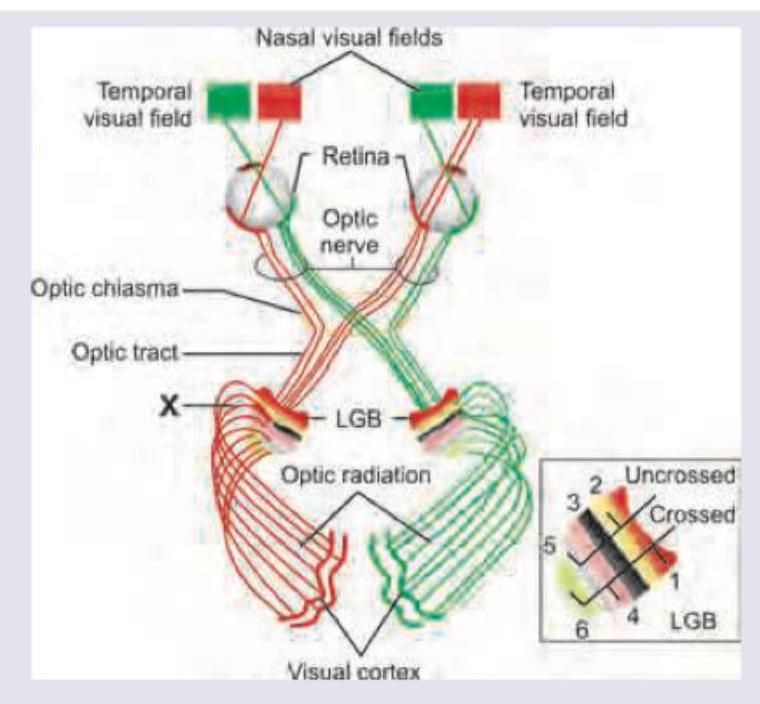
Explanation: The **epithalamus** is the most dorsal part of the diencephalon, forming the roof of the third ventricle [1]. It primarily connects the limbic system to other parts of the brain. ### Why Geniculate Bodies is the Correct Answer The **Geniculate bodies** (Lateral and Medial) are components of the **Metathalamus**, not the epithalamus [2]. * The **Lateral Geniculate Body (LGB)** is a relay station for the visual pathway [5]. * The **Medial Geniculate Body (MGB)** is a relay station for the auditory pathway [3]. ### Analysis of Other Options (Parts of Epithalamus) * **Pineal body (Epiphysis cerebri):** An endocrine gland attached to the diencephalon by a stalk [1]. It secretes melatonin and regulates circadian rhythms. * **Habenular nuclei & Trigonum habenulae:** Located in the posterior part of the thalamus, the habenular trigone contains the nuclei that serve as a relay station for olfactory and visceral pathways. * **Posterior commissure:** A rounded band of white fibers crossing the midline at the upper end of the cerebral aqueduct. It mediates the **consensual light reflex** [4]. * **Stria medullaris thalami:** (Often included) A bundle of fibers connecting the septal area to the habenular nuclei. ### High-Yield NEET-PG Pearls * **Pineal Gland Calcification:** Often visible on X-rays/CT scans in adults (Brain sand or *Acervuli cerebri*); it serves as a useful midline marker [1]. * **Parinaud Syndrome:** Compression of the **superior colliculi and posterior commissure** (often by a pineal tumor) leads to upward gaze palsy. * **Mnemonic for Geniculates:** **M**edial for **M**usic (Auditory); **L**ateral for **L**ight (Visual).
Explanation: The question asks which of the listed conditions does **not** cause visible pigmentation in the liver. **Why Wilson’s Disease is the correct answer:** In Wilson’s Disease (Hepatolenticular degeneration), there is an accumulation of **Copper** in the liver due to a defect in the *ATP7B* gene. While copper levels are pathologically high, copper itself does not impart a distinct "pigment" visible on routine gross or microscopic examination in the same way the other options do. It requires special stains like **Rhodanine** or **Orcein** for visualization. Clinically, the characteristic pigmentation in Wilson's occurs in the eye (**Kayser-Fleischer rings**), not as a primary liver pigment. **Analysis of Incorrect Options:** * **Lipofuscin:** Known as the "wear-and-tear" pigment, it is a golden-brown pigment representing lipid peroxidation. It commonly accumulates in hepatocytes, especially in the elderly or in states of atrophy (Brown atrophy). * **Pseudomelanin:** This is a dark pigment (melanin-like) seen in **Dubin-Johnson Syndrome**. It results from the failure of hepatocytes to excrete epinephrine metabolites, giving the liver a characteristic "black" gross appearance. * **Malaria Pigment (Hemozoin):** During malaria infection, the breakdown of hemoglobin by parasites produces hemozoin. This pigment is taken up by the Kupffer cells in the liver, leading to a slate-grey or blackish discoloration. **NEET-PG High-Yield Pearls:** * **Dubin-Johnson vs. Rotor:** Both cause conjugated hyperbilirubinemia, but only Dubin-Johnson presents with a **black liver** (pseudomelanin). * **Iron vs. Copper:** Iron (Hemosiderin) appears blue on **Prussian Blue** stain; Copper appears reddish-brown on **Rhodanine** stain. * **Lipofuscin** is derived from free radical injury and lipid peroxidation; it is typically found at the poles of the nucleus.
Organization of the Nervous System
Practice Questions
Spinal Cord Anatomy
Practice Questions
Brainstem Anatomy
Practice Questions
Cerebellum
Practice Questions
Diencephalon
Practice Questions
Cerebral Cortex
Practice Questions
Basal Ganglia
Practice Questions
Limbic System
Practice Questions
Cranial Nerves
Practice Questions
Autonomic Nervous System
Practice Questions
Neural Pathways and Tracts
Practice Questions
Neurovascular Anatomy
Practice Questions
Get full access to all questions, explanations, and performance tracking.
Start For Free