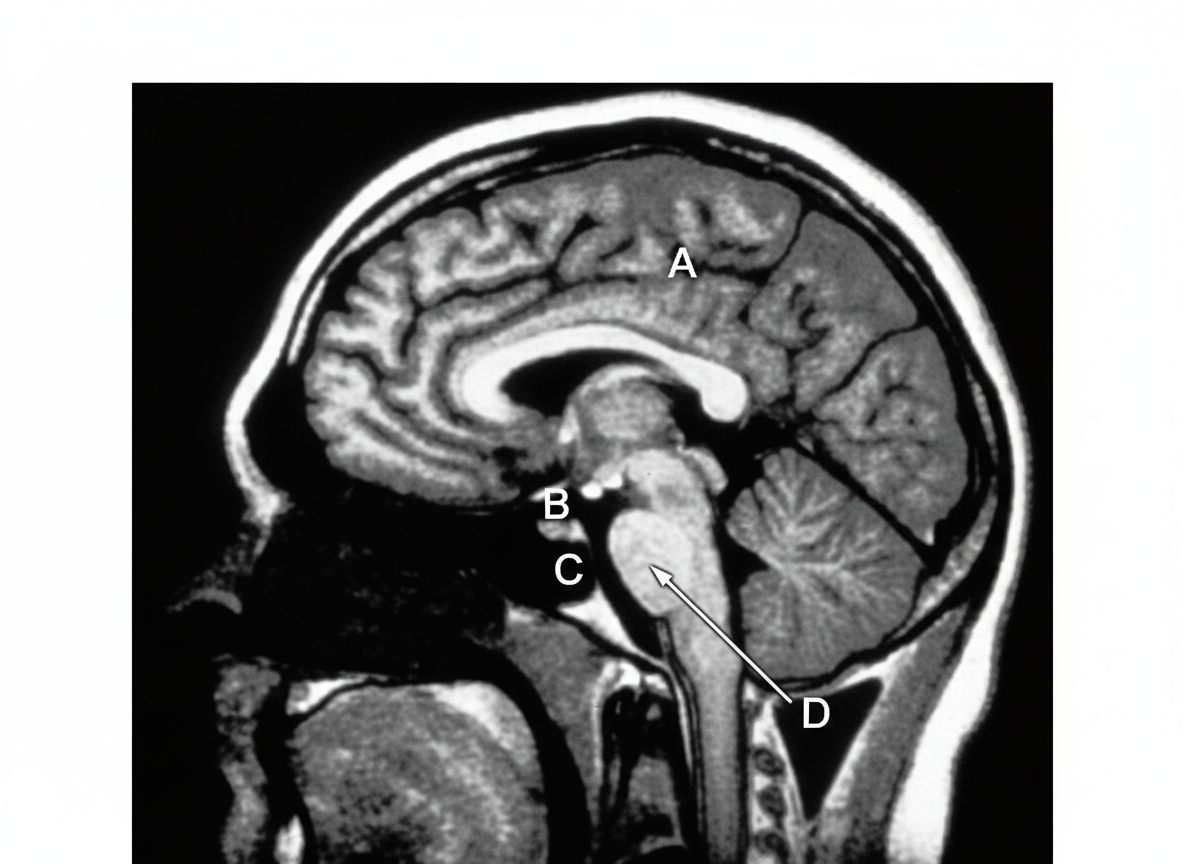
Which of the following features differentiates hydranencephaly from hydrocephalus?
Which of the following statements about the cerebellum is incorrect?
A 26-year-old asymptomatic woman is found to have arrhythmias and a systolic murmur associated with mid-systolic clicks. Which investigation would you use?
Occlusion of which of the following blood vessels can result in hemiplegia?
Medullary carcinoma of thyroid is associated with mutation in which gene?
Which of the following eye muscles is supplied by the contralateral nerve nucleus?
Two internal cerebral veins fuse to form which of the following?
Wire loop lesions are seen in which condition?
The HLA class II region genes are an important element in which of the following?
What is the major mineral component of the cell membrane?
Explanation: The fundamental difference between **hydranencephaly** and **hydrocephalus** lies in the presence or absence of the cerebral mantle. 1. **Why Option C is Correct:** In **hydranencephaly**, the cerebral hemispheres are largely absent and replaced by sacs filled with cerebrospinal fluid (CSF). This is typically due to a vascular insult (e.g., bilateral internal carotid artery occlusion) during fetal development. The **cerebral cortex is deficient or hypoplastic**, while the brainstem, cerebellum, and thalami usually remain intact. In contrast, **hydrocephalus** is a disorder of CSF dynamics (production, flow, or absorption) where the cerebral cortex is present but may be thinned or compressed due to increased intracranial pressure [1], [2]. 2. **Why Other Options are Incorrect:** * **Option A & B:** These are common misconceptions. While hydranencephaly involves a loss of brain tissue, the head size can still increase (macrocephaly) because CSF continues to be produced by the choroid plexus, leading to expansion of the fluid-filled sac [2], [3]. Therefore, hydranencephaly is not necessarily "static" in size, nor is it characterized by a lack of head growth. **NEET-PG High-Yield Pearls:** * **Transillumination Test:** Classically positive in hydranencephaly (the entire skull glows) because there is no overlying cortex to block the light. * **Vascular Territory:** Hydranencephaly usually affects the territory of the **Anterior and Middle Cerebral Arteries**, sparing the structures supplied by the Posterior Cerebral Artery (e.g., thalami, occipital lobes). * **Imaging:** On CT/MRI, the absence of the falx cerebri is seen in holoprosencephaly, but the **falx is present** in hydranencephaly, helping to differentiate the two.
Explanation: ### Explanation The cerebellum functions through a complex circuit of excitatory and inhibitory signals. Understanding the histology and connectivity of the cerebellar cortex is high-yield for NEET-PG [1]. **Why Option C is Incorrect (The Correct Answer):** Mossy fibers are **excitatory**, not inhibitory [1]. They originate from the spinal cord and brainstem nuclei (e.g., spinocerebellar, pontocerebellar tracts). Crucially, they do not contact Purkinje cells directly. Instead, they synapse on **Granule cells**, which then give rise to parallel fibers that excite Purkinje cells [1]. Therefore, the mossy fiber pathway is an indirect excitatory input. **Analysis of Other Options:** * **Option A:** This is a classic "3-4-5" rule of cerebellar anatomy. It has **3 layers** (Molecular, Purkinje, Granular), **4 deep nuclei** (Dentate, Emboliform, Globose, Fastigial), and **5 cell types** (Purkinje, Granule, Stellate, Basket, and Golgi) [1]. * **Option B:** Climbing fibers (originating from the **Inferior Olivary Nucleus**) and Mossy fibers are the two primary afferent (input) systems to the cerebellum [2]. * **Option D:** Climbing fibers are highly excitatory. A single climbing fiber wraps around a single Purkinje cell, creating one of the most powerful excitatory synapses in the CNS (producing "complex spikes") [2]. **High-Yield Clinical Pearls for NEET-PG:** * **All output** from the cerebellar cortex is via **Purkinje cells**, which are **inhibitory (GABAergic)** to the deep cerebellar nuclei [1]. * **Granule cells** are the only **excitatory** neurons within the cerebellar cortex; the other four (Purkinje, Golgi, Stellate, Basket) are inhibitory [1]. * **Lesion Localization:** Midline lesions (vermis) cause truncal ataxia/gait instability; lateral lesions (hemispheres) cause limb ataxia and dysmetria [1].
Explanation: **Explanation:** The clinical presentation of a young, asymptomatic female with **mid-systolic clicks** and a **late systolic murmur** is the classic diagnostic triad for **Mitral Valve Prolapse (MVP)**, also known as Barlow’s Syndrome [1]. 1. **Why Echocardiography is correct:** Echocardiography is the **gold standard** and the investigation of choice for diagnosing MVP. It allows for the visualization of the displacement of one or both mitral valve leaflets (usually >2 mm) into the left atrium during systole. It also assesses the severity of associated mitral regurgitation and ventricular function. 2. **Why other options are incorrect:** * **Electrophysiological testing:** While MVP is associated with arrhythmias (like PVCs or PACs), EP studies are invasive and reserved for complex rhythm disorders, not for the primary diagnosis of the underlying valvular structural defect. * **Technetium scan:** This is a nuclear medicine study used for myocardial perfusion or identifying infarcted tissue; it has no role in diagnosing valvular morphology. * **Angiography:** This is an invasive procedure primarily used to visualize coronary arteries or quantify regurgitation before surgery. It is not a first-line diagnostic tool for MVP. **High-Yield Clinical Pearls for NEET-PG:** * **MVP Association:** Frequently associated with connective tissue disorders like **Marfan Syndrome** and Ehlers-Danlos Syndrome. * **Auscultation Dynamics:** The murmur and click in MVP occur **earlier** with maneuvers that decrease preload (e.g., standing, Valsalva) and **later** with maneuvers that increase preload (e.g., squatting). * **Most common cause:** Myxomatous degeneration of the mitral valve leaflets [1].
Explanation: **Explanation:** **Middle Cerebral Artery (MCA)** is the correct answer because it supplies the majority of the **primary motor cortex** (Precentral gyrus) and the **internal capsule** (via lenticulostriate branches). The motor cortex contains the upper motor neurons responsible for voluntary movement. Specifically, the MCA supplies the areas representing the face and upper limbs [2]. Occlusion leads to contralateral hemiplegia (paralysis) and hemisensory loss, typically affecting the face and arm more than the leg [4]. **Analysis of Incorrect Options:** * **Anterior Cerebral Artery (ACA):** While ACA occlusion can cause motor deficits, it primarily affects the medial aspect of the motor cortex (paracentral lobule), which represents the **lower limb**. It results in monoplegia or hemiplegia where the leg is more affected than the arm/face. * **Posterior Cerebral Artery (PCA):** This vessel primarily supplies the occipital lobe (visual cortex) and the inferior temporal lobe. Occlusion typically results in **visual field defects** (e.g., contralateral homonymous hemianopia with macular sparing) rather than motor paralysis. * **Posterior Communicating Artery:** This is a component of the Circle of Willis that connects the ICA and PCA systems. While an aneurysm here can cause a **CN III (Oculomotor) nerve palsy**, its occlusion does not directly cause hemiplegia [3]. **High-Yield NEET-PG Pearls:** * **Most common site of stroke:** Middle Cerebral Artery [2]. * **Lenticulostriate Arteries:** Branches of the MCA known as the "arteries of stroke/cerebral hemorrhage," frequently involved in hypertensive bleeds affecting the internal capsule [1]. * **Total MCA Syndrome:** Presents with "Global Aphasia" (if dominant hemisphere), contralateral hemiplegia, and hemianesthesia.
Explanation: **Explanation:** **Medullary Carcinoma of the Thyroid (MTC)** is a neuroendocrine tumor arising from the **Parafollicular C-cells** (which secrete calcitonin) [3]. These cells are embryologically derived from the neural crest [3]. 1. **Why RET is correct:** The **RET proto-oncogene** (located on chromosome 10q11.2) encodes a receptor tyrosine kinase. Mutations in RET lead to constitutive activation of the receptor, driving oncogenesis. * **Germline mutations** in RET are responsible for nearly 100% of hereditary MTC cases (MEN 2A and 2B syndromes) [2]. * **Somatic mutations** in RET are found in approximately 50% of sporadic MTC cases. 2. **Why the other options are incorrect:** * **RAS:** Mutations in the RAS family (HRAS, KRAS, NRAS) are commonly associated with **Follicular Thyroid Carcinoma** and the follicular variant of Papillary Thyroid Carcinoma, but not typically MTC. * **NF (Neurofibromatosis):** Mutations in NF1 or NF2 are associated with Neurofibromatosis types 1 and 2, leading to tumors like neurofibromas, optic gliomas, and acoustic neuromas. * **Rb (Retinoblastoma):** The Rb tumor suppressor gene mutation is the hallmark of Retinoblastoma and Osteosarcoma. **High-Yield Clinical Pearls for NEET-PG:** * **MEN 2A:** MTC + Pheochromocytoma + Parathyroid Hyperplasia [1]. * **MEN 2B:** MTC + Pheochromocytoma + Mucosal Neuromas/Marfanoid habitus [1]. * **Tumor Marker:** Calcitonin is used for diagnosis and monitoring recurrence [3]. * **Histology:** Characterized by nests of cells in a prominent **Amyloid stroma** (stained with Congo Red). * **Prophylaxis:** In families with known RET mutations, prophylactic thyroidectomy is often performed in early childhood.
Explanation: ### **Explanation** The **Oculomotor nucleus (CN III)**, located in the midbrain at the level of the superior colliculus, is a complex of subnuclei. The innervation pattern of these subnuclei is unique and high-yield for NEET-PG: 1. **Superior Rectus (SR):** This is the only extraocular muscle supplied by the **contralateral** oculomotor nucleus. Axons from the SR subnucleus decussate (cross) within the midbrain before emerging as part of the opposite oculomotor nerve. Therefore, a lesion of the SR subnucleus affects the contralateral eye. 2. **Levator Palpebrae Superioris (LPS):** This muscle is supplied by a single midline structure called the **Central Caudal Nucleus**, which provides bilateral innervation. 3. **Other Muscles (MR, IR, IO):** The subnuclei for the Medial Rectus, Inferior Rectus, and Inferior Oblique provide **ipsilateral** innervation [1]. --- ### **Analysis of Options** * **A. Superior Rectus (Correct):** As explained, its fibers decussate within the brainstem, making it the only muscle supplied by the contralateral nucleus [1]. * **B. Inferior Rectus:** Supplied by the ipsilateral subnucleus of CN III. * **C. Medial Rectus:** Supplied by the ipsilateral subnucleus of CN III. * **D. Inferior Oblique:** Supplied by the ipsilateral subnucleus of CN III. --- ### **NEET-PG High-Yield Pearls** * **Trochlear Nerve (CN IV):** While the SR is the only muscle supplied by a contralateral *nucleus*, the Trochlear nerve is the only cranial nerve that exits the brainstem **dorsally** and whose fibers decussate completely before exiting. It supplies the Superior Oblique. * **Edinger-Westphal Nucleus:** The parasympathetic component of CN III; it provides bilateral innervation to the constrictor pupillae and ciliary muscles. * **Rule of Thumb:** All extraocular muscles are supplied by ipsilateral nuclei except the **Superior Rectus** (Contralateral) and **Superior Oblique** (Contralateral nucleus, though the nerve itself is named by its exit).
Explanation: **Explanation** The **Great Cerebral Vein (of Galen)** is a short, thick venous trunk formed by the union of the **two internal cerebral veins**. This union occurs just below and behind the splenium of the corpus callosum. The Great Cerebral Vein then travels posteriorly to join the inferior sagittal sinus, together forming the **Straight Sinus**. **Analysis of Options:** * **Great Cerebral Vein (Correct):** It is a key deep venous structure. It receives the two internal cerebral veins and the two basal veins (of Rosenthal). * **Middle Cerebral Vein (Incorrect):** This is divided into superficial and deep parts. The superficial middle cerebral vein runs in the lateral sulcus and drains into the cavernous sinus, while the deep middle cerebral vein joins the anterior cerebral vein to form the basal vein. * **Anterior Cerebral Vein (Incorrect):** This vein accompanies the anterior cerebral artery and joins the deep middle cerebral vein to form the Basal Vein of Rosenthal. * **Inferior Cerebral Vein (Incorrect):** These are small veins on the inferior surface of the hemispheres that drain into the cavernous and transverse sinuses. **NEET-PG High-Yield Pearls:** 1. **Formation of Straight Sinus:** Great Cerebral Vein + Inferior Sagittal Sinus = Straight Sinus. 2. **Basal Vein of Rosenthal:** Formed by the union of the Anterior Cerebral Vein, Deep Middle Cerebral Vein, and Inferior Striate Veins. 3. **Internal Cerebral Veins:** Formed at the interventricular foramen (of Monro) by the union of the **Thalamostriate vein** and the **Choroid vein**. 4. **Clinical Significance:** Obstruction or malformations (Vein of Galen Malformation) can lead to high-output heart failure in neonates or hydrocephalus [1].
Explanation: **Explanation:** **Correct Answer: A. Systemic Lupus Erythematosus (SLE)** "Wire loop lesions" are a classic histopathological hallmark of **Lupus Nephritis (Class IV - Diffuse Proliferative Glomerulonephritis)**. These lesions represent the subendothelial deposition of immune complexes (IgG, IgA, IgM, C3, and C1q) along the glomerular basement membrane (GBM). On light microscopy, this causes massive, rigid thickening of the capillary loops, giving them a characteristic "wire-like" appearance. **Analysis of Incorrect Options:** * **B. Diabetic Nephropathy:** Characterized by **Kimmelstiel-Wilson (KW) nodules** (nodular glomerulosclerosis) and diffuse thickening of the GBM, but not wire loop lesions. * **C. Benign Nephrosclerosis:** Associated with long-standing hypertension, showing **hyaline arteriolosclerosis** (pink, homogeneous thickening of arteriolar walls) and "leather-grained" kidneys. * **D. Wegener's Granulomatosis (GPA):** Typically presents as a **Crescentic Glomerulonephritis** (RPGN Type III - Pauci-immune). It is characterized by necrotizing lesions and crescent formation in Bowman’s space, rather than subendothelial deposits. **High-Yield Clinical Pearls for NEET-PG:** * **Full House Pattern:** On Immunofluorescence (IF), SLE shows positivity for IgG, IgA, IgM, C3, and C1q. * **Electron Microscopy (EM):** Wire loop lesions correspond to **subendothelial deposits**. In contrast, "Subepithelial" deposits (Spike and Dome) are seen in Membranous Nephropathy. * **Most Common/Severe SLE Nephritis:** Class IV (Diffuse Proliferative) is the most common and most severe form, where wire loops are most prominent.
Explanation: **Explanation:** The Human Leukocyte Antigen (HLA) system, located on the short arm of chromosome 6, is the Major Histocompatibility Complex (MHC) in humans. **HLA Class II genes (HLA-DR, DQ, and DP)** are primarily expressed on antigen-presenting cells (APCs). **Why Option B is Correct:** The strongest association of the HLA system with clinical medicine is its role in **governing susceptibility to autoimmune diseases** [1]. Specific HLA Class II alleles are linked to an increased risk of certain conditions because they may inefficiently present self-antigens during T-cell maturation in the thymus (leading to a failure of central tolerance) or present self-antigens to mature T-cells in the periphery, triggering an autoimmune response [1]. **Analysis of Incorrect Options:** * **Option A (Graft rejection):** While HLA matching is vital, graft rejection is primarily mediated by **HLA Class I** (HLA-A, B) and Class II molecules acting as targets for the recipient’s T-cells. However, "governing susceptibility" is a more specific hallmark of Class II gene associations. * **Option C (Immune surveillance):** This is primarily the function of **HLA Class I** molecules, which present endogenous peptides (like viral or tumor antigens) to CD8+ Cytotoxic T-cells. * **Option D (Antigen presentation):** While Class II molecules do present exogenous antigens to CD4+ T-cells, this is a general physiological function. The question asks what the *region genes* are an important element in, pointing towards the genetic predisposition to disease. **High-Yield Clinical Pearls for NEET-PG:** * **HLA-B27 (Class I):** Strongly associated with Seronegative Spondyloarthropathies (Ankylosing Spondylitis). * **HLA-DR3/DR4 (Class II):** Associated with Type 1 Diabetes Mellitus [1]. * **HLA-DR4 (Class II):** Associated with Rheumatoid Arthritis. * **HLA-DQ2/DQ8 (Class II):** Associated with Celiac Disease. * **Mnemonic:** Class **I** has **1** letter (A, B, C) and interacts with CD**8** (1x8=8). Class **II** has **2** letters (DR, DP, DQ) and interacts with CD**4** (2x4=8).
Explanation: **Explanation:** The cell membrane is primarily composed of a **phospholipid bilayer** [1]. The "Phospho-" component refers to the phosphate group, which contains **Phosphorus** as its central mineral element. Each phospholipid molecule consists of a polar, hydrophilic head (containing the phosphate group) and two non-polar, hydrophobic fatty acid tails [1]. This arrangement is fundamental to the "Fluid Mosaic Model," providing the structural integrity and selective permeability required for cellular function. **Analysis of Options:** * **Phosphorus (Correct):** It is the key mineral constituent of the phosphate heads that form the outer and inner surfaces of the plasma membrane [1]. * **Cholesterol (Incorrect):** While cholesterol is a major *lipid* component of the cell membrane (regulating fluidity), it is an organic molecule, not a mineral. * **Calcium (Incorrect):** Calcium is a vital secondary messenger and is often bound to the exterior of the membrane or stored in the endoplasmic reticulum, but it is not a structural mineral component of the membrane itself. * **Sodium (Incorrect):** Sodium is the chief extracellular cation. While it interacts with membrane channels and pumps (like the Na+/K+ ATPase) [2], it is not a constituent part of the membrane structure. **High-Yield Clinical Pearls for NEET-PG:** * **Ratio:** The protein-to-lipid ratio varies by cell type; for example, **Myelin** has a high lipid content (80%) for insulation, whereas the **Inner Mitochondrial Membrane** is protein-rich (75%) for the electron transport chain. * **Amphipathic Nature:** Phospholipids are amphipathic, meaning they possess both hydrophilic (water-loving) and hydrophobic (water-fearing) properties [1]. * **Glycocalyx:** The carbohydrate coat on the outer surface of the membrane is essential for cell recognition and immune response.
Organization of the Nervous System
Practice Questions
Spinal Cord Anatomy
Practice Questions
Brainstem Anatomy
Practice Questions
Cerebellum
Practice Questions
Diencephalon
Practice Questions
Cerebral Cortex
Practice Questions
Basal Ganglia
Practice Questions
Limbic System
Practice Questions
Cranial Nerves
Practice Questions
Autonomic Nervous System
Practice Questions
Neural Pathways and Tracts
Practice Questions
Neurovascular Anatomy
Practice Questions
Get full access to all questions, explanations, and performance tracking.
Start For Free