Venous return to the heart during quiet standing is facilitated by all of the following factors EXCEPT?
Which of the following are antigen-presenting cells?
The testes are developed from which embryonic structure?
Which nerve roots contribute to the dermatome supplying the thumb and index finger?
Which of the following hormones has a cytoplasmic receptor?
A child climbs with alternate steps, builds a tower of 8-9 cubes, uses pronouns like 'I', but cannot state their name, age, or sex. What is the probable age of this child?
Which of the following are associated with endocytosis?
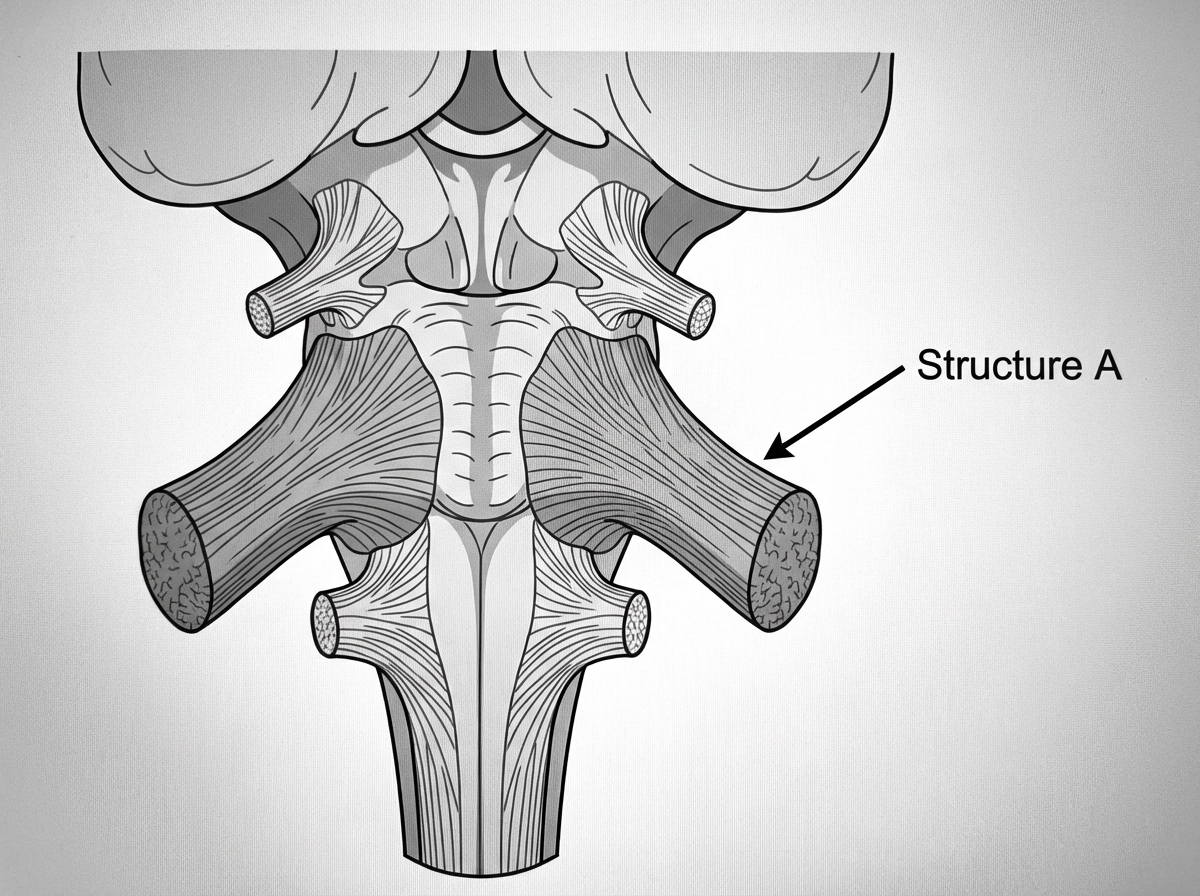
Which of the following cranial nerves are attached to the medulla?
Wallerian degeneration involves:
Which of the following is NOT a neuronal tumor?
Explanation: The venous return from the lower limbs against gravity is primarily driven by the **"Musculovenous Pump"** (often called the peripheral heart) [1]. **Why Option C is the Correct Answer:** There are **no valves in the deep fascia** itself. The deep fascia of the leg is a tough, inelastic sheath that acts as a boundary. When calf muscles contract, this rigid fascia prevents the muscles from expanding outward, instead forcing the pressure inward to compress the deep veins and propel blood upward [1]. While valves exist *within* the veins located deep to the fascia, the fascia itself is a fibrous tissue layer devoid of valves. **Analysis of Incorrect Options:** * **Option A (Calf muscle contraction):** Even during "quiet standing," micro-contractions and postural sway occur. These contractions compress the deep veins (like the soleal sinusoids), pumping blood toward the heart [1], [2]. * **Option B (Valves in perforating veins):** Perforating veins connect superficial veins to deep veins. Their valves ensure blood flows in only one direction—from superficial to deep. This prevents blood from being pushed back into the skin during muscle contraction, facilitating efficient return [1]. * **Option D (Gravitational increase in venous pressure):** Paradoxically, gravity increases hydrostatic pressure in the foot veins (up to 90 mmHg). This distends the veins, which, according to the Frank-Starling-like mechanism in vessels, allows for a larger volume of blood to be moved when the muscle pump eventually activates [3]. **NEET-PG High-Yield Pearls:** * **Soleus Muscle:** Known as the **"Peripheral Heart"** because it contains large venous sinuses (soleal sinuses) that lack valves and act as a reservoir [1]. * **Direction of Flow:** Normal flow is **Superficial → Perforators → Deep** [1]. * **Clinical Correlation:** Failure of valves in the perforating veins leads to **Varicose Veins** due to high-pressure blood regurgitating into the superficial system [2].
Explanation: In the context of neuroanatomy and immunology, **Antigen-Presenting Cells (APCs)** are specialized cells that process and present antigens to T-cells. While professional APCs (like dendritic cells) are well-known, certain non-professional cells also perform this function under specific conditions. [1] **Why Endothelial Cells are correct:** In the Central Nervous System (CNS), the **vascular endothelial cells** forming the blood-brain barrier (BBB) act as non-professional APCs. They can be induced to express MHC Class II molecules and costimulatory signals (like CD40 and ICOSL) in response to inflammatory cytokines. This allows them to present antigens to circulating T-lymphocytes, facilitating their entry into the CNS during neuroinflammatory processes. [2] **Analysis of Incorrect Options:** * **Astrocytes (A):** While astrocytes provide structural support and maintain the BBB, they are generally considered poor APCs. They lack significant expression of costimulatory molecules required for effective T-cell activation compared to endothelial cells or microglia. * **Epithelial cells (C):** These are structural cells lining surfaces. While some specialized epithelia (like M-cells in the gut) have immune roles, they are not the primary APCs in the context of neuro-vasculature. * **Langerhans cells (D):** These are professional APCs (dendritic cells) found in the **stratum spinosum of the skin**, not the CNS [3]. While they are potent APCs, they are anatomically irrelevant to neuroanatomy questions unless discussing skin innervation. **High-Yield Clinical Pearls for NEET-PG:** * **Microglia** are the primary "resident" professional APCs of the CNS (derived from yolk sac macrophages). * **Virchow-Robin spaces** contain pial macrophages which also act as potent APCs. * **MHC Expression:** CNS neurons normally do not express MHC Class I or II, making them "immunologically privileged" to prevent autoimmune destruction. [1]
Explanation: The development of the gonads is a high-yield topic in embryology. Here is the breakdown of the question: ### **Explanation of the Correct Answer** The **Genital Ridge** (or Gonadal Ridge) is the precursor to the gonads (testes in males, ovaries in females). It is formed by the proliferation of the **coelomic epithelium** and the condensation of the underlying **intermediate mesoderm** on the medial aspect of the mesonephros. * During the 5th week of development, primordial germ cells migrate from the yolk sac to these ridges. * In males, the presence of the **SRY gene** on the Y chromosome triggers the differentiation of the genital ridge into the testes. ### **Why Other Options are Incorrect** * **B. Genital Tubercle:** This is the precursor to the **external genitalia**. In males, it develops into the glans penis and the corpora cavernosa/spongiosum; in females, it becomes the clitoris [1]. * **C & D. Wolffian Duct (Mesonephric Duct):** These are the same structure. Under the influence of testosterone, the Wolffian duct differentiates into the **internal male genital passages**, specifically the epididymis, vas deferens, and seminal vesicles [1]. It does *not* form the testis itself. ### **NEET-PG High-Yield Pearls** 1. **Descent:** The testes begin their descent from the lumbar region (L2-L3) towards the scrotum, guided by the **gubernaculum**. 2. **Blood Supply:** Because the testes develop near the kidneys (L2 level), the testicular arteries arise directly from the **Abdominal Aorta**. 3. **Lymphatic Drainage:** Lymph from the testes drains to the **Para-aortic nodes**, whereas lymph from the scrotum drains to the **Superficial Inguinal nodes**. 4. **Remnants:** The **Appendix of the testis** is a vestigial remnant of the Paramesonephric (Müllerian) duct in males.
Explanation: ### Explanation **Correct Answer: B (C5, C6)** The sensory innervation of the upper limb follows a sequential segmental distribution (dermatomes) derived from the brachial plexus. The **C6 dermatome** is the primary supply for the **thumb** (lateral aspect) and often extends to include the **index finger**. In many clinical anatomical models, the transition between C6 and C7 occurs at the index or middle finger [1]. Therefore, the C5 and C6 roots are the major contributors to the lateral forearm and the first two digits. **Analysis of Options:** * **C5, C6 (Correct):** C5 supplies the lateral aspect of the arm (deltoid area), while C6 supplies the lateral forearm, the thumb, and the radial half of the index finger [1]. * **C6, C7:** While C7 supplies the middle finger (and sometimes the index), C6 is the definitive root for the thumb. This pair is less accurate for the specific "thumb and index" combination. * **C7, C8:** C7 primarily supplies the middle finger, while C8 supplies the ring finger, little finger, and medial aspect of the hand/wrist. * **C5, C6 (Duplicate):** Note that in the provided options, B and D are identical; both represent the correct segmental contribution. **Clinical Pearls for NEET-PG:** 1. **The "Hand" Rule:** * **C6:** Thumb ("6" looks like a 'b' for 'thumb' or use your hand to make a '6' with your thumb). * **C7:** Middle finger (The "7th" heaven/middle). * **C8:** Little finger. 2. **Reflex Correlation:** C6 is also the root responsible for the **Brachioradialis reflex** and **Biceps reflex**. 3. **Clinical Correlation:** A herniated disc at the **C5-C6 level** typically compresses the **C6 nerve root**, leading to paresthesia in the thumb and weakness in wrist extension.
Explanation: The location of a hormone receptor is primarily determined by the hormone's chemical nature (solubility). Hormones are categorized into two main groups: **Lipid-soluble** (can cross the cell membrane) and **Water-soluble** (cannot cross the cell membrane). [1] **1. Why Cortisol is Correct:** Cortisol is a **steroid hormone** derived from cholesterol. [2] Being lipophilic, it easily diffuses through the lipid bilayer of the plasma membrane. [1] Once inside the cell, it binds to its specific **cytoplasmic receptor**. This hormone-receptor complex then translocates into the nucleus to act as a transcription factor, modulating gene expression. **2. Why the Other Options are Incorrect:** * **Epinephrine (Option A):** This is a catecholamine (amino acid derivative). [2] Despite its small size, it is polar and cannot cross the membrane; it binds to **G-protein coupled receptors (GPCRs)** on the cell surface. * **Insulin (Option B):** This is a large peptide hormone. It binds to a transmembrane **Receptor Tyrosine Kinase (RTK)** on the cell surface. * **FSH (Option C):** Follicle-Stimulating Hormone is a large glycoprotein. Like other pituitary hormones, it binds to **extracellular GPCRs** that utilize the cAMP second messenger system. **High-Yield NEET-PG Pearls:** * **Cytoplasmic Receptors:** Primarily used by **Glucocorticoids** (Cortisol), Mineralocorticoids (Aldosterone), and Progesterone. * **Nuclear Receptors:** Used by **Thyroid hormones (T3/T4)**, Retinoic acid, Vitamin D, Estrogen, and Testosterone. *Note: T3/T4 are unique because they are amino acid derivatives but act via nuclear receptors.* * **Mnemonic for Steroids:** "All Steroids are Lipophilic" – they always have intracellular receptors (either cytoplasmic or nuclear). [1]
Explanation: This question tests the integration of developmental milestones, a high-yield topic for NEET-PG. To determine the correct age, one must analyze the milestones across four domains: gross motor, fine motor, language, and social. ### **Analysis of Milestones** 1. **Gross Motor:** Climbing stairs with **alternate steps** is a milestone achieved at **30 months**. At 24 months, children typically use a "two feet per step" pattern. 2. **Fine Motor:** Building a **tower of 8–9 cubes** is characteristic of a **30-month-old**. (Formula: Age in years × 3 = number of cubes. 2.5 years × 3 = 7.5 to 9 cubes). 3. **Language:** Using **pronouns like "I"** begins at **30 months**. However, the inability to state their full name, age, or sex is the key "upper limit" marker; these are **36-month** milestones. ### **Why Other Options are Incorrect** * **24 months:** A 2-year-old builds a tower of 6 cubes, kicks a ball, and uses 2-word phrases (e.g., "want milk"), but cannot yet climb stairs with alternating feet. * **36 months (3 years):** By this age, a child can ride a tricycle, build a tower of 9–10 cubes, and—crucially—**can state their name, age, and sex**. * **48 months (4 years):** A 4-year-old can hop on one foot, use scissors to cut paper, and tell stories. ### **NEET-PG Clinical Pearls** * **Stairs Rule:** 2 years (2 feet per step); 3 years (alternating up); 4 years (alternating down). * **Cube Tower Rule:** 15m (2 cubes), 18m (3 cubes), 24m (6 cubes), 30m (8-9 cubes), 36m (9-10 cubes). * **Language:** 18m (10 words), 24m (2-word sentences), 36m (3-word sentences + name/age/sex).
Explanation: ### Explanation **Endocytosis** is the cellular process by which substances are brought into the cell [1]. This process often requires specific proteins to facilitate the formation of vesicles from the plasma membrane. **Why the Correct Answer is Right:** * **Clathrin:** This is the most well-known protein associated with **receptor-mediated endocytosis** [2]. It forms a "triskelion" structure that assembles into a lattice-like coat, helping the membrane invaginate into "clathrin-coated pits" to internalize ligands [2]. * **Megalin (LRP2):** This is a large endocytic receptor found primarily in the **proximal convoluted tubules (PCT)** of the kidney and the choroid plexus. It acts as a multi-ligand scavenger receptor that mediates the endocytosis of proteins (like albumin and vitamins) from the glomerular filtrate, preventing their loss in urine. * Since both Clathrin and Megalin are integral to the endocytic pathway, **Option D** is the correct choice. **Why the Other Option is Incorrect:** * **SNARE Proteins (Soluble NSF Attachment Protein Receptors):** These are primarily involved in **exocytosis** and vesicular trafficking [3]. They mediate the **fusion** of vesicles with the target membrane (e.g., neurotransmitter release at the synapse) rather than the internalizing process of endocytosis [3]. **NEET-PG High-Yield Pearls:** * **Cubilin:** Often works alongside Megalin in the PCT for protein reabsorption. A deficiency in these leads to proteinuria (Donnai-Barrow syndrome). * **Dynamin:** A GTPase responsible for "pinching off" the clathrin-coated vesicle from the cell membrane [2]. * **Caveolae:** Small invaginations of the plasma membrane (associated with the protein **caveolin**) represent a clathrin-independent pathway of endocytosis [2].
Explanation: The brainstem is divided into the midbrain, pons, and medulla oblongata. The cranial nerves (CN) emerge from these segments in a sequential numerical order from superior to inferior. **Correct Answer: D (9th, 10th, 11th, and 12th)** The **medulla oblongata** serves as the exit point for the last four cranial nerves. Specifically: * **CN IX (Glossopharyngeal), X (Vagus), and XI (Accessory):** These emerge from the **posterolateral sulcus** (retro-olivary groove), located between the olive and the inferior cerebellar peduncle. * **CN XII (Hypoglossal):** This emerges from the **anterolateral sulcus** (pre-olivary groove), located between the pyramid and the olive. [2] **Incorrect Options:** * **Option A (1st and 2nd):** These are not true brainstem nerves. CN I (Olfactory) relates to the telencephalon, and CN II (Optic) relates to the diencephalon. * **Option B (3rd and 4th):** These are associated with the **Midbrain**. CN III emerges ventrally, while CN IV is the only nerve to emerge from the dorsal aspect. * **Option C (5th, 6th, 7th, and 8th):** These are associated with the **Pons**. CN V emerges from the mid-pons, while CN VI, VII, and VIII emerge at the **ponto-medullary junction**. [1] **High-Yield NEET-PG Pearls:** 1. **Rule of 4:** 4 nerves are in the medulla (9-12), 4 in the pons (5-8), and 2 in the midbrain (3-4). 2. **CN IV (Trochlear):** Has the longest intracranial course and is the only nerve to exit posteriorly. 3. **Medial vs. Lateral:** Nerves that divide into 12 (3, 4, 6, 12) are midline/medial. Lesions here (e.g., Medial Medullary Syndrome) typically involve CN XII.
Explanation: **Explanation:** **Wallerian Degeneration** refers to the sequence of events that occur distal to the site of a nerve injury (axotomy). [1] **1. Why Option C is Correct:** When an axon is severed, the distal segment loses its connection to the metabolic center (the cell body). Within 24–48 hours, the cytoskeleton breaks down, leading to the **successive fragmentation of the axon** and its myelin sheath. [1] This debris is subsequently cleared by macrophages and Schwann cells to prepare a path for potential regeneration. **2. Analysis of Incorrect Options:** * **Options A & D (Chromatolysis and Swelling of the cell body):** These describe the **Retrograde reaction** occurring in the *proximal* segment and the cell body (soma), not the distal segment. * **Option B (Only the CNS):** Wallerian degeneration occurs in both the Peripheral Nervous System (PNS) and the Central Nervous System (CNS). However, it is more efficient in the PNS due to Schwann cells; in the CNS, the process is slower and often inhibited by glial scarring. [2] **3. High-Yield Clinical Pearls for NEET-PG:** * **Timeline:** Degeneration begins within 24 hours; myelin sheath breakdown follows by day 3–5. * **Bands of Büngner:** These are columns of proliferating Schwann cells in the distal stump that guide the regenerating axon. [1] * **Nissl Substance:** Composed of Rough Endoplasmic Reticulum (RER); its disappearance (chromatolysis) is a hallmark of the cell body's response to injury. * **Regeneration Rate:** In the PNS, axons typically regrow at a rate of approximately **1–3 mm/day**.
Explanation: **Explanation:** The classification of Central Nervous System (CNS) tumors is based on the cell of origin. To answer this question, one must distinguish between **neuronal tumors** (derived from neurons or their precursors) and **glial tumors** (derived from supporting cells). **Why Ependymoma is the correct answer:** **Ependymoma** is a **glial tumor**, not a neuronal one [1]. It arises from the ependymal cells that line the ventricular system of the brain and the central canal of the spinal cord. Under microscopy, it is classically characterized by **perivascular pseudorosettes** [1]. **Analysis of incorrect options:** * **Neuroblastoma:** This is a primitive neuronal tumor arising from undifferentiated neural crest cells. It is the most common extracranial solid tumor of childhood, typically occurring in the adrenal medulla. * **Gangliocytoma:** A rare, slow-growing CNS tumor composed entirely of mature neoplastic neurons (ganglion cells) [2]. * **Ganglioglioma:** A mixed tumor containing both neoplastic neuronal elements (ganglion cells) and neoplastic glial elements (usually astrocytoma) [1]. Since it contains a significant neuronal component, it is classified under neuronal/mixed glioneuronal tumors [1]. **High-Yield Clinical Pearls for NEET-PG:** * **Most common primary CNS tumor:** Glioma (specifically Glioblastoma Multiforme in adults). * **Homer-Wright Rosettes:** Seen in Neuroblastoma and Medulloblastoma (indicates primitive neuroectodermal origin). * **Perivascular Pseudorosettes:** Pathognomonic for Ependymoma [1]. * **Location:** In children, ependymomas most commonly arise in the **fourth ventricle**, often leading to obstructive hydrocephalus. In adults, they are more common in the spinal cord.
Organization of the Nervous System
Practice Questions
Spinal Cord Anatomy
Practice Questions
Brainstem Anatomy
Practice Questions
Cerebellum
Practice Questions
Diencephalon
Practice Questions
Cerebral Cortex
Practice Questions
Basal Ganglia
Practice Questions
Limbic System
Practice Questions
Cranial Nerves
Practice Questions
Autonomic Nervous System
Practice Questions
Neural Pathways and Tracts
Practice Questions
Neurovascular Anatomy
Practice Questions
Get full access to all questions, explanations, and performance tracking.
Start For Free