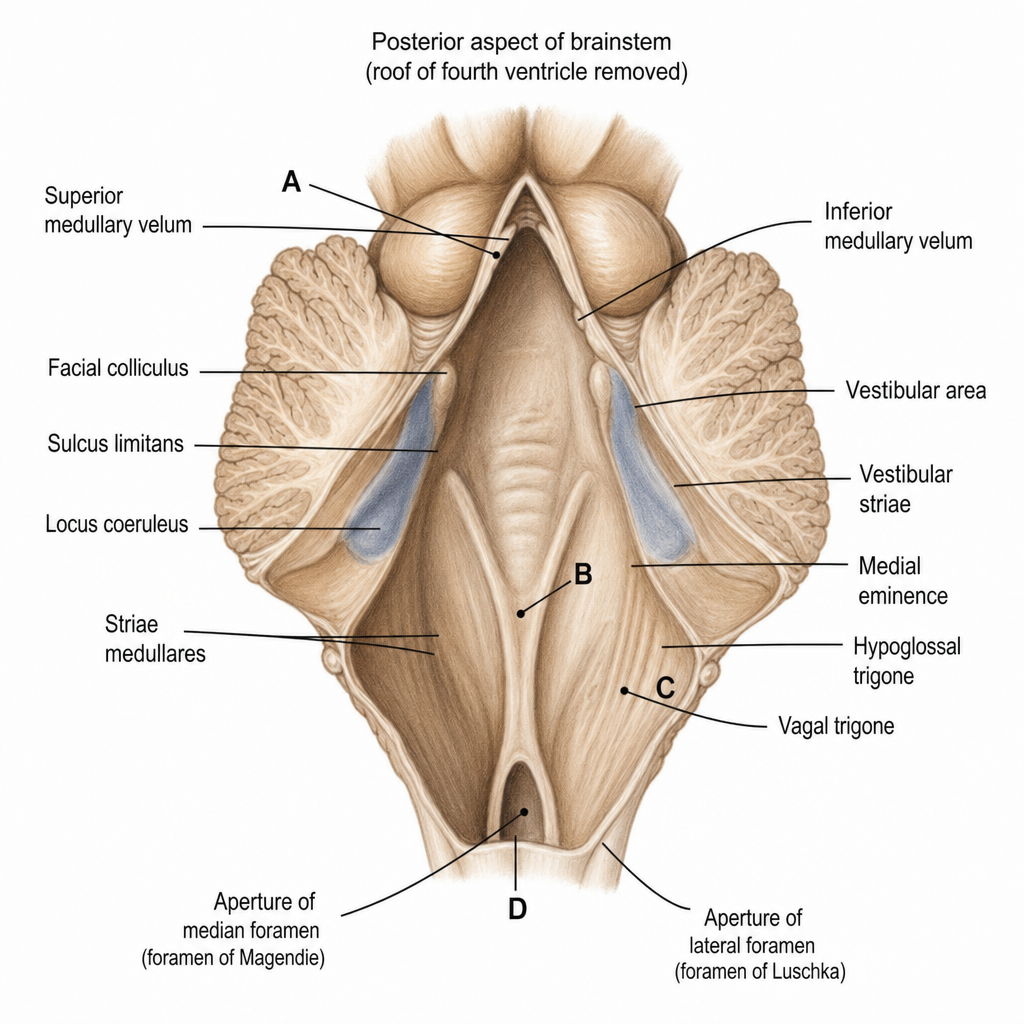
In stratified squamous epithelium, what is the shape of the cells in the basal layer?
Which glial cell type is primarily responsible for phagocytosis in the central nervous system?
What is the remnant of the omphalomesenteric duct?
Edema in nephrotic syndrome occurs due to:
Parasympathetic fibers arise from all the following cranial nerves except?
Which of the following is NOT a granulomatous disease?
What type of epithelium lines the common bile duct?
A patient presents with random, disconnected thoughts that do not lead to a goal. What type of thought disorder is this, which is classical of schizophrenia?
Which of the following cranial nerves carries parasympathetic fibers?
Which of the following is NOT true about dentition?
Explanation: The classification of stratified epithelium is based on the shape of the cells in the **superficial (topmost) layer**, not the basal layer. In stratified squamous epithelium, while the surface cells are flattened (squamous), the deeper layers undergo constant mitosis to replace shed cells [1]. **1. Why the correct answer is right:** The basal layer (stratum basale) consists of germinal cells resting on the basement membrane. These cells are metabolically active and undergo frequent division [1]; therefore, they require more cytoplasmic volume and organelles than flattened cells. Consequently, the basal cells are typically **cuboidal or columnar** in shape. As these cells migrate toward the surface, they become progressively dehydrated, flattened, and squamous. **2. Why the other options are wrong:** * **A. Squamous:** Only the most superficial layers are squamous. If the basal cells were squamous, the tissue would likely be "simple squamous" or would lack the regenerative capacity required for stratified tissue. * **B & C. Cuboidal / Columnar:** While both are found in the basal layer, selecting only one is incomplete. Depending on the specific location (e.g., esophagus vs. skin) and the rate of proliferation, the basal layer can transition between these two shapes. **3. NEET-PG High-Yield Pearls:** * **Classification Rule:** Always name stratified epithelium by its **surface layer**. * **Types:** Stratified squamous is divided into **Keratinized** (e.g., skin/epidermis) and **Non-keratinized** (e.g., esophagus, vagina, cornea). * **Clinical Correlation:** In **Metaplasia**, one adult cell type replaces another (e.g., Barrett’s Esophagus, where stratified squamous changes to simple columnar) to better withstand environmental stress. * **Basement Membrane:** All basal cells, regardless of shape, are anchored to the basement membrane via **hemidesmosomes**.
Explanation: **Explanation:** **Correct Answer: C. Microglia** Microglia are the resident macrophages of the Central Nervous System (CNS) [1]. Unlike other glial cells derived from the neuroectoderm, microglia originate from **mesodermal yolk sac progenitors** that migrate into the brain during embryonic development [1]. They act as the primary immune defense; when brain injury or infection occurs, microglia become "activated," transforming from a branched (ramified) state into a mobile, amoeboid shape to perform **phagocytosis** of cellular debris, plaques, and pathogens [1], [2]. **Analysis of Incorrect Options:** * **A. Astrocytes:** These are the most numerous glial cells. Their primary roles include forming the **Blood-Brain Barrier (BBB)**, maintaining extracellular ion balance (K+ buffering), and providing structural support [1]. While they can perform limited phagocytosis, it is not their primary function. * **B. Oligodendrocytes:** These cells are responsible for **myelinating axons within the CNS** [1], [2]. A single oligodendrocyte can myelinate multiple segments of several different axons [2]. * **C. Schwann cells:** These are found in the **Peripheral Nervous System (PNS)**, not the CNS. Their primary role is myelinating peripheral nerves (one Schwann cell per axon segment) [2]. **High-Yield Clinical Pearls for NEET-PG:** * **Origin:** Microglia are the only glial cells of **mesodermal** origin (others are ectodermal) [1]. * **HIV Pathology:** Microglia are the primary target of HIV in the brain; they fuse to form **multinucleated giant cells**, a hallmark of HIV-associated dementia [1]. * **Gitter Cells:** These are activated, lipid-laden microglia seen in areas of liquefactive necrosis (e.g., brain infarct). * **Staining:** Microglia can be visualized using silver stains (e.g., Rio-Hortega method).
Explanation: Explanation: The **omphalomesenteric duct** (also known as the vitelline duct) is an embryonic structure that connects the primitive yolk sac to the midgut [3]. Normally, this duct completely obliterates between the 5th and 8th weeks of gestation. If the ileal end of the duct fails to atrophy, it persists as **Meckel’s diverticulum** [1], [3]. **Analysis of Options:** * **Meckel’s Diverticulum (Correct):** It is a true diverticulum (containing all layers of the bowel wall) located on the antimesenteric border of the ileum. * **Median Umbilical Ligament:** This is the fibrous remnant of the **urachus** (which connects the fetal bladder to the umbilicus), not the vitelline duct [3]. * **Medial Umbilical Fold:** This is formed by the obliterated **umbilical arteries**. * **Omphalocele:** This is a congenital abdominal wall defect where herniated bowel remains covered by a peritoneal sac; while it involves the umbilicus, it is not a "remnant" of the duct itself. **High-Yield Clinical Pearls for NEET-PG:** * **Rule of 2s:** Occurs in 2% of the population, located 2 feet proximal to the ileocecal valve, is 2 inches long, contains 2 types of ectopic tissue (most commonly **Gastric**, followed by Pancreatic), and usually presents by age 2 [1]. * **Clinical Presentation:** The most common presentation in children is painless lower GI bleeding (due to acid secretion from ectopic gastric mucosa causing ileal ulcers) [1], [2]. In adults, it often presents as intestinal obstruction or diverticulitis (mimicking appendicitis) [2]. * **Diagnosis:** The investigation of choice for a bleeding Meckel’s is the **Technetium-99m pertechnetate scan** (Meckel’s scan), which identifies ectopic gastric mucosa.
Explanation: The primary mechanism of edema in Nephrotic Syndrome is explained by the **Starling Hypothesis**, which governs fluid movement between the capillary and the interstitium. **Why "Decreased serum albumin" is correct:** Nephrotic syndrome is characterized by massive proteinuria (>3.5g/day) due to increased glomerular permeability [1]. This leads to **hypoalbuminemia** (decreased serum albumin). Since albumin is the primary contributor to **plasma oncotic pressure**, its loss reduces the force that normally "holds" fluid within the vascular compartment [1]. Consequently, fluid leaks into the interstitial space, causing generalized edema (anasarca). This fluid shift also causes intravascular volume depletion, triggering the Renin-Angiotensin-Aldosterone System (RAAS), which further worsens sodium and water retention. **Analysis of Incorrect Options:** * **A. Sodium and water restrictions:** These are actually *treatments* used to manage edema, not causes of it. * **B. Increased venous pressure:** This is the mechanism for edema in **Congestive Heart Failure (CHF)** or venous obstruction (e.g., DVT), where increased hydrostatic pressure pushes fluid out. * **D. Decreased fibrinogen:** While the liver increases the synthesis of many proteins (including fibrinogen and lipids) to compensate for albumin loss, fibrinogen levels are typically normal or elevated in nephrotic syndrome, and it does not significantly impact oncotic pressure. **High-Yield Clinical Pearls for NEET-PG:** * **Definition of Nephrotic Syndrome:** Proteinuria (>3.5g/day), Hypoalbuminemia (<3g/dL), Hyperlipidemia, and Edema [1]. * **First sign:** Periorbital puffiness (especially in the morning) is often the earliest clinical manifestation. * **Hypercoagulability:** Patients are at risk for Renal Vein Thrombosis due to the loss of Antithrombin III in urine. * **Mnemonic:** "Soft" edema (pitting) is characteristic of hypoproteinemia, whereas "Hard" non-pitting edema is seen in Myxedema or Lymphatic obstruction.
Explanation: The parasympathetic nervous system (craniosacral outflow) originates from specific nuclei in the brainstem and the sacral spinal cord (S2-S4). The cranial component consists of four specific cranial nerves: **CN III, VII, IX, and X.** [1][2] ### Why Abducent (CN VI) is the Correct Answer: The **Abducent nerve** is a pure general somatic efferent (GSE) nerve. Its sole function is to provide motor innervation to the **Lateral Rectus** muscle of the eye. It does not carry any autonomic (parasympathetic) fibers. ### Why the Other Options are Incorrect: * **Oculomotor (CN III):** Carries preganglionic parasympathetic fibers from the **Edinger-Westphal nucleus** to the ciliary ganglion. [3] These fibers control the sphincter pupillae (miosis) and ciliary muscles (accommodation). * **Glossopharyngeal (CN IX):** Carries fibers from the **Inferior Salivatory nucleus** via the lesser petrosal nerve to the otic ganglion, providing secretomotor supply to the **parotid gland**. * **Vagus (CN X):** Carries the bulk of the body's parasympathetic outflow from the **Dorsal Nucleus of Vagus**. It supplies the thoracic and abdominal viscera up to the splenic flexure of the colon. ### NEET-PG High-Yield Pearls: 1. **Mnemonic for Parasympathetic Cranial Nerves:** Remember the number **1973** (CN X, IX, VII, III). 2. **Facial Nerve (CN VII):** It carries fibers from the **Superior Salivatory nucleus** to the pterygopalatine ganglion (for lacrimation) and submandibular ganglion (for submandibular/sublingual glands). 3. **Ganglion Association:** * CN III $\rightarrow$ Ciliary Ganglion [3] * CN VII $\rightarrow$ Pterygopalatine & Submandibular Ganglions * CN IX $\rightarrow$ Otic Ganglion * CN X $\rightarrow$ Ganglia within the walls of organs (mural ganglia)
Explanation: **Explanation:** A **granuloma** is a focal collection of inflammatory cells, primarily activated macrophages (epithelioid cells), often surrounded by a rim of lymphocytes and sometimes containing multinucleated giant cells. It is a manifestation of **Type IV hypersensitivity** in response to persistent irritants. **Why D is the Correct Answer:** * **Pneumocystis jirovecii pneumonia (PJP):** This is an opportunistic fungal infection typically seen in immunocompromised patients (e.g., HIV/AIDS). Pathologically, it is characterized by an **intra-alveolar foamy, "cotton-candy" exudate** containing the organisms. It does not typically elicit a granulomatous response because the host's cell-mediated immunity is usually too suppressed to form granulomas. **Why the other options are Incorrect:** * **A. Syphilis:** Characterized by the **Gumma**, a type of granuloma with central necrosis (coagulative) surrounded by mononuclear cells and plasma cells. * **B. Sarcoidosis:** The classic example of **non-caseating granulomas**. These contain asteroid bodies and Schaumann bodies within giant cells. * **C. Schistosomiasis:** A parasitic infection where the host forms **eosinophilic granulomas** around the trapped eggs in the liver or bladder wall. **NEET-PG High-Yield Pearls:** * **Caseating Granuloma:** Tuberculosis (central "cheesy" necrosis). * **Non-Caseating Granuloma:** Sarcoidosis, Crohn’s disease, Leprosy (Tuberculoid), and Berylliosis. * **Stellate Granuloma:** Cat-scratch disease and Lymphogranuloma venereum (LGV). * **Suppurative Granuloma:** Fungal infections and Melioidosis. * **PJP Diagnosis:** Best visualized using **Gomori Methenamine Silver (GMS)** stain, showing crushed "ping-pong ball" shaped cysts.
Explanation: The biliary tree, which includes the gallbladder and the extrahepatic bile ducts (such as the common bile duct), is primarily lined by **Simple Columnar Epithelium**. These cells are specialized for the transport of ions and water, which helps in maintaining the concentration and flow of bile [1]. * **Simple Columnar (Correct):** This is the standard lining for most of the gastrointestinal tract and the biliary system. In the gallbladder, these cells possess microvilli to absorb water and concentrate bile, whereas in the common bile duct, they provide a smooth conduit for bile transport into the duodenum. * **Ciliated Columnar:** This epithelium is characteristic of the respiratory tract (bronchioles) and the female reproductive tract (fallopian tubes) to facilitate the movement of mucus or ova. It is not found in the biliary system. * **Pseudostratified Squamous:** This is a distractor; pseudostratified epithelium is typically "ciliated columnar" (found in the trachea), while squamous epithelium is found in areas of high friction (skin, esophagus). * **Transitional:** Also known as urothelium, this is unique to the urinary system (ureters, bladder) and allows for significant stretching. **High-Yield Clinical Pearls for NEET-PG:** * **The Ampulla of Vater:** At the distal end of the common bile duct, the epithelium transitions as it enters the duodenum. * **Rokitansky-Aschoff Sinuses:** These are herniations of the simple columnar gallbladder mucosa into the muscular wall, often seen in chronic cholecystitis. * **Cholangiocarcinoma:** This is an adenocarcinoma arising from the simple columnar epithelial cells (cholangiocytes) lining the bile ducts [1].
Explanation: **Explanation:** **Loosening of Association (Knight’s Move Thinking)** is a formal thought disorder characterized by a lack of logical connection between successive thoughts. The patient shifts from one topic to another that is completely unrelated, and the speaker is unaware of the lack of connectivity. This "disconnected" nature makes the speech incoherent and is a **hallmark "positive symptom" of Schizophrenia.** **Analysis of Incorrect Options:** * **Circumstantiality:** The patient provides excessive, tedious detail and takes a long "detour," but—unlike loosening of association—they **eventually reach the original goal** or point of the conversation. * **Flight of Ideas:** Characterized by rapid shifting between ideas, but there is usually a **discernible link** (often based on play on words or distracting stimuli). It is classically seen in **Mania** and is associated with "pressured speech." * **Clang Association:** Thoughts are connected based on the **sounds of words** (rhyming or punning) rather than logical meaning (e.g., "I am tall, call, ball"). **NEET-PG High-Yield Pearls:** * **Schizophrenia:** Look for "Knight's move thinking" or "Derailment" (synonyms for loosening of association). * **Word Salad:** The most extreme form of loosening of association where speech is a random jumble of words. * **Neologism:** Coining new words that have meaning only to the patient; also common in schizophrenia. * **Tangentiality:** The patient moves away from the topic and **never** returns to the original point (distinguish from circumstantiality).
Explanation: **Explanation:** The parasympathetic nervous system (craniosacral outflow) involves four specific cranial nerves: **CN III (Oculomotor), CN VII (Facial), CN IX (Glossopharyngeal), and CN X (Vagus).** [1] **Why Option C is Correct:** The **Oculomotor nerve (CN III)** carries preganglionic parasympathetic fibers originating from the **Edinger-Westphal nucleus** in the midbrain [2]. These fibers synapse in the **ciliary ganglion** [1]. Postganglionic fibers then travel via short ciliary nerves to supply the **sphincter pupillae** (causing miosis) and the **ciliary muscle** (mediating accommodation) [1], [2]. **Why Other Options are Incorrect:** * **CN I (Olfactory):** A purely sensory nerve responsible for the sense of smell. * **CN II (Optic):** A purely sensory nerve responsible for vision. While it forms the *afferent* limb of the pupillary light reflex, it carries no autonomic fibers [2]. * **CN IV (Trochlear):** A purely motor nerve that supplies only one muscle: the Superior Oblique. **High-Yield Clinical Pearls for NEET-PG:** * **Mnemonic for Parasympathetic CNs:** Remember the years **1973** (CN **10, 9, 7, 3**). * **Ciliary Ganglion:** Known as the "parasympathetic ganglion of the eye." * **Clinical Correlation:** In **uncal herniation**, the third nerve is compressed, leading to a "fixed and dilated pupil" because the superficial parasympathetic fibers are affected first. * **Argyll Robertson Pupil:** Characterized by "accommodation present, light reflex absent"; involves the pathway near the Edinger-Westphal nucleus (often associated with neurosyphilis).
Explanation: Explanation: The correct answer is **D** because it is a false statement. In primary (deciduous) dentition, the **lower central incisor** is typically the first tooth to erupt, usually around 6–10 months of age. The canines generally appear much later, between 16–20 months. **Analysis of Options:** * **Option A (True):** Endocrine disorders significantly impact dental development. **Hypothyroidism** (Cretinism) and hypopituitarism are classic causes of delayed dentition and delayed bone age. * **Option B (True):** The primary dentition formula is **2102** (2 Incisors, 1 Canine, 0 Premolars, 2 Molars per quadrant). Premolars are absent in children; they only appear in secondary dentition, where they replace the primary molars. * **Option C (True):** The third molar (wisdom tooth) is the last to erupt in secondary dentition, typically appearing between **17–25 years** of age. **High-Yield NEET-PG Pearls:** * **Sequence of Primary Eruption:** Central Incisor → Lateral Incisor → First Molar → Canine → Second Molar. * **Sequence of Secondary Eruption:** First Molar (6 years) → Central Incisor → Lateral Incisor → First Premolar → Second Premolar → Canine → Second Molar → Third Molar. * **The
Organization of the Nervous System
Practice Questions
Spinal Cord Anatomy
Practice Questions
Brainstem Anatomy
Practice Questions
Cerebellum
Practice Questions
Diencephalon
Practice Questions
Cerebral Cortex
Practice Questions
Basal Ganglia
Practice Questions
Limbic System
Practice Questions
Cranial Nerves
Practice Questions
Autonomic Nervous System
Practice Questions
Neural Pathways and Tracts
Practice Questions
Neurovascular Anatomy
Practice Questions
Get full access to all questions, explanations, and performance tracking.
Start For Free