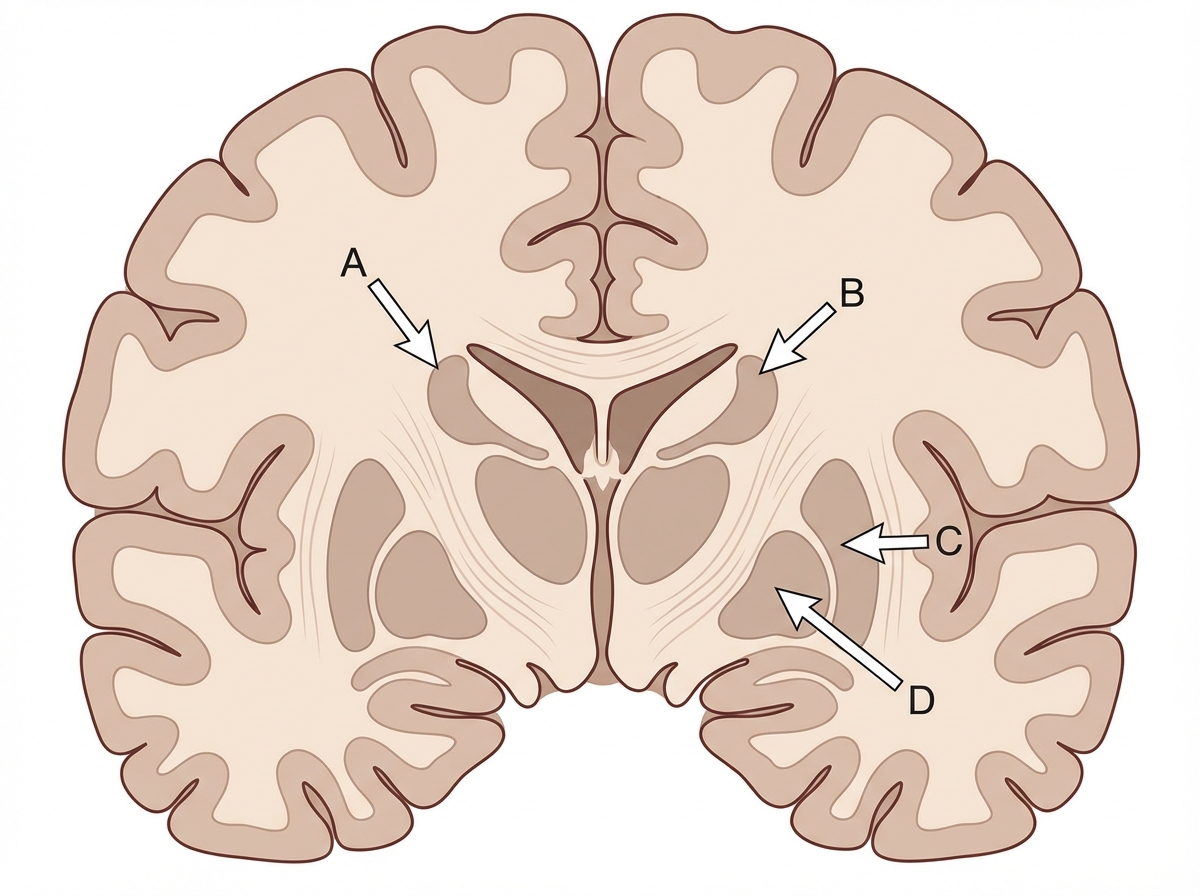
Which of the following arteries provides blood supply to the lateral geniculate body?
The embryonic period of human development typically extends up to which gestational week?
Which of the following conditions is characterized by caseating granulomas?
Which of the following is NOT a neuroglial cell in the Central Nervous System?
An early systolic murmur may be caused by all of the following except?
What is the recommended dilution of epinephrine for anaphylactic shock?
Retrograde ejaculation is a common side effect of which class of medications?
Which stain is NOT used for lipids?
Which of the following is NOT a part of the process of leukocyte transmigration through blood vessels?
Which cells are primarily responsible for innate immunity against cancer cells?
Explanation: The **Lateral Geniculate Body (LGB)** is a crucial relay station in the visual pathway located in the posteroventral aspect of the thalamus [1]. Its blood supply is derived primarily from the **Posterior Cerebral Artery (PCA)** and its branches. ### Why the Posterior Cerebral Artery is Correct: The LGB receives a dual blood supply from two specific branches of the PCA: 1. **Anterior Choroidal Artery:** Supplies the hilum and the lateral part of the LGB. (Note: While this is a branch of the Internal Carotid, it is functionally grouped with the posterior circulation supply here). 2. **Lateral Posterior Choroidal Artery:** A direct branch of the **PCA** that supplies the medial part of the LGB. Since the PCA is the parent vessel for the primary nutrient arteries of the thalamic nuclei, it is the most accurate choice. ### Why Other Options are Incorrect: * **Anterior Cerebral Artery (ACA):** Supplies the medial surface of the cerebral hemispheres (frontal and parietal lobes) and the corpus callosum. It does not reach the thalamic region. * **Middle Cerebral Artery (MCA):** Supplies the lateral surface of the hemispheres and deep structures via lenticulostriate branches (basal ganglia and internal capsule), but not the geniculate bodies. * **Posterior Communicating Artery:** While it forms part of the Circle of Willis, its primary role is connecting the ICA and PCA; it does not directly provide the main supply to the LGB. ### NEET-PG High-Yield Pearls: * **LGB Function:** Relay center for **Visual** impulses (Mnemonic: **L** for **L**ight) [1]. * **MGB Function:** Medial Geniculate Body is for **Auditory** impulses (Mnemonic: **M** for **M**usic). * **Lesion Sign:** A lesion in the LGB results in **Contralateral Homonymous Hemianopia** with pupillary sparing [1]. * **Blood Supply Summary:** The Thalamus is almost entirely supplied by the **Posterior Cerebral Artery** (via posteromedial, posterolateral, and choroidal branches).
Explanation: **Explanation:** The prenatal development of a human is divided into two distinct phases: the **embryonic period** and the **fetal period**. **Why D is correct:** The **embryonic period** extends from fertilization until the **end of the 8th week** (56 days) of gestation [3]. This is the most critical phase of development because it involves **organogenesis**—the formation of all major organ systems (e.g., the neural tube, heart, and limbs). By the end of the 8th week, the embryo has acquired a distinctly human appearance, and the foundation of all body structures is established [3]. **Analysis of Incorrect Options:** * **A & B (16 and 12 weeks):** These weeks fall well into the **fetal period** (9th week until birth). While significant growth and histological differentiation occur during these stages, the primary morphological structures are already formed [2]. * **C (10 weeks):** While some older clinical texts occasionally used "10 weeks" (referring to menstrual age rather than post-fertilization age), the standard embryological definition used in exams like NEET-PG is strictly **8 weeks** [3]. **NEET-PG High-Yield Pearls:** * **Teratogenicity:** The embryonic period (Weeks 3–8) is the **"period of maximum susceptibility"** to teratogens [1]. Exposure during this time is most likely to result in major structural congenital anomalies [1][3]. * **Transition:** From the 9th week onwards, the concept is referred to as a **fetus**, characterized primarily by rapid body growth and functional maturation of tissues [2]. * **Rule of 2s and 3s:** Remember that the 2nd week is the "period of 2s" (bilaminar disc) and the 3rd week is the "period of 3s" (trilaminar disc/gastrulation).
Explanation: Explanation: The hallmark of certain chronic inflammatory conditions is the formation of **granulomas**. These are categorized into **caseating** (central "cheese-like" necrosis) and **non-caseating** (no central necrosis). **1. Why Histoplasmosis is correct:** Histoplasmosis, caused by the fungus *Histoplasma capsulatum*, is a classic cause of **caseating granulomas**. In the lungs and lymph nodes, it mimics Tuberculosis by producing necrotic centers within the granuloma. While TB is the most common cause of caseation, fungal infections like Histoplasmosis and Coccidioidomycosis can also present this way; however, in the context of standard medical examinations, Histoplasmosis is a high-yield fungal representative for caseation. **2. Why the other options are incorrect:** * **Sarcoidosis:** This is the classic prototype for **non-caseating granulomas**. The absence of central necrosis is a key diagnostic feature used to differentiate it from Tuberculosis. * **Coccidioidomycosis:** While it can occasionally show caseation, it more typically presents with pyogenic or non-caseating granulomatous responses containing characteristic **spherules** filled with endospores. * **All of the above:** Incorrect because Sarcoidosis strictly produces non-caseating granulomas. **NEET-PG High-Yield Pearls:** * **Caseating Granuloma:** Think Tuberculosis (most common), Histoplasmosis, and Lepromatous Leprosy (rarely). * **Non-Caseating Granuloma:** Think Sarcoidosis, Crohn’s disease, Berylliosis, and Cat-scratch disease. * **Histology Tip:** Look for "Schaumann bodies" and "Asteroid bodies" in Sarcoidosis (though not pathognomonic). * **Histoplasma Identification:** On silver stain (GMS), look for small, intracellular budding yeasts within macrophages.
Explanation: The correct answer is **D. Kupffer cells**. Neuroglia (glial cells) are the non-neuronal supporting cells of the nervous system. They are categorized based on their location into Central Nervous System (CNS) glia and Peripheral Nervous System (PNS) glia [1]. **Kupffer cells** are specialized macrophages located in the sinusoids of the **liver**, forming part of the Mononuclear Phagocyte System. They are not found in the nervous system. **Analysis of Incorrect Options:** * **A. Oligodendrocytes:** These are CNS glial cells responsible for the **myelination** of axons [2]. A single oligodendrocyte can myelinate multiple axon segments [2]. * **B. Microglia:** These are the resident macrophages of the CNS. They are unique because they are derived from **mesoderm** (yolk sac), unlike other neuroglia which are ectodermal in origin [1]. * **C. Astrocytes:** The most numerous glial cells in the CNS. They provide structural support, maintain the **Blood-Brain Barrier (BBB)**, and regulate the chemical environment (K+ metabolism). **High-Yield Clinical Pearls for NEET-PG:** * **Origin:** All neuroglia are derived from **Neuroectoderm**, EXCEPT **Microglia** (Mesodermal) [1] and **Schwann cells** (Neural crest). * **PNS Glia:** The primary glial cells in the PNS are **Schwann cells** (myelination of a single axon) [2] and **Satellite cells**. * **Tumors:** Most primary intracranial tumors (Gliomas) arise from astrocytes (Astrocytomas) [3]. * **Ependymal Cells:** Another type of CNS glia that line the ventricles and central canal, involved in CSF production [3].
Explanation: The key to answering this question lies in distinguishing between the timing and shape of systolic murmurs. **1. Why Aortic Stenosis is the Correct Answer:** Aortic stenosis (AS) typically produces a **mid-systolic (ejection systolic) murmur**. The murmur begins after the first heart sound (S1) following a brief isovolumetric contraction phase, peaks in mid-systole as flow velocity increases, and ends before the second heart sound (S2) [1]. It is characterized by a "crescendo-decrescendo" shape. Therefore, it is not an early systolic murmur. **2. Analysis of Incorrect Options:** * **Small Ventricular Septal Defect (VSD):** While large VSDs cause holosystolic murmurs, a small VSD (Maladie de Roger) often produces an **early systolic murmur**. As ventricular pressure rises, the shunt occurs immediately, but as the small defect is compressed by the contracting myocardium, the shunt ceases before S2. * **Papillary Muscle Dysfunction:** This often leads to acute mitral regurgitation. Because the left atrium is non-compliant in acute settings, the pressure gradient between the LV and LA disappears quickly in late systole, resulting in a murmur that starts at S1 but ends well before S2 (early systolic). * **Tricuspid Regurgitation (TR):** In cases of organic TR with normal pulmonary artery pressures, the murmur is often early systolic rather than holosystolic. **NEET-PG High-Yield Pearls:** * **Holosystolic (Pansystolic) Murmurs:** Mitral Regurgitation (chronic), Tricuspid Regurgitation (with pulmonary HTN), and large VSD. * **Mid-Systolic Murmurs:** Aortic Stenosis, Pulmonic Stenosis, HOCM, and Atrial Septal Defect (due to increased flow across the pulmonic valve). * **Innocent Murmurs:** These are always systolic (usually mid-systolic) and never diastolic.
Explanation: **Explanation:** The management of anaphylaxis requires different concentrations and routes of administration for Epinephrine (Adrenaline) based on the severity and clinical setting. While the **Intramuscular (IM) route** is the first-line treatment for acute anaphylaxis in the community or emergency department, all three options listed are clinically valid applications of epinephrine. 1. **1:1000, IM route (Option B):** This is the **standard first-line treatment** for anaphylaxis. The 1:1000 concentration (1 mg/mL) allows for a small volume (0.5 mg for adults) to be injected into the vastus lateralis, providing rapid peak plasma concentrations and a high safety profile. 2. **1:10000, IV route (Option C):** This dilute concentration (0.1 mg/mL) is reserved for **severe anaphylactic shock** or cardiac arrest where there is profound hypotension and poor peripheral perfusion. It must be administered slowly by experienced clinicians to avoid life-threatening arrhythmias or hypertensive crises. 3. **1:100, Inhalational route (Option A):** While less common for systemic anaphylaxis, high-concentration epinephrine (10 mg/mL) is used via nebulization for **refractory upper airway obstruction (laryngeal edema)** or severe croup. **Clinical Pearls for NEET-PG:** * **Site of Choice:** The **anterolateral thigh (vastus lateralis)** is preferred over the deltoid due to better absorption. * **Adult Dose (IM):** 0.5 mg of 1:1000. * **Pediatric Dose (IM):** 0.01 mg/kg (max 0.3 mg) of 1:1000. * **Mechanism:** Epinephrine acts as an agonist at $\alpha_1$ (vasoconstriction), $\beta_1$ (increased cardiac output), and $\beta_2$ (bronchodilation and stabilization of mast cells) receptors.
Explanation: The original explanation provided information about Chlorpromazine and its association with retrograde ejaculation as a side effect of its alpha-adrenergic blocking properties. While Chlorpromazine is an older antipsychotic, it remains a classic example of this effect [1].
Explanation: **Explanation:** The correct answer is **Congo red** because it is a specific stain used for **Amyloid**, not lipids. In medical histology, staining techniques are categorized based on the chemical affinity of the dye for specific cellular components. 1. **Why Congo Red is the correct answer:** Congo red is the gold standard for detecting amyloid deposits. Under ordinary light, it stains amyloid pink or red. However, its diagnostic hallmark is **apple-green birefringence** when viewed under a polarized microscope. It has no affinity for lipid molecules. 2. **Why the other options are incorrect (Lipid Stains):** Lipids are typically dissolved during routine paraffin processing (using alcohol and xylene). Therefore, lipid staining requires **frozen sections**. * **Sudan 3 & Sudan 4:** These are lysochrome (fat-soluble) dyes that stain neutral triglycerides orange-red. * **Sudan Black B:** This is the most sensitive lipid stain. It stains a variety of lipids, including phospholipids and sterols, black. It is also used in hematopathology to differentiate AML from ALL. * **Oil Red O:** A very common stain that demonstrates neutral lipids and cholesterols as bright red droplets. **High-Yield Clinical Pearls for NEET-PG:** * **Best stain for Lipids:** Sudan Black B. * **Best stain for Amyloid:** Congo Red (Apple-green birefringence). * **Best stain for Glycogen/Carbohydrates:** PAS (Periodic Acid-Schiff). * **Best stain for Iron:** Prussian Blue (Perl’s stain). * **Best stain for Copper:** Rhodanine stain or Orcein. * **Best stain for Calcium:** Von Kossa (stains black) or Alizarin Red.
Explanation: ### Explanation The process of **leukocyte extravasation** (transmigration) is the mechanism by which white blood cells move from the systemic circulation into the interstitial space to reach a site of injury or infection [1]. This process is a sequence of specific steps: 1. **Rolling:** Mediated by **selectins** (E, P, and L-selectins). Leukocytes loosely bind to the endothelium, causing them to "roll" along the vessel wall. 2. **Adhesion:** Mediated by **integrins** (on leukocytes) and **ICAM-1/VCAM-1** (on endothelium). This results in firm attachment of the leukocyte to the vessel wall. 3. **Migration (Diapedesis):** Mediated by **PECAM-1 (CD31)**. The leukocyte squeezes through the endothelial junctions to enter the extravascular space [1]. **Phagocytosis** is the correct answer because it is **not** a part of the transmigration process. Instead, phagocytosis is a subsequent functional step that occurs *after* the leukocyte has already reached the site of inflammation. It involves the engulfment and digestion of pathogens or debris. #### Why the other options are incorrect: * **Rolling:** This is the essential first step of recruitment where cells slow down. * **Adhesion:** This is the critical second step where the cell stops moving and prepares to exit the vessel. * **Migration:** This is the final step of the transmigration process itself, allowing the cell to cross the basement membrane. #### NEET-PG High-Yield Pearls: * **Selectins** = Rolling; **Integrins** = Firm Adhesion; **PECAM-1** = Diapedesis. * **Leukocyte Adhesion Deficiency (LAD) Type 1:** Caused by a defect in **CD18** (integrin subunit), leading to impaired firm adhesion and recurrent infections without pus formation. * **LAD Type 2:** Caused by a defect in **Sialyl-Lewis X** (selectin ligand), leading to impaired rolling.
Explanation: **Explanation:** The correct answer is **NK (Natural Killer) cells**. **1. Why NK Cells are Correct:** NK cells are large granular lymphocytes that form a critical component of the **innate immune system**. Unlike T-cells, they do not require prior sensitization or MHC-restricted antigen presentation to function. They specialize in identifying and killing "stressed" cells, specifically **virally-infected cells** and **tumor cells** [1]. They operate via the "missing-self" hypothesis: when cancer cells downregulate MHC Class I molecules to evade T-cells, NK cells detect this absence and trigger apoptosis using perforins and granzymes [1]. **2. Why Other Options are Incorrect:** * **Basophils (A):** These are granulocytes primarily involved in type I hypersensitivity reactions (allergy) and defense against ectoparasites [2]. They release histamine and heparin. * **Eosinophils (B):** These are mainly responsible for combating multicellular parasites (helminths) and are involved in allergic inflammation (e.g., asthma) [2]. * **Neutrophils (D):** These are the "first responders" of the innate system, primarily focused on phagocytosis and killing of **extracellular bacteria** and fungi through oxidative burst and NETs (Neutrophil Extracellular Traps) [2]. **3. NEET-PG High-Yield Pearls:** * **Markers:** NK cells are identified by the presence of **CD56** and **CD16**, and the absence of CD3. * **Cytokine Activation:** Their activity is significantly enhanced by **IL-2** and **IL-12** [1]. * **LAK Cells:** NK cells treated with high-dose IL-2 become Lymphokine-Activated Killer (LAK) cells, used in experimental cancer immunotherapy [1]. * **Antibody-Dependent Cellular Cytotoxicity (ADCC):** NK cells use their CD16 receptor to bind to the Fc portion of IgG, allowing them to kill antibody-coated target cells.
Organization of the Nervous System
Practice Questions
Spinal Cord Anatomy
Practice Questions
Brainstem Anatomy
Practice Questions
Cerebellum
Practice Questions
Diencephalon
Practice Questions
Cerebral Cortex
Practice Questions
Basal Ganglia
Practice Questions
Limbic System
Practice Questions
Cranial Nerves
Practice Questions
Autonomic Nervous System
Practice Questions
Neural Pathways and Tracts
Practice Questions
Neurovascular Anatomy
Practice Questions
Get full access to all questions, explanations, and performance tracking.
Start For Free