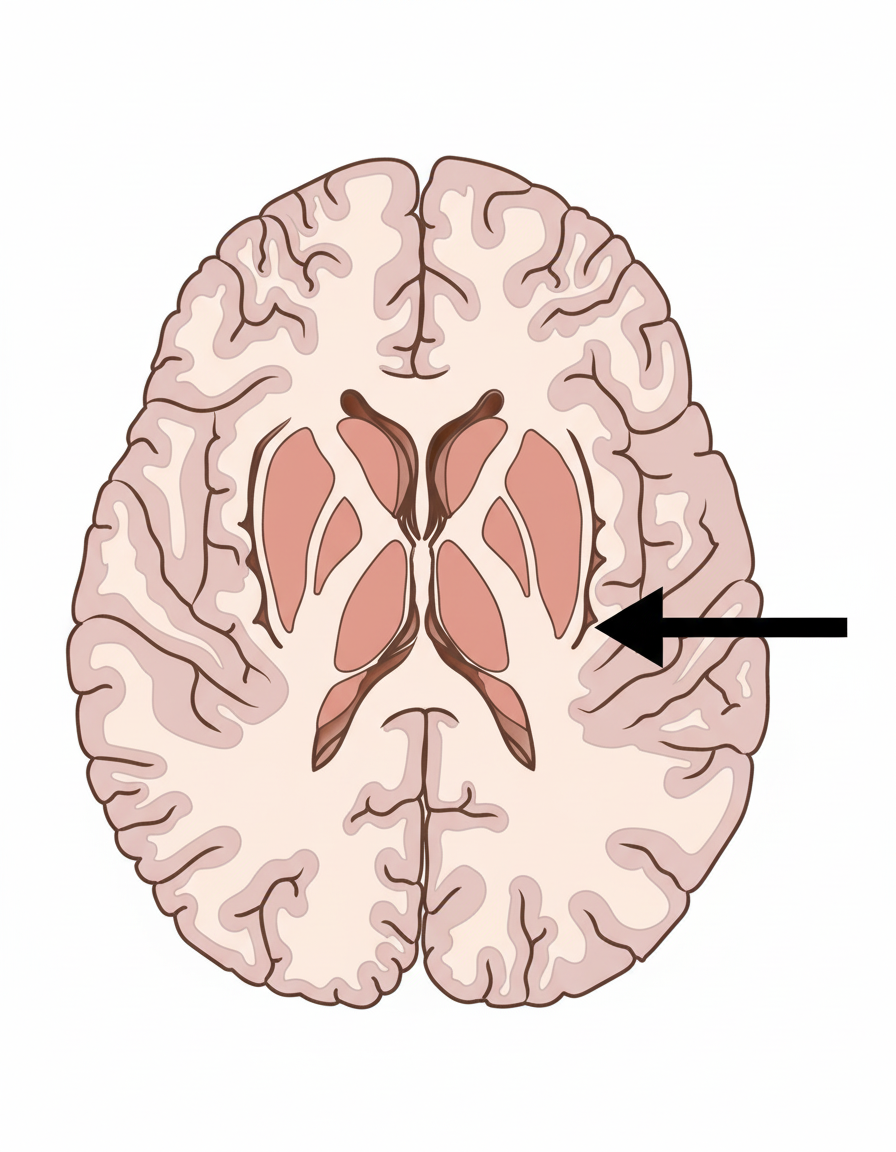
A lesion of the optic radiation involving Meyer's loop causes which of the following visual field defects?
Pointing index sign is seen in which nerve palsy?
Which of the following muscles is considered an accessory muscle of mastication?
Mammary gland is which type of gland?
The vocal cord is lined by which of the following types of epithelium?
Where is SGLT 2 primarily found?
Lynch syndrome is associated with which of the following cancers?
The optic nerve is a tract of the diencephalon that is not completely myelinated until when?
Heart failure cells are seen in which condition?
Alcoholics may develop fatal lactic acidosis due to inhibition of which of the following enzymes?
Explanation: ### Explanation **Underlying Medical Concept:** The optic radiation (geniculocalcarine tract) carries visual information from the Lateral Geniculate Body (LGB) to the primary visual cortex. It is divided into two distinct bundles [1]: 1. **Meyer’s Loop (Inferior Fibers):** These fibers loop forward into the **temporal lobe** before heading back to the lingual gyrus. They carry information from the **inferior retina**, which corresponds to the **superior visual field** [1]. 2. **Baum’s Loop (Superior Fibers):** These fibers travel directly through the **parietal lobe** to the cuneus gyrus. They carry information from the **superior retina**, corresponding to the **inferior visual field** [1]. Because the optic radiation is post-chiasmatic, a lesion on one side affects the contralateral visual field [2]. Therefore, a lesion in Meyer’s loop results in a **Contralateral Superior Quadrantanopia** (often called "Pie in the Sky" defect). **Analysis of Options:** * **B (Correct):** Meyer’s loop (temporal lobe) = Superior visual field defect. * **A (Incorrect):** **Homonymous hemianopia** occurs with complete destruction of the optic tract or the entire optic radiation [2]. * **C (Incorrect):** **Inferior quadrantanopia** ("Pie on the Floor") is caused by a lesion in the parietal lobe (Baum’s loop). * **D (Incorrect):** **Central scotoma** is typically associated with macular degeneration or lesions of the optic nerve/macular fibers. **High-Yield Clinical Pearls for NEET-PG:** * **Temporal Lobe Lesion:** Superior Quadrantanopia ("Pie in the Sky"). * **Parietal Lobe Lesion:** Inferior Quadrantanopia ("Pie on the Floor"). * **Macular Sparing:** Seen in Posterior Cerebral Artery (PCA) strokes affecting the visual cortex, as the macula has a dual blood supply (PCA + Middle Cerebral Artery) [2]. * **Mnemonic:** **M**eyer’s = **M**id-brain/Temporal = **M**ountain (Sky/Superior). **P**arietal = **P**it (Floor/Inferior).
Explanation: **Explanation:** The **Pointing Index Sign** (also known as the **Ochsner’s Test** or **Hand of Benediction** when attempting to make a fist) is a classic clinical feature of a **high median nerve palsy** (lesion at or above the elbow). **Why Median Nerve is Correct:** The median nerve innervates the **Flexor Digitorum Superficialis (FDS)** and the lateral half of the **Flexor Digitorum Profundus (FDP)** (which goes to the index and middle fingers) [1]. When a patient with a high median nerve lesion attempts to clench their fist, they cannot flex the IP joints of the index and middle fingers. Consequently, the index finger remains straight (pointing), while the ring and little fingers flex normally (as their FDP supply from the ulnar nerve remains intact). **Why other options are incorrect:** * **Ulnar Nerve:** Palsy leads to a "Claw Hand" (hyperextension at MCP joints and flexion at IP joints of the ring and little fingers) due to paralysis of the medial lumbricals and interossei. * **Radial Nerve:** Palsy typically results in "Wrist Drop" or "Finger Drop" due to paralysis of the extensors of the wrist and fingers. * **Axillary Nerve:** Palsy results in the loss of shoulder abduction (deltoid paralysis) and sensory loss over the "regimental badge" area; it does not affect finger movement. **High-Yield Clinical Pearls for NEET-PG:** * **Ape Thumb Deformity:** Seen in low median nerve palsy (at the wrist) due to thenar muscle atrophy and loss of thumb opposition [1]. * **Froment’s Sign:** Used to test for Ulnar nerve palsy (weakness of Adductor Pollicis). * **Kiloh-Nevin Syndrome:** Isolated paralysis of the Flexor Pollicis Longus and FDP to the index finger due to **Anterior Interosseous Nerve (AIN)** involvement (a branch of the median nerve), resulting in an inability to make the "OK" sign.
Explanation: ### Explanation **Correct Answer: C. Buccinator** The **Buccinator** is anatomically classified as a muscle of facial expression (innervated by the Facial nerve, CN VII), but it is functionally considered an **accessory muscle of mastication**. **Why it is the correct answer:** While the primary muscles of mastication (Masseter, Temporalis, Medial, and Lateral Pterygoids) move the mandible, the Buccinator plays a crucial role during the chewing process. It flattens the cheek against the teeth, preventing food from accumulating in the oral vestibule and pushing the bolus back between the occlusal surfaces of the teeth. Without the Buccinator, efficient mastication is impossible as food would constantly get stuck between the gums and cheeks. **Analysis of Incorrect Options:** * **A. Risorius:** A superficial muscle of facial expression that pulls the angle of the mouth laterally (the "grinning" muscle). It has no functional role in chewing. * **B. Orbicularis oris:** A sphincter muscle that closes and protrudes the lips (the "kissing" muscle). While it helps keep the mouth closed during chewing, it does not manipulate the food bolus between the teeth. * **C. Platysma:** A broad, thin sheet of muscle in the neck that depresses the mandible and wrinkles the skin of the lower face; it is not involved in the active process of mastication. **High-Yield Clinical Pearls for NEET-PG:** * **Innervation:** Unlike the primary muscles of mastication (Trigeminal nerve, V3), the Buccinator is supplied by the **buccal branch of the Facial nerve (CN VII)**. * **Structures piercing the Buccinator:** The **Parotid duct (Stensen’s duct)** pierces the buccinator muscle opposite the upper second molar tooth. * **Clinical Sign:** In **Bell’s Palsy** (CN VII palsy), paralysis of the buccinator leads to the accumulation of food in the vestibule of the mouth on the affected side.
Explanation: **Explanation:** The mammary gland is a modified sweat gland classified as a **compound tubuloalveolar gland** [1]. It is primarily considered an **Apocrine** gland because of its mechanism of secretion. **1. Why Apocrine is correct:** In apocrine secretion, the secretory product (specifically the lipid/fat droplets of milk) accumulates at the apical portion of the cell. This apical portion then pinches off and is released along with the secretion. The cell then repairs itself and repeats the process. *Note:* While the protein component of milk is secreted via merocrine (exocytosis) mechanism, for examination purposes (NEET-PG/INI-CET), the mammary gland is classically categorized as **Apocrine**. **2. Why the other options are incorrect:** * **Mesocrine (Merocrine):** In this type, secretions are released via exocytosis without any loss of cell membrane (e.g., salivary glands, eccrine sweat glands). * **Endocrine:** These are ductless glands that secrete hormones directly into the bloodstream (e.g., Thyroid, Pituitary). The mammary gland uses a duct system [1]. * **Exocrine:** While the mammary gland *is* an exocrine gland (it uses ducts), "Apocrine" is the more specific and correct functional classification requested in this context. **Clinical Pearls & High-Yield Facts:** * **Development:** Mammary glands develop from the **milk line** (ectodermal thickening) extending from the axilla to the groin. * **Modified Sweat Glands:** Other apocrine glands include those in the axilla, areola, and circumanal region. * **Holocrine Secretion:** This involves the destruction of the entire cell (e.g., **Sebaceous glands**). * **Cooper’s Ligaments:** These are the suspensory ligaments of the breast; their involvement in malignancy causes "dimpling" of the skin [2].
Explanation: The larynx is primarily lined by **pseudostratified ciliated columnar epithelium** (respiratory epithelium). However, the **vocal cords (true vocal folds)** are a critical exception to this rule [1]. ### 1. Why Stratified Squamous Epithelium is Correct The vocal cords are subject to significant mechanical stress and constant vibration during phonation [1]. To withstand this physical wear and tear, the delicate respiratory epithelium is replaced by **non-keratinized stratified squamous epithelium**. This multi-layered structure provides the necessary protection against mechanical trauma. ### 2. Analysis of Incorrect Options * **A & C (Cuboidal/Stratified Columnar):** These are not typically found in the human airway. Cuboidal epithelium is generally found in glandular ducts or kidney tubules, while stratified columnar is rare, found only in parts of the conjunctiva or large excretory ducts. * **D (Pseudostratified Ciliated Columnar):** While this lines most of the larynx (including the false vocal cords), it is too fragile for the high-impact environment of the true vocal cords. ### 3. NEET-PG High-Yield Facts & Clinical Pearls * **The Transition Zone:** The change from respiratory epithelium to stratified squamous epithelium occurs at the "linea alba" of the vocal folds. * **Clinical Correlation:** Because the vocal cords are lined by squamous cells, the most common type of laryngeal cancer is **Squamous Cell Carcinoma (SCC)**. * **Reinke’s Space:** This is a potential space between the vocal ligament and the overlying squamous epithelium. * **Lymphatic Drainage:** The true vocal cords have **no lymphatic drainage** [1]. This is a high-yield surgical fact because it means glottic cancer often remains localized for a long time and has a better prognosis than supraglottic cancer.
Explanation: **Explanation:** The correct answer is **None of the above** because **SGLT 2 (Sodium-Glucose Cotransporter 2)** is primarily and almost exclusively located in the **Kidney**, specifically in the **S1 and S2 segments of the Proximal Convoluted Tubule (PCT)** [2]. It is responsible for reabsorbing approximately 90% of the filtered glucose from the tubular fluid back into the bloodstream [1]. **Analysis of Options:** * **A. Liver:** The liver primarily utilizes **GLUT 2** (a glucose transporter) for the bidirectional movement of glucose; it does not express SGLT 2 [2]. * **B. Intestine:** The primary sodium-glucose cotransporter in the small intestine is **SGLT 1**, which is responsible for the absorption of glucose and galactose from the dietary lumen [2]. (Note: SGLT 1 is also found in the S3 segment of the renal PCT, accounting for the remaining 10% of glucose reabsorption) [2]. * **C. Spleen:** The spleen does not play a significant role in active glucose transport via SGLT proteins. **High-Yield Clinical Pearls for NEET-PG:** * **SGLT 2 Inhibitors (Gliflozins):** Drugs like Dapagliflozin and Empagliflozin inhibit SGLT 2 in the PCT, leading to glucosuria. They are used in managing Type 2 Diabetes, Heart Failure, and Chronic Kidney Disease. * **SGLT 1 vs. SGLT 2:** Remember "1" is for the Gut (and 10% Kidney), and "2" is for the Kidney (90%). * **Fanconi Syndrome:** A generalized dysfunction of the PCT where SGLT 2 function is impaired along with the reabsorption of amino acids, uric acid, and phosphates.
Explanation: **Explanation:** **Lynch Syndrome**, also known as Hereditary Non-Polyposis Colorectal Cancer (HNPCC), is an autosomal dominant condition caused by germline mutations in **DNA Mismatch Repair (MMR) genes** (primarily *MLH1, MSH2, MSH6,* and *PMS2*) [2], [4]. This leads to microsatellite instability (MSI) and a significantly increased risk of various malignancies [1]. **Why Option D is Correct:** The hallmark of Lynch syndrome is the high risk of **Colorectal cancer** (often right-sided) [2]. However, it is a multi-organ cancer syndrome. In women, the risk of **Endometrial cancer** is exceptionally high, often equaling or exceeding the risk of colon cancer [3], [4]. **Ovarian cancer** is the third most common associated malignancy. Therefore, the triad of Colon, Endometrium, and Ovary represents the core clinical spectrum of the syndrome. **Why Other Options are Incorrect:** * **Options A, B, and C:** These options include **Breast cancer**. While some studies suggest a slightly elevated risk, breast cancer is **not** a classic component of the Lynch syndrome diagnostic criteria (Amsterdam II or Bethesda criteria). Breast cancer is more typically associated with *BRCA1/2* mutations or Li-Fraumeni syndrome [1], [4]. **High-Yield Clinical Pearls for NEET-PG:** * **Inheritance:** Autosomal Dominant [2]. * **Most common mutation:** *MLH1* and *MSH2* [1], [2]. * **Amsterdam II Criteria (3-2-1 Rule):** 3 relatives with Lynch-associated cancer, 2 successive generations, 1 diagnosed before age 50 [3]. * **Other associated cancers:** Gastric, small bowel, hepatobiliary, and transitional cell carcinoma of the ureter/renal pelvis [4]. * **Muir-Torre Syndrome:** A variant of Lynch syndrome associated with sebaceous gland tumors and keratoacanthomas.
Explanation: The optic nerve is unique because it is not a true peripheral nerve but rather an **outgrowth of the diencephalon**. Unlike peripheral nerves, which are myelinated by Schwann cells, the optic nerve is myelinated by **oligodendrocytes** [1] and is encased in the three layers of the meninges (dura, arachnoid, and pia mater). [3] **Why Option D is correct:** Myelination of the optic nerve begins centrally at the optic chiasm during the 7th month of fetal life and progresses distally toward the eyeball. At birth, myelination usually reaches the level of the lamina cribrosa. However, the process is not functionally complete until approximately **3 months after birth**, coinciding with the development of visual acuity and fixation in infants. **Analysis of Incorrect Options:** * **Options A & B (5 years and 2 years):** These timeframes are too late. While the brain undergoes significant synaptic pruning and refinement during these years, the structural myelination of the primary visual pathway is established much earlier. * **Option C (1 year):** While some complex association tracts in the brain continue to myelinate until the end of the first year (and beyond), the optic nerve completes its primary myelination phase by the end of the first trimester of infancy. **NEET-PG High-Yield Pearls:** * **Origin:** The optic nerve is a tract of the **CNS**, not a PNS nerve. * **Myelination:** It is myelinated by **oligodendrocytes**, which explains why it is affected in **Multiple Sclerosis** (a CNS demyelinating disease) but spared in Guillain-Barré Syndrome. [1],[2] * **Clinical Sign:** Myelinated nerve fibers can sometimes extend beyond the lamina cribrosa into the retina, appearing as white, feathery patches on fundoscopy; this is usually a benign finding. * **Pressure:** Because it is surrounded by the subarachnoid space, increased intracranial pressure (ICP) is transmitted to the optic nerve head, leading to **papilledema**.
Explanation: **Explanation:** **Heart failure cells** are **hemosiderin-laden macrophages** found in the alveoli. They are the hallmark of **Chronic Venous Congestion (CVC) of the lung**, typically resulting from left-sided heart failure. [1] **Why Option B is correct:** In left-sided heart failure, the heart cannot pump blood efficiently, leading to increased pressure in the pulmonary veins. This causes congestion of the pulmonary capillaries. [1] The high pressure forces red blood cells (RBCs) to extravasate into the alveolar spaces. Alveolar macrophages then phagocytose these RBCs and break down the hemoglobin into **hemosiderin**, a golden-brown pigment. The presence of these pigmented macrophages in the lung tissue or sputum indicates chronic congestion. **Why other options are incorrect:** * **Options A & D (Liver):** CVC of the liver presents with a "Nutmeg liver" appearance due to congestion around the central veins. While it involves macrophages (Kupffer cells), the specific term "heart failure cells" is reserved for pulmonary pathology. * **Option C (Acute Lung Congestion):** In acute stages, there is edema and hemorrhage, but there has not been enough time for macrophages to ingest RBCs and convert them into visible hemosiderin. **High-Yield NEET-PG Pearls:** * **Nutmeg Liver:** Characteristic of CVC of the liver (central hemorrhagic necrosis vs. fatty peripheral zones). * **Brown Induration:** The gross appearance of the lungs in long-standing CVC due to the combination of hemosiderin deposition and fibrosis. * **Prussian Blue Stain:** Used to confirm the presence of iron (hemosiderin) within heart failure cells, staining them deep blue.
Explanation: **Explanation:** The correct answer is **Pyruvate dehydrogenase (A)**. **Mechanism and Concept:** Chronic alcoholism often leads to a deficiency of **Thiamine (Vitamin B1)** due to poor dietary intake and impaired intestinal absorption. Thiamine is the precursor for **Thiamine Pyrophosphate (TPP)**, a critical cofactor for the **Pyruvate Dehydrogenase (PDH) complex**. [1] When PDH is inhibited due to TPP deficiency, pyruvate cannot be converted into Acetyl-CoA to enter the TCA cycle. Instead, the excess pyruvate is shunted toward the anaerobic pathway, where it is converted into **lactate** by Lactate Dehydrogenase (LDH). This accumulation of lactic acid leads to metabolic acidosis, which can be fatal. [1] **Analysis of Incorrect Options:** * **B and C (Dihydrolipoyl transacetylase & dehydrogenase):** These are sub-units (E2 and E3) of the PDH complex. While they are part of the enzyme system, the question specifically targets the primary enzyme inhibited by the lack of TPP (E1 - Pyruvate decarboxylase/dehydrogenase). * **D (Phosphoglycerate kinase):** This is an enzyme involved in glycolysis. It is not thiamine-dependent and is not the primary cause of lactic acidosis in alcoholics. **High-Yield Clinical Pearls for NEET-PG:** * **Wernicke-Korsakoff Syndrome:** The classic clinical triad of thiamine deficiency (Ataxia, Ophthalmoplegia, and Confusion). * **The "Big Four" TPP-dependent enzymes:** 1. Pyruvate Dehydrogenase (Link reaction) 2. $\alpha$-Ketoglutarate Dehydrogenase (TCA cycle) 3. Branched-chain $\alpha$-ketoacid Dehydrogenase (Maple Syrup Urine Disease) 4. Transketolase (HMP Shunt) * **Clinical Tip:** Always administer Thiamine *before* Glucose in a malnourished alcoholic patient to prevent precipitating acute Wernicke encephalopathy by suddenly exhausting remaining TPP stores via glycolysis.
Organization of the Nervous System
Practice Questions
Spinal Cord Anatomy
Practice Questions
Brainstem Anatomy
Practice Questions
Cerebellum
Practice Questions
Diencephalon
Practice Questions
Cerebral Cortex
Practice Questions
Basal Ganglia
Practice Questions
Limbic System
Practice Questions
Cranial Nerves
Practice Questions
Autonomic Nervous System
Practice Questions
Neural Pathways and Tracts
Practice Questions
Neurovascular Anatomy
Practice Questions
Get full access to all questions, explanations, and performance tracking.
Start For Free