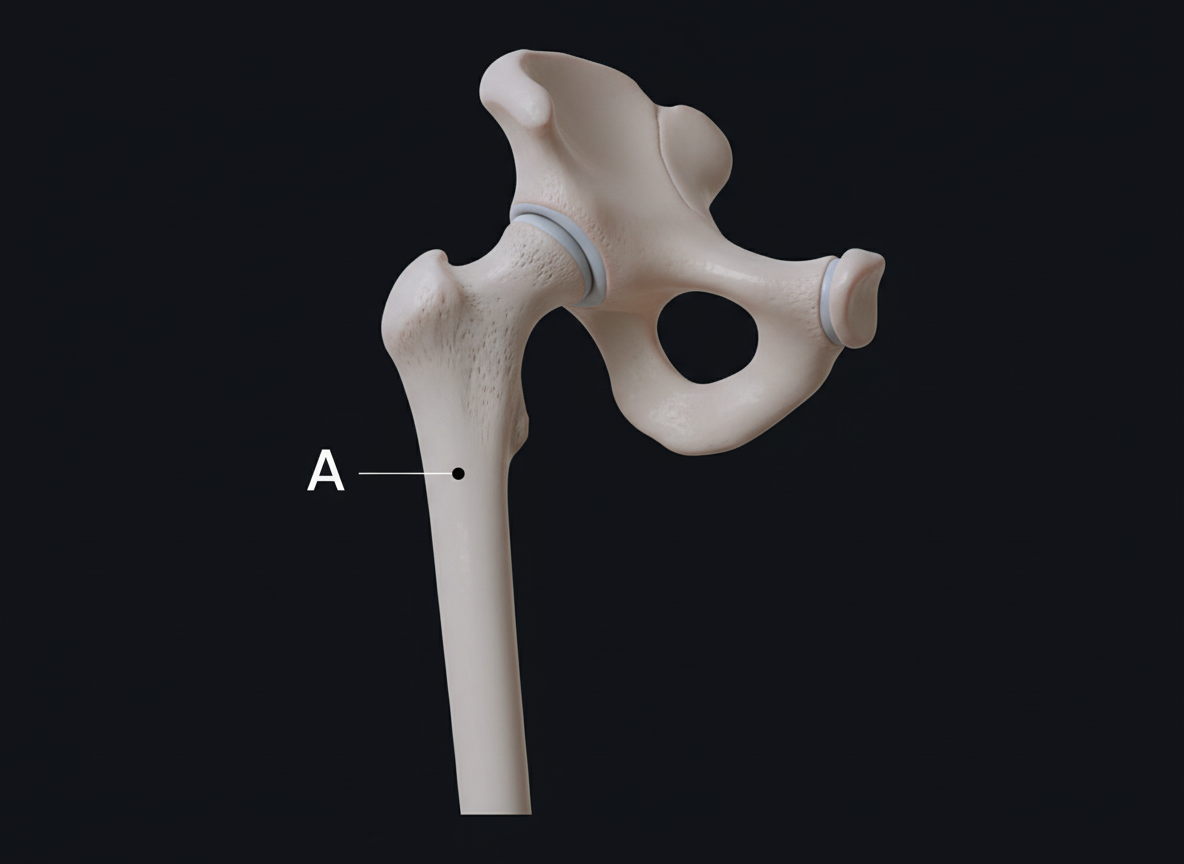
Gluteus medius is supplied by which of the following arteries?
Popliteus muscle arises from which anatomical structure?
What nerve supplies the tensor fascia lata?
Which of the following is not a content of the adductor canal?
Which of the following actions is performed by the tensor fasciae latae muscle?
What is the sensory supply to the medial side of the thigh?
Which spinal nerve root(s) innervate the posterior thigh dermatome?
Anterior cruciate ligament prevents which of the following?
The Biceps Femoris muscle is primarily responsible for which actions?
Which is the thickest nerve in the human body?
Explanation: The **Gluteus medius** is a key muscle of the gluteal region, primarily responsible for hip abduction and stabilizing the pelvis during the stance phase of walking. **Why Option B is Correct:** While the **Superior Gluteal Artery (SGA)** is the primary blood supply to the gluteus medius and minimus, the **Inferior Gluteal Artery (IGA)** also contributes significantly to its vascularization through anastomotic branches. In the context of standard anatomical variations and specific examination patterns (like NEET-PG), the IGA is recognized as a major source of supply to the entire gluteal musculature, including the gluteus maximus, medius, and the external rotators. **Why the Other Options are Incorrect:** * **Option A (Superior Gluteal Artery):** In many textbooks, this is listed as the *primary* supply. However, if the question or key specifies the IGA, it highlights the extensive collateral circulation in the gluteal region where the IGA supplies the lower portions of the medius. * **Option B (Obturator Artery):** This artery primarily supplies the medial compartment of the thigh (adductors) and the head of the femur via the acetabular branch. * **Option D (Ilioinguinal Artery):** This is a misnomer; the *Ilioinguinal nerve* exists, but there is no major artery by this name supplying the gluteal region. **High-Yield Clinical Pearls for NEET-PG:** * **Trendelenburg Sign:** Paralysis of the gluteus medius (due to **Superior Gluteal Nerve** injury) leads to the dropping of the pelvis on the unsupported side. * **Cruciate Anastomosis:** The Inferior Gluteal Artery participates in this vital collateral pathway around the hip, connecting the internal iliac system with the femoral artery (via the medial/lateral circumflex and first perforating arteries). * **Safe Zone for Injections:** Intramuscular injections are given in the superolateral quadrant of the gluteal region to avoid the sciatic nerve and the inferior gluteal vessels.
Explanation: ### Explanation The **Popliteus muscle** is a unique, thin, triangular muscle located at the floor of the popliteal fossa. It is often referred to as the **"Key to the Knee"** because of its role in initiating the process of knee flexion. #### Why the Correct Answer is Right: The Popliteus has an **intracapsular but extrasynovial** origin. It arises by a strong tendon from a deep groove on the **lateral surface of the lateral femoral condyle**. From this origin, the muscle fibers pass downwards and medially to insert into the posterior surface of the tibia, above the soleal line. #### Analysis of Incorrect Options: * **Option A:** The medial femoral condyle is the site of origin for the medial head of the gastrocnemius and the insertion of the adductor magnus (adductor tubercle), not the popliteus. * **Option C:** The posterolateral (and posterior) aspect of the tibia is the site of **insertion** for the popliteus, not its origin. * **Option D:** The anterior tibial eminence is related to the attachment of the Anterior Cruciate Ligament (ACL), not muscle origins. #### High-Yield Clinical Pearls for NEET-PG: 1. **Unlocking the Knee:** To initiate flexion of a fully extended (locked) knee, the popliteus **rotates the femur laterally** on the fixed tibia (in weight-bearing) or **rotates the tibia medially** on the fixed femur (in non-weight-bearing). 2. **Nerve Supply:** Tibial Nerve (L4, L5, S1). 3. **Morphology:** It is considered the "remnant" of the long flexor of the hallux in lower animals. 4. **The Popliteus Tendon:** It separates the lateral meniscus from the fibular collateral ligament, which explains why the lateral meniscus is more mobile and less frequently injured than the medial meniscus.
Explanation: **Explanation:** The **Superior Gluteal Nerve (L4, L5, S1)** is a branch of the sacral plexus that exits the pelvis through the greater sciatic foramen, passing *above* the piriformis muscle. It provides motor innervation to three specific muscles: the **Gluteus medius**, **Gluteus minimus**, and the **Tensor Fasciae Latae (TFL)**. These muscles act together to abduct the hip and stabilize the pelvis during the stance phase of walking. **Analysis of Options:** * **Option A (Nerve to quadratus femoris):** This nerve supplies the quadratus femoris and the inferior gemellus muscles. It does not reach the gluteal region's abductor group. * **Option C (Inferior gluteal nerve):** This nerve (L5, S1, S2) exits *below* the piriformis and exclusively supplies the **Gluteus maximus**, the primary extensor of the hip. * **Option D (Sciatic nerve):** The largest nerve in the body, it supplies the posterior thigh (hamstrings) and all muscles below the knee, but it does not innervate the gluteal muscles. **High-Yield Clinical Pearls for NEET-PG:** * **Trendelenburg Sign:** Injury to the superior gluteal nerve leads to paralysis of the gluteus medius and minimus. When the patient stands on the affected leg, the pelvis drops on the healthy (unsupported) side. * **Safe Injection Site:** Intramuscular injections are given in the **upper outer quadrant** of the gluteal region to avoid the sciatic nerve, but deep injections here can still potentially injure the superior gluteal nerve. * **Anatomical Landmark:** The superior gluteal nerve is the only nerve that exits the greater sciatic foramen **above** the piriformis muscle.
Explanation: The **Adductor Canal** (also known as Hunter’s canal or the subsartorial canal) is an aponeurotic tunnel in the middle third of the thigh. It serves as a passageway for structures moving from the femoral triangle to the popliteal fossa. ### Why "Nerve to Vastus Lateralis" is the Correct Answer: The **Nerve to Vastus Lateralis** is a branch of the posterior division of the femoral nerve. It descends lateral to the femoral vessels and enters the vastus lateralis muscle high in the thigh, **well before** the commencement of the adductor canal. Therefore, it is never a content of the canal. ### Analysis of Incorrect Options: * **Femoral Artery (A):** This is the primary arterial content. It enters the canal at the apex of the femoral triangle and exits through the adductor hiatus to become the popliteal artery. * **Femoral Vein (B):** It lies posterior to the artery in the upper part of the canal and posterolateral to it in the lower part. * **Saphenous Nerve (C):** This is the longest cutaneous branch of the femoral nerve. It enters the canal, crosses the femoral artery from lateral to medial, and eventually exits by piercing the roof (vasovastadductor fascia) to become superficial. ### High-Yield NEET-PG Pearls: * **Contents of the Canal:** Femoral artery, Femoral vein, Saphenous nerve, and the **Nerve to Vastus Medialis** (often confused with the nerve to vastus lateralis in exams). * **Boundaries:** Anterolateral (Vastus medialis), Posterior (Adductor longus and magnus), and Medial/Roof (Sartorius). * **Clinical Significance:** The canal is a common site for **Adductor Canal Blocks**, used for regional anesthesia in knee surgeries (sparing the quadriceps motor function while providing sensory block via the saphenous nerve).
Explanation: The **Tensor Fasciae Latae (TFL)** is a unique muscle of the gluteal region that acts on both the hip and knee joints due to its insertion into the **Iliotibial Tract (ITT)**. ### **Explanation of the Correct Answer** The TFL originates from the outer lip of the anterior iliac crest and the ASIS. It inserts between the two layers of the ITT. Its actions are determined by its position relative to the joint axes: * **Flexion of the Hip:** Because it lies anterior to the hip joint, it assists the iliopsoas and rectus femoris in flexing the thigh. * **Abduction of the Hip:** Positioned laterally, it works with the gluteus medius and minimus to abduct the hip and stabilize the pelvis during walking. * **Extension of the Knee:** The ITT crosses the knee joint and inserts onto **Gerdy’s tubercle** on the lateral condyle of the tibia. When the knee is in the terminal stages of extension (last 30°), the TFL pulls the ITT anteriorly, acting as an accessory extensor and stabilizer of the extended knee. Since the TFL contributes to all three movements, **Option D** is the correct answer. ### **High-Yield NEET-PG Pearls** * **Innervation:** It is supplied by the **Superior Gluteal Nerve (L4, L5, S1)**, the same nerve that supplies the gluteus medius and minimus. * **Clinical Sign:** Weakness of the TFL and gluteal muscles leads to a **Positive Trendelenburg Sign**. * **Iliotibial Band Syndrome:** Overuse can lead to "Runner's Knee," causing lateral knee pain due to friction of the ITT against the lateral femoral epicondyle. * **Steadying the Pelvis:** Its most crucial functional role is steadying the pelvis on the head of the femur when the opposite foot is raised during the swing phase of gait.
Explanation: The sensory innervation of the thigh is a high-yield topic for NEET-PG, requiring a clear distinction between anterior, medial, and lateral compartments. **Explanation of the Correct Answer:** The **Femoral Nerve (L2-L4)** provides sensory supply to the **medial side of the thigh** via its **Medial Cutaneous Nerve of the Thigh**. While the femoral nerve primarily supplies the anterior compartment, this specific branch crosses the femoral artery to supply the skin of the lower medial third of the thigh. Additionally, the Intermediate Cutaneous Nerve (another branch of the femoral nerve) supplies the anterior aspect. **Analysis of Incorrect Options:** * **B. Sciatic Nerve:** This nerve does not provide direct cutaneous innervation to the thigh. It supplies the muscles of the posterior compartment and all sensory/motor functions below the knee (via tibial and common peroneal branches). * **C. Obturator Nerve:** While the obturator nerve is the primary motor nerve for the medial (adductor) compartment, its sensory contribution is limited to a **small patch of skin on the middle part of the medial thigh**. In many clinical contexts and standard anatomical diagrams, the broader medial cutaneous distribution is attributed to the femoral nerve. **High-Yield Clinical Pearls for NEET-PG:** 1. **Saphenous Nerve:** The longest branch of the femoral nerve; it provides sensation to the **medial side of the leg and foot** (up to the ball of the great toe). 2. **Lateral Cutaneous Nerve of Thigh (L2, L3):** Arises directly from the lumbar plexus (not the femoral nerve) [1]. Compression under the inguinal ligament causes **Meralgia Paresthetica**. 3. **Hilton’s Law:** The nerve supplying a joint also supplies the muscles acting on that joint and the skin over the insertions of those muscles. This explains why hip joint pathology can cause referred pain to the knee via the femoral or obturator nerves.
Explanation: The cutaneous innervation of the lower limb follows a specific segmental distribution (dermatomes) based on the spinal nerve roots. The **S2 nerve root** is primarily responsible for the sensory innervation of the **posterior aspect of the thigh** and the popliteal fossa. **Why S2 is Correct:** The dermatomes of the lower limb transition from the anterior to the posterior surface as they descend. While L1-L4 cover the anterior and medial thigh, the sacral segments (S1-S3) supply the posterior aspect. Specifically, S2 provides sensory coverage to the longitudinal strip running down the center of the posterior thigh. This area is clinically associated with the **posterior cutaneous nerve of the thigh** (S1, S2, S3). **Analysis of Incorrect Options:** * **L4:** Supplies the **medial leg** (down to the medial malleolus) and the anterior knee. * **L5:** Supplies the **lateral leg** and the dorsum of the foot, including the first web space. * **S1:** Supplies the **lateral malleolus**, the lateral edge of the foot, and the little toe. **High-Yield Clinical Pearls for NEET-PG:** * **The "Heel" Rule:** The heel is typically supplied by **S1**. * **Perineum:** The S3, S4, and S5 roots supply the "saddle area" or perineal region. * **Reflex Correlation:** While S2 is sensory to the posterior thigh, it also contributes to the **Achilles reflex (S1, S2)**. * **Key Landmark:** The dermatome passing through the inguinal ligament is L1, while the one over the patella is L4.
Explanation: The **Anterior Cruciate Ligament (ACL)** is one of the most critical intracapsular ligaments of the knee joint, extending from the anterior intercondylar area of the tibia to the medial aspect of the lateral femoral condyle. ### **Explanation of the Correct Option** **A. Anterior dislocation of the tibia:** The primary biomechanical function of the ACL is to resist **anterior translation (sliding forward)** of the tibia relative to the femur. By anchoring the tibia to the femur, it prevents the tibia from moving too far forward, especially during weight-bearing and pivoting movements. ### **Explanation of Incorrect Options** * **B. Posterior dislocation of the tibia:** This is prevented by the **Posterior Cruciate Ligament (PCL)**, which is the strongest ligament in the knee [1]. * **C. Anterior dislocation of the femur:** This is functionally equivalent to posterior dislocation of the tibia, which is prevented by the **PCL** [1]. * **D. Posterior dislocation of the femur:** This is functionally equivalent to anterior dislocation of the tibia. While the ACL technically prevents the femur from moving backward relative to the tibia, the standard clinical description always refers to the **movement of the distal bone (tibia)**. ### **NEET-PG High-Yield Pearls** * **Lachman Test:** The most sensitive clinical test for an ACL tear (more sensitive than the Anterior Drawer Test). * **Unhappy Triad of O'Donoghue:** A common sports injury involving simultaneous rupture of the **ACL**, **Medial Collateral Ligament (MCL)**, and **Medial Meniscus** (though recent studies suggest the lateral meniscus is more commonly injured in acute ACL tears). * **Blood Supply:** The cruciate ligaments are supplied primarily by the **middle genicular artery** (a branch of the popliteal artery). * **Nerve Supply:** Supplied by the **tibial nerve**.
Explanation: The **Biceps Femoris** is a member of the hamstring group located in the posterior compartment of the thigh. Its actions are determined by its origin and insertion: it originates (long head) from the ischial tuberosity and inserts onto the head of the fibula, crossing both the hip and knee joints. 1. **Why Option D is Correct:** Because the muscle crosses posterior to the hip joint, its contraction pulls the femur backward, resulting in **hip extension**. Simultaneously, because it crosses posterior to the knee joint, its contraction pulls the leg toward the thigh, resulting in **knee flexion**. It also acts as a lateral rotator of the leg when the knee is flexed. 2. **Why Other Options are Incorrect:** * **Option A:** These are the primary actions of the **Anterior Compartment** (e.g., Rectus Femoris). * **Option B:** While it flexes the knee, it *extends* the hip. Hip flexion is primarily performed by the Iliopsoas and Rectus Femoris. * **Option C:** While it extends the hip, it *flexes* the knee. Knee extension is the primary function of the Quadriceps Femoris. **High-Yield Clinical Pearls for NEET-PG:** * **Dual Nerve Supply:** The Biceps Femoris is a "hybrid/composite muscle." The **Long Head** is supplied by the Tibial component of the Sciatic nerve, while the **Short Head** is supplied by the Common Peroneal (Fibular) component. * **Short Head Exception:** Unlike the other hamstrings, the short head originates from the Linea Aspera of the femur and **only** acts on the knee joint (flexion). * **Clinical Sign:** Injury to the hamstrings (strain/tear) is common in athletes and typically occurs during the terminal swing phase of running.
Explanation: **Explanation:** The **Sciatic nerve** is the correct answer as it is the largest and thickest nerve in the human body. It measures approximately **2 cm in width** at its origin. It is formed by the ventral rami of spinal nerves **L4 to S3** (Sacral Plexus). It enters the gluteal region through the greater sciatic foramen, below the piriformis muscle, and supplies the muscles of the posterior compartment of the thigh and all muscles of the leg and foot. **Analysis of Incorrect Options:** * **Trigeminal Nerve (CN V):** While it is the largest *cranial* nerve, its overall thickness and length are significantly less than the sciatic nerve. * **Radial Nerve:** This is the largest branch of the brachial plexus, but its diameter is much smaller than the sciatic nerve. It primarily supplies the posterior compartment of the arm and forearm. * **Femoral Nerve (L2-L4):** This is the largest branch of the *lumbar* plexus and supplies the anterior compartment of the thigh. However, it is significantly thinner than the sciatic nerve. **High-Yield Clinical Pearls for NEET-PG:** * **Root Value:** L4, L5, S1, S2, S3. * **Components:** It consists of two distinct parts—the **Tibial part** and the **Common Peroneal (Fibular) part**, usually enclosed in a single connective tissue sheath. * **Termination:** It typically bifurcates into its two terminal branches at the superior angle of the **popliteal fossa**. * **Clinical Correlation:** **Sciatica** refers to pain radiating along the course of the nerve, often due to a herniated disc. **Piriformis Syndrome** occurs when the nerve is compressed by the piriformis muscle. * **Safe Injection Site:** Intramuscular injections in the gluteal region are given in the **upper outer quadrant** to avoid injuring the sciatic nerve.
Gluteal Region and Hip
Practice Questions
Thigh and Popliteal Fossa
Practice Questions
Leg and Foot
Practice Questions
Joints of Lower Limb
Practice Questions
Nerves of Lower Limb
Practice Questions
Arterial Supply and Venous Drainage
Practice Questions
Lymphatic Drainage
Practice Questions
Muscles and Their Actions
Practice Questions
Gait Analysis and Biomechanics
Practice Questions
Applied Anatomy and Clinical Correlations
Practice Questions
Get full access to all questions, explanations, and performance tracking.
Start For Free