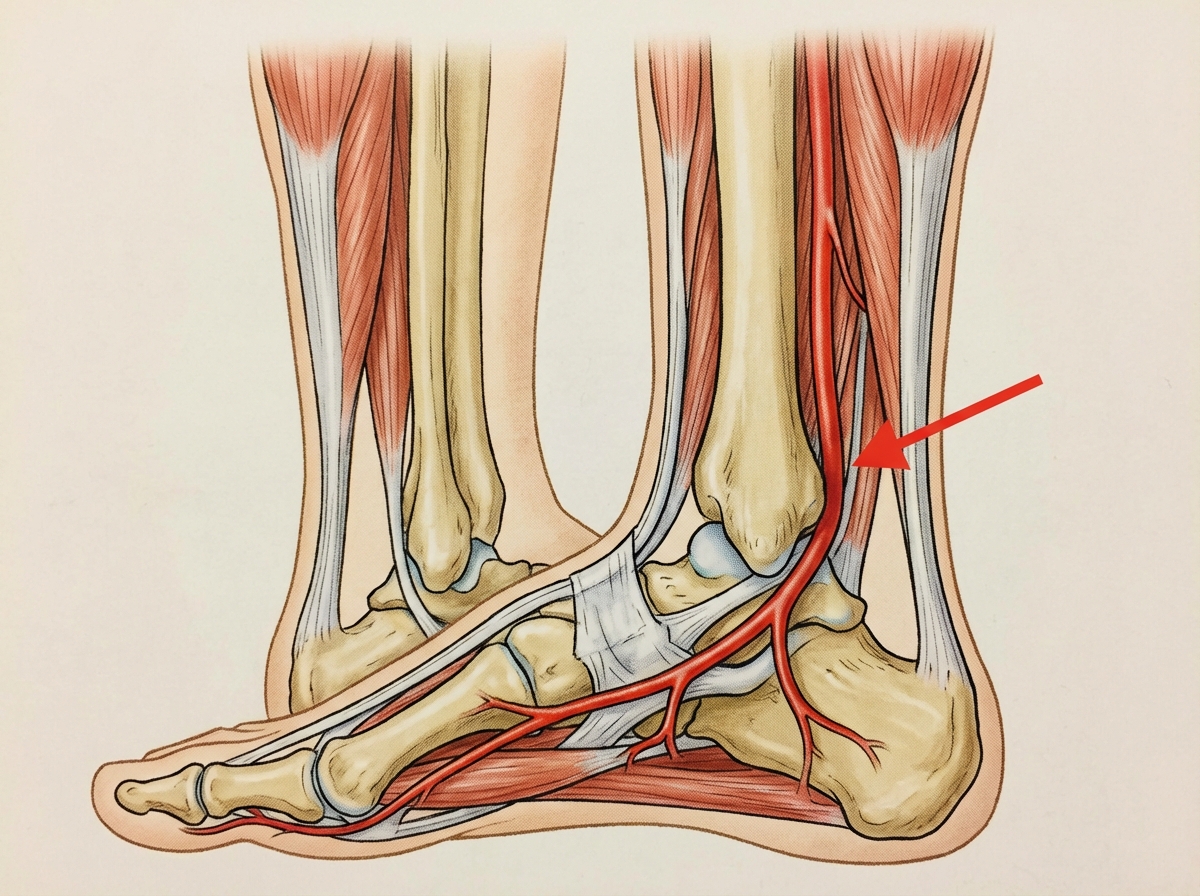
What is the largest synovial joint in the body?
Which of the following tendons is commonly used for transplantation in the body?
A patient sustained a hyperextension injury to the knee. Which of the following ligaments prevents excessive anterior gliding of the femur on the tibia?
What is the chief extensor of the knee joint during hip flexion?
A sesamoid bone is present in the tendon of which of the following muscles?
What is the primary source of arterial supply to the head and neck of the femur?
The Trendelenburg sign is due to paralysis of which muscle?
Which muscle of the foot is NOT supplied by the lateral plantar nerve?
Which muscles are responsible for the dorsiflexion of the foot?
What is the most anterior structure on the tibial plateau?
Explanation: The **Knee Joint** is the correct answer as it is anatomically the **largest and most complex synovial joint** in the human body. It is classified as a modified hinge joint (bicondylar joint) that involves three articulations: two femorotibial and one femoropatellar. Its size is necessitated by the massive articular surfaces of the femoral and tibial condyles required to support the body's weight while providing a wide range of motion. **Analysis of Options:** * **Shoulder Joint (Option A):** While it is the most mobile joint in the body (ball-and-socket), its articular surfaces are relatively small, with a shallow glenoid cavity that covers only a fraction of the humeral head. * **Hip Joint (Option B):** This is a very large and stable ball-and-socket joint, often confused with the knee. However, in terms of total surface area and the volume of the synovial cavity, it is smaller than the knee. * **Ankle Joint (Option C):** This is a hinge joint formed by the tibia, fibula, and talus. It is significantly smaller in surface area compared to the three joints mentioned above. **High-Yield Clinical Pearls for NEET-PG:** * **Stability:** The knee joint is inherently unstable due to the fit of the bones; it relies heavily on ligaments (**ACL, PCL, MCL, LCL**) and the **menisci** for structural integrity. * **Locking Mechanism:** The knee undergoes "locking" during full extension via **medial rotation of the femur on the tibia** (weight-bearing). The **Popliteus** muscle is known as the "Key to the knee" because it unlocks the joint by laterally rotating the femur. * **Synovial Extension:** The suprapatellar bursa is a direct extension of the knee's synovial cavity, making it a common site for joint effusions.
Explanation: The **Plantaris tendon** is the correct answer because it is considered a "vestigial" structure in humans, often referred to as the **"Freshman’s Nerve"** (due to its thin, cord-like appearance being mistaken for a nerve by first-year students). **Why Plantaris?** 1. **Redundancy:** It is a weak flexor of the knee and ankle; its absence does not result in any functional deficit. 2. **Length and Strength:** It provides a long, high-tensile strength tendon suitable for grafting. 3. **Anatomical Availability:** It is absent in approximately 7–10% of the population, but when present, it is the premier choice for reconstructive surgeries, such as repairing tendons in the hand [1]. **Analysis of Incorrect Options:** * **Extensor Hallucis Longus (EHL):** Essential for the extension of the great toe and dorsiflexion of the foot. Removing it would cause significant functional loss (e.g., "drop toe"). * **Extensor Digitorum Longus (EDL):** Crucial for extending the lateral four toes and dorsiflexing the ankle. It is not used as a primary graft source due to the resulting gait impairment. * **Flexor Hallucis Longus (FHL):** While the FHL is sometimes used in specific local transfers (e.g., to reinforce a chronic Achilles tendon rupture), it is not the "standard" or most common tendon for general transplantation because it is vital for the "push-off" phase of walking. **High-Yield Clinical Pearls for NEET-PG:** * **Palmaris Longus:** In the upper limb, the Palmaris Longus is the equivalent "vestigial" tendon used for grafting. * **Freshman’s Nerve:** Always remember this synonym for the Plantaris tendon to avoid confusion with the Sural nerve. * **Clinical Use:** Apart from hand surgery, the Plantaris is a common graft source for **flexor tendon injuries** and **reconstructive ophthalmic surgery** [1].
Explanation: ### Explanation The **Posterior Cruciate Ligament (PCL)** is the strongest ligament of the knee. Its primary biomechanical function is to prevent **posterior displacement of the tibia relative to the femur**. Conversely, this can be described as preventing **anterior gliding of the femur on the tibia**, especially when the knee is weight-bearing and flexed. During hyperextension injuries, the PCL is the primary structure that resists the posterior displacement of the tibia, making it the correct answer. #### Analysis of Options: * **Posterior Cruciate Ligament (PCL):** It originates from the lateral surface of the medial condyle of the femur and attaches to the posterior intercondylar area of the tibia. It prevents the femur from sliding forward off the tibial plateau during weight-bearing. * **Anterior Cruciate Ligament (ACL):** This ligament prevents **anterior displacement of the tibia on the femur** (or posterior gliding of the femur on the tibia). It is most commonly injured during non-contact pivoting or sudden deceleration. * **Medial Collateral Ligament (MCL):** Its primary role is to resist **valgus (abduction) stress** at the knee. * **Lateral Collateral Ligament (LCL):** Its primary role is to resist **varus (adduction) stress** at the knee. #### High-Yield Clinical Pearls for NEET-PG: * **PCL Injury Sign:** The **"Sag Sign"** or **Posterior Drawer Test** is used to diagnose PCL deficiency. * **ACL vs. PCL:** Remember the mnemonic **"PAM"** (PCL attaches to Medial condyle) and **"APL"** (ACL attaches to Lateral condyle) for their femoral attachments. * **Unhappy Triad (O'Donoghue):** Involves injury to the ACL, MCL, and Medial Meniscus (though modern studies suggest the Lateral Meniscus is more commonly injured in acute phases). * **Blood Supply:** The cruciate ligaments are supplied by the **middle genicular artery**, a branch of the popliteal artery.
Explanation: **Explanation:** The **Rectus femoris** is the correct answer because it is the only component of the quadriceps femoris muscle group that is **bi-articular** (crosses two joints). It originates from the Anterior Inferior Iliac Spine (AIIS) and the groove above the acetabulum, allowing it to act on both the hip and the knee. **Why Rectus Femoris is correct:** While all four heads of the quadriceps extend the knee, the Rectus femoris is uniquely positioned to extend the knee while the hip is flexed (e.g., during the preparatory phase of kicking a ball). According to Starling’s law of muscle contraction, a muscle is most effective when stretched. When the hip is extended, the Rectus femoris is stretched, but when the hip is flexed, it becomes the primary driver of knee extension to maintain power, as the vasti muscles are purely mono-articular. **Why other options are incorrect:** * **Vastus medialis & Vastus lateralis:** These are mono-articular muscles originating from the femur. They only act on the knee joint and their action is independent of the position of the hip joint. * **Hamstrings:** These are primarily flexors of the knee and extensors of the hip. They are antagonists to the action described in the question. **High-Yield Clinical Pearls for NEET-PG:** * **Nerve Supply:** All quadriceps muscles are supplied by the **Femoral Nerve (L2-L4)**. * **Kicking Muscle:** Rectus femoris is often referred to as the "kicking muscle." * **Vastus Medialis Obliquus (VMO):** This specific part of the vastus medialis is crucial for the patellar alignment and prevents lateral dislocation of the patella. * **Clinical Sign:** Avulsion of the AIIS typically involves the origin of the Rectus femoris, common in young athletes.
Explanation: ### Explanation **Correct Answer: D. Flexor hallucis brevis** **Concept:** Sesamoid bones are small, rounded bones embedded within tendons, typically found where tendons cross joints. Their primary function is to reduce friction and act as pulleys to increase the mechanical advantage of the muscle. In the foot, the most prominent sesamoid bones are located within the **two heads of the Flexor Hallucis Brevis (FHB)** tendon, specifically at the plantar aspect of the first metatarsophalangeal (MTP) joint. * The **medial (tibial) sesamoid** is located in the medial head of the FHB. * The **lateral (fibular) sesamoid** is located in the lateral head of the FHB. These bones bear weight and protect the tendon of the Flexor Hallucis Longus (FHL), which runs in the groove between them. **Analysis of Incorrect Options:** * **A. Flexor hallucis longus:** While this tendon passes *between* the sesamoids of the FHB, it does not contain a sesamoid bone itself at the MTP joint. * **B. Extensor hallucis brevis:** This muscle inserts into the dorsal aspect of the proximal phalanx; sesamoids are typically found on the plantar (weight-bearing) surface to resist compression. * **C. Adductor hallucis:** Although the lateral sesamoid receives some fibers from the adductor hallucis and abductor hallucis, the bones are anatomically defined as being embedded within the FHB tendon. **High-Yield Facts for NEET-PG:** * **Largest Sesamoid:** The Patella (embedded in the Quadriceps tendon). * **Fabella:** A common sesamoid bone found in the lateral head of the **Gastrocnemius**. * **Os Vesalianum:** A sesamoid occasionally found in the **Peroneus brevis** tendon at the base of the 5th metatarsal. * **Clinical Correlation:** **Sesamoiditis** is a common cause of pain under the great toe in athletes. Fractures of these sesamoids (especially the medial one) must be differentiated from a **bipartite sesamoid** (a normal anatomical variant).
Explanation: The arterial supply to the head and neck of the femur is a high-yield topic in NEET-PG, particularly due to its clinical significance in femoral neck fractures. ### **Explanation of the Correct Answer** The **Medial Circumflex Femoral Artery (MCFA)** is the primary source of blood supply to the femoral head and neck. It gives off **retinacular arteries** (mainly the posterosuperior and posteroinferior groups) that pierce the joint capsule to reach the head. The MCFA is more critical than its lateral counterpart because its branches provide the majority of the blood to the weight-bearing portion of the femoral head. ### **Analysis of Incorrect Options** * **A. Lateral Circumflex Femoral Artery (LCFA):** While it contributes to the extracapsular arterial anastomosis around the trochanteric region, its contribution to the femoral head is significantly less than the MCFA. It primarily supplies the anterior aspect of the femoral neck and the vastus lateralis. * **C. Profunda Femoris Artery:** This is the parent vessel from which both the medial and lateral circumflex arteries typically arise. While it is the ultimate source, it is not the *direct* primary supply. * **D. External Iliac Artery:** This vessel becomes the femoral artery after passing the inguinal ligament. It is too proximal to directly supply the hip joint. ### **Clinical Pearls for NEET-PG** * **Avascular Necrosis (AVN):** Intracapsular fractures of the femoral neck often tear the retinacular vessels of the MCFA, leading to AVN of the femoral head. * **Artery of Ligamentum Teres:** Derived from the **obturator artery**, it supplies a small portion of the head near the fovea centralis. However, in adults, this supply is usually insufficient to maintain viability if the circumflex supply is lost. * **Cruciate Anastomosis:** The MCFA and LCFA participate in this important collateral pathway at the level of the lesser trochanter.
Explanation: The **Trendelenburg sign** is a clinical indicator of dysfunction in the **hip abductor mechanism**. The primary muscles responsible for stabilizing the pelvis during the stance phase of walking are the **Gluteus medius** and **Gluteus minimus**, both innervated by the **Superior Gluteal Nerve (L4-S1)**. When the weight is supported by one leg (the stance limb), the gluteus medius contracts to prevent the opposite side of the pelvis from sagging. If the gluteus medius is paralyzed or weak, the pelvis drops toward the unsupported (swinging) side. This is a "Positive Trendelenburg Sign." **Analysis of Options:** * **Gluteus medius (Correct):** It is the chief abductor of the hip. Its failure leads to pelvic instability during the gait cycle. * **Gluteus maximus:** This is the chief extensor of the hip (used for climbing stairs). Paralysis results in a "Gluteus Maximus Lurch" (backward trunk lean), not a pelvic drop. * **Piriformis:** This is a lateral rotator of the hip. While clinically significant due to its proximity to the sciatic nerve (Piriformis syndrome), it does not stabilize the pelvis in the coronal plane. * **Obturator externus:** This is a short lateral rotator of the thigh and does not contribute to hip abduction or pelvic stability during walking. **Clinical Pearls for NEET-PG:** 1. **Nerve Involved:** Damage to the **Superior Gluteal Nerve** (e.g., due to misplaced intramuscular injections in the gluteal region) is the most common cause of a positive Trendelenburg sign. 2. **Trendelenburg Gait:** To compensate for the pelvic drop, the patient tilts their trunk *towards* the affected side to shift the center of gravity; this is known as a **compensated Trendelenburg gait** or "Waddling gait" if bilateral. 3. **Mechanism:** The hip acts as a **Class 1 lever**, where the hip joint is the fulcrum.
Explanation: The innervation of the intrinsic muscles of the foot is a high-yield topic for NEET-PG, following a pattern similar to the hand. The muscles are supplied by the **medial and lateral plantar nerves**, which are terminal branches of the tibial nerve. ### **Why the 1st Lumbrical is the Correct Answer** The **1st Lumbrical** is supplied by the **Medial Plantar Nerve**. In the foot, the medial plantar nerve (analogous to the median nerve in the hand) supplies only four muscles, often remembered by the mnemonic **"LAFF"**: 1. **L** – 1st **L**umbrical 2. **A** – **A**bductor hallucis 3. **F** – **F**lexor hallucis brevis 4. **F** – **F**lexor digitorum brevis ### **Analysis of Incorrect Options** The **Lateral Plantar Nerve** (analogous to the ulnar nerve) supplies all other intrinsic muscles of the foot not covered by the medial plantar nerve: * **Abductor digiti minimi:** Supplied by the trunk/superficial branch of the lateral plantar nerve. * **Adductor hallucis:** Supplied by the deep branch of the lateral plantar nerve (similar to the adductor pollicis in the hand). * **Flexor digitorum accessorius (Quadratus Plantae):** Supplied by the main trunk of the lateral plantar nerve. ### **High-Yield Clinical Pearls for NEET-PG** * **Hand vs. Foot Analogy:** The Medial Plantar Nerve = Median Nerve; the Lateral Plantar Nerve = Ulnar Nerve. * **Baxter’s Nerve:** The first branch of the lateral plantar nerve (supplying Abductor digiti minimi) can become compressed, causing chronic heel pain mimicking plantar fasciitis. * **Sensory Distribution:** The medial plantar nerve supplies the medial 3.5 toes, while the lateral plantar nerve supplies the lateral 1.5 toes.
Explanation: **Explanation:** The movement of **dorsiflexion** (lifting the foot upward toward the shin) is the primary function of the muscles located in the **Anterior Compartment of the leg**. All muscles in this compartment are innervated by the **Deep Peroneal Nerve**. * **Extensor Hallucis Longus (EHL):** This is the correct answer. It originates from the fibula and interosseous membrane and inserts into the distal phalanx of the great toe. Its primary actions are the extension of the big toe and assisting in the dorsiflexion of the foot at the ankle joint. **Analysis of Incorrect Options:** * **Plantaris (A):** Located in the superficial posterior compartment, it is a vestigial muscle that acts as a weak **plantarflexor** of the foot and a flexor of the knee. * **Flexor Digitorum Longus (C) & Flexor Hallucis Longus (D):** Both are located in the deep posterior compartment of the leg. They are responsible for **plantarflexion** of the foot and flexion of the toes. They are innervated by the Tibial Nerve. **High-Yield Clinical Pearls for NEET-PG:** 1. **The "Tom, Dick, And Very Nervous Harry" Mnemonic:** This helps remember the structures passing deep to the flexor retinaculum (medial malleolus): **T**ibialis posterior, flexor **D**igitorum longus, posterior tibial **A**rtery, posterior tibial **V**ein, tibial **N**erve, and flexor **H**allucis longus. 2. **Foot Drop:** Injury to the **Common Peroneal Nerve** (specifically the Deep Peroneal branch) leads to paralysis of the anterior compartment muscles, resulting in "Foot Drop" (loss of dorsiflexion). 3. **Primary Dorsiflexor:** While EHL assists, the **Tibialis Anterior** is the most powerful dorsiflexor and inverter of the foot.
Explanation: The tibial plateau serves as the attachment site for several vital intra-articular structures. To master this high-yield topic, one must remember the specific **anteroposterior (front-to-back) sequence** of attachments on the intercondylar area of the tibia. ### **Anatomical Sequence (Mnemonic: Medical Licensure Always Leads Many People)** From anterior to posterior, the structures are attached in the following order: 1. **M**edial Meniscus (Anterior horn) — **Most Anterior** 2. **L**ateral Meniscus (Anterior horn) 3. **A**nterior Cruciate Ligament (ACL) 4. **L**ateral Meniscus (Posterior horn) 5. **M**edial Meniscus (Posterior horn) 6. **P**osterior Cruciate Ligament (PCL) — **Most Posterior** ### **Analysis of Options** * **Anterior horn of the medial meniscus (Correct):** This is the most anteriorly placed structure on the intercondylar area, sitting just in front of the intercondylar eminence. * **Anterior horn of the lateral meniscus (Incorrect):** This attaches just behind the medial meniscus and slightly lateral to the ACL's anterior attachment. * **Anterior cruciate ligament (Incorrect):** The ACL attaches behind both anterior horns of the menisci. * **Ligamentum patella (Incorrect):** While it is an anterior structure, it attaches to the **tibial tuberosity**, which is on the anterior surface of the tibia, not on the tibial plateau (superior surface). ### **Clinical Pearls for NEET-PG** * **Shape Difference:** The medial meniscus is **C-shaped** (larger and less mobile), while the lateral meniscus is **circular** (smaller and more mobile). * **The
Gluteal Region and Hip
Practice Questions
Thigh and Popliteal Fossa
Practice Questions
Leg and Foot
Practice Questions
Joints of Lower Limb
Practice Questions
Nerves of Lower Limb
Practice Questions
Arterial Supply and Venous Drainage
Practice Questions
Lymphatic Drainage
Practice Questions
Muscles and Their Actions
Practice Questions
Gait Analysis and Biomechanics
Practice Questions
Applied Anatomy and Clinical Correlations
Practice Questions
Get full access to all questions, explanations, and performance tracking.
Start For Free