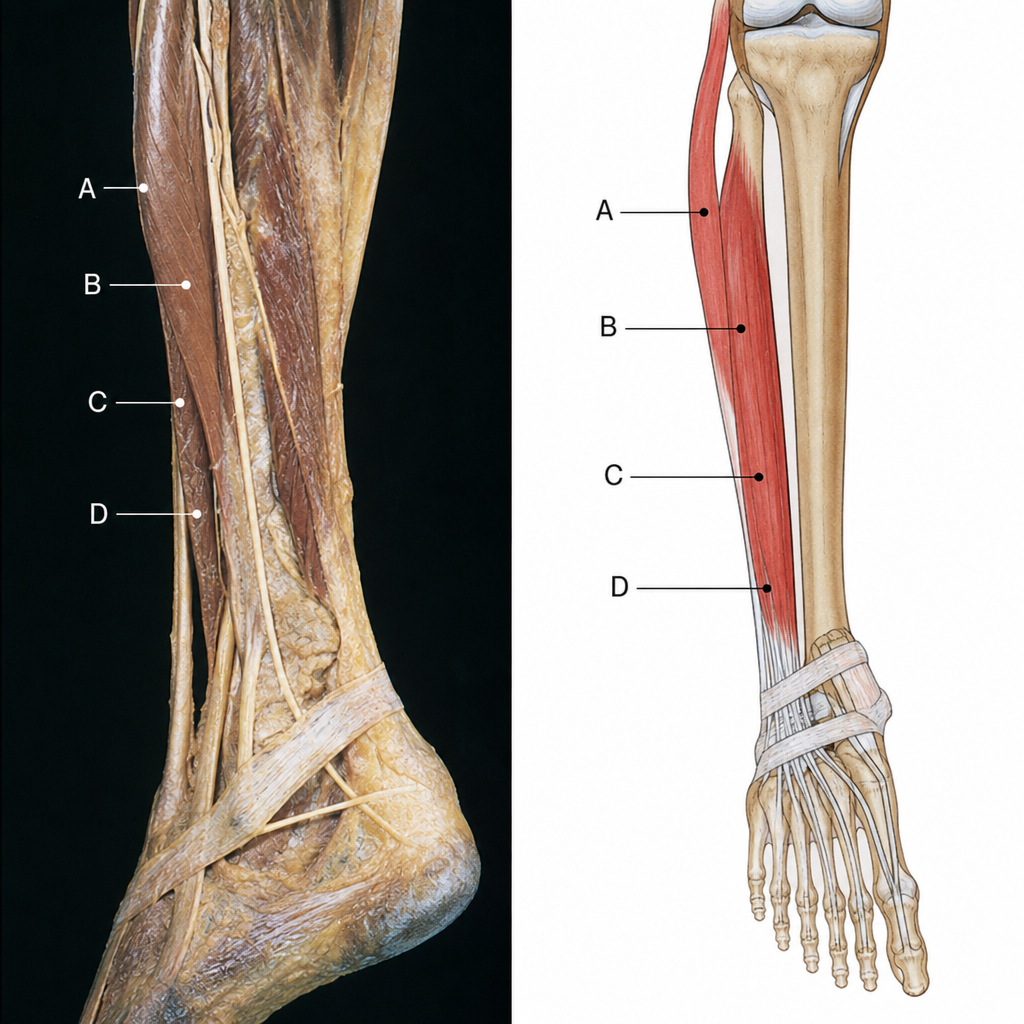
What is the nerve supply of the Tibialis anterior muscle?
The saphenous nerve is a branch of which of the following nerves?
Which is the locking muscle of the knee joint?
The calcaneum is most commonly associated with which bone?
Following a car accident with a deep laceration on the medial side of the right knee, the patient notices numbness along the medial side of the right leg and foot. There is no motor deficit. Which nerve appears to have been injured?
An intern performing venesection at the lower limb could injure which of the following nerves?
What is true about the cuboid bone?
The popliteal artery is difficult to palpate because:
Which nerve supplies the adductor compartment of the thigh?
Which of the following is NOT true regarding the course of the great saphenous vein?
Explanation: **Explanation:** The **Tibialis anterior** is the most medial muscle of the **anterior compartment of the leg**. Muscles in this compartment are primarily responsible for dorsiflexion of the foot and extension of the toes. 1. **Why the Correct Answer is Right:** The **Deep Peroneal Nerve** (L4, L5) is the nerve of the anterior compartment of the leg. It arises from the common peroneal nerve at the neck of the fibula. It supplies all muscles in this compartment: Tibialis anterior, Extensor digitorum longus, Extensor hallucis longus, and Peroneus tertius. The Tibialis anterior specifically acts as the primary dorsiflexor and invertor of the foot. 2. **Why the Incorrect Options are Wrong:** * **Tibial nerve:** This nerve supplies the **posterior compartment** of the leg (e.g., Gastrocnemius, Soleus, Tibialis posterior). Its primary functions are plantarflexion and toe flexion. * **Femoral nerve:** This nerve supplies the **anterior compartment of the thigh** (e.g., Quadriceps femoris), facilitating hip flexion and knee extension. * **Sural nerve:** This is a **purely sensory nerve** formed by branches of the tibial and common peroneal nerves. It supplies the skin of the lateral and posterior part of the lower third of the leg and the lateral border of the foot. **Clinical Pearls & High-Yield Facts:** * **Foot Drop:** Injury to the Common Peroneal Nerve (at the fibular neck) or the Deep Peroneal Nerve leads to paralysis of the Tibialis anterior, resulting in "Foot Drop" and a "High-steppage gait." * **Anterior Compartment Syndrome:** The Tibialis anterior is the muscle most commonly involved in this surgical emergency, which can lead to ischemic necrosis and deep peroneal nerve palsy. * **Inversion vs. Eversion:** While Tibialis anterior (Deep Peroneal Nerve) and Tibialis posterior (Tibial Nerve) both **invert** the foot, they have opposite actions on the ankle joint (Dorsiflexion vs. Plantarflexion).
Explanation: The **saphenous nerve** is the longest and largest cutaneous branch of the **femoral nerve (L2–L4)**. It arises in the femoral triangle, descends through the adductor canal (subsartorial canal) alongside the femoral artery, and eventually pierces the fascia between the sartorius and gracilis muscles to provide sensory innervation to the medial aspect of the leg and foot. **Why the other options are incorrect:** * **Tibial nerve:** This is a terminal branch of the sciatic nerve. It supplies the posterior compartment of the leg and the sole of the foot. * **Sciatic nerve:** This is the largest nerve in the body (L4–S3). While it gives rise to the nerves of the lower leg, it does not directly branch into the saphenous nerve. * **Common peroneal (fibular) nerve:** This is the other terminal branch of the sciatic nerve. It supplies the lateral and anterior compartments of the leg and the dorsal surface of the foot. **High-Yield Clinical Pearls for NEET-PG:** * **Course:** The saphenous nerve is the only branch of the femoral nerve that extends below the knee. * **Adductor Canal:** It is a key content of the adductor canal but, unlike the femoral artery and vein, it **does not** pass through the adductor hiatus. * **Clinical Correlation:** The nerve is closely related to the **great saphenous vein** anterior to the medial malleolus. It is at high risk of injury during **venesection** or varicose vein stripping, leading to numbness along the medial border of the foot. * **Nerve Block:** A saphenous nerve block is often performed at the level of the adductor canal for surgeries involving the distal leg or foot.
Explanation: ### Explanation **1. Why Vastus Medialis is the Correct Answer:** The "locking" of the knee joint refers to the terminal phase of extension. During the last 10–15 degrees of extension, the femur undergoes **medial rotation** (in a closed kinetic chain) or the tibia undergoes **lateral rotation** (in an open kinetic chain) on the other bone. This mechanism tightens the ligaments, making the joint stable and rigid. The **Vastus Medialis**, specifically its distal horizontal fibers known as the **Vastus Medialis Obliquus (VMO)**, is the primary muscle responsible for achieving these final degrees of extension. By completing the extension and facilitating the terminal rotation, it effectively "locks" the knee. **2. Why Other Options are Incorrect:** * **Vastus Lateralis (A):** This is the largest and most powerful part of the Quadriceps. While it is a strong extensor, it tends to pull the patella laterally and does not contribute to the terminal locking rotation. * **Vastus Intermedius (C):** Located deep to the Rectus Femoris, it acts as a pure extensor of the knee but lacks the specific orientation to facilitate the locking mechanism. * **Rectus Femoris (D):** This is a bipennate, superficial muscle that crosses two joints (hip and knee). It is primarily involved in hip flexion and general knee extension but is not the specific driver for terminal locking. **3. Clinical Pearls & High-Yield Facts for NEET-PG:** * **Locking vs. Unlocking:** While Vastus Medialis is the **locking** muscle, the **Popliteus** is the **unlocking** muscle (it initiates flexion by laterally rotating the femur on the tibia). * **VMO Atrophy:** The Vastus Medialis is the first muscle to atrophy in knee injuries or chronic effusions, often leading to patellar maltracking. * **Screw-Home Mechanism:** This is the anatomical term for the locking of the knee, which increases joint stability while standing for long periods with minimal muscular effort.
Explanation: **Explanation:** The correct answer is **Vertebra**. This question refers to the developmental and morphological homology between the bones of the axial skeleton and the appendicular skeleton. **1. Why Vertebra is Correct:** In comparative anatomy and embryology, the **calcaneum** (the largest tarsal bone) is considered morphologically homologous to the **vertebra**. Specifically, the calcaneum represents the "body" or the "centrum" of a specialized segment in the limb development pattern. Just as the vertebral column provides the primary weight-bearing axis for the trunk, the calcaneum serves as the primary weight-bearing foundation for the foot (the "heel"). **2. Why other options are incorrect:** * **Rib:** Ribs are homologous to the transverse processes of vertebrae or specific costal elements. In the limbs, the counterparts to ribs are typically the **metatarsals/metacarpals** or phalanges. * **Skull:** The skull is a complex structure derived from the desmocranium and chondrocranium; it does not share a direct segmental homology with individual tarsal bones like the calcaneum. * **Fibula:** The fibula is a long bone of the leg. Its morphological homologue in the upper limb is the **fibula-equivalent, the ulna**. **Clinical Pearls & High-Yield Facts for NEET-PG:** * **Weight Bearing:** The calcaneum transmits the majority of the body weight to the ground. It is the first bone of the foot to ossify (except for the occasional primary center in the talus). * **Angle of Incidence:** The **Bohler’s Angle** (normally 25–40°) is measured on the calcaneum; a decrease in this angle indicates a calcaneal fracture. * **Sustentaculum Tali:** This is a shelf-like projection on the medial aspect of the calcaneum that supports the talus and serves as a groove for the *Flexor hallucis longus* tendon. * **Tendo-Achilles:** The calcaneal tuberosity is the insertion site for the Achilles tendon, the strongest tendon in the body.
Explanation: **Explanation:** The correct answer is **B. Saphenous nerve.** **Why it is correct:** The saphenous nerve is the longest cutaneous branch of the **femoral nerve** (L2-L4). It becomes superficial on the medial side of the knee after piercing the roof of the adductor canal (subsartorial canal). It descends along the medial side of the leg alongside the **great saphenous vein** and provides sensory innervation to the **medial side of the leg and the medial border of the foot** up to the ball of the great toe. Since the patient has a medial knee laceration and purely sensory symptoms in this specific distribution, the saphenous nerve is the most likely structure injured. **Why the other options are incorrect:** * **Femoral nerve:** While it is the parent nerve, a femoral nerve injury would cause motor deficits (weakness in knee extension/quadriceps) and sensory loss in the anterior thigh, not just the lower leg. * **Sural nerve:** This nerve supplies the **lateral** aspect of the ankle and the lateral border of the foot. It is formed by branches of the tibial and common fibular nerves. * **Superficial fibular nerve:** This nerve supplies the lateral compartment of the leg (motor) and the skin over the **lower lateral leg and the dorsum of the foot** (sensory). **High-Yield Clinical Pearls for NEET-PG:** * **Anatomical Landmark:** The saphenous nerve passes between the Sartorius and Gracilis muscles at the knee. * **Surgical Correlation:** The saphenous nerve is at high risk of injury during **venesection of the great saphenous vein** or during orthopedic surgeries involving the medial aspect of the knee. * **Purely Sensory:** It is a purely sensory nerve; any motor deficit rules out an isolated saphenous nerve injury.
Explanation: **Explanation:** The correct answer is **Saphenous nerve**. **1. Why Saphenous nerve is correct:** Venesection (venous cutdown) in the lower limb is most commonly performed on the **Great Saphenous Vein (GSV)**, specifically at its most accessible point: **anterior to the medial malleolus** at the ankle. The **saphenous nerve**, which is a branch of the femoral nerve, descends in the leg and runs immediately adjacent to the GSV in this region. During the surgical incision or isolation of the vein, the nerve is at high risk of accidental injury, leading to numbness or paresthesia along the medial aspect of the leg and foot. **2. Why other options are incorrect:** * **Sural nerve:** This nerve runs along the lateral aspect of the ankle, posterior to the lateral malleolus, accompanying the **Small Saphenous Vein**. While it could be injured during procedures on the small saphenous vein, it is not the primary nerve at risk during standard lower limb venesection. * **Common peroneal nerve:** This nerve winds around the **neck of the fibula**. It is susceptible to injury from tight casts or compression but is not anatomically related to the common sites for venesection. * **Tibial nerve:** This nerve lies deep in the posterior compartment of the leg and passes posterior to the medial malleolus (within the tarsal tunnel). It is too deep to be injured during a superficial venous cutdown. **3. Clinical Pearls for NEET-PG:** * **Anatomical Landmark:** The Great Saphenous Vein is consistently found **2 cm anterior and superior** to the medial malleolus. * **Nerve-Vein Pairs:** * Great Saphenous Vein + Saphenous Nerve (Anterior to medial malleolus). * Small Saphenous Vein + Sural Nerve (Posterior to lateral malleolus). * **Saphenous Nerve Origin:** It is the longest cutaneous branch of the **Femoral Nerve (L2-L4)**. It provides sensory innervation to the medial leg and the medial border of the foot up to the ball of the great toe.
Explanation: **Explanation:** The **cuboid bone** is one of the seven tarsal bones located on the lateral aspect of the foot. It plays a crucial role in maintaining the lateral longitudinal arch. **1. Why Option D is Correct:** The cuboid articulates proximally with the **calcaneus** at the calcaneocuboid joint. This joint is a part of the midtarsal (transverse tarsal) joint complex. Distally, it articulates with the 4th and 5th metatarsals, and medially with the lateral cuneiform and occasionally the navicular. **2. Why the Other Options are Incorrect:** * **Option A:** Like all tarsal bones, the cuboid develops via **endochondral ossification** (ossification within a cartilage model), not membranous ossification. * **Option B:** The **lunate** is a carpal bone found in the wrist, not the foot. The cuboid articulates proximally with the calcaneus. * **Option C:** The flexor retinaculum of the foot (laciniate ligament) attaches to the medial malleolus and the calcaneus. It is the **peroneal retinaculum** and the **long plantar ligament** that have attachments related to the cuboid. **3. High-Yield Clinical Pearls for NEET-PG:** * **Ossification:** The cuboid is often the only tarsal bone (besides the calcaneus and talus) to have an ossification center present at **birth**. This is a key radiological marker for assessing fetal maturity. * **Peroneal Groove:** The plantar surface of the cuboid contains a deep groove for the tendon of the **peroneus longus** muscle. * **Nutcracker Fracture:** A compression fracture of the cuboid between the calcaneus and the metatarsals is colloquially known as a "Nutcracker fracture."
Explanation: To palpate a peripheral pulse effectively, an artery should ideally be **superficial** and lie directly over a **hard bony surface** against which it can be compressed. The popliteal artery fails on both counts, making it the most difficult pulse to palpate in the lower limb. ### **Explanation of the Correct Answer (D)** 1. **Depth (Not Superficial):** The popliteal artery is the deepest structure in the popliteal fossa. it lies anterior to the popliteal vein and the tibial nerve, resting directly on the floor of the fossa (the popliteal surface of the femur and the capsule of the knee joint). 2. **Lack of Bony Support:** Unlike the radial artery (at the wrist) or the femoral artery (at the midinguinal point), the popliteal artery does not cross a prominent, superficial bony ridge. To feel the pulse, the clinician must press deeply into the fossa to compress the artery against the distal femur or proximal tibia. ### **Analysis of Incorrect Options** * **Option A & B:** These are partially correct but incomplete. The difficulty arises from the **combination** of its deep location and the lack of a superficial bony backing. * **Option C:** This is factually incorrect. The artery is the deepest structure in the fossa, covered by skin, subcutaneous fat, dense popliteal fascia, the tibial nerve, and the popliteal vein. ### **Clinical Pearls for NEET-PG** * **Palpation Technique:** The pulse is best felt in the **flexed knee** position. This relaxes the taut popliteal fascia and the gastrocnemius muscles, allowing the clinician’s fingers to reach the deeper structures. * **Popliteal Aneurysm:** This is the most common site for peripheral arterial aneurysms. A bounding or expansile pulse in the fossa is highly suggestive. * **Relationship:** From superficial to deep in the popliteal fossa: **Nerve → Vein → Artery** (Mnemonic: **NVA**). * **Genicular Anastomosis:** The popliteal artery gives off five genicular branches that maintain blood supply to the knee during prolonged flexion.
Explanation: The **obturator nerve** is the primary motor nerve of the **medial (adductor) compartment** of the thigh. Arising from the ventral rami of **L2, L3, and L4** (lumbar plexus), it enters the thigh through the obturator canal. It supplies all muscles in this compartment, including the adductor longus, adductor brevis, gracilis, and obturator externus. **Analysis of Options:** * **Femoral Nerve (L2-L4):** This is the nerve of the **anterior (extensor) compartment** of the thigh. It supplies the quadriceps femoris, sartorius, and pectineus. * **Superior Gluteal Nerve (L4-S1):** This nerve supplies the gluteus medius, gluteus minimus, and tensor fasciae latae. Its primary function is hip abduction and stabilization. * **Inferior Gluteal Nerve (L5-S2):** This nerve exclusively supplies the **gluteus maximus**, the chief extensor of the hip. **High-Yield Clinical Pearls for NEET-PG:** * **The "Hybrid" Muscle:** The **Adductor Magnus** has a dual nerve supply. Its adductor part is supplied by the **obturator nerve**, while its "hamstring" part is supplied by the **tibial component of the sciatic nerve**. * **Pectineus:** Often considered a transitional muscle, it is located in the medial compartment but is typically supplied by the **femoral nerve** (though it may occasionally receive a branch from the obturator). * **Howship-Romberg Sign:** Pain or numbness on the medial aspect of the thigh due to compression of the obturator nerve (often by an obturator hernia). * **Referred Pain:** Because the obturator nerve also provides sensory innervation to the hip and knee joints, pathology in the hip (like Perthes disease) often presents as referred pain to the medial knee.
Explanation: Explanation: 1. Why Option A is the correct answer (The False Statement): The Great Saphenous Vein (GSV) does not begin at the saphenous opening; rather, it ends there. It originates at the medial end of the dorsal venous arch of the foot. It then ascends anterior to the medial malleolus, passes along the medial side of the leg and thigh, and finally pierces the cribriform fascia at the saphenous opening (hiatus saphenus) to drain into the femoral vein [1]. 2. Analysis of Incorrect Options (True Statements): * Option B: At the knee, the GSV passes along the posteromedial aspect (roughly a hand's breadth behind the medial border of the patella). This is a high-yield anatomical landmark for surgical procedures. * Option C: In the leg, the GSV is closely accompanied by the saphenous nerve (a branch of the femoral nerve) [2]. Injury to this nerve during vein stripping leads to numbness along the medial aspect of the leg and foot [2]. * Option D: The posterior arch vein (Leonardo’s vein) is a significant tributary in the leg that joins the GSV just below the knee. It is clinically important as it communicates with the deep veins via "Cockett’s perforators." Clinical Pearls for NEET-PG: * Venesection Site: The GSV is most consistently found anterior to the medial malleolus, making it a preferred site for emergency venous access. * Valves: It contains approximately 10–20 valves, with the most functional one located at the saphenofemoral junction. * Coronary Artery Bypass Graft (CABG): The GSV is the most commonly used vessel for arterial grafting due to its length and accessibility [3].
Gluteal Region and Hip
Practice Questions
Thigh and Popliteal Fossa
Practice Questions
Leg and Foot
Practice Questions
Joints of Lower Limb
Practice Questions
Nerves of Lower Limb
Practice Questions
Arterial Supply and Venous Drainage
Practice Questions
Lymphatic Drainage
Practice Questions
Muscles and Their Actions
Practice Questions
Gait Analysis and Biomechanics
Practice Questions
Applied Anatomy and Clinical Correlations
Practice Questions
Get full access to all questions, explanations, and performance tracking.
Start For Free