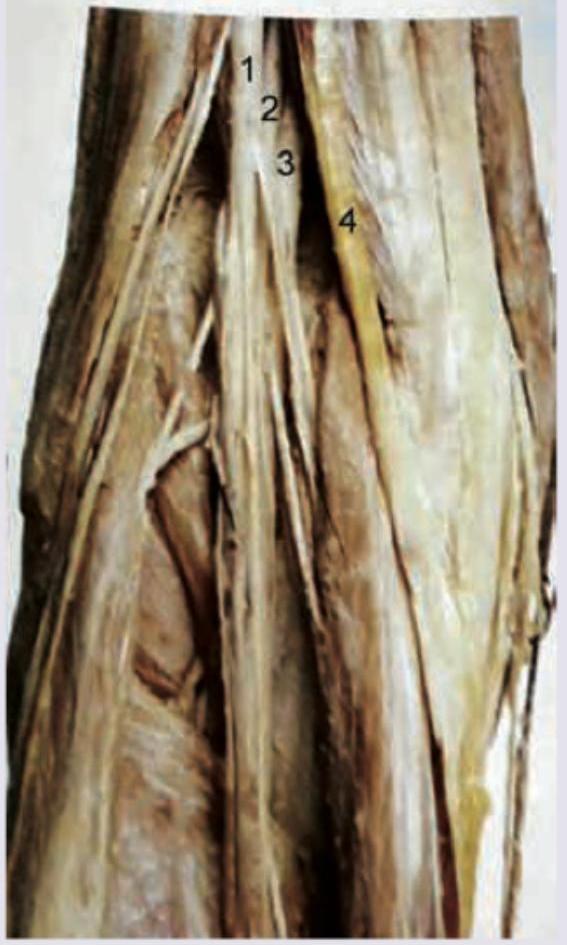
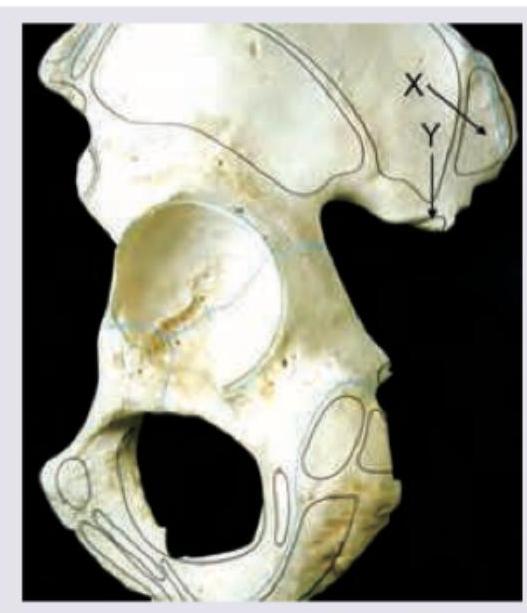
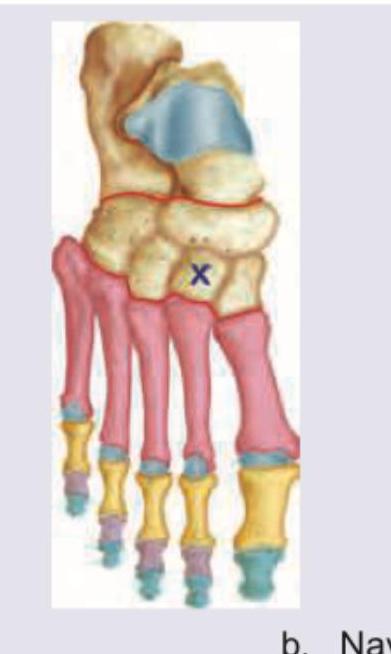
Which of the following muscles is responsible for plantar flexion?
Foot drop results as a result of injury to which nerve?
Which dermatome corresponds to the posterior thigh?
A 45-year-old intoxicated male was struck by a tour bus while walking in the middle of the street. The man was admitted to the emergency department and during physical examination was diagnosed with "scissor gait," in which an individual crosses one limb in front of the other, due to powerful hip adduction. Which of the following nerves was most likely involved in this condition?
All of the following are contents of the second layer of the sole, except?
The tibial nerve supplies all of the following muscles except:
Which quadrant of the gluteal region is considered safe for intramuscular injections?
Surgical exploration of the ankle and foot demonstrates a muscle arising from the medial and lateral processes of the tuberosity of the calcaneus and inserting into the lateral side of the base of the proximal phalanx of the 5th toe. How does this muscle act on the 5th toe?
Which ligament is primarily responsible for supporting the medial arch of the foot?
Which of the following structures is not a part of the knee extensor mechanism?
Explanation: Explanation: Plantar flexion of the foot occurs at the **talocrural (ankle) joint**. This movement is primarily performed by the muscles of the **posterior compartment of the leg**. 1. **Why Option A is Correct:** * **Soleus:** Along with the Gastrocnemius, it forms the *Triceps Surae*. It is a powerful plantar flexor and is essential for posture and walking. * **Plantaris:** A small muscle with a long tendon; though its contribution is weak, it acts as a synergist in plantar flexion. * **Flexor Hallucis Longus (FHL):** Located in the deep posterior compartment, its primary action is flexing the great toe, but because it crosses the ankle joint posteriorly, it also assists in plantar flexion. 2. **Analysis of Incorrect Options:** * **Option B:** While FHL is a plantar flexor, **Peroneus brevis** (lateral compartment) primarily performs **eversion**. While it can weakly assist in plantar flexion, Option A is more comprehensive. * **Option C:** **Tibialis anterior** is the primary **dorsiflexor** of the foot. Its inclusion makes this option fundamentally incorrect. * **Option D:** While both are plantar flexors, this option is incomplete compared to Option A, which includes the FHL. **High-Yield NEET-PG Pearls:** * **Prime Movers:** The Gastrocnemius and Soleus are the strongest plantar flexors. * **The
Explanation: **Explanation:** **Foot drop** is a clinical condition characterized by the inability to dorsiflex the foot at the ankle joint, leading to a "dragging" gait. **Why Deep Peroneal Nerve (DPN) is the correct answer:** The Deep Peroneal Nerve (a branch of the Common Peroneal Nerve) supplies the muscles of the **anterior compartment of the leg**, including the Tibialis anterior, Extensor digitorum longus, and Extensor hallucis longus. The Tibialis anterior is the primary dorsiflexor of the foot. Damage to the DPN results in paralysis of these muscles, causing the foot to remain in a plantar-flexed position (Foot Drop). **Analysis of Incorrect Options:** * **Superficial Peroneal Nerve:** Supplies the lateral compartment of the leg (Peroneus longus and brevis). Injury leads to loss of **eversion**, but dorsiflexion remains intact. * **Tibial Nerve:** Supplies the posterior compartment (plantar flexors). Injury results in "calcaneovalgus" deformity (inability to plantar flex), not foot drop. * **Deltoid Ligament:** This is a strong medial ligament of the ankle joint. Its rupture (often in Pott’s fracture) affects joint stability but does not cause nerve-related motor deficits like foot drop. **Clinical Pearls for NEET-PG:** 1. **Common Peroneal Nerve (CPN):** The most common site of injury is at the **neck of the fibula**. Since the CPN divides into the Deep and Superficial branches, a proximal injury here causes **both** foot drop and loss of eversion. 2. **Gait:** Patients with foot drop exhibit a **High Steppage Gait** to prevent their toes from scraping the ground. 3. **Sensory Loss:** Isolated DPN injury causes sensory loss specifically in the **first web space** of the foot.
Explanation: The dermatomes of the lower limb follow a specific developmental rotation pattern, making them a high-yield topic for NEET-PG. ### **Explanation of the Correct Answer (S2)** The **S2 dermatome** covers the skin of the **posterior thigh**, the popliteal fossa, and the midline of the posterior leg. This distribution corresponds to the sensory supply provided by the **posterior cutaneous nerve of the thigh** (S1, S2, S3). In the embryological development of the lower limb, the "pre-axial" borders (L1–L4) migrate anteriorly, while the "post-axial" borders (S1–S2) migrate posteriorly, placing S2 squarely on the back of the thigh. ### **Analysis of Incorrect Options** * **A. L4:** This dermatome covers the **medial side of the leg** and the medial malleolus. It is commonly tested in the context of L3-L4 disc prolapse. * **B. L5:** This covers the **anterolateral aspect of the leg**, the dorsum of the foot, and the first web space (between the big toe and second toe). * **C. S1:** This dermatome supplies the **lateral malleolus**, the lateral border of the foot, and the little toe. It is the key dermatome for testing S1 nerve root compression (e.g., loss of ankle reflex). ### **Clinical Pearls for NEET-PG** * **The "Strip" Rule:** Remember that L1-L5 dermatomes generally spiral from the hip down to the medial foot, while S1-S2 return up the posterior aspect of the limb. * **Key Landmarks:** * **L3:** Knee (anterior). * **L4:** Medial malleolus. * **L5:** Dorsum of foot/Big toe. * **S1:** Lateral malleolus/Little toe. * **S2:** Posterior thigh/Popliteal fossa. * **S3-S5:** Perianal area ("Saddle anesthesia"). * **Clinical Correlation:** A patient with a herniated disc at **L5-S1** will typically present with sensory loss in the **S1** distribution (lateral foot) and a diminished Achilles reflex.
Explanation: ### Explanation **1. Why the Correct Answer is Right:** The **Obturator nerve (L2–L4)** supplies the muscles of the **medial compartment of the thigh**, which are primarily responsible for hip adduction (Adductor longus, brevis, magnus, and Gracilis). A **"Scissor Gait"** is characterized by excessive activation or spasticity of these adductor muscles, causing the legs to cross over each other during the swing phase of walking. While this condition is most commonly associated with **Upper Motor Neuron (UMN) lesions** (like Cerebral Palsy), the question asks which nerve is "involved" in the mechanism of this gait. Since the Obturator nerve provides the motor innervation to the adductors, it is the anatomical structure responsible for the powerful hip adduction described. **2. Why the Incorrect Options are Wrong:** * **Tibial Nerve:** Supplies the posterior compartment of the leg and hamstrings. Injury leads to loss of plantar flexion and "calcaneovalgus" deformity, not adduction. * **Inferior Gluteal Nerve:** Supplies the Gluteus maximus. Injury results in difficulty climbing stairs or rising from a seated position (weak hip extension). * **Superior Gluteal Nerve:** Supplies the Gluteus medius and minimus (hip abductors). Injury leads to a **Trendelenburg gait**, where the pelvis drops on the unsupported side. **3. Clinical Pearls for NEET-PG:** * **Obturator Nerve Injury:** Can occur during pelvic surgeries or due to compression by a fetal head during labor. It results in loss of thigh adduction and sensory loss over the **medial aspect of the thigh**. * **Scissor Gait vs. Trendelenburg Gait:** Scissor gait is due to **overactive adductors** (Obturator nerve), whereas Trendelenburg gait is due to **weak abductors** (Superior Gluteal nerve). * **Adductor Magnus:** This is a "hybrid" muscle. Its adductor part is supplied by the Obturator nerve, while its hamstring part is supplied by the Tibial component of the Sciatic nerve.
Explanation: The sole of the foot is organized into four distinct layers. To answer this question, one must distinguish between the extrinsic tendons passing through the sole and the intrinsic muscles located within specific layers. ### **Why Flexor Hallucis Brevis is the Correct Answer** **Flexor hallucis brevis (FHB)** is a component of the **third layer** of the sole, not the second. The third layer consists of three short muscles: Flexor hallucis brevis, Adductor hallucis, and Flexor digiti minimi brevis. ### **Analysis of Incorrect Options (Contents of the Second Layer)** The second layer is characterized by "2 tendons and 2 muscles" (the "Layer of Tendons"): * **Flexor digitorum longus (B):** An extrinsic tendon that enters the second layer and serves as the insertion point for the lumbricals and flexor accessorius. * **Flexor hallucis longus (A):** An extrinsic tendon that passes deep to the flexor digitorum longus within this layer. * **Flexor digitorum accessorius (C):** Also known as *Quadratus plantae*, this intrinsic muscle originates from the calcaneus and inserts into the tendon of the flexor digitorum longus. * **Lumbricals (4):** These originate from the tendons of the flexor digitorum longus. ### **High-Yield NEET-PG Pearls** * **Layer 1 (Superficial):** Abductor hallucis, Flexor digitorum brevis, Abductor digiti minimi. * **Layer 4 (Deepest):** Interossei (3 Plantar, 4 Dorsal) and the tendons of Peroneus longus and Tibialis posterior. * **Nerve Supply:** Most intrinsic muscles are supplied by the **Lateral Plantar Nerve**, except for the "LAFF" muscles (1st **L**umbrical, **A**bductor hallucis, **F**lexor digitorum brevis, **F**lexor hallucis brevis), which are supplied by the **Medial Plantar Nerve**. * **Clinical Note:** The Flexor digitorum accessorius is unique because it corrects the oblique pull of the flexor digitorum longus tendon, ensuring the toes flex straight.
Explanation: Explanation: The **Tibial nerve (L4–S3)** is one of the two terminal branches of the sciatic nerve. It descends through the popliteal fossa to enter the posterior compartment of the leg. It provides motor innervation to all muscles in the **posterior compartment** (both superficial and deep groups). **Why Peroneus Longus is the correct answer:** The **Peroneus (Fibularis) longus** belongs to the **lateral compartment** of the leg. Muscles in the lateral compartment are exclusively supplied by the **Superficial Peroneal nerve** (a branch of the Common Peroneal nerve). Therefore, the tibial nerve does not supply it. **Analysis of incorrect options:** * **Gastrocnemius:** A superficial muscle of the posterior compartment; supplied by the tibial nerve in the popliteal fossa. * **Plantaris:** A vestigial superficial muscle of the posterior compartment; supplied by the tibial nerve. * **Tibialis posterior:** The deepest muscle of the posterior compartment; supplied by the tibial nerve as it descends toward the ankle. **High-Yield Clinical Pearls for NEET-PG:** * **The "Rule of Posterior":** The Tibial nerve supplies all muscles on the posterior aspect of the leg and the sole of the foot (via medial and lateral plantar nerves). * **Exception to remember:** The **Short head of Biceps Femoris** is the only muscle in the posterior thigh NOT supplied by the tibial part of the sciatic nerve (it is supplied by the **common peroneal** part). * **Clinical Correlation:** Injury to the tibial nerve results in the inability to plantarflex the foot and "clawing" of the toes, leading to a **calcaneovalgus** deformity.
Explanation: The gluteal region is a common site for intramuscular (IM) injections, but it contains vital neurovascular structures that must be avoided. To ensure safety, the region is divided into four quadrants by a horizontal line at the level of the highest point of the iliac crest and a vertical line through the center of the buttock. **Why the Upper and Outer Quadrant is Correct:** The **upper and outer (superolateral) quadrant** is the safest site because it contains the thickest mass of the **gluteus medius** muscle and is devoid of major nerves and large blood vessels. The skin here is also thinner compared to other areas, allowing for easier penetration. **Why Other Options are Incorrect:** * **Upper and Inner (Superomedial):** This quadrant is avoided because it contains the **superior gluteal nerve and artery**. Damage to this nerve leads to paralysis of the gluteus medius and minimus, resulting in a positive Trendelenburg sign. * **Lower and Inner (Inferomedial):** This is the most dangerous site. It contains the **Sciatic nerve** (the largest nerve in the body), the **pudendal nerve**, and the **internal pudendal vessels**. Accidental injection into the sciatic nerve can cause permanent motor and sensory loss in the lower limb. * **Lower and Outer (Inferolateral):** This area contains the **inferior gluteal nerve and vessels**, which supply the gluteus maximus. It is also in close proximity to the sciatic nerve. **Clinical Pearls for NEET-PG:** 1. **Sciatic Nerve Location:** It typically enters the gluteal region through the greater sciatic foramen, inferior to the piriformis muscle. 2. **Alternative Site:** The **Ventrogluteal site** (area over the gluteus medius between the anterior superior iliac spine and the iliac crest) is increasingly preferred over the dorsogluteal site as it is furthest from the sciatic nerve. 3. **Trendelenburg Sign:** Injury to the superior gluteal nerve in the upper-inner quadrant causes the pelvis to tilt toward the unaffected side when standing on the affected leg.
Explanation: ### Explanation **1. Why the Correct Answer is Right:** The muscle described is the **Abductor Digiti Minimi (ADM)**. It is the most lateral muscle of the first layer of the sole. * **Origin:** Medial and lateral processes of the tuberosity of the calcaneus. * **Insertion:** Lateral side of the base of the proximal phalanx of the 5th toe. * **Action:** Due to its lateral insertion relative to the axis of the 5th digit, its primary action is **abduction** of the little toe at the metatarsophalangeal joint. It also assists in flexion. **2. Why the Incorrect Options are Wrong:** * **B. Adduction:** Adduction of the toes (moving toward the 2nd toe axis) is performed by the **Plantar Interossei**. The 5th toe has its own plantar interosseus for adduction, which originates from the 5th metatarsal, not the calcaneus. * **C. Extension:** Extension of the 5th toe is primarily performed by the **Extensor Digitorum Longus** and **Brevis** (dorsal muscles), not muscles of the plantar first layer. * **D. Flexion of the middle phalanx on the proximal phalanx:** This is the specific action of the **Flexor Digitorum Brevis** (which inserts into the middle phalanges of the lateral four toes). The ADM inserts into the *proximal* phalanx. **3. High-Yield Clinical Pearls for NEET-PG:** * **Nerve Supply:** The Abductor Digiti Minimi is supplied by the **Lateral Plantar Nerve** (S2, S3), a branch of the Tibial nerve. * **Layering of the Sole:** Remember the "1-2-3-4" rule for muscles. The 1st layer contains three muscles: Abductor Hallucis, Flexor Digitorum Brevis, and Abductor Digiti Minimi. * **Functional Axis:** In the foot, the axis for abduction/adduction is the **2nd toe**, unlike the hand where it is the 3rd finger.
Explanation: **Explanation:** The **Spring ligament** (Plantar Calcaneonavicular ligament) is the primary dynamic and static stabilizer of the **medial longitudinal arch**. It spans the gap between the sustentaculum tali of the calcaneus and the tuberosity of the navicular bone. Its critical function is to support the head of the talus, which acts as the "keystone" of the medial arch. By preventing the talus from descending inferiorly and medially under weight-bearing conditions, it maintains the arch's height and integrity. **Analysis of Options:** * **Deltoid Ligament (Option A):** This is a strong, triangular ligament on the medial side of the ankle joint. While it provides medial stability to the ankle, it is not the primary supporter of the plantar arch. * **Short Plantar Ligament (Option C):** Also known as the plantar calcaneocuboid ligament, it supports the **lateral longitudinal arch**, not the medial. * **Long Plantar Ligament (Option D):** This is the longest ligament of the tarsus. It converts the sulcus of the cuboid into a canal for the Fibularis longus tendon and primarily supports the **lateral longitudinal arch**. **Clinical Pearls for NEET-PG:** * **Flat Foot (Pes Planus):** Chronic stretching or rupture of the Spring ligament leads to the collapse of the medial longitudinal arch, resulting in a "flat foot" deformity. * **Keystone Concept:** The **Talus** is the keystone of the medial arch, while the **Cuboid** is the keystone of the lateral arch. * **Dynamic Support:** While the Spring ligament is the most important *passive* stabilizer, the **Tibialis posterior tendon** is the most important *dynamic* stabilizer of the medial arch. Its dysfunction is a common cause of acquired flat foot in adults.
Explanation: ### Explanation The **knee extensor mechanism** is a complex functional unit of the anterior compartment of the thigh designed to extend the leg at the knee joint. It consists of a series of structures that transmit the force generated by the quadriceps muscle to the tibia. **Why Biceps Femoris is the correct answer:** The **Biceps femoris** is a member of the hamstring group located in the **posterior compartment** of the thigh. Its primary functions are knee flexion and lateral rotation of the leg (when the knee is flexed). Since it acts as an antagonist to extension, it is not part of the extensor mechanism. **Analysis of Incorrect Options:** * **Quadriceps tendon (A):** This is the collective tendon of the four quadriceps muscles (rectus femoris, vastus lateralis, medialis, and intermedius). It inserts into the superior pole of the patella and is the primary driver of extension. * **Patellar tendon/ligament (D):** This structure connects the inferior pole of the patella to the tibial tuberosity. It acts as the final link in transmitting the contractile force of the quadriceps to the lower leg. * **Tibial tubercle (C):** This is the bony insertion point for the patellar tendon. Without this stable distal attachment, the extensor mechanism cannot function. **High-Yield Clinical Pearls for NEET-PG:** * **The Patella:** The largest sesamoid bone in the body, it acts as a fulcrum to increase the mechanical advantage (leverage) of the quadriceps by about 30%. * **Innervation:** The entire extensor mechanism is supplied by the **Femoral Nerve (L2-L4)**. * **Clinical Sign:** A rupture at any point in this mechanism (quadriceps tendon tear, patellar fracture, or patellar tendon rupture) results in an **inability to perform an active straight leg raise**. * **Jumper’s Knee:** Clinical term for patellar tendonitis, often seen in athletes due to repetitive stress on the extensor mechanism.
Gluteal Region and Hip
Practice Questions
Thigh and Popliteal Fossa
Practice Questions
Leg and Foot
Practice Questions
Joints of Lower Limb
Practice Questions
Nerves of Lower Limb
Practice Questions
Arterial Supply and Venous Drainage
Practice Questions
Lymphatic Drainage
Practice Questions
Muscles and Their Actions
Practice Questions
Gait Analysis and Biomechanics
Practice Questions
Applied Anatomy and Clinical Correlations
Practice Questions
Get full access to all questions, explanations, and performance tracking.
Start For Free