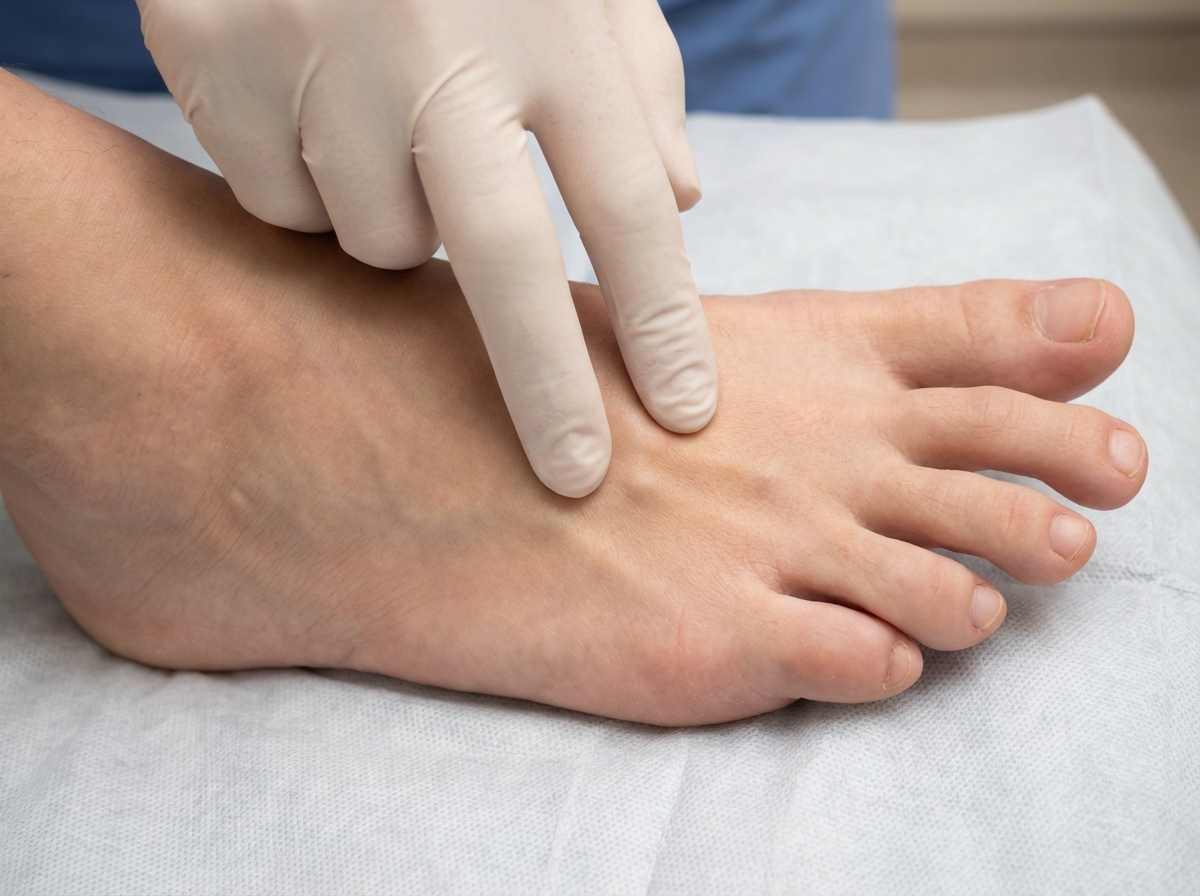
The first web space of the toes is supplied by which nerve?
An elderly woman was admitted with a fracture of the neck of the right femur which failed to unite. On examination, avascular necrosis of the head of the femur was noted. The condition most probably resulted from damage to which of the following?
All of the following statements regarding the deep fascia of the thigh are true except?
A patient experiences paralysis of a muscle that originates at the femur and directly contributes to knee stability. Which of the following muscles is involved?
Knee is which type of joint?
A 67-year-old patient has been given a course of antibiotics by gluteal intramuscular injections after a major abdominal surgery. To avoid damaging the sciatic nerve during an injection, the needle should be inserted into which of the following areas?
Which of the following structures does NOT pass through the adductor hiatus?
An obese man presents with burning pain on his right outer thigh, which worsens with standing, walking, or rubbing and is relieved by sitting. He is diagnosed clinically with meralgia paresthetica. Which nerve lesion is responsible for meralgia paresthetica?
What is the major extensor of the thigh?
Which of the following ligaments does NOT contribute to the stability of the ankle (talocrural) joint?
Explanation: The sensory innervation of the foot is a high-yield topic for NEET-PG. The correct answer is the **Deep Peroneal Nerve (DPN)**. ### **Explanation of the Correct Answer** The Deep Peroneal Nerve (a branch of the Common Peroneal Nerve) primarily supplies the muscles of the anterior compartment of the leg. However, its sensory distribution is highly specific: it provides cutaneous innervation **only** to the skin of the **first web space** (the cleft between the great toe and the second toe) and the adjacent sides of these toes. This is a classic "signature" area used in clinical exams to test the integrity of the DPN or the L5 nerve root. ### **Why Other Options are Incorrect** * **Femoral Nerve:** This nerve supplies the anterior thigh. Its longest cutaneous branch is the saphenous nerve, which does not reach the web spaces. * **Superficial Peroneal Nerve:** This nerve supplies the lateral compartment of the leg and provides sensory innervation to the majority of the **dorsum of the foot**, except for the first web space (DPN) and the lateral border (Sural nerve). * **Saphenous Nerve:** A branch of the femoral nerve, it provides sensation to the **medial side of the leg and foot**, extending up to the base of the great toe (metatarsophalangeal joint), but not the web space. ### **Clinical Pearls for NEET-PG** * **Anterior Tarsal Tunnel Syndrome:** Compression of the Deep Peroneal Nerve under the inferior extensor retinaculum leads to sensory loss specifically in the first web space. * **Foot Drop:** Injury to the Common Peroneal Nerve (at the neck of the fibula) results in foot drop and sensory loss over both the dorsum of the foot (Superficial) and the first web space (Deep). * **Sural Nerve:** Supplies the lateral border of the foot and the 5th toe.
Explanation: **Explanation:** The blood supply to the head of the femur is derived from three main sources: the retinacular arteries, the foveolar artery (branch of the obturator), and the metaphyseal vessels. **Why Option D is Correct:** The **retinacular branches**, primarily derived from the **medial circumflex femoral artery (MCFA)**, provide the most significant blood supply to the femoral head. These vessels run along the neck of the femur within the joint capsule. In intracapsular fractures (like a fracture of the femoral neck), these vessels are frequently torn or compressed. Their disruption leads to ischemia and subsequent **Avascular Necrosis (AVN)** because the remaining sources are usually insufficient to maintain viability in adults. **Why Other Options are Incorrect:** * **A & B (Superior/Inferior Gluteal Arteries):** These arteries supply the gluteal muscles and contribute to the cruciate anastomosis, but they do not provide direct, significant perfusion to the femoral head. * **C (Acetabular branch of the obturator artery):** This vessel (running in the ligamentum teres) is crucial in children. However, in adults, it is often obliterated or provides only a negligible amount of blood to the region around the fovea capitis, making it insufficient to prevent AVN if the retinacular vessels are damaged. **NEET-PG High-Yield Pearls:** * **Medial Circumflex Femoral Artery (MCFA):** This is the "artery of choice" for the femoral head supply. * **Intracapsular vs. Extracapsular:** Neck of femur fractures are *intracapsular*; hence, they carry a high risk of AVN. Intertrochanteric fractures are *extracapsular* and rarely result in AVN. * **Garden Classification:** Used for femoral neck fractures; Stages III and IV have the highest risk of vascular compromise.
Explanation: The deep fascia of the thigh, known as the **fascia lata**, is a strong, fibrous investment that acts like an elastic stocking for the thigh muscles. ### 1. Why Option C is the Correct Answer (The False Statement) The **Iliotibial (IT) tract** is a longitudinal thickening of the fascia lata located on the **lateral** aspect of the thigh, not the medial aspect. It extends from the iliac crest to the lateral condyle of the tibia (Gerdy’s tubercle). Medially, the fascia lata is actually quite thin. ### 2. Analysis of Other Options * **Option A (True):** In the gluteal region, the fascia lata splits to enclose the **gluteus maximus** muscle. Superiorly, it also covers the gluteus medius. * **Option B (True):** The IT tract splits superiorly to enclose the **tensor fasciae latae (TFL)** muscle. Both the TFL and approximately 3/4th of the gluteus maximus insert into the IT tract. * **Option D (True):** "Fascia lata" is the anatomical name for the deep fascia of the thigh (derived from "latus" meaning broad). ### 3. High-Yield Clinical Pearls for NEET-PG * **Saphenous Opening:** A gap in the fascia lata located 3-4 cm below and lateral to the pubic tubercle. It is covered by the **cribriform fascia** and transmits the great saphenous vein. * **Intermuscular Septa:** The fascia lata sends three septa (lateral, medial, and posterior) to the **linea aspera** of the femur, dividing the thigh into anterior, posterior, and medial compartments. * **Clinical Significance:** The IT tract helps maintain the knee in extension and stabilizes the pelvis while standing. Tightness of this tract can lead to **IT Band Syndrome**, common in runners.
Explanation: The correct answer is **Vastus lateralis**. To identify the correct muscle, two criteria must be met: it must originate from the **femur** and contribute directly to **knee stability**. **1. Why Vastus Lateralis is Correct:** The Vastus lateralis originates from the greater trochanter and the lateral lip of the linea aspera of the **femur**. As part of the Quadriceps femoris group, it inserts into the patella and tibial tuberosity. These muscles are the primary extensors of the knee and are the most important stabilizers of the knee joint, particularly in maintaining the integrity of the patellofemoral joint during movement. **2. Why the Other Options are Incorrect:** * **Semimembranosus:** This is a hamstring muscle. It originates from the **ischial tuberosity** (pelvis), not the femur. * **Sartorius:** Known as the "tailor's muscle," it originates from the **Anterior Superior Iliac Spine (ASIS)** of the pelvis. It crosses both the hip and knee joints but does not originate on the femur. * **Biceps femoris:** While the short head originates from the femur, the muscle as a whole is categorized by its long head origin at the **ischial tuberosity**. Furthermore, the quadriceps (Vastus group) are considered more critical for active knee stability compared to the hamstrings. **Clinical Pearls for NEET-PG:** * **The "Locking" Muscle:** The **Popliteus** (originates from the lateral femoral condyle) is responsible for "unlocking" the knee by medially rotating the tibia. * **Patellar Tracking:** The **Vastus medialis obliquus (VMO)** is clinically vital for preventing lateral dislocation of the patella. * **Nerve Supply:** All quadriceps muscles are supplied by the **Femoral Nerve (L2-L4)**. Loss of the patellar reflex (knee-jerk) indicates a lesion in this pathway.
Explanation: **Explanation:** The knee joint is a classic example of a **Diarthrosis**, which is the functional classification for a **freely movable synovial joint**. Structurally, the knee is a complex synovial joint (specifically a modified hinge joint) characterized by a fluid-filled joint cavity, an articular capsule, and hyaline cartilage covering the bone ends [1]. This design allows for a wide range of motion, primarily flexion and extension, along with slight medial and lateral rotation. **Analysis of Incorrect Options:** * **Synarthrosis:** These are **immovable joints** where bones are tightly joined by fibrous tissue. Examples include the sutures of the skull or the gomphosis (tooth in socket). * **Symphysis:** This is a type of secondary cartilaginous joint where bones are joined by a fibrocartilaginous disc. These are typically found in the midline of the body, such as the Pubic Symphysis or Intervertebral discs. * **Amphiarthrosis:** These are **slightly movable joints**. This category includes symphyses and syndesmoses (like the inferior tibiofibular joint). While the knee allows for complex movement, it exceeds the limited mobility defined by amphiarthrosis. **High-Yield Clinical Pearls for NEET-PG:** * **Structural Classification:** The knee is a **Modified Hinge Joint** (Bicondylar joint) because it involves two condylar articulations and permits "conjunct rotation" during the locking mechanism. * **Locking/Unlocking:** The **Popliteus** muscle is the "key to the knee," responsible for unlocking the joint by laterally rotating the femur on a fixed tibia. * **Stability:** The knee is the largest and most complex joint in the body; its stability depends more on ligaments (ACL, PCL, MCL, LCL) and muscles (Quadriceps) than on bony architecture.
Explanation: ### Explanation **1. Why the Correct Answer is Right:** The gluteal region is a common site for intramuscular (IM) injections, but it houses the **sciatic nerve**, the largest nerve in the body. The sciatic nerve typically emerges from the greater sciatic foramen below the piriformis muscle and descends through the midpoint of the gluteal region. To ensure safety, the gluteal region is clinically divided into four quadrants by a horizontal line at the level of the highest point of the iliac crest and a vertical line through the center of the buttock. The **upper lateral quadrant** is the safest site because it contains the **gluteus medius and gluteus minimus** muscles, while the sciatic nerve lies deep to the gluteus maximus in the lower quadrants. Injecting here avoids the sciatic nerve and the superior/inferior gluteal neurovascular bundles. **2. Why the Other Options are Wrong:** * **Option A:** The sacrospinous ligament is located deep within the pelvic outlet. An injection here would risk damaging the **pudendal nerve** and internal pudendal vessels. * **Option B:** The space between the ischial tuberosity and the lesser trochanter is the exact anatomical path where the **sciatic nerve** descends into the posterior thigh. This is the most dangerous site for an injection. * **Option C:** The gemelli muscles (superior and inferior) lie directly over or adjacent to the sciatic nerve in the deep gluteal plane. Injecting here would almost certainly cause nerve injury. **3. Clinical Pearls for NEET-PG:** * **Trendelenburg Sign:** Injury to the superior gluteal nerve (also in the gluteal region) leads to paralysis of the gluteus medius/minimus, causing the pelvis to tilt toward the unsupported side during walking. * **Safe Alternative:** The **Ventrogluteal site** (using the palm on the greater trochanter and index finger on the ASIS) is often considered even safer than the dorsogluteal site as it is further from major nerves. * **Sciatic Nerve Variation:** In about 12% of individuals, the common peroneal division of the sciatic nerve pierces the **piriformis muscle**, increasing the risk of "Piriformis Syndrome."
Explanation: ### Explanation The **adductor hiatus** is a gap between the adductor and hamstring parts of the **adductor magnus** muscle. It serves as the exit point for the contents of the adductor (subsartorial) canal into the popliteal fossa. **1. Why the Femoral Nerve is the Correct Answer:** The **femoral nerve** does not reach the adductor hiatus. It terminates in the femoral triangle (proximal to the adductor canal) by dividing into several motor and sensory branches. Its longest branch, the **saphenous nerve**, enters the adductor canal but exits early by piercing the vastoadductor membrane (along with the saphenous branch of the descending genicular artery) to become superficial. Therefore, neither the main femoral nerve nor its branches pass through the hiatus. **2. Analysis of Incorrect Options:** * **Femoral Artery:** This is the primary structure passing through the hiatus. Upon exiting, its name changes to the **popliteal artery**. * **Femoral Vein:** It travels with the artery through the hiatus. As it enters the popliteal fossa from below, it becomes the **popliteal vein**. * **Descending Genicular Artery:** This arises from the femoral artery just before it enters the adductor hiatus. While its saphenous branch pierces the roof of the canal, its **articular branches** continue downward through the adductor magnus fibers/hiatus to participate in the anastomosis around the knee. **Clinical Pearls for NEET-PG:** * **Boundaries:** The hiatus is bounded medially by the adductor magnus tendon and laterally by the femur. * **Transition Point:** The adductor hiatus marks the official transition where "Femoral" vessels become "Popliteal" vessels. * **High-Yield Content:** The adductor canal contains the femoral artery, femoral vein, saphenous nerve, and the nerve to the vastus medialis. Remember: **Only the vessels** (Artery and Vein) actually pass through the **hiatus**.
Explanation: **Explanation:** **Meralgia paresthetica** is a clinical syndrome caused by the compression of the **lateral cutaneous nerve of the thigh (L2, L3)**. This nerve is purely sensory. It typically passes under or through the inguinal ligament, just medial to the anterior superior iliac spine (ASIS). Compression at this site leads to burning pain, tingling, or numbness over the anterolateral aspect of the thigh. Symptoms are often exacerbated by factors that increase tension on the ligament or abdominal pressure, such as obesity, tight clothing (belts/corsets), or prolonged standing. Sitting often relieves the pain by reducing the tension on the nerve. **Analysis of Incorrect Options:** * **Sciatic Nerve:** This is the largest nerve of the body (L4-S3). Lesions typically cause motor weakness in the leg/foot and sensory loss in the posterior thigh and below the knee (sciatica), not localized lateral thigh pain. * **Radial Nerve:** This is a nerve of the upper limb (C5-T1). It supplies the extensor compartments of the arm and forearm. It has no anatomical relevance to thigh symptoms. * **Cutaneous branches of Obturator Nerve:** The obturator nerve (L2-L4) supplies the adductor muscles and provides sensation to the **medial** aspect of the thigh, not the lateral side. **High-Yield Clinical Pearls for NEET-PG:** * **Anatomical Site:** The most common site of entrapment is where the nerve passes deep to the **Inguinal Ligament**. * **Risk Factors:** The "3 Ws"—**W**eight (obesity), **W**aistbands (tight belts), and **W**omb (pregnancy). * **Key Feature:** There is **no motor deficit** because the lateral cutaneous nerve of the thigh carries no motor fibers. If motor weakness is present, consider a lumbar radiculopathy (L2/L3) instead.
Explanation: **Explanation:** The **Gluteus maximus** is the largest and most superficial muscle of the gluteal region. Its primary action is the **powerful extension of the thigh** at the hip joint. It is particularly active during movements requiring force, such as rising from a sitting position, climbing stairs, or running. It is supplied by the **Inferior Gluteal Nerve (L5, S1, S2)**. **Analysis of Options:** * **Gluteus maximus (Correct):** It is the chief extensor of the hip. It also assists in lateral rotation and provides steadying of the femur on the tibia via the iliotibial tract. * **Psoas major & Iliacus (Incorrect):** These two muscles often act together as the **Iliopsoas**, which is the **strongest flexor** of the thigh at the hip joint—the direct functional antagonist to the gluteus maximus. * **Obturator internus (Incorrect):** This is a member of the short rotator group. Its primary function is **lateral rotation** of the extended thigh and abduction of the flexed thigh. **High-Yield Clinical Pearls for NEET-PG:** * **Trendelenburg Test:** Evaluates the Gluteus **medius and minimus** (abductors), not the maximus. Superior gluteal nerve injury leads to a positive Trendelenburg sign. * **Gower’s Sign:** Patients with muscular dystrophy use their hands to
Explanation: The stability of the **ankle (talocrural) joint**—a hinge-type synovial joint—is primarily maintained by the shape of the talus within the malleolar mortise and two major sets of collateral ligaments. **1. Why Calcaneonavicular (Spring) Ligament is the correct answer:** The spring ligament connects the sustentaculum tali of the calcaneus to the navicular bone. Its primary function is to support the **head of the talus** and maintain the **medial longitudinal arch** of the foot. While it is crucial for the stability of the **talocalcaneonavicular joint**, it does not cross or directly stabilize the talocrural (ankle) joint. **2. Why the other options are incorrect:** * **Deltoid Ligament (Medial):** A very strong, triangular ligament that stabilizes the medial aspect of the ankle. It prevents over-eversion and consists of superficial and deep fibers. * **Lateral Ligament:** Composed of three distinct bands (ATFL, CFL, and PTFL), it stabilizes the lateral aspect of the ankle against over-inversion. * **Posterior Talofibular Ligament (PTFL):** This is the strongest part of the lateral collateral ligament complex. It runs horizontally from the lateral malleolar fossa to the posterior tubercle of the talus, providing significant posterior stability to the ankle joint. **Clinical Pearls for NEET-PG:** * **Most commonly injured ligament:** The **Anterior Talofibular Ligament (ATFL)** is the weakest and the first to tear in inversion (sprain) injuries. * **The "Spring" Ligament:** If this ligament is overstretched or ruptured, it leads to the collapse of the medial longitudinal arch, resulting in **Pes Planus (Flat Foot)**. * **Pott’s Fracture:** Occurs during forced eversion; the strong deltoid ligament often pulls off the medial malleolus (avulsion) rather than tearing itself.
Gluteal Region and Hip
Practice Questions
Thigh and Popliteal Fossa
Practice Questions
Leg and Foot
Practice Questions
Joints of Lower Limb
Practice Questions
Nerves of Lower Limb
Practice Questions
Arterial Supply and Venous Drainage
Practice Questions
Lymphatic Drainage
Practice Questions
Muscles and Their Actions
Practice Questions
Gait Analysis and Biomechanics
Practice Questions
Applied Anatomy and Clinical Correlations
Practice Questions
Get full access to all questions, explanations, and performance tracking.
Start For Free