What is the action of the popliteus muscle?
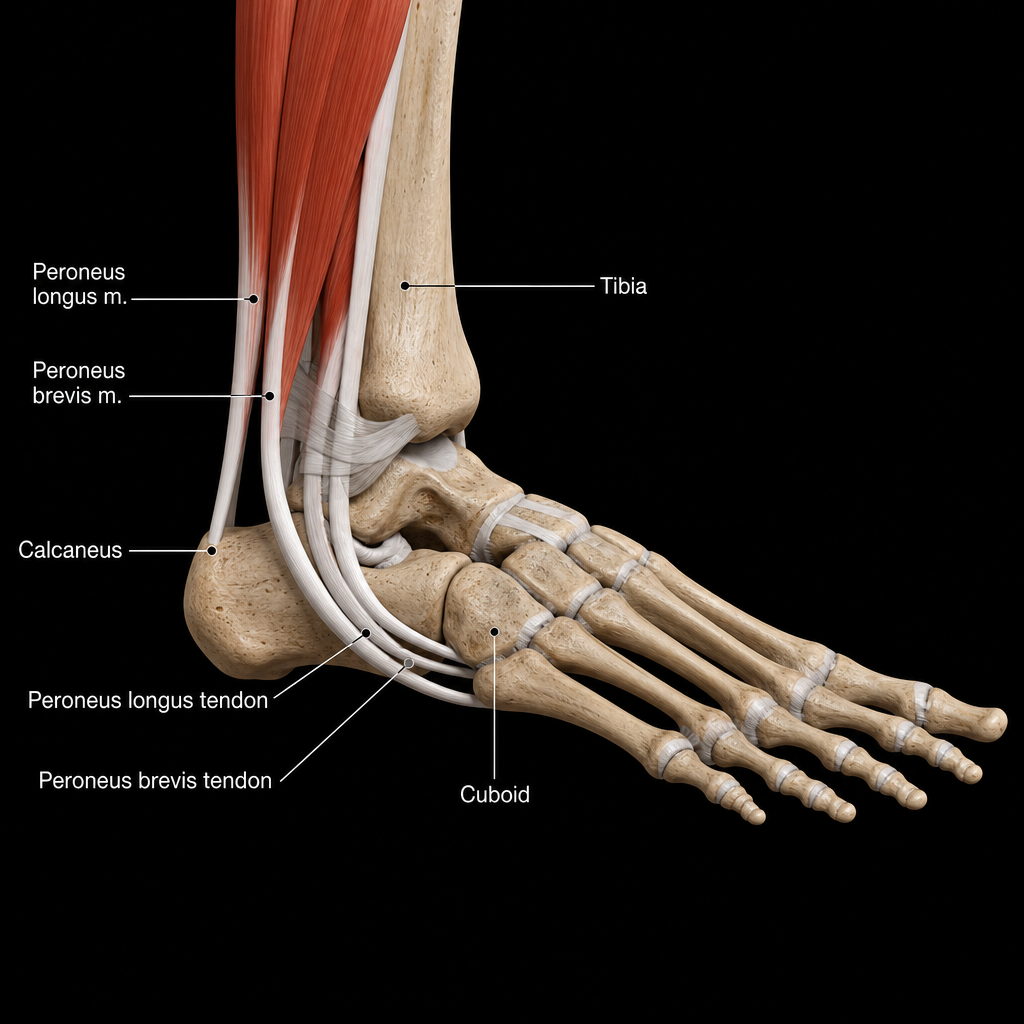
Peroneus longus is supplied by which nerve?
What is the root value for the nerve to the quadratus femoris muscle?
Which of the following arteries is NOT involved in cruciate anastomosis?
Which muscle is responsible for the extension of the knee joint?
A patient presents with defective adduction of the hip joint and pain in the hip and knee joint. Which nerve is involved?
Which tarsal bone is interposed between the proximal and distal rows of the foot?
What is the primary action of the obturator externus muscle?
What is the number of plantar interossei muscles in the sole of the foot?
Trendelenberg test is positive in palsy of which muscle?
Explanation: The **Popliteus** is a small, deep muscle located at the back of the knee, often referred to as the **"Key to the knee joint."** ### Why Option B is Correct: The "locking" of the knee occurs during full extension when the femur rotates medially on the tibia (in a weight-bearing position), tightening the ligaments to provide stability. To initiate flexion, the knee must first be "unlocked." * **Mechanism:** The popliteus initiates this by rotating the **femur laterally** on the fixed tibia (when standing) or rotating the **tibia medially** on the fixed femur (when sitting). This action relaxes the major ligaments, allowing flexion to proceed. ### Why Other Options are Incorrect: * **Option A (Locking):** Locking is a passive mechanism achieved by the **Vastus Medialis** (specifically the oblique fibers) and the structural alignment of the femoral condyles during terminal extension. * **Option C (Medial rotation of femur):** This is incorrect because medial rotation of the femur actually contributes to the **locking** mechanism. The popliteus performs the opposite action—**lateral rotation** of the femur—to unlock the joint. ### High-Yield Clinical Pearls for NEET-PG: * **Origin:** It is unique because it arises from a **tendon within the joint capsule** (intracapsular) but remains extrasynovial. It originates from the lateral condyle of the femur. * **Insertion:** Posterior surface of the tibia, above the soleal line. * **Nerve Supply:** Tibial Nerve (L4, L5, S1). * **Morphology:** It is considered the "remnant" of the long flexor of the hallux in lower animals. * **Bursa:** The popliteus bursa usually communicates with the synovial cavity of the knee joint.
Explanation: **Explanation:** The **Peroneus longus** (along with the Peroneus brevis) is a muscle of the **lateral compartment** of the leg. The nerve of the lateral compartment is the **Superficial Peroneal Nerve** (L5, S1), which is a terminal branch of the Common Peroneal Nerve. It provides motor innervation to these muscles and sensory innervation to the lower part of the leg and the dorsum of the foot. **Analysis of Options:** * **Superficial Peroneal Nerve (Correct):** Specifically supplies the lateral compartment (Peroneus longus and brevis). * **Deep Peroneal Nerve:** Supplies the **anterior compartment** of the leg (Tibialis anterior, EHL, EDL, Peroneus tertius) and the EDB on the dorsum of the foot. * **Tibial Nerve:** Supplies the **posterior compartment** of the leg (Gastrocnemius, Soleus, Tibialis posterior, etc.). * **Sural Nerve:** This is a purely **sensory nerve** formed by branches of the tibial and common peroneal nerves; it does not supply motor innervation to any muscles. **High-Yield Clinical Pearls for NEET-PG:** * **Action:** Peroneus longus is a powerful **evertor** of the foot and helps maintain the **lateral longitudinal and transverse arches** of the foot. * **Insertion:** Its tendon crosses the sole of the foot diagonally to insert into the base of the **1st metatarsal** and the **medial cuneiform** (similar to Tibialis anterior). * **Nerve Injury:** Injury to the Common Peroneal Nerve (at the neck of the fibula) affects both deep and superficial branches, leading to **Foot Drop** (loss of dorsiflexion) and loss of eversion. However, an isolated injury to the Superficial Peroneal Nerve would result in loss of eversion but preserved dorsiflexion.
Explanation: The **nerve to quadratus femoris** is a branch of the **sacral plexus**. It arises from the ventral rami of the **L4, L5, and S1** spinal nerves. It exits the pelvis through the greater sciatic foramen (infra-piriform compartment) and supplies two muscles: the **quadratus femoris** and the **inferior gemellus**. It also provides an articular branch to the hip joint. **Analysis of Options:** * **L4, L5, S1 (Correct):** This is the specific root value for both the nerve to quadratus femoris and the **superior gluteal nerve**. * **L1, L2, L3 (Incorrect):** These roots contribute to the iliohypogastric, ilioinguinal, and genitofemoral nerves (lumbar plexus). * **L2, L3, L4 (Incorrect):** This is the root value for the **femoral nerve** and the **obturator nerve**, which supply the anterior and medial compartments of the thigh, respectively. * **S1, S2, S3 (Incorrect):** These roots contribute to the posterior cutaneous nerve of the thigh. The nerve to obturator internus (which supplies the superior gemellus) has a root value of L5, S1, S2. **High-Yield Clinical Pearls for NEET-PG:** * **The "Rule of Two":** The nerve to quadratus femoris supplies **two** muscles (Quadratus femoris + Inferior gemellus). Similarly, the nerve to obturator internus supplies **two** muscles (Obturator internus + Superior gemellus). * **Course:** It runs deep to the tendon of the obturator internus and the gemelli muscles. * **Hip Joint Innervation:** It is a key nerve involved in the Hilton’s Law application for the hip joint. * **Mnemonic:** Remember "4-5-1" for both the **S**uperior Gluteal Nerve and the Nerve to **Q**uadratus Femoris (SQ451).
Explanation: The **cruciate anastomosis** is a vital collateral circulatory pathway located at the level of the lesser trochanter of the femur. It ensures a continuous blood supply to the lower limb if the femoral artery is obstructed between the origin of the profunda femoris and the popliteal artery. ### **Why Option D is Correct** The **Superior Gluteal Artery** is the correct answer because it does **not** participate in the cruciate anastomosis. Instead, it is a primary component of the **trochanteric anastomosis**, which is located higher up near the greater trochanter and supplies the head of the femur. ### **Why the Other Options are Incorrect** The cruciate anastomosis is formed by the "cross-shaped" intersection of four specific arteries: * **Inferior Gluteal Artery (Option A):** Provides the **superior** limb of the anastomosis (descending branch). * **Medial Circumflex Femoral Artery (Option B):** Provides the **medial** limb (transverse branch). * **Lateral Circumflex Femoral Artery (Option C):** Provides the **lateral** limb (transverse branch). * **First Perforating Artery:** A branch of the profunda femoris that provides the **inferior** limb (ascending branch). ### **High-Yield Clinical Pearls for NEET-PG** * **Location:** The cruciate anastomosis lies at the level of the **lesser trochanter**, whereas the trochanteric anastomosis lies in the **trochanteric fossa**. * **Trochanteric Anastomosis Components:** Superior gluteal, Inferior gluteal, Medial circumflex femoral, and Lateral circumflex femoral arteries. * **Key Distinction:** The **Superior Gluteal Artery** is involved in the trochanteric anastomosis but **never** the cruciate anastomosis. * **Clinical Significance:** These anastomoses are crucial in maintaining viability of the femoral head and lower limb in cases of femoral artery ligation or atherosclerotic occlusion.
Explanation: **Explanation:** The **Quadriceps femoris** is the primary and most powerful extensor of the knee joint. It is located in the anterior compartment of the thigh and consists of four distinct heads: the Rectus femoris, Vastus lateralis, Vastus medialis, and Vastus intermedius. All four muscles converge into a single tendon that inserts into the patella and, via the patellar ligament, onto the tibial tuberosity. This anatomical arrangement allows the muscle to pull the tibia forward relative to the femur, resulting in extension. **Analysis of Incorrect Options:** * **Gracilis:** Located in the medial compartment of the thigh, it acts primarily as an adductor of the hip and a weak **flexor** of the knee. * **Popliteus:** Known as the "key to the knee," this muscle is responsible for **unlocking** the knee by initiating **flexion** (specifically by rotating the femur laterally on a fixed tibia). * **Semitendinosus:** Part of the hamstring group in the posterior compartment, its primary action is **flexion** of the knee and extension of the hip. **Clinical Pearls for NEET-PG:** * **Nerve Supply:** The Quadriceps is supplied by the **Femoral Nerve (L2-L4)**. A lesion here results in the inability to extend the knee and a loss of the patellar reflex. * **Vastus Medialis Obliquus (VMO):** This specific part of the quadriceps is crucial for the stabilization of the patella; weakness in the VMO often leads to patellar maltracking or dislocation. * **Rectus Femoris:** It is the only component of the quadriceps that crosses two joints (hip and knee), allowing it to assist in hip flexion.
Explanation: ### Explanation The correct answer is **Obturator nerve**. #### 1. Why the Obturator Nerve is Correct The **Obturator nerve (L2–L4)** is the primary motor nerve for the **medial compartment of the thigh**. It supplies the adductor group of muscles, including the Adductor longus, Adductor brevis, Adductor magnus (adductor part), and Gracilis. Therefore, a lesion results in **defective hip adduction**. The clinical presentation of pain in both the hip and knee is explained by **Hilton’s Law**, which states that the nerve supplying a joint also supplies the muscles moving the joint and the skin over the insertion of those muscles. The obturator nerve provides sensory branches to both the **hip joint** and the **knee joint**. Irritation of the nerve (e.g., in pelvic pathology or obturator hernia) often causes referred pain to the medial aspect of the knee. #### 2. Why Other Options are Incorrect * **Femoral Nerve:** Supplies the anterior compartment of the thigh (hip flexors and knee extensors). Injury leads to loss of knee extension and the patellar reflex. * **Saphenous Nerve:** A pure sensory branch of the femoral nerve. It supplies the skin on the medial side of the leg and foot; it has no motor function. * **Sciatic Nerve:** Supplies the posterior compartment (hamstrings) and all muscles below the knee. Injury would affect knee flexion and all foot movements, not hip adduction. #### 3. High-Yield Clinical Pearls for NEET-PG * **Howship-Romberg Sign:** Pain/paresthesia on the medial aspect of the thigh/knee due to compression of the obturator nerve by an **obturator hernia**. * **Referred Pain:** In children with hip pathologies (like Perthes disease or SCFE), the primary complaint is often **knee pain** due to the shared supply of the obturator nerve. * **Adductor Magnus:** This is a **hybrid (composite) muscle**. The adductor part is supplied by the obturator nerve, while the hamstring part is supplied by the tibial component of the sciatic nerve.
Explanation: The tarsal bones are organized into two functional rows: a **proximal row** (Talus and Calcaneus) and a **distal row** (Medial, Intermediate, and Lateral Cuneiforms, plus the Cuboid). **Explanation of the Correct Answer:** The **Navicular** bone is anatomically positioned as the "keystone" between these two rows on the medial side of the foot. It articulates posteriorly with the head of the talus (proximal row) and anteriorly with the three cuneiform bones (distal row). This unique interposition makes it essential for the integrity of the **medial longitudinal arch**. **Analysis of Incorrect Options:** * **Talus & Calcaneus (Options A & B):** These constitute the **proximal row** (hindfoot). The talus sits superiorly to transmit body weight from the tibia, while the calcaneus forms the heel. * **Cuboid (Option C):** While the cuboid is sometimes described as being lateral to the navicular, it is functionally part of the **distal row**. It articulates posteriorly with the calcaneus, but unlike the navicular, it does not act as a bridge between rows; rather, it sits directly in the lateral column of the distal tarsus. **High-Yield Clinical Pearls for NEET-PG:** * **The "Boat" Bone:** Navicular is derived from the Latin *navicula* (little ship) due to its concave proximal surface. * **Tibialis Posterior Insertion:** The tuberosity of the navicular is the primary insertion site for the Tibialis Posterior muscle. An accessory navicular bone (Os Tibiale Externum) can sometimes be found here, causing medial foot pain. * **Köhler’s Disease:** This is the avascular necrosis of the navicular bone, typically seen in children. * **Chopart’s Joint:** The mid-tarsal joint (transverse tarsal joint) is formed by the talonavicular and calcancocuboid articulations.
Explanation: The **obturator externus** is a deep muscle of the gluteal region, often grouped with the "short lateral rotators" of the hip. ### Why Option B is Correct The muscle originates from the outer surface of the obturator membrane and the surrounding bony margins of the obturator foramen. Its tendon passes **posterior** to the neck of the femur to insert into the **trochanteric fossa**. When the muscle contracts, it pulls the greater trochanter posteriorly, causing the femur to rotate outward around its longitudinal axis. Therefore, its primary action is **lateral (external) rotation** of the thigh. It also helps stabilize the femoral head in the acetabulum. ### Why Other Options are Incorrect * **Option A (Medial rotation):** This is primarily performed by the gluteus medius, gluteus minimus, and tensor fasciae latae. * **Option C (Flexion):** The primary flexor of the hip is the iliopsoas. While the obturator externus may weakly assist in adduction, it does not contribute significantly to flexion. * **Option D (Extension):** This is the domain of the gluteus maximus and the hamstring muscles. ### NEET-PG High-Yield Pearls * **Nerve Supply:** Unlike most lateral rotators (supplied by branches of the sacral plexus), the obturator externus is supplied by the **posterior division of the obturator nerve (L3, L4)**. * **Anatomical Relation:** The tendon of the obturator externus is a key landmark; it runs directly inferior to the neck of the femur and is often used by surgeons to locate the hip joint posteriorly. * **The "Short Lateral Rotators":** This group includes the Piriformis, Superior Gemellus, Obturator Internus, Inferior Gemellus, Quadratus Femoris, and Obturator Externus.
Explanation: **Explanation:** The **plantar interossei** are intrinsic muscles of the foot located in the fourth layer of the sole. There are **three** plantar interossei, and they are responsible for **adducting** the toes (moving them toward the axis of the foot). **Why Option B is Correct:** The axis of the foot passes through the **second toe**. The three plantar interossei arise from the medial sides of the 3rd, 4th, and 5th metatarsals and insert into the medial sides of the proximal phalanges of the same toes. Since the second toe is the axis, it does not require a plantar interosseus for adduction; thus, only three muscles are needed for the lateral three toes. **Why Other Options are Incorrect:** * **Option A (2):** This is numerically incorrect. * **Option C (4):** There are **four dorsal interossei** in the foot (responsible for abduction). Students often confuse the number of dorsal (4) with plantar (3) interossei. * **Option D (5):** While there are five metatarsals, the first toe (hallux) has its own dedicated adductor muscle (*Adductor hallucis*), and the second toe is the midline axis, making five interossei unnecessary. **High-Yield NEET-PG Pearls:** * **Mnemonic:** **"PAD DAB"** — **P**lantar **AD**duct / **D**orsal **AB**duct. * **Nerve Supply:** All interossei (both plantar and dorsal) are supplied by the **lateral plantar nerve** (S2, S3), which is a branch of the tibial nerve. * **Action:** They adduct the 3rd, 4th, and 5th toes and assist the lumbricals in flexing the metatarsophalangeal joints and extending the interphalangeal joints. * **Comparison with Hand:** In the hand, there are also 3 (or sometimes 4) palmar interossei, but the axis of the hand is the **middle (3rd) finger**.
Explanation: ### Explanation **1. Why Gluteus Medius is Correct:** The Trendelenburg test assesses the **hip abductor mechanism**. The primary muscles responsible for hip abduction are the **Gluteus medius** and **Gluteus minimus**, both innervated by the **Superior Gluteal Nerve (L4-S1)**. When standing on one leg, the gluteus medius of the supporting (weight-bearing) limb contracts to stabilize the pelvis, preventing the opposite (non-weight-bearing) side from sagging. If the gluteus medius is weak or paralyzed, it cannot hold the pelvis level; consequently, the pelvis drops toward the unsupported side. This is a **Positive Trendelenburg Sign**. **2. Why Other Options are Incorrect:** * **Gluteus maximus:** This is the chief **extensor** of the hip (and lateral rotator). Paralysis leads to a "Gluteus Maximus Lurch" (difficulty climbing stairs or standing from a sitting position), not a pelvic drop. * **Rectus femoris & Vastus medialis:** These are components of the Quadriceps femoris muscle group. Their primary action is **extension of the knee**. Weakness here affects gait stability and stair climbing but does not control pelvic tilt in the coronal plane. **3. Clinical Pearls for NEET-PG:** * **Nerve Involved:** Superior Gluteal Nerve. Injury often occurs due to misplaced intragluteal injections (upper inner quadrant instead of upper outer). * **Trendelenburg Gait:** Also known as a "Ducking" or "Waddling" gait. If bilateral, it is seen in conditions like Congenital Dislocation of the Hip (CDH). * **The "Sound" Side:** Remember, the pelvis drops on the **healthy side** (the side with the lifted foot), while the pathology lies in the **standing/weight-bearing limb**. * **Other causes of positive test:** Fracture of the greater trochanter, non-union of the femoral neck, or developmental dysplasia of the hip (DDH).
Gluteal Region and Hip
Practice Questions
Thigh and Popliteal Fossa
Practice Questions
Leg and Foot
Practice Questions
Joints of Lower Limb
Practice Questions
Nerves of Lower Limb
Practice Questions
Arterial Supply and Venous Drainage
Practice Questions
Lymphatic Drainage
Practice Questions
Muscles and Their Actions
Practice Questions
Gait Analysis and Biomechanics
Practice Questions
Applied Anatomy and Clinical Correlations
Practice Questions
Get full access to all questions, explanations, and performance tracking.
Start For Free