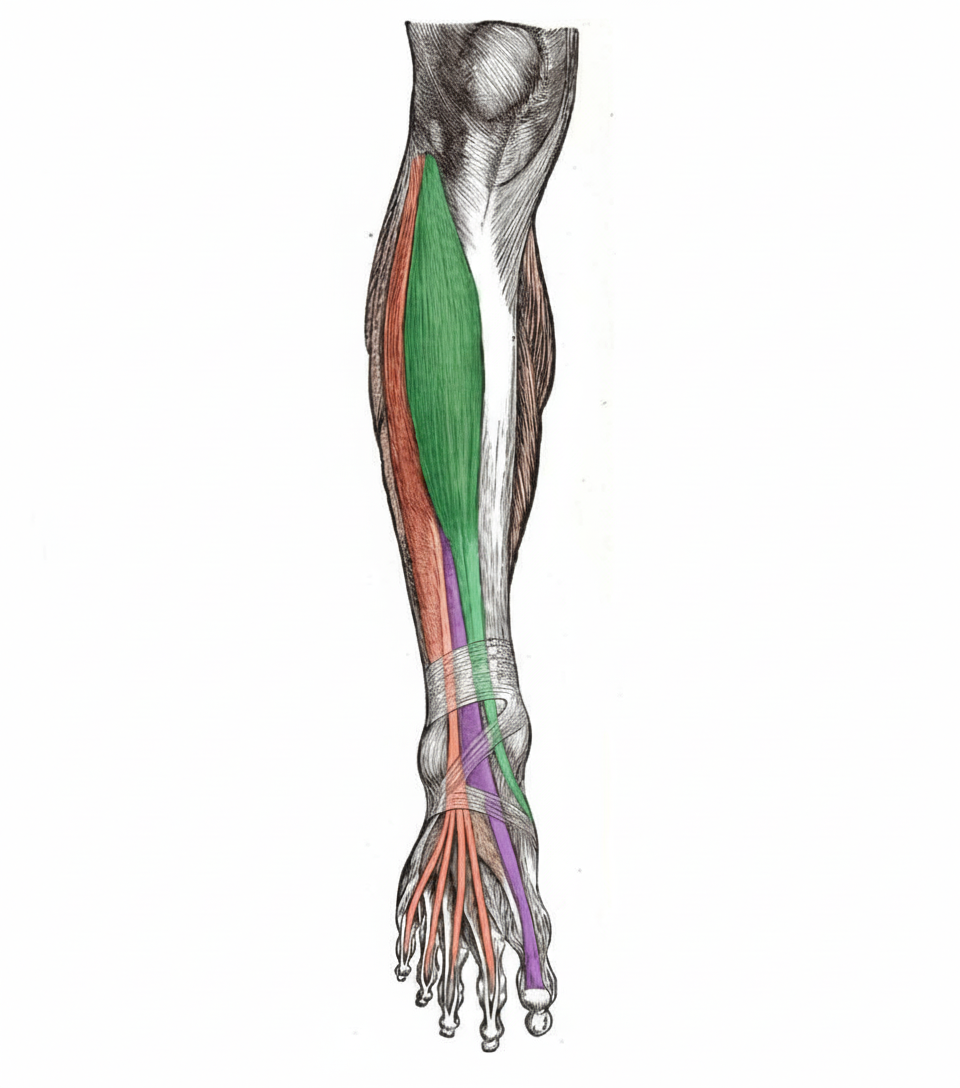
Stability of the ankle joint is maintained by the following, except?
What is the chief source of blood supply to the head and neck of the femur?
Which of the following is a hybrid muscle?
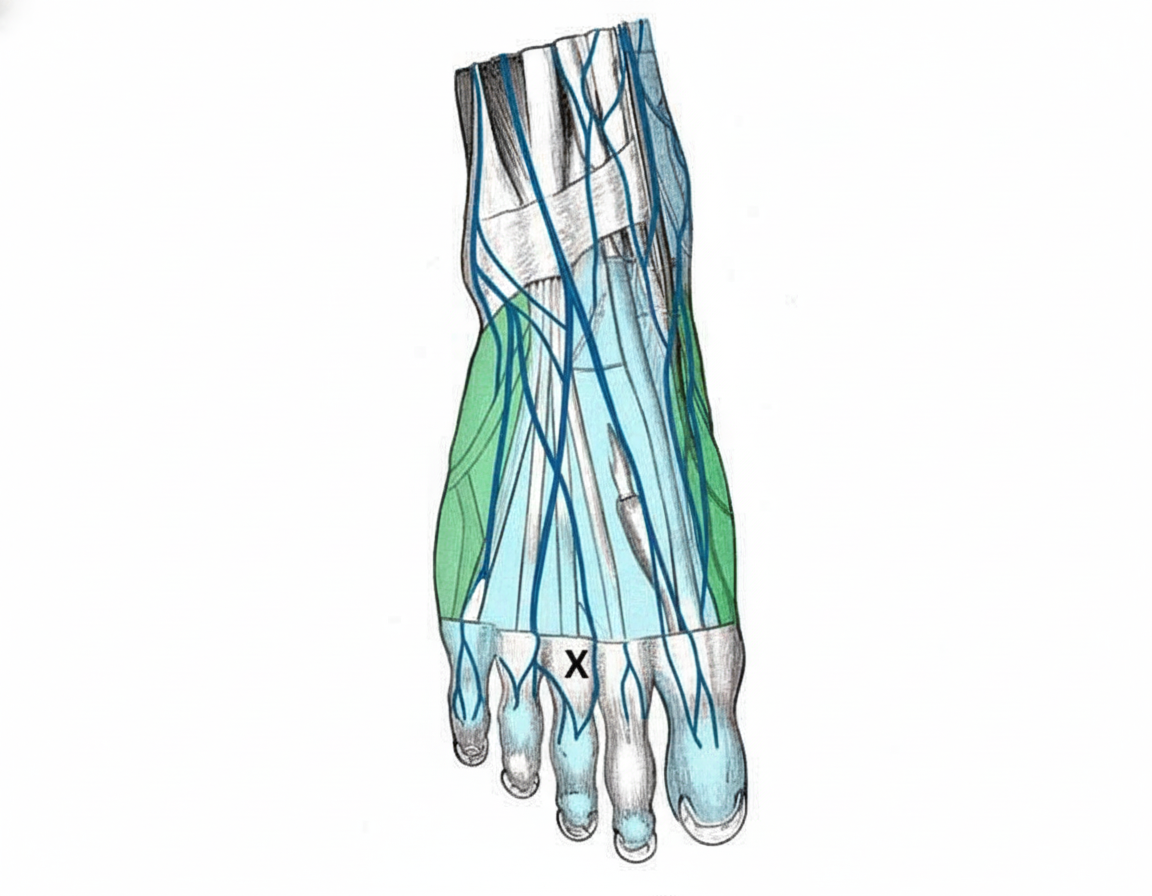
Radiological examination of women with foot pain reveals Maon's neuroma. What is the most likely site of the lesion?
Which bone in the foot is not directly attached by any muscle?
A 72-year-old woman presents with a painful right foot. A CT scan reveals a thrombotic occlusion of the femoral artery in the proximal part of the adductor canal. Which artery will most likely provide blood supply to the leg through the genicular anastomosis?
Which of the following is NOT an action of the sartorius muscle?
Which of the following muscles is responsible for plantar flexion?
Injury to the medial meniscus is rather impossible when the knee joint does not:
A 34-year-old power lifter has difficulty walking and a problem unlocking the knee joint to permit leg flexion. Which of the following muscles is most likely damaged?
Explanation: **Explanation:** The stability of the ankle joint (talocrural joint) is primarily derived from its bony architecture and supporting ligamentous structures. **Why "Cruciate Ligaments" is the correct answer:** Cruciate ligaments (Anterior and Posterior) are intra-articular ligaments found exclusively in the **knee joint**, where they prevent anterior and posterior displacement of the tibia. They have no anatomical presence or functional role in the ankle joint. **Analysis of Incorrect Options:** * **Collateral Ligaments:** These are the primary stabilizers of the ankle. The **Medial (Deltoid) ligament** is extremely strong and prevents over-eversion, while the **Lateral ligament** (comprising the ATFL, CFL, and PTFL) prevents over-inversion. * **Tendons of muscles:** Dynamic stability is provided by tendons crossing the joint. The **Tibialis anterior/posterior** and the **Peroneus longus/brevis** act as "active" stabilizers, maintaining the integrity of the joint during movement. * **Close approximation of articular surfaces:** The ankle is a hinge joint where the "mortise" (formed by the tibia and fibula) tightly grips the "tenon" (the body of the talus). This bony interlocking, especially during dorsiflexion when the wider anterior part of the talus wedges into the mortise, is a key factor in joint stability. **High-Yield Clinical Pearls for NEET-PG:** * The ankle is **most stable in dorsiflexion** and most vulnerable (least stable) in plantarflexion. * The **Anterior Talofibular Ligament (ATFL)** is the most commonly injured ligament in inversion ankle sprains. * The **Deltoid ligament** is so strong that excessive eversion often results in an avulsion fracture of the medial malleolus rather than a ligamentous tear (Pott’s fracture).
Explanation: ### Explanation The blood supply to the head and neck of the femur is a high-yield topic in orthopedics and anatomy, primarily due to its clinical significance in femoral neck fractures. **1. Why Option C is Correct:** The **Medial Circumflex Femoral Artery (MCFA)** is the most important source of blood to the femoral head. It gives off **retinacular branches** (superior, inferior, anterior, and posterior) that pierce the joint capsule and travel along the femoral neck. Among these, the **posterosuperior retinacular branches** are the most critical, supplying the majority of the femoral head. **2. Why Other Options are Incorrect:** * **Option A & B:** The **acetabular branches** (from the obturator and MCFA) primarily supply the acetabular fat pad and the ligamentum teres. While the artery of the ligamentum teres (from the obturator) provides some blood to the head in children, it is usually insufficient to maintain viability in adults if the retinacular supply is lost. * **Option D:** The **nutrient artery** of the femur enters the shaft and supplies the marrow and endosteum; it does not reach the intracapsular portion of the femoral head in significant amounts. **3. Clinical Pearls for NEET-PG:** * **Avascular Necrosis (AVN):** Intracapsular fractures of the femoral neck frequently tear the retinacular vessels. Because the MCFA is the "chief" supply, its disruption often leads to AVN of the femoral head. * **Cruciate Anastomosis:** The MCFA is a key component of the cruciate anastomosis (along with the lateral circumflex femoral, first perforating, and inferior gluteal arteries), which provides collateral circulation to the hip. * **Trochanteric Anastomosis:** This is the main communication between the MCFA and LCFA, providing the primary supply to the femoral head.
Explanation: **Explanation:** A **hybrid (or composite) muscle** is defined as a muscle that possesses dual nerve supply, typically because it develops from two different embryological compartments. **Why Adductor Magnus is the Correct Answer:** The Adductor magnus is the classic example of a hybrid muscle in the lower limb. It consists of two distinct functional parts: 1. **Adductor Part:** Originates from the ischiopubic ramus and inserts into the linea aspera. It is supplied by the **Obturator nerve** (L2-L4). 2. **Hamstring (Extensor) Part:** Originates from the ischial tuberosity and inserts into the adductor tubercle of the femur. It is supplied by the **Tibial component of the Sciatic nerve** (L4-S3). **Analysis of Incorrect Options:** * **A. Adductor longus:** A pure adductor compartment muscle supplied solely by the anterior division of the **Obturator nerve**. * **C. Tibialis anterior:** The main dorsiflexor of the foot, located in the anterior compartment of the leg and supplied only by the **Deep Peroneal nerve**. * **D. Gluteus maximus:** The chief extensor of the hip, supplied exclusively by the **Inferior Gluteal nerve**. **High-Yield Clinical Pearls for NEET-PG:** * **Other Hybrid Muscles:** Pectineus (Obturator and Femoral nerves), Biceps Femoris (Short head by Common Peroneal; Long head by Tibial nerve), and Subscapularis (Upper and Lower Subscapular nerves). * **The "Adductor Hiatus":** This is a gap between the two insertions of the adductor magnus that allows the femoral vessels to pass into the popliteal fossa. * **Functional Role:** Because of its dual supply, the adductor magnus acts as both a powerful adductor and a medial rotator/extensor of the hip.
Explanation: **Explanation:** **Morton’s Neuroma** (often referred to as Maon's neuroma in some texts) is a common cause of metatarsalgia. It is not a true tumor but rather a **perineural fibrosis** and degeneration of the common plantar digital nerve. **Why Option C is Correct:** The most common site for Morton’s neuroma is the **third intermetatarsal space**, located between the **third and fourth metatarsal heads (MTP) joints**. This specific location is anatomically predisposed because the third common plantar digital nerve is formed by a communication between the medial and lateral plantar nerves. This makes the nerve thicker and more prone to compression under the deep transverse metatarsal ligament during the toe-off phase of walking. **Analysis of Incorrect Options:** * **Option A & B:** While neuromas can occur in the first or second intermetatarsal spaces, they are statistically much rarer. The second space is the second most common site, but the third space remains the classic "textbook" location. * **Option D:** The fourth intermetatarsal space is rarely involved as the mechanical stresses and nerve thickness are significantly less in this area compared to the third space. **NEET-PG High-Yield Pearls:** * **Clinical Presentation:** Patients describe a sensation of "walking on a marble" or a "folded sock" in the shoe, accompanied by burning pain radiating to the toes. * **Demographics:** Significantly more common in **females**, often associated with wearing high-heeled, narrow-toed shoes. * **Mulder’s Click:** A diagnostic clinical test where squeezing the metatarsal heads together produces a palpable/audible click and reproduces the pain. * **Treatment:** Initial management involves wide-toed footwear and metatarsal pads; refractory cases may require surgical excision.
Explanation: The **Talus** is unique among the bones of the foot because it has **no muscular or tendinous attachments**. Its entire surface is either covered by articular cartilage (forming the ankle, subtalar, and talonavicular joints) or serves as an attachment site for ligaments. This lack of direct muscle attachment means the talus moves passively, driven by the forces exerted by muscles on the surrounding bones. **Why the other options are incorrect:** * **Calcaneum:** This is the largest bone of the foot and serves as a major attachment site. Most notably, the **Tendo Achilles** (Gastrocnemius and Soleus) inserts on its posterior surface, and the **Flexor Digitorum Brevis** originates from its tubercle. * **Metatarsals:** These bones provide attachment for several muscles. For example, the **Peroneus brevis** inserts on the base of the 5th metatarsal, and the **Interossei** muscles originate from the shafts of the metatarsals. * **Fibula:** Although a leg bone, it is a primary site for muscle origins (e.g., **Peroneus longus and brevis**, **Extensor digitorum longus**) and the insertion of the **Biceps femoris**. **Clinical Pearls for NEET-PG:** 1. **Blood Supply:** Because the talus is largely covered by articular cartilage, its blood supply is precarious (entering mainly through the sinus tarsi and tarsal canal). This makes it highly susceptible to **Avascular Necrosis (AVN)** following fractures of the talar neck (Hawkins Classification). 2. **"The Keystone":** The talus acts as the keystone of the medial longitudinal arch of the foot. 3. **Nutrient Artery:** The main blood supply to the body of the talus is the artery of the tarsal canal, a branch of the **posterior tibial artery**.
Explanation: ### **Explanation** **1. Why the Correct Answer is Right:** The **adductor canal (Hunter’s canal)** is a narrow fascial tunnel in the middle third of the thigh. When the femoral artery is occluded here, blood must bypass the blockage to reach the popliteal artery and the leg. The **genicular anastomosis** around the knee provides this bypass. The **descending branch of the lateral circumflex femoral artery (LCFA)** is the key vessel for this collateral circulation. It arises from the deep femoral artery (profunda femoris) in the proximal thigh, travels inferiorly along the vastus lateralis, and anastomoses with the **superior lateral genicular artery** (a branch of the popliteal artery). Since the LCFA arises proximal to the adductor canal, it remains patent and can deliver blood to the knee and leg, bypassing the femoral artery occlusion. **2. Why the Other Options are Wrong:** * **A. Medial circumflex femoral:** This artery primarily supplies the head and neck of the femur. It does not descend far enough to participate in the genicular anastomosis. * **C. First perforating branch:** While perforating branches of the profunda femoris do participate in the **cruciate anastomosis** (near the hip), they do not reach the knee. It is the *fourth* perforating branch that typically contributes to the genicular network. * **D. Inferior gluteal:** This artery supplies the gluteus maximus and participates in the cruciate and trochanteric anastomoses at the hip level, far proximal to the knee. **3. Clinical Pearls for NEET-PG:** * **Adductor Canal Boundaries:** Anterior/Lateral (Vastus medialis), Posterior (Adductor longus/magnus), Medial/Roof (Sartorius). * **Contents:** Femoral artery, femoral vein, **saphenous nerve** (nerve to vastus medialis). Note: The femoral nerve itself is NOT in the canal; only its branches are. * **Surgical Significance:** The adductor canal is a common site for "Adductor Canal Blocks" in knee surgeries to provide sensory anesthesia (via the saphenous nerve) while preserving motor function of the quadriceps.
Explanation: The **Sartorius muscle**, known as the "Tailor's muscle," is the longest muscle in the human body. It is a superficial muscle of the anterior compartment of the thigh that crosses two joints: the hip and the knee. ### **Why "Extension of the leg" is the Correct Answer** The Sartorius originates from the **Anterior Superior Iliac Spine (ASIS)** and inserts into the upper part of the medial surface of the tibia (as part of the **Pes Anserinus**). Because it passes **posterior** to the transverse axis of the knee joint, its contraction results in **flexion of the leg**, not extension. Extension of the leg is the primary function of the Quadriceps Femoris group. ### **Analysis of Other Options** * **Flexion of the thigh:** As it crosses the hip joint anteriorly, it acts as a synergist in flexing the hip. * **Flexion of the leg:** Unlike the quadriceps, the sartorius pulls the tibia backward, causing knee flexion. * **Lateral rotation of the thigh:** Due to its oblique course across the thigh, it assists in rotating the femur laterally at the hip. ### **NEET-PG High-Yield Pearls** * **The "Tailor's Position":** The sartorius performs all actions required to sit cross-legged: Hip flexion, abduction, lateral rotation, and knee flexion. * **Pes Anserinus (Goose's Foot):** This is a common insertion point on the medial tibia for three muscles: **S**artorius (Femoral n.), **G**racilis (Obturator n.), and **S**emitendinosus (Tibial n.). *Mnemonic: "Say Grace before Tea."* * **Adductor Canal (Hunter’s Canal):** The sartorius forms the **roof** of this canal, which contains the femoral artery, femoral vein, and saphenous nerve. * **Nerve Supply:** It is supplied by the **Femoral Nerve (L2, L3)**.
Explanation: **Explanation:** Plantar flexion is the movement that increases the angle between the front of the foot and the shin (pointing the toes downward). This action is primarily performed by the muscles located in the **posterior compartment of the leg**, all of which are innervated by the **tibial nerve**. 1. **Soleus (Option C):** Along with the gastrocnemius, the soleus forms the *triceps surae*. It is a powerful plantar flexor and is often called the "peripheral heart" because its venous sinuses help pump blood back to the heart. 2. **Plantaris (Option A):** This is a vestigial muscle with a long, thin tendon. While its contribution is weak, it acts across the ankle joint to assist in plantar flexion. 3. **Flexor Hallucis Longus (Option B):** Located in the deep posterior compartment, its primary action is flexing the great toe, but because it passes posterior to the transverse axis of the ankle joint, it also serves as a secondary plantar flexor. Since all three muscles cross the ankle joint posteriorly, they all contribute to the movement, making **"All of the above"** the correct choice. **High-Yield NEET-PG Pearls:** * **Prime Movers:** The Gastrocnemius and Soleus are the strongest plantar flexors. * **The "Freshman’s Nerve":** The Plantaris tendon is often mistaken for a nerve by first-year students; its tendon is commonly used for grafting. * **Clinical Correlation:** Rupture of the **Achilles tendon** (calcaneal tendon) results in a profound loss of plantar flexion and a positive **Thompson test** (Simmonds' test). * **Antagonist:** The Tibialis anterior is the primary dorsiflexor of the foot.
Explanation: The medial meniscus is most vulnerable to injury during a specific combination of movements: **weight-bearing, flexion, and rotation.** **Why Flexion is the Correct Answer:** The menisci are most stable when the knee is in full extension (the "locked" position), as they are tightly compressed between the femoral condyles and the tibial plateau. However, when the knee **flexes**, the menisci (especially the medial one) move posteriorly. In this flexed, "unlocked" state, the meniscus is subjected to significant shearing forces if a sudden rotation occurs. Without flexion, the rotational forces cannot easily trap the meniscus between the articular surfaces to cause a tear. Therefore, a meniscus injury is "rather impossible" (highly unlikely) in a completely straight, non-flexed knee. **Analysis of Incorrect Options:** * **A. Extend:** Extension is the position of maximal stability for the knee. While injuries can occur during the transition to extension (like the "Screw-home" mechanism), the initial mechanism of injury almost always involves a degree of flexion. * **C. Rotate:** Rotation is a primary *cause* of meniscal tears, not a protective factor. Medial meniscus tears typically occur during internal rotation of the femur on a fixed tibia. * **D. Abduct or Adduct:** These movements (Valgus/Varus stress) often accompany meniscal injuries (e.g., O’Donoghue’s Triad), but they are secondary to the primary requirement of flexion and rotation. **High-Yield Clinical Pearls for NEET-PG:** * **McMurray Test:** Used to diagnose meniscal tears; it involves flexing the knee and then rotating it while extending. * **Anatomy Fact:** The medial meniscus is **C-shaped** and more commonly injured than the lateral meniscus because it is firmly attached to the **Medial Collateral Ligament (MCL)**, making it less mobile. * **O’Donoghue’s Triad:** Consists of injury to the **Anterior Cruciate Ligament (ACL)**, **Medial Collateral Ligament (MCL)**, and **Medial Meniscus**.
Explanation: ### Explanation **Correct Option: C. Popliteus** The **Popliteus** is known as the **"Key to the knee"** because of its essential role in initiating flexion from a fully extended position. * **The Mechanism:** When the knee is fully extended, it is "locked" in a position of maximum stability due to the medial rotation of the femur on the tibia. To initiate flexion, the knee must first be "unlocked." * **The Action:** The popliteus muscle accomplishes this by **laterally rotating the femur** on the fixed tibia (in a weight-bearing position, like a powerlifter standing) or medially rotating the tibia on the femur (in a non-weight-bearing position). This rotation relaxes the ligaments and allows flexion to proceed. --- ### Why the other options are incorrect: * **A. Biceps femoris:** This is a lateral hamstring muscle. While it is a flexor of the knee and a lateral rotator of the leg when the knee is flexed, it does not perform the initial "unlocking" required to start flexion from full extension. * **B. Gastrocnemius:** This muscle acts as a weak flexor of the knee and a strong plantarflexor of the ankle. It helps maintain the stability of the knee but does not have a rotatory component to unlock the joint. * **D. Semimembranosus:** This is a medial hamstring muscle. It assists in knee flexion and medial rotation of the leg when the knee is already flexed, but it is not the primary initiator of the unlocking mechanism. --- ### High-Yield Clinical Pearls for NEET-PG: * **Origin:** Lateral condyle of the femur (intracapsular but extrasynovial). * **Insertion:** Posterior surface of the tibia, above the soleal line. * **Innervation:** Tibial nerve (L4, L5, S1). * **The "Locking" Mechanism:** Occurs during the last 30° of extension; it is a passive movement (medial rotation of femur) that requires no muscle power. * **The "Unlocking" Mechanism:** An active process initiated by the **Popliteus**.
Gluteal Region and Hip
Practice Questions
Thigh and Popliteal Fossa
Practice Questions
Leg and Foot
Practice Questions
Joints of Lower Limb
Practice Questions
Nerves of Lower Limb
Practice Questions
Arterial Supply and Venous Drainage
Practice Questions
Lymphatic Drainage
Practice Questions
Muscles and Their Actions
Practice Questions
Gait Analysis and Biomechanics
Practice Questions
Applied Anatomy and Clinical Correlations
Practice Questions
Get full access to all questions, explanations, and performance tracking.
Start For Free