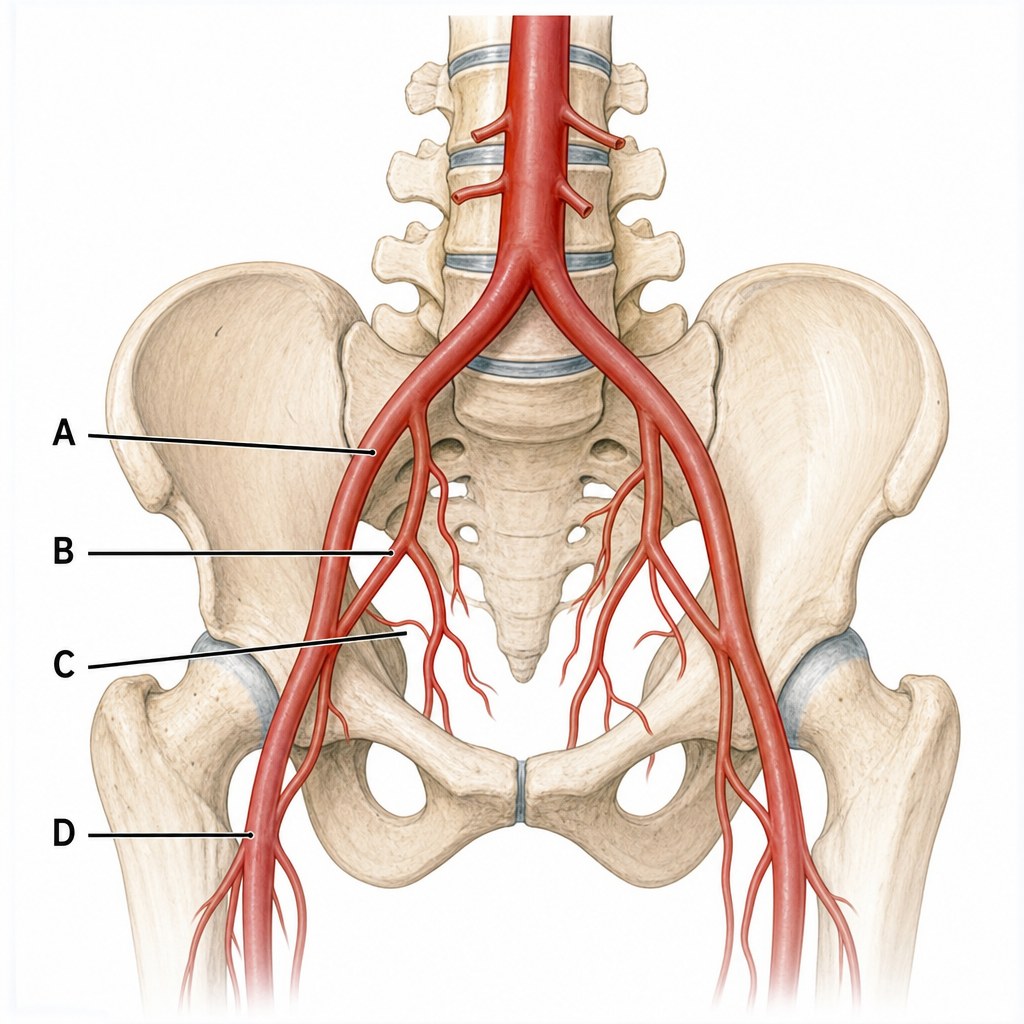
Which structure pierces the sacrotuberous ligament?
Which muscle or muscles cause dorsiflexion of the foot?
Which structure prevents posterior dislocation of the tibia on the femur?
A 32-year-old patient received an intramuscular injection to the posterior part of his gluteal region. The needle injured a motor nerve. Later, he had great difficulty rising to a standing position from a seated position. Which muscle was most likely affected by the injury?
A 50-year-old male patient with a history of pelvic fracture presented with difficulty walking downstairs and frequent falls due to knee buckling. The patient also complains of medial leg and calf muscle numbness. The cause of the condition was found to be mononeuropathy of the dorsal division of the ventral primary rami of L2, L3, and L4 nerves. Which of the following muscles would NOT be affected?

The fibular collateral ligament is a continuation of which structure?
A patient develops a swollen and tender lymph node in his popliteal fossa. An infected skin lesion in which of the following sites would most likely induce lymphadenopathy in this region?
Which of the following structures pass through the adductor magnus?
Which of the following is NOT true about the anterior compartment of the leg?
The gluteofemoral bursa is located between the gluteus maximus muscle and which of the following structures?
Explanation: The **sacrotuberous ligament** is a powerful ligament of the pelvis that transforms the greater and lesser sciatic notches into the greater and lesser sciatic foramina. ### Why the Inferior Gluteal Artery is Correct The **inferior gluteal artery** (a branch of the internal iliac artery) exits the pelvis through the greater sciatic foramen, passing below the piriformis muscle. As it descends into the gluteal region, its branches **pierce the sacrotuberous ligament** to supply the gluteus maximus muscle and the overlying skin. This anatomical relationship is a high-yield fact often tested in pelvic and lower limb anatomy. ### Analysis of Incorrect Options * **A. Nerve to obturator internus:** This nerve exits the greater sciatic foramen, passes over the ischial spine, and re-enters the pelvis through the lesser sciatic foramen. It does not pierce the ligament. * **C. Superior gluteal artery:** This artery exits the greater sciatic foramen *above* the piriformis muscle and remains deep to the gluteus maximus, primarily supplying the gluteus medius and minimus. * **D. Sciatic nerve:** This is the largest nerve in the body. It exits the greater sciatic foramen below the piriformis and descends deep to the gluteus maximus, but it does not pierce the sacrotuberous ligament. ### NEET-PG High-Yield Pearls * **Perforating cutaneous nerve (S2, S3):** This is another key structure that pierces the sacrotuberous ligament to supply the skin of the lower medial buttock. * **Ligamentous Function:** The sacrotuberous and sacrospinous ligaments prevent the upward tilting of the sacrum during weight-bearing. * **Pudendal Canal (Alcock’s Canal):** Note that the internal pudendal vessels and pudendal nerve pass *behind* the sacrospinous ligament but do not pierce the sacrotuberous ligament; they run along the lateral wall of the ischioanal fossa.
Explanation: **Explanation:** The movement of **dorsiflexion** (bringing the toes toward the shin) occurs at the ankle joint and is primarily performed by the muscles located in the **anterior compartment of the leg**. All muscles in this compartment are innervated by the **deep peroneal (fibular) nerve**. * **Tibialis Anterior:** This is the most powerful dorsiflexor of the foot. It also aids in the inversion of the foot at the subtalar joint. * **Extensor Digitorum Longus (EDL):** While its primary action is extending the lateral four toes, its position anterior to the ankle joint allows it to assist significantly in dorsiflexion. * **Extensor Hallucis Longus (EHL):** Primarily extends the great toe (hallux), but also acts as a synergist for dorsiflexion. * **Peroneus Tertius:** (Often considered part of EDL) This muscle also contributes to dorsiflexion and eversion. Since all three listed muscles (Tibialis anterior, EDL, and EHL) cross the ankle joint anteriorly, they all contribute to the movement. Therefore, **Option D** is correct. **Clinical Pearls for NEET-PG:** 1. **Foot Drop:** Injury to the **Common Peroneal Nerve** (e.g., at the neck of the fibula) leads to paralysis of these anterior compartment muscles, resulting in "foot drop" and a characteristic high-steppage gait. 2. **Anterior Compartment Syndrome:** Ischemic necrosis of these muscles can occur due to increased pressure within the tight fascial compartment, often presenting with loss of dorsiflexion and weakened toe extension. 3. **Shin Splints:** Tibialis anterior strain is a common cause of pain along the medial edge of the tibia in runners.
Explanation: The **Posterior Cruciate Ligament (PCL)** is the strongest ligament of the knee joint. It originates from the posterior intercondylar area of the tibia and attaches to the anterolateral aspect of the medial condyle of the femur. Its primary biomechanical function is to **prevent posterior displacement of the tibia relative to the femur**, especially when the knee is flexed. It also acts as the main stabilizer against hyperflexion. ### Why the other options are incorrect: * **Anterior Cruciate Ligament (ACL):** This ligament prevents **anterior** dislocation/displacement of the tibia on the femur. It is the primary stabilizer against hyperextension. * **Medial and Lateral Menisci:** These are C-shaped fibrocartilaginous structures that primarily function as shock absorbers, deepen the articular surfaces of the tibial plateaus, and distribute weight. While they contribute to secondary stability, they do not prevent linear translation (dislocation) of the bones. ### High-Yield Clinical Pearls for NEET-PG: * **Mechanism of Injury:** PCL injuries often occur due to a direct blow to the proximal tibia while the knee is flexed (e.g., **"Dashboard injury"** in motor vehicle accidents). * **Clinical Test:** The **Posterior Drawer Test** is the most sensitive clinical test for PCL deficiency. A positive sign is the "Sag sign," where the tibia sags posteriorly when the knee is flexed to 90 degrees. * **Blood Supply:** Both the ACL and PCL receive their primary blood supply from the **middle genicular artery** (a branch of the popliteal artery). * **Nerve Supply:** They are supplied by the **tibial nerve**.
Explanation: ### Explanation **Correct Answer: A. Gluteus maximus** The clinical presentation describes a classic injury to the **inferior gluteal nerve**, which supplies the **gluteus maximus** muscle. **1. Why Gluteus Maximus is Correct:** The gluteus maximus is the chief extensor of the hip joint. While it is not heavily utilized during normal level-surface walking, it is essential for powerful movements such as **rising from a seated position**, climbing stairs, or running. An intramuscular injection in the lower inner or lower outer quadrants of the gluteal region can damage the inferior gluteal nerve, leading to weakness in hip extension. **2. Why the Other Options are Incorrect:** * **Gluteus minimus (B):** Supplied by the *superior* gluteal nerve. Its primary action is abduction and medial rotation of the hip. Injury leads to a positive Trendelenburg sign (pelvic tilt), not difficulty rising from a chair. * **Hamstrings (C):** These muscles (semitendinosus, semimembranosus, and biceps femoris) assist in hip extension but are primarily knee flexors. They are supplied by the sciatic nerve. While they contribute to rising, the gluteus maximus is the prime mover for this specific action. * **Iliopsoas (D):** This is the chief **flexor** of the hip. Injury would make it difficult to lift the knee toward the chest, rather than rising from a seated position. **3. Clinical Pearls for NEET-PG:** * **Safe Zone for Injection:** To avoid nerve injury (specifically the sciatic and gluteal nerves), intramuscular injections should be administered in the **upper outer quadrant** of the gluteal region or the **ventrogluteal area**. * **Nerve Supply:** * Superior Gluteal Nerve (L4-S1): Gluteus medius, minimus, and tensor fasciae latae. * Inferior Gluteal Nerve (L5-S2): Gluteus maximus only. * **Trendelenburg Gait:** Result of superior gluteal nerve injury; the pelvis drops on the unsupported side (opposite to the lesion).
Explanation: ***Muscle A*** - **Gracilis** or **adductor longus** are innervated by the **obturator nerve** (ventral divisions of L2-L4), not the femoral nerve. - These muscles are part of the **medial compartment** of the thigh and would remain unaffected in femoral nerve palsy. *Muscle D* - Likely represents **rectus femoris** or another **quadriceps femoris** head innervated by the **femoral nerve**. - Weakness of quadriceps muscles causes **knee buckling** and difficulty with **stair climbing**, as seen in this patient. *Muscle B* - Represents another **femoral nerve-innervated muscle** such as **vastus lateralis**, **vastus medialis**, or **sartorius**. - Dysfunction contributes to **quadriceps weakness** and the characteristic **gait instability** with frequent falls. *Muscle C* - Another **femoral nerve muscle** like **vastus intermedius**, **pectineus**, or **iliacus**. - Loss of function results in **knee extensor weakness** and contributes to the **saphenous nerve sensory loss** over medial leg and calf.
Explanation: The fibular collateral ligament (FCL), also known as the lateral collateral ligament (LCL) of the knee, is a cord-like structure that extends from the lateral epicondyle of the femur to the head of the fibula. ### **Explanation of the Correct Answer** **Option A (Peroneus longus):** Morphologically, the fibular collateral ligament is considered the **degenerated tendon of the Peroneus longus muscle**. In lower vertebrates, the Peroneus longus takes its origin from the femur; however, in humans, the proximal portion has evolved into a ligamentous band (the FCL) to provide lateral stability to the knee, while the muscle itself now originates from the fibula. ### **Analysis of Incorrect Options** * **Option B (Biceps femoris):** The tendon of the biceps femoris inserts onto the lateral aspect of the head of the fibula. Crucially, the FCL splits the biceps femoris tendon into two parts just before its insertion. * **Option C (Semimembranosus):** This muscle inserts primarily on the medial condyle of the tibia. Its expansion forms the **oblique popliteal ligament**, not the FCL. * **Option D (Adductor magnus):** The tendon of the adductor magnus inserts into the adductor tubercle of the femur. Its morphological continuation is the **medial collateral ligament (MCL)**, not the FCL. ### **High-Yield NEET-PG Pearls** * **Morphological Equivalents:** * FCL = Peroneus longus tendon. * MCL = Adductor magnus tendon. * **Key Relation:** The FCL is separated from the lateral meniscus by the **tendon of the popliteus** and the inferior lateral genicular vessels. This explains why lateral meniscus tears are less common than medial ones (the MCL is attached to the medial meniscus). * **Nerve Relation:** The **common peroneal nerve** passes behind the tendon of the biceps femoris and the FCL before winding around the neck of the fibula.
Explanation: ### Explanation The lymphatic drainage of the lower limb follows a specific pattern based on the course of the superficial veins. Regional lymph nodes serve as filters where collecting vessels pass through before draining into the main lymph channels [1]. **1. Why Option A is Correct:** The **popliteal lymph nodes** primarily receive afferent lymph vessels from the **lateral side of the foot** and the **posterolateral aspect of the leg**. This drainage pathway follows the course of the **small saphenous vein**, which pierces the deep fascia in the popliteal fossa to join the popliteal vein. Therefore, an infection on the lateral side of the dorsum of the foot will lead to lymphadenopathy in the popliteal fossa. **2. Why the Other Options are Incorrect:** * **Options C and D (Medial side of the leg/sole):** Lymphatic vessels from the medial side of the foot, the medial side of the leg, and the entire thigh follow the **great saphenous vein**. These vessels bypass the popliteal nodes and drain directly into the **superficial inguinal lymph nodes**. * **Option B (Lateral side of the thigh):** The lymphatics of the thigh (both medial and lateral) drain into the superficial inguinal lymph nodes. **3. High-Yield Clinical Pearls for NEET-PG:** * **Superficial Inguinal Nodes:** Drain the entire lower limb (except the lateral foot/posterior leg), the anterior abdominal wall below the umbilicus, the perineum, and the external genitalia (excluding the glans penis/clitoris and testes). * **Deep Inguinal Nodes:** Receive drainage from the glans penis/clitoris and deep lymphatics of the thigh. * **Testicular Drainage:** The testes drain to the **Para-aortic (Lumbar) lymph nodes**, not the inguinal nodes, because of their embryological origin. * **The "Vertical Group"** of superficial inguinal nodes follows the great saphenous vein, while the **"Horizontal Group"** lies just below the inguinal ligament.
Explanation: Explanation: The **Adductor Magnus** is a large, composite muscle of the medial compartment of the thigh. It is characterized by a large gap between its adductor part and hamstring part, known as the **Adductor Hiatus** (or hiatus magnus). 1. **Why Option A is Correct:** The femoral artery and vein travel down the thigh within the adductor canal. At the lower third of the thigh, these **femoral vessels** pass through the adductor hiatus in the adductor magnus to reach the popliteal fossa, where they are renamed the **popliteal artery and vein**. This transition point is a high-yield anatomical landmark. 2. **Why Incorrect Options are Wrong:** * **Femoral Nerve (B):** This nerve terminates in the femoral triangle by dividing into several branches; it does not reach the adductor hiatus. * **Femoral Sheath (C):** This is a fascial extension that ends approximately 3–4 cm below the inguinal ligament. It does not extend into the adductor canal or through the muscle. * **Saphenous Nerve (D):** While it travels in the adductor canal, it does **not** pass through the adductor hiatus. Instead, it pierces the vastoadductor membrane to become cutaneous. **NEET-PG High-Yield Pearls:** * **Dual Nerve Supply:** Adductor magnus is a "hybrid muscle." The adductor part is supplied by the **Obturator nerve**, while the hamstring part is supplied by the **Tibial part of the Sciatic nerve**. * **The "Osseo-aponeurotic" Openings:** Besides the main hiatus, the muscle has four small openings for the **perforating branches** of the profunda femoris artery. * **Clinical Significance:** The adductor hiatus is a common site for the entrapment of the femoral artery (Adductor Canal Syndrome).
Explanation: The question asks to identify the statement that is **NOT** true regarding the **Anterior Compartment** of the leg. ### **Explanation of the Correct Answer (Option C)** **Option C is the correct answer because it is a false statement regarding the anterior compartment.** While the Peroneus longus does indeed cause eversion of the foot, it is located in the **Lateral Compartment** of the leg, not the anterior. The muscles of the anterior compartment include the Tibialis anterior, Extensor digitorum longus, Extensor hallucis longus, and Peroneus tertius. ### **Analysis of Incorrect Options** * **Option A:** **True.** The Tibialis anterior is the primary dorsiflexor of the foot at the ankle joint and also aids in inversion. * **Option B:** **True.** The Extensor hallucis longus (EHL) extends the big toe at the metatarsophalangeal (MTP) and interphalangeal (IP) joints and assists in dorsiflexion. * **Option D:** **True.** The **Deep Peroneal Nerve** (a branch of the common peroneal nerve) provides motor supply to all muscles in the anterior compartment. ### **High-Yield Clinical Pearls for NEET-PG** * **Nerve Supply Rule:** Anterior Compartment = Deep Peroneal Nerve; Lateral Compartment = Superficial Peroneal Nerve; Posterior Compartment = Tibial Nerve. * **Foot Drop:** Injury to the Common Peroneal Nerve (at the neck of the fibula) results in "Foot Drop" due to paralysis of the anterior compartment muscles (loss of dorsiflexion). * **Anterior Tibial Artery:** This is the primary arterial supply to the anterior compartment and continues onto the dorsum of the foot as the **Dorsalis Pedis Artery**. * **Peroneus Tertius:** This is a unique muscle of the anterior compartment that acts as a weak evertor, unlike its counterparts.
Explanation: **Explanation:** The **gluteofemoral bursa** (also known as the trochanteric bursa of the gluteus maximus) is a large, multiloculated bursa situated between the deep surface of the lower part of the **gluteus maximus** muscle and the upper part of the **vastus lateralis** muscle. Its primary function is to reduce friction as the gluteus maximus tendon slides over the vastus lateralis during hip movement. **Analysis of Options:** * **Vastus lateralis (Correct):** The gluteofemoral bursa specifically separates the iliotibial tract (where gluteus maximus inserts) from the origin of the vastus lateralis. * **Greater trochanter:** This is the site of the **trochanteric bursa**, which lies between the gluteus maximus and the lateral surface of the greater trochanter. It is the most clinically significant bursa in this region. * **Ischial tuberosity:** This is the site of the **ischiadica (ischiatic) bursa**, which separates the gluteus maximus from the ischial tuberosity. Inflammation here is known as "Weaver’s Bottom." * **Lesser trochanter:** This is the insertion point for the iliopsoas muscle; the **iliopsoas bursa** is located here, separating the tendon from the hip joint capsule. **High-Yield Clinical Pearls for NEET-PG:** * **Trochanteric Bursitis:** The most common cause of lateral hip pain. Pain is elicited by palpation over the greater trochanter and resisted abduction. * **Gluteus Maximus Insertions:** Remember the **rule of 25/75**—25% of fibers insert into the gluteal tuberosity of the femur, while 75% insert into the Iliotibial Tract (ITT). * **Bursae of Gluteus Maximus:** There are three constant bursae: Trochanteric, Ischiadic, and Gluteofemoral.
Gluteal Region and Hip
Practice Questions
Thigh and Popliteal Fossa
Practice Questions
Leg and Foot
Practice Questions
Joints of Lower Limb
Practice Questions
Nerves of Lower Limb
Practice Questions
Arterial Supply and Venous Drainage
Practice Questions
Lymphatic Drainage
Practice Questions
Muscles and Their Actions
Practice Questions
Gait Analysis and Biomechanics
Practice Questions
Applied Anatomy and Clinical Correlations
Practice Questions
Get full access to all questions, explanations, and performance tracking.
Start For Free