A patient undergoing saphenous cannulation develops sudden onset of pain along the medial border of the ipsilateral foot. Which nerve is most likely to have been accidentally ligated?
Which ligaments provide antero-posterior stability to the knee joint?
What is the anatomical course of the great saphenous vein in relation to the malleoli?
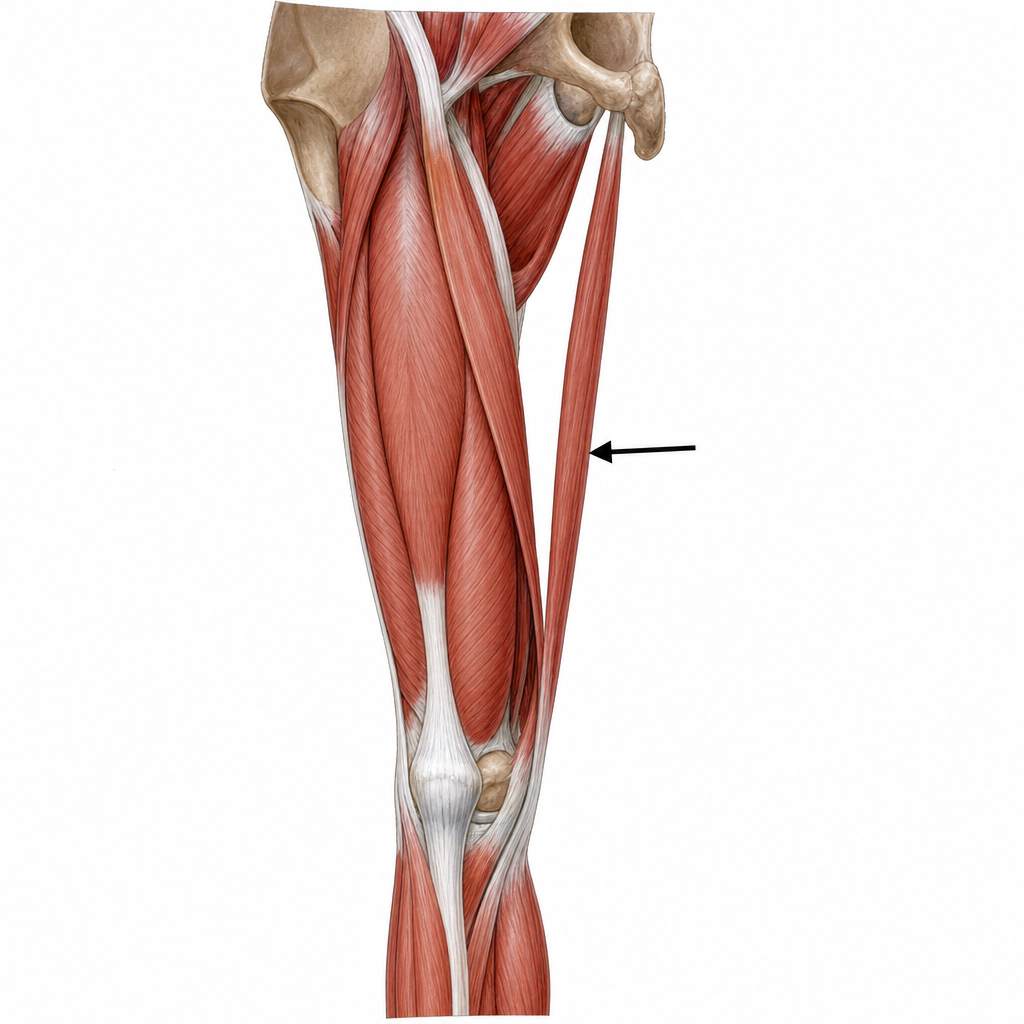
What is the strongest flexor of the hip joint?
Regarding the hip joint, which of the following statements is true?
Largest bursa of the body is?
All of the following are true regarding the great saphenous vein, except:
The peroneal tubercle is a bony landmark found on which bone?
What is true about the saphenous opening?
The tendon of tibialis posterior inserts into which of the following tarsal bones, except?
Explanation: ### Explanation **Correct Answer: C. Saphenous nerve** The **saphenous nerve** is the longest cutaneous branch of the femoral nerve ($L2-L4$). It descends through the adductor canal and becomes superficial at the medial side of the knee. Crucially, at the ankle, it runs **immediately anterior to the medial malleolus**, closely accompanying the **great saphenous vein**. During a saphenous cutdown (cannulation), which is typically performed 1 cm anterior and superior to the medial malleolus, the nerve is at high risk of being accidentally ligated or injured. Since the saphenous nerve provides sensory innervation to the **medial border of the foot** (up to the head of the first metatarsal), injury results in localized pain, numbness, or paresthesia in that specific distribution. **Analysis of Incorrect Options:** * **A. Sural nerve:** Accompanies the *small* saphenous vein behind the *lateral* malleolus. It supplies the lateral border of the foot. * **B. Deep peroneal nerve:** Supplies the skin of the first interdigital cleft (web space between the 1st and 2nd toes). * **D. Genicular nerve:** These are branches (from femoral, obturator, and sciatic nerves) that supply the knee joint capsule, not the medial border of the foot. **High-Yield NEET-PG Pearls:** * **Saphenous Cutdown Site:** 1 cm anterior and superior to the medial malleolus. * **Nerve-Vein Pairs:** * Great Saphenous Vein + Saphenous Nerve (Anterior to medial malleolus). * Small Saphenous Vein + Sural Nerve (Posterior to lateral malleolus). * **Clinical Sign:** Injury to the saphenous nerve during surgery often presents as "Saphenous Neuritis" or chronic pain along the medial leg and foot.
Explanation: **Explanation:** The knee joint is a modified hinge joint that relies heavily on its ligamentous structures for stability. The **Cruciate Ligaments** (Anterior and Posterior) are the primary stabilizers against **antero-posterior (AP) displacement** of the tibia relative to the femur. * **Anterior Cruciate Ligament (ACL):** Prevents anterior translation of the tibia on the femur. It is the weaker of the two and is frequently injured during sudden deceleration or pivoting. * **Posterior Cruciate Ligament (PCL):** Prevents posterior translation of the tibia on the femur. It is the strongest ligament of the knee and acts as the main stabilizer in the weight-bearing flexed knee. **Analysis of Incorrect Options:** * **Medial and Lateral Collateral Ligaments (MCL/LCL):** These are extracapsular ligaments that provide **medio-lateral (valgus/varus) stability**. They prevent the knee from buckling sideways. * **Patellar Ligament:** This is the distal continuation of the quadriceps tendon. Its primary role is to facilitate the **extensor mechanism** of the knee rather than providing AP stability. **Clinical Pearls for NEET-PG:** 1. **Drawer Tests:** The Anterior Drawer Test (ACL) and Posterior Drawer Test (PCL) are the classic clinical maneuvers used to assess AP stability. 2. **Lachman Test:** This is the most sensitive clinical test for an ACL tear. 3. **Unhappy Triad (O'Donoghue):** A common sports injury involving the ACL, Medial Meniscus, and MCL. 4. **Blood Supply:** The cruciate ligaments are supplied by the **middle genicular artery** (a branch of the popliteal artery).
Explanation: The **Great Saphenous Vein (GSV)** is the longest vein in the body and a high-yield topic for NEET-PG [1]. Its course is defined by specific bony landmarks that are crucial for clinical procedures. ### **Explanation of the Correct Answer** The GSV originates from the **medial end of the dorsal venous arch** of the foot. It ascends by passing **anterior to the medial malleolus**. This is a constant anatomical landmark, making it the preferred site for a **venous cutdown** when peripheral veins are collapsed (e.g., in hypovolemic shock). From here, it travels up the medial side of the leg, passes a hand’s breadth posterior to the medial condyle of the femur at the knee, and eventually drains into the femoral vein at the saphenous opening. ### **Analysis of Incorrect Options** * **B. Posterior to the medial malleolus:** No major superficial vein passes here. However, the **Tibialis posterior tendon** and the **Posterior tibial artery** are located posterior to the medial malleolus (within the tarsal tunnel). * **C. Anterior to the lateral malleolus:** This area is primarily occupied by the tendons of the Peroneus tertius and Extensor digitorum longus. * **D. Posterior to the lateral malleolus:** This is the anatomical course of the **Small Saphenous Vein (SSV)** [1]. The SSV begins at the lateral end of the dorsal venous arch and ascends behind the lateral malleolus alongside the **sural nerve**. ### **NEET-PG Clinical Pearls** * **Saphenous Nerve Relationship:** In the lower leg, the GSV is accompanied by the **saphenous nerve**. Injury to this nerve during stripping or cutdown leads to loss of sensation along the medial aspect of the foot. * **Valves:** The GSV contains approximately 10–12 valves, with the most functional one located at the **saphenofemoral junction**. * **Clinical Use:** It is the vessel of choice for **Coronary Artery Bypass Grafting (CABG)**; it is reversed during the procedure so that its valves do not obstruct blood flow.
Explanation: The **Iliopsoas** is the correct answer as it is the most powerful and primary flexor of the hip joint. It is a composite muscle formed by the union of the **Psoas major** (originating from the T12-L5 vertebrae) and the **Iliacus** (originating from the iliac fossa). Both muscles insert into the **lesser trochanter** of the femur. Its strategic position and large physiological cross-sectional area allow it to initiate hip flexion and maintain posture while standing. **Analysis of Incorrect Options:** * **Sartorius (A):** Known as the "Tailor’s muscle," it is a weak flexor of the hip. Its primary actions are a combination of flexion, abduction, and lateral rotation of the hip, along with flexion of the knee. * **Gluteus Maximus (B):** This is the **strongest extensor** of the hip joint, not a flexor. It is crucial for activities like climbing stairs or rising from a sitting position. * **Pectineus (D):** While it contributes to hip flexion and adduction, it is significantly weaker than the iliopsoas. It is often considered a hybrid muscle (dual nerve supply: femoral and obturator nerves). **High-Yield Clinical Pearls for NEET-PG:** * **Nerve Supply:** Iliacus is supplied by the Femoral nerve (L2, L3), while Psoas major is supplied by the ventral rami of L1-L3. * **Psoas Sign:** Pain on passive extension of the hip (stretching the iliopsoas) is a clinical sign of an inflamed appendix (Retrocecal appendicitis). * **Psoas Abscess:** Infections (like TB spine/Pott’s disease) can track down the psoas sheath and present as a swelling in the femoral triangle.
Explanation: **Explanation:** **1. Why Option C is Correct:** The fibrous capsule of the hip joint is a strong, dense structure. Anteriorly, it is attached to the **intertrochanteric line** of the femur. Posteriorly, however, it is attached to the neck of the femur about 1 cm medial to the intertrochanteric crest. This means the entire anterior surface of the femoral neck is intracapsular, while only the medial two-thirds of the posterior surface is intracapsular—a high-yield anatomical detail for fracture classifications. **2. Why the Other Options are Incorrect:** * **Option A:** The **retinacula** are actually longitudinal reflections of the capsule that travel along the neck of the femur. They carry the essential **retinacular arteries** (branches of the medial circumflex femoral artery) which provide the primary blood supply to the head of the femur. * **Option B:** The **Superior Gluteal Nerve** (L4-S1) supplies the primary abductors (Gluteus medius and minimus). The inferior gluteal nerve (L5-S2) supplies the Gluteus maximus, which is the chief extensor of the hip. * **Option D:** The **Iliopsoas** is the most powerful **flexor** of the hip joint, not an abductor. **Clinical Pearls for NEET-PG:** * **Blood Supply:** The medial circumflex femoral artery is the most important source of blood to the femoral head. Damage to retinacular vessels in intracapsular fractures leads to **Avascular Necrosis (AVN)**. * **Stability:** The **Iliofemoral ligament (Ligament of Bigelow)** is the strongest ligament in the body and prevents hyperextension. * **Nerve Supply:** The hip joint follows **Hilton’s Law** and is supplied by the femoral, obturator, and superior gluteal nerves, as well as the nerve to the quadratus femoris.
Explanation: The **Ilio-psoas bursa** is the largest bursa in the human body. It is located deep to the iliopsoas muscle and superficial to the joint capsule of the hip, extending from the lesser trochanter of the femur to the iliac fossa. In approximately 15% of individuals, it communicates directly with the hip joint cavity. Its primary function is to reduce friction between the iliopsoas tendon and the underlying bony prominences of the pelvis and hip. **Analysis of Options:** * **Suprapatellar bursa:** While it is the largest bursa around the knee joint and frequently communicates with the knee joint cavity, its total surface area and volume are smaller than the iliopsoas bursa. * **Subcoracoid bursa:** This is a small bursa located in the shoulder between the coracoid process and the subscapularis tendon; it is significantly smaller than the major bursae of the lower limb. * **Olecranon bursa:** Located over the posterior aspect of the elbow (olecranon process), it is a superficial bursa prone to inflammation (Student’s elbow) but is relatively small in size. **NEET-PG High-Yield Pearls:** * **Clinical Correlation:** Inflammation of the iliopsoas bursa (Iliopsoas Bursitis) can mimic hip joint pathology or a femoral hernia. * **Housemaid’s Knee:** Inflammation of the **Prepatellar bursa**. * **Clergyman’s Knee:** Inflammation of the **Infrapatellar bursa**. * **Baker’s Cyst:** A synovial fluid collection in the **Popliteal bursa** (medial head of gastrocnemius/semimembranosus bursa).
Explanation: The **Great Saphenous Vein (GSV)** is the longest vein in the body and a frequent topic in NEET-PG anatomy [1]. ### **Analysis of the Question** The question asks for the **exception** (the statement that is **true**), implying that three of the provided options are incorrect. 1. **Why Option A is Correct:** The GSV originates from the medial end of the dorsal venous arch of the foot. It ascends **anterior** to the medial malleolus and continues its course along the **medial side of the leg** and thigh before draining into the femoral vein at the saphenous opening [1]. This is a fundamental anatomical fact. 2. **Why Other Options are Incorrect:** * **Option B:** The GSV runs **anterior** to the medial malleolus, not posterior. (The Small Saphenous Vein runs posterior to the lateral malleolus). * **Option C:** The GSV is accompanied by the **saphenous nerve** (a branch of the femoral nerve) in the leg. The **sural nerve** accompanies the Small Saphenous Vein. * **Option D:** The Achilles tendon (Tendo Achilles) is located **posteriorly** in the midline of the ankle/calcaneus. The GSV is located far **medially and anteriorly** relative to it. ### **High-Yield Clinical Pearls for NEET-PG** * **Venesection Site:** The GSV is most consistently found **2 cm anterior and superior to the medial malleolus**, making it a preferred site for emergency venous cutdown. * **Nerve Injury:** During stripping of the GSV or venesection at the ankle, the **saphenous nerve** is at risk of injury, leading to loss of sensation on the medial side of the foot. * **Valves:** It contains approximately 10–20 valves, with the most functional one located at the **saphenofemoral junction**. * **CABG:** It is the most commonly used vessel for coronary artery bypass grafting due to its length and accessibility.
Explanation: The **peroneal tubercle** (also known as the peroneal trochlea) is a small, lateral bony projection found on the **calcaneum** (heel bone). The peroneal tubercle is located on the **lateral surface** of the calcaneum. It serves as a vital anatomical landmark that separates the tendons of the **peroneus brevis** and **peroneus longus** muscles as they pass along the lateral side of the foot. * The **peroneus brevis** tendon passes **above** (superior to) the tubercle. * The **peroneus longus** tendon passes **below** (inferior to) the tubercle. * **Cuboid:** While the peroneus longus tendon passes through a groove on the plantar surface of the cuboid, the tubercle itself is located more posteriorly on the calcaneum. * **Talus:** The talus has landmarks like the *sustentaculum tali* (which is actually a part of the calcaneum supporting the talus) and the posterior process, but it does not possess a peroneal tubercle. * **Fibula:** The fibula has a lateral malleolus, but the peroneal tubercle is a feature of the tarsal bones, not the long bones of the leg. * **Sustentaculum Tali:** A shelf-like projection on the **medial** side of the calcaneum that supports the talus and serves as an attachment for the spring ligament. * **Peroneal Groove:** Located on the inferior surface of the **cuboid**; it houses the peroneus longus tendon. * **Clinical Significance:** Hypertrophy of the peroneal tubercle can lead to stenosing tenosynovitis of the peroneal tendons, causing lateral ankle pain. * **Ossification:** The calcaneum is the first tarsal bone to begin ossification (around the 5th month of fetal life).
Explanation: The **saphenous opening** (fossa ovalis) is a gap in the **fascia lata** (deep fascia of the thigh) located in the upper medial part of the anterior thigh. **1. Why Option C is Correct:** The opening is not a "hole" in the literal sense; it is bridged by a thin, perforated layer of fibroareolar tissue known as the **cribriform fascia**. This fascia is pierced by the great saphenous vein and several small blood and lymphatic vessels, giving it a sieve-like (cribriform) appearance [1]. **2. Analysis of Incorrect Options:** * **Option A:** The great saphenous vein passes **through** (not above) the opening to drain into the femoral vein [1]. * **Option B:** Anatomically, the saphenous opening is situated approximately 3–4 cm **below and lateral** to the pubic tubercle. * **Option C:** It is an opening in the **fascia lata** (deep fascia), not Scarpa’s fascia (superficial fascia). **3. High-Yield Facts for NEET-PG:** * **Boundaries:** The opening has a sharp, crescentic lateral margin called the **falciform margin**, which is continuous with the inguinal ligament. The medial margin is smooth and formed by the fascia covering the pectineus. * **Structures Piercing the Cribriform Fascia:** 1. Great Saphenous Vein (GSV) [1]. 2. Superficial Epigastric Artery/Vein [1], [2]. 3. Superficial External Pudendal Artery/Vein [1], [2]. 4. Superficial Circumflex Iliac Artery/Vein [1], [2]. 5. Efferent lymph vessels from the superficial inguinal nodes. * **Clinical Pearl:** A **femoral hernia** typically pushes through the femoral canal and may project forward through the saphenous opening, appearing as a swelling in the upper thigh [2].
Explanation: The **Tibialis Posterior** is the deepest muscle of the posterior compartment of the leg and serves as the primary dynamic stabilizer of the medial longitudinal arch. Its insertion is unique due to its extensive "finger-like" expansions designed to support the foot's structural integrity. ### **Why Talus is the Correct Answer** The tendon of the tibialis posterior passes behind the medial malleolus and primarily inserts into the **tuberosity of the navicular bone**. From there, it sends slips to **all tarsal bones except the Talus**. The Talus has no muscular or tendinous insertions; it is entirely covered by articular cartilage or ligamentous attachments, making it the "odd one out" in the tarsal assembly. ### **Analysis of Other Options** * **Calcaneus:** The tendon sends a slip to the sustentaculum tali of the calcaneus. * **Intermediate Cuneiform:** It sends slips to all three cuneiforms (medial, intermediate, and lateral). * **Cuboid:** It sends a slip to the cuboid bone before some fibers continue to the bases of the 2nd, 3rd, and 4th metatarsals. ### **NEET-PG High-Yield Pearls** * **Main Insertion:** Navicular tuberosity (Primary site). * **The "Rule of All":** Inserts into all tarsal bones (except Talus) and the bases of middle three metatarsals. * **Clinical Correlation:** Paralysis or rupture of the Tibialis Posterior leads to **Pes Planus (Flat Foot)** because the medial longitudinal arch loses its primary support. * **Tom, Dick, and Harry:** Mnemonic for structures passing deep to the flexor retinaculum (Anterior to Posterior): **T**ibialis posterior, flexor **D**igitorum longus, posterior tibial **A**rtery, tibial **N**erve, flexor **H**allucis longus.
Gluteal Region and Hip
Practice Questions
Thigh and Popliteal Fossa
Practice Questions
Leg and Foot
Practice Questions
Joints of Lower Limb
Practice Questions
Nerves of Lower Limb
Practice Questions
Arterial Supply and Venous Drainage
Practice Questions
Lymphatic Drainage
Practice Questions
Muscles and Their Actions
Practice Questions
Gait Analysis and Biomechanics
Practice Questions
Applied Anatomy and Clinical Correlations
Practice Questions
Get full access to all questions, explanations, and performance tracking.
Start For Free