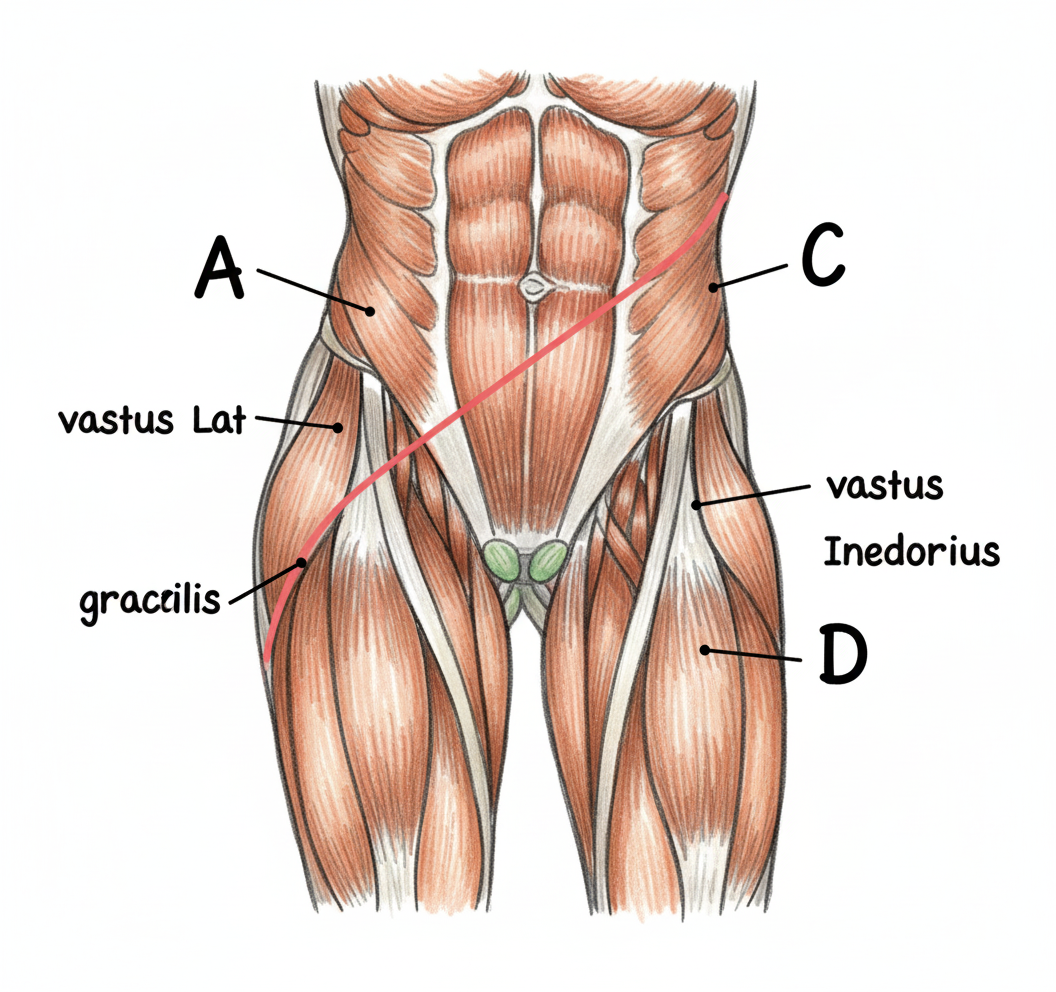
Which muscles are primarily used during the stance and swing phases of a normal walk?
Which of the following structures does NOT pass through the obturator foramen?
Great saphenous vein is a tributary of which of the following?
Which of the following is true for the linea aspera?
Fractures of the fibular neck may involve which of the following nerves?
What is the common site of fracture in the tibia?
Trendelenburg's gait is due to the weakness of which muscle group?
Foot drop is typically due to injury of which nerve?
Bigelow's ligament is located at which joint?
Which of the following statements is NOT TRUE about the medial meniscus?
Explanation: The gait cycle consists of two main phases: the **Stance phase** (60%) and the **Swing phase** (40%) [1]. **Explanation of the Correct Answer:** The **Gastrocnemius** (along with the Soleus) is the primary muscle used during the late stance phase. Its most critical role is **"Toe-off"** (propulsion), where it undergoes powerful plantarflexion to push the body forward. Additionally, it acts as a knee flexor during the initial swing phase [1]. Because it provides the necessary power for forward progression, it is considered a fundamental muscle for a normal walking gait [1]. **Analysis of Incorrect Options:** * **Popliteus:** Known as the "Key to the knee," its primary function is to unlock the knee by laterally rotating the femur on the tibia (or medially rotating the tibia) to initiate flexion. It does not provide the primary power for stance or swing. * **Tibialis Anterior:** This muscle is most active during the **initial contact (heel strike)** to prevent foot slap (eccentric contraction) and during the **swing phase** to provide dorsiflexion for ground clearance. While important, it is not the primary driver of propulsion. * **Iliopsoas:** This is the chief flexor of the hip. It is primarily active during the **initial swing phase** to lift the limb, but it does not contribute significantly to the stance phase stability or propulsion compared to the calf muscles. **High-Yield Clinical Pearls for NEET-PG:** * **Gluteus Maximus:** Prevents trunk lurching forward during heel strike. * **Gluteus Medius/Minimus:** Stabilize the pelvis during the single-leg stance; paralysis leads to a **Trendelenburg gait**. * **Foot Drop:** Caused by injury to the **Common Peroneal Nerve**, leading to paralysis of the Tibialis anterior and a "High-steppage gait." * **Calf Muscles:** Often referred to as the **"Peripheral Heart"** due to their role in venous return during walking.
Explanation: ### Explanation The **obturator foramen** is a large opening in the hip bone formed by the margins of the ischium and pubis. In a living subject, this foramen is almost completely closed by the **obturator membrane**, except for a small gap superiorly known as the **obturator canal**. **1. Why "Internal Pudendal vessels" is the correct answer:** The internal pudendal vessels (and the pudendal nerve) exit the pelvis through the **greater sciatic foramen** and enter the perineum via the **lesser sciatic foramen**. They do not pass through the obturator foramen. Instead, they travel within the **pudendal (Alcock’s) canal**, which is a fascial tunnel located on the lateral wall of the ischioanal fossa, overlying the obturator internus muscle. **2. Why the other options are incorrect:** * **Obturator Nerve (B):** This nerve arises from the lumbar plexus (L2-L4) and passes through the obturator canal to reach the medial compartment of the thigh, where it supplies the adductor muscles. * **Obturator Artery (C) & Vein (D):** These vessels accompany the nerve through the obturator canal. The artery is typically a branch of the internal iliac artery (anterior division). **3. Clinical Pearls & High-Yield Facts for NEET-PG:** * **Corona Mortis (Crown of Death):** In about 20-30% of individuals, an "accessory" or "aberrant" obturator artery arises from the **inferior epigastric artery** and crosses the superior pubic ramus. It is at high risk of injury during femoral hernia repairs. * **Obturator Hernia:** A rare type of hernia where abdominal contents protrude through the obturator canal. It often presents with the **Howship-Romberg sign** (pain extending down the medial thigh to the knee due to compression of the obturator nerve). * **Obturator Internus:** This muscle originates from the inner surface of the obturator membrane; its tendon exits the pelvis through the **lesser sciatic foramen**.
Explanation: **Explanation:** The **Great Saphenous Vein (GSV)** is the longest vein in the body. It originates on the dorsum of the foot by the union of the **dorsal digit vein of the great toe** and the **medial end of the dorsal venous arch**. While the GSV is a superficial vein, it is functionally and anatomically connected to the deep venous system [1]. The question asks what the GSV is a **tributary of**. In clinical anatomy, a tributary usually refers to a smaller vessel flowing into a larger one; however, in the context of the lower limb venous system, the GSV eventually drains into the **Femoral Vein** at the saphenofemoral junction [1]. Among the provided options, the **Posterior Tibial Vein** is the correct answer because the GSV communicates extensively with it via **perforating veins** (specifically the Cockett perforators in the leg) [1]. In many standardized PG exams, the GSV is considered a tributary of the deep system it feeds into. **Analysis of Options:** * **A & C (Lateral/Medial marginal veins):** These are the *formative* vessels. The medial marginal vein continues upwards as the GSV, while the lateral marginal vein continues as the Small Saphenous Vein. * **D (Dorsal venous arch):** This is the *source* of the GSV, not the vessel it is a tributary of. **High-Yield Clinical Pearls for NEET-PG:** * **Course:** Passes **anterior** to the medial malleolus (site for emergency venous cut-down) and **posterior** to the medial condyle of the femur. * **Saphenous Nerve:** Runs closely with the GSV in the leg; injury leads to numbness on the medial aspect of the foot [1]. * **Valves:** Contains approximately 10–12 valves, with the most proximal one located just before it joins the femoral vein. * **Clinical Use:** Frequently used as a graft for Coronary Artery Bypass Grafting (CABG) due to its length and accessibility.
Explanation: The **linea aspera** is a prominent longitudinal ridge on the posterior surface of the shaft of the femur, serving as a critical site for muscle attachments in the thigh. ### **Explanation of the Correct Option** **Option D is correct.** The **lateral lip** of the linea aspera provides the origin for the **short head of the biceps femoris**. This muscle is unique because, unlike the long head (supplied by the tibial part of the sciatic nerve), the short head is supplied by the **common peroneal (fibular) nerve**. ### **Analysis of Incorrect Options** * **Option A:** The **vastus intermedius** originates from the anterior and lateral surfaces of the femoral shaft, not the medial lip. The medial lip provides origin to the **vastus medialis**. * **Option B:** Superiorly, the **lateral lip** continues as the **gluteal tuberosity** (for gluteus maximus), while the **medial lip** continues as the **spiral line**, which winds around the femur to become the intertrochanteric line. * **Option C:** The **adductor magnus** (adductor part) inserts into the **intermediate area** (interstice) of the linea aspera and its medial supracondylar ridge, not specifically the medial lip. ### **High-Yield NEET-PG Pearls** * **Medial Lip Attachments:** Vastus medialis (origin). * **Lateral Lip Attachments:** Vastus lateralis (origin), Short head of biceps femoris (origin), and Gluteal tuberosity (superior extension). * **Intermediate Area (Interstice):** Adductor longus, Adductor brevis, and Adductor magnus insert here. * **Nutrient Foramen:** Usually located near the linea aspera, directed **away from the knee** (upwards), following the rule: *"To the elbow I go, from the knee I flee."*
Explanation: **Explanation:** The **common peroneal nerve (CPN)**, also known as the common fibular nerve, is the most frequently injured nerve in the lower limb due to its superficial and vulnerable course. After originating from the sciatic nerve, it winds laterally around the **neck of the fibula**, passing through the opening in the peroneus longus muscle. Because it lies directly against the bone at this site, fractures of the fibular neck or tight plaster casts often result in nerve compression or laceration. **Analysis of Options:** * **Common Peroneal Nerve (Correct):** Its anatomical proximity to the fibular neck makes it the primary structure at risk. Injury leads to **Foot Drop** (loss of dorsiflexion) and loss of sensation on the dorsum of the foot. * **Tibial Nerve:** This nerve passes through the popliteal fossa and enters the posterior compartment of the leg deep to the soleus. It is well-protected by muscles and is not related to the fibular neck. * **Sciatic Nerve:** This nerve terminates into the CPN and tibial nerve at the apex of the popliteal fossa (superior to the fibular neck). It is typically injured in posterior dislocations of the hip. * **Sural Nerve:** Formed by branches from both the tibial and common peroneal nerves, it is a purely sensory nerve located distally in the calf and lateral ankle. **High-Yield Clinical Pearls for NEET-PG:** 1. **Clinical Presentation:** Injury to the CPN at the fibular neck results in paralysis of the anterior and lateral compartment muscles, causing **Foot Drop** and an **Equinovarus** deformity. 2. **Gait:** Patients exhibit a **"High-steppage gait"** to prevent the toes from dragging. 3. **Sensory Loss:** Anesthesia occurs over the lateral aspect of the leg and the dorsum of the foot (sparing the web space between the 1st and 2nd toes if only the superficial branch is involved).
Explanation: The tibia is the most commonly fractured long bone in the body. The **junction of the upper two-thirds and lower one-third** of the shaft is the most frequent site of fracture due to two primary anatomical factors: 1. **Change in Cross-sectional Shape:** The tibial shaft transitions from a robust, triangular cross-section in its upper two-thirds to a weaker, cylindrical (circular) cross-section in the lower one-third. This transition zone creates a natural point of mechanical weakness. 2. **Nutrient Artery Entry:** The nutrient artery enters the posterior surface of the tibia in its upper third and runs downwards. Fractures at the junction of the middle and lower thirds often disrupt this blood supply, leading to a high incidence of delayed union or non-union. **Analysis of Options:** * **Option A & D:** While fractures can occur in the upper and middle thirds (often due to direct high-energy trauma), these areas are wider and have better muscular coverage and blood supply compared to the distal junction. * **Option C:** While the lower one-third is vulnerable, the specific point of maximal weakness is the transition zone where the bone morphology changes (the junction). **Clinical Pearls for NEET-PG:** * **Blood Supply:** The lower third of the tibia is notorious for poor blood supply because it lacks significant muscular attachments (it is mostly subcutaneous). * **Compound Fractures:** Because the anteromedial surface of the tibia is subcutaneous throughout its length, tibial fractures are the most common **open (compound) fractures** in the body. * **March Fracture:** This refers to a stress fracture, typically involving the neck of the 2nd or 3rd metatarsal, not the tibia. * **Runner's High-Yield:** Medial Tibial Stress Syndrome (Shin Splints) typically involves the distal two-thirds of the tibial shaft.
Explanation: **Explanation:** The **Gluteus medius** (along with the Gluteus minimus) is the primary **abductor** of the hip. Its crucial function is to stabilize the pelvis during the "stance phase" of walking. When one foot is lifted off the ground (swing phase), the gluteus medius on the weight-bearing side (stance side) contracts to prevent the pelvis from tilting toward the unsupported side. If the Gluteus medius is weak or paralyzed (often due to damage to the **Superior Gluteal Nerve**), the pelvis drops toward the healthy side when that leg is lifted. To compensate and clear the foot from the ground, the patient tilts their trunk toward the affected side, resulting in the characteristic **Trendelenburg’s gait** (or "lurching gait"). **Why the other options are incorrect:** * **Quadriceps:** These are extensors of the knee. Weakness leads to a "Hand-to-knee" gait where the patient pushes their thigh back to lock the knee. * **Iliopsoas:** This is the chief flexor of the hip. Weakness makes it difficult to initiate the swing phase of walking. * **Sartorius:** Known as the "tailor's muscle," it assists in hip flexion, abduction, and lateral rotation, but it is not a primary pelvic stabilizer. **High-Yield Clinical Pearls for NEET-PG:** * **Trendelenburg Sign:** If the right gluteus medius is weak, the **left** side of the pelvis drops when the left foot is lifted. * **Nerve Supply:** Gluteus medius and minimus are supplied by the **Superior Gluteal Nerve (L4–S1)**. * **Injection Site:** Intramuscular injections are given in the superolateral quadrant of the gluteal region to avoid injuring the Sciatic nerve, but deep injections can sometimes affect the superior gluteal nerve branches.
Explanation: **Explanation:** **1. Why the Common Peroneal Nerve (CPN) is correct:** Foot drop is the inability to dorsiflex the foot and evert the ankle. The **Common Peroneal Nerve** (also known as the Common Fibular Nerve) is the most frequently injured nerve in the lower limb due to its superficial course as it winds around the **neck of the fibula**. It divides into: * **Deep Peroneal Nerve:** Innervates the anterior compartment of the leg (dorsiflexors like Tibialis Anterior). * **Superficial Peroneal Nerve:** Innervates the lateral compartment (evertors like Peroneus Longus/Brevis). Injury to the CPN leads to paralysis of these muscles, resulting in a "dropped" foot and a characteristic **high-steppage gait**. **2. Why other options are incorrect:** * **Lateral Cutaneous Nerve of Thigh:** This is a purely sensory nerve (L2-L3). Injury causes **Meralgia Paresthetica** (tingling/numbness on the outer thigh) but no motor deficit or foot drop. * **Sural Nerve:** Formed by branches of the tibial and common peroneal nerves, it is a purely sensory nerve supplying the posterolateral leg and lateral foot. It is commonly used for nerve grafting. **3. High-Yield Clinical Pearls for NEET-PG:** * **Mechanism of Injury:** Pressure from tight plaster casts, leg crossing, or fibular neck fractures. * **Sensory Loss:** Occurs on the dorsum of the foot and the lateral aspect of the leg. * **The "Flip-Flop" Sign:** Loss of sensation in the first dorsal web space is specific to Deep Peroneal Nerve involvement. * **Differential:** If foot drop is accompanied by loss of inversion and the Achilles reflex, consider an **L5 radiculopathy** or Sciatic nerve injury rather than isolated CPN palsy.
Explanation: **Explanation:** The correct answer is the **Hip joint**. Bigelow’s ligament is the eponym for the **Iliofemoral ligament**, which is the strongest ligament in the human body. **Why the Hip Joint is Correct:** The Iliofemoral ligament is a thick, triangular band located on the anterior aspect of the hip joint capsule. It originates from the anterior inferior iliac spine (AIIS) and the acetabular rim, bifurcating to attach along the intertrochanteric line of the femur. Because of its inverted "Y" shape, it is frequently referred to as the **"Y-shaped ligament of Bigelow."** Its primary function is to prevent hyperextension of the hip joint during standing. **Why Other Options are Incorrect:** * **Knee joint:** The primary stabilizing ligaments here are the Cruciates (ACL/PCL) and Collaterals (MCL/LCL). * **Shoulder joint:** This joint is stabilized by the Glenohumeral ligaments and the Coracohumeral ligament. * **Ankle joint:** The major stabilizers are the Deltoid ligament (medially) and the Lateral collateral complex (ATFL, CFL, PTFL). **NEET-PG High-Yield Pearls:** 1. **Strength:** The Iliofemoral ligament is so strong that it rarely tears; instead, it often causes avulsion fractures of the bone. 2. **Clinical Significance:** In posterior dislocations of the hip (the most common type), Bigelow’s ligament usually remains intact and acts as a fulcrum during reduction maneuvers (e.g., Allis or Stimson techniques). 3. **Other Hip Ligaments:** Remember the **Pubofemoral** (prevents over-abduction) and **Ischiofemoral** (weakest of the three, prevents excessive internal rotation) ligaments.
Explanation: The **medial meniscus** is a fibrocartilaginous structure that acts as a shock absorber in the knee joint. Understanding its anatomy is crucial for NEET-PG, as it is frequently compared to the lateral meniscus. ### **Explanation of the Correct Answer** **Option B is NOT TRUE** because the medial meniscus is **firmly attached** to the deep surface of the **Medial Collateral Ligament (MCL)**. This anatomical tethering significantly restricts its mobility. In contrast, the lateral meniscus is separated from the Lateral Collateral Ligament (LCL) by the tendon of the popliteus muscle, making it more mobile. ### **Analysis of Other Options** * **Option A (Semicircular):** This is true. The medial meniscus is "C-shaped" or semicircular, whereas the lateral meniscus is more circular (nearly a complete ring). * **Option C (Anchored to the tibia):** This is true. Both menisci are attached to the intercondylar area of the tibia via their anterior and posterior horns. The medial meniscus is more fixed due to its peripheral attachments to the joint capsule and MCL. * **Option D (Prone to injury):** This is true. Because the medial meniscus is less mobile (fixed to the MCL), it cannot move out of the way during stressful rotations. Consequently, it is injured **20 times more frequently** than the lateral meniscus. ### **Clinical Pearls for NEET-PG** * **O’Donoghue’s Unhappy Triad:** Consists of a concomitant tear of the **Anterior Cruciate Ligament (ACL)**, **Medial Collateral Ligament (MCL)**, and **Medial Meniscus**. * **Blood Supply:** The peripheral 1/3 (Red Zone) is vascularized, while the inner 2/3 (White Zone) is avascular and relies on synovial fluid for nutrition. * **Coronary Ligaments:** These attach the peripheral margins of both menisci to the tibial condyles.
Gluteal Region and Hip
Practice Questions
Thigh and Popliteal Fossa
Practice Questions
Leg and Foot
Practice Questions
Joints of Lower Limb
Practice Questions
Nerves of Lower Limb
Practice Questions
Arterial Supply and Venous Drainage
Practice Questions
Lymphatic Drainage
Practice Questions
Muscles and Their Actions
Practice Questions
Gait Analysis and Biomechanics
Practice Questions
Applied Anatomy and Clinical Correlations
Practice Questions
Get full access to all questions, explanations, and performance tracking.
Start For Free