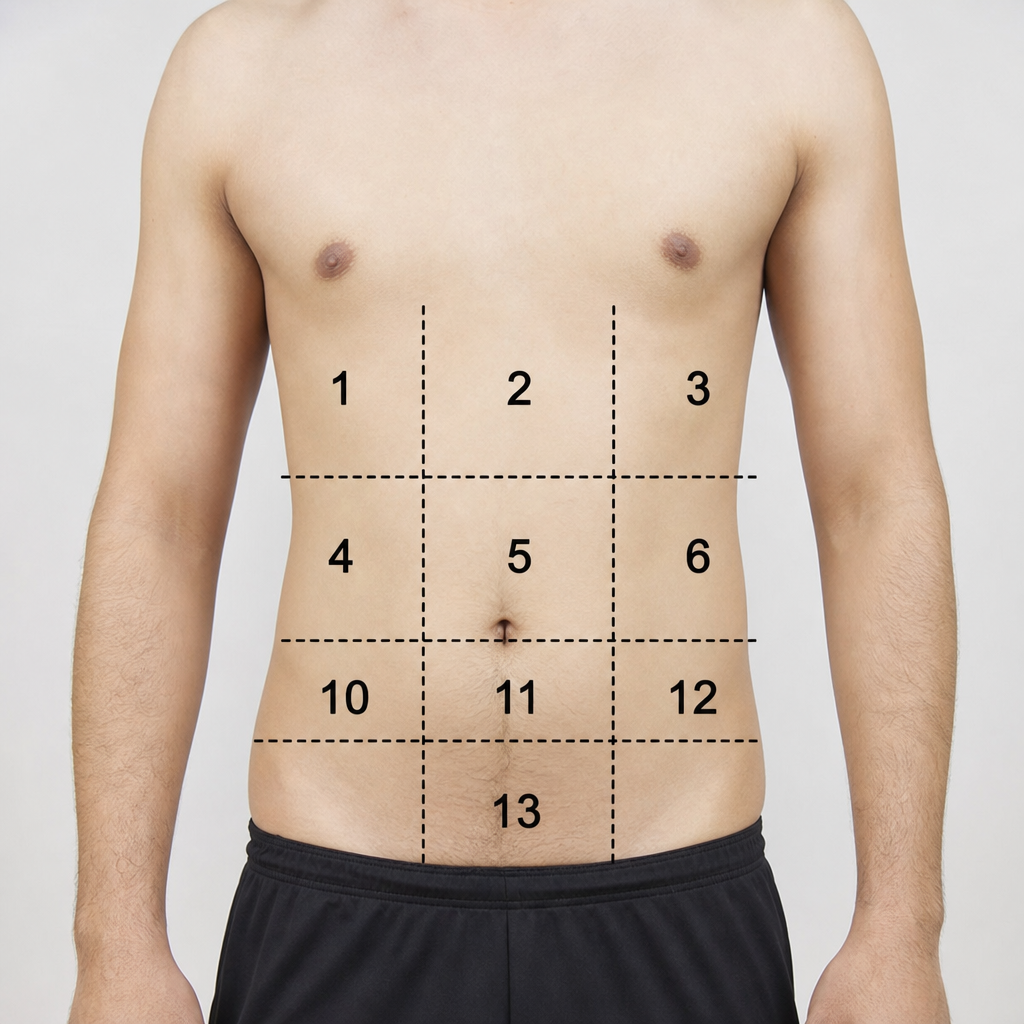
The nerve of Grassi is anatomically related to which of the following nerves?
Which of the following cells are present in the human intestinal glands?
A young athlete, after rigorous training and strict diet control, develops a 'washboard stomach'. Which of the following structures marks its lateral border?
All of the following are features of the large intestine except?
Subdiaphragmatic peritoneum is more absorptive than pelvic peritoneum because the former possesses which of the following?
A lecturer is demonstrating a fibrous band that runs on the visceral surface of the liver. It is attached on one end to the inferior vena cava and on the other end to the left branch of the portal vein. In the adult, what does this structure correspond to?
All of the following structures lie in the renal medulla, EXCEPT:
Which of the following is true about the renal arterial system?
Which of the following structures does not form the covering of a femoral hernia?
The root of the mesentery does not cross which of the following structures?
Explanation: ### Explanation **Correct Answer: C. Vagus nerve** The **Nerve of Grassi** (also known as the criminal nerve of Grassi) is the **first branch of the posterior vagus nerve**. It arises high up near the cardia of the stomach and supplies the gastric fundus. [1] In the context of surgical anatomy, this nerve is clinically significant during a **Highly Selective Vagotomy (HSV)**. If a surgeon fails to identify and divide this specific branch, it continues to stimulate acid secretion from the fundus, leading to **recurrent peptic ulcers**. This "criminal" tendency to cause treatment failure is why it is frequently tested in surgical anatomy. [1] **Analysis of Incorrect Options:** * **A. Facial nerve (CN VII):** Supplies muscles of facial expression and taste to the anterior two-thirds of the tongue; it has no anatomical relation to the gastric nerve of Grassi. * **B. Glossopharyngeal nerve (CN IX):** Involved in the gag reflex and taste to the posterior third of the tongue; it does not descend into the abdomen. * **D. Hypoglossal nerve (CN XII):** A purely motor nerve supplying the muscles of the tongue; it remains in the head and neck region. **High-Yield Clinical Pearls for NEET-PG:** * **Anterior Vagus:** Gives off the **Hepatic branch** and continues as the Anterior Nerve of Latarjet. * **Posterior Vagus:** Gives off the **Celiac branch** and the **Nerve of Grassi**. * **Crow’s Foot:** The terminal branches of the nerves of Latarjet near the antrum/pylorus. In Highly Selective Vagotomy, these must be preserved to maintain antral pump function and gastric emptying. [1] * **Vagotomy Types:** Truncal (total denervation), Selective (denervates stomach only), and Highly Selective (denervates acid-secreting areas only). [1]
Explanation: The intestinal glands, also known as **Crypts of Lieberkühn**, are simple tubular glands found in the mucosa of both the small and large intestines [1]. These crypts serve as the primary site for cell renewal and secretion. **Explanation of the Correct Answer:** The correct answer is **D (All of the above)** because the intestinal crypts house a diverse population of specialized cells: * **Paneth cells:** Located at the base of the crypts (primarily in the small intestine), these cells contain eosinophilic granules and secrete antimicrobial substances like **lysozyme** and defensins [1]. * **Neuroendocrine cells (Enteroendocrine cells):** These cells secrete hormones such as secretin, cholecystokinin (CCK), and serotonin into the bloodstream to regulate digestive functions [2]. * **Stem cells:** Found in the lower half of the crypt, these are undifferentiated cells that rapidly divide to replenish the intestinal epithelium (enterocytes, goblet cells, etc.) every 3–5 days [1]. **Why other options are considered part of the whole:** Options A, B, and C are all individual components of the glandular epithelium. Selecting only one would be incomplete, as the crypt functions as a coordinated unit of secretion, endocrine signaling, and regeneration. **NEET-PG High-Yield Pearls:** * **Paneth Cells:** They are rich in **Zinc** and are absent in the large intestine (except occasionally in the cecum) [1]. * **M-cells (Microfold cells):** Found in the epithelium overlying Peyer’s patches; they are involved in antigen presentation. * **Brunner’s Glands:** These are located in the **submucosa of the duodenum** (not the mucosa) and secrete alkaline mucus to neutralize gastric acid. * **Argentaffin cells:** A type of neuroendocrine cell in the crypts that stains with silver salts and is the origin of most **Carcinoid tumors** [2].
Explanation: **Explanation:** The "washboard stomach" appearance in athletes is caused by the visibility of the **Rectus Abdominis** muscle. This muscle is divided horizontally by tendinous intersections and bounded laterally by a distinct curved groove known as the **Linea semilunaris** [1]. 1. **Why Linea semilunaris is correct:** The linea semilunaris is a curved, vertical line that marks the lateral border of the rectus abdominis [2]. It represents the site where the aponeuroses of the external oblique, internal oblique, and transversus abdominis muscles fuse to form the rectus sheath [1]. In lean individuals, this transition creates a visible surface depression lateral to the "six-pack" abs. 2. **Why the other options are incorrect:** * **Linea alba:** This is the midline fibrous structure formed by the fusion of aponeuroses from both sides. It marks the **medial** border of the rectus abdominis, not the lateral. * **Linea semicircularis (Arcuate line):** This is a horizontal anatomical landmark located in the lower abdomen (midway between the umbilicus and pubic symphysis) where the posterior wall of the rectus sheath ends [1]. It is an internal feature and does not define the lateral border. * **Transversalis fascia:** This is a thin aponeurotic membrane lying between the transversus abdominis muscle and the extraperitoneal fat. It forms the posterior lining of the abdominal wall but is not a surface landmark. **High-Yield Clinical Pearls for NEET-PG:** * **Spigelian Hernia:** This occurs through the **linea semilunaris**, typically at the level of the arcuate line. It is also known as a spontaneous lateral ventral hernia. * **Tendinous Intersections:** Usually three in number (at the level of the xiphoid, umbilicus, and halfway between), these are firmly attached to the **anterior** wall of the rectus sheath, creating the "washboard" segments. * **Rectus Sheath Content:** Contains the Rectus abdominis, Pyramidalis muscle, and the **superior and inferior epigastric vessels** [3].
Explanation: The large intestine is distinguished from the small intestine by three hallmark morphological features: **Taenia coli, Haustrations (sacculations), and Appendices epiploicae.** ### Why "Valvular Conniventes" is the Correct Answer: **Valvular conniventes** (also known as Plicae circulares or Valves of Kerckring) are permanent circular mucosal folds found exclusively in the **small intestine**. They begin in the second part of the duodenum and are most prominent in the jejunum. Their primary function is to increase the surface area for absorption and slow down the passage of chime [1]. They are **absent** in the large intestine (except for the rectum, which has transverse folds called Houston’s valves). ### Why the other options are incorrect: * **Appendices epiploicae (Option A):** These are small, peritoneum-covered pouches of fat attached to the outer surface of the colon. They are absent in the cecum, appendix, and rectum. * **Taenia coli (Option C):** These are three longitudinal bands of smooth muscle formed by the thickening of the outer muscular layer [2]. They converge at the base of the appendix (a surgical landmark) and end at the recto-sigmoid junction [2]. * **Haustrations (Option D):** These are sacculations of the colon wall produced because the taenia coli are shorter than the circular muscle layer, causing the colon to "pucker" [3]. ### High-Yield Clinical Pearls for NEET-PG: 1. **Radiological Distinction:** On an X-ray, valvular conniventes cross the **entire width** of the bowel (small bowel obstruction), whereas haustrations only **partially** cross the lumen (large bowel obstruction). 2. **The Appendix:** The taenia coli converge at the base of the vermiform appendix, making them the most reliable guide to locating the appendix during surgery [2]. 3. **Absence of Features:** The **rectum** is unique because it lacks all three cardinal features (no taenia, no haustra, no appendices epiploicae).
Explanation: The peritoneum is a semi-permeable serous membrane that facilitates the movement of fluids and solutes. The rate of absorption across the peritoneum is primarily governed by the **effective surface area** available for exchange. **1. Why "Wide surface area" is correct:** The subdiaphragmatic (upper) peritoneum, particularly the area covering the inferior surface of the diaphragm, has a significantly larger and more complex surface area compared to the pelvic peritoneum. This region contains specialized lymphatic openings called **stomata** (of von Recklinghausen) that communicate directly with the subperitoneal lymphatics [1]. The vast surface area, combined with the rhythmic "pumping" action of the diaphragm during respiration, creates a pressure gradient that facilitates the rapid absorption of fluids, particulate matter, and even bacteria into the lymphatic system [1]. **2. Why other options are incorrect:** * **Larger macrophages:** While macrophages are present in the peritoneal fluid (milky spots), their size does not determine the rate of fluid absorption. * **Bigger stomata:** The presence of stomata is crucial, but their "size" is relatively uniform. It is the **density and total area** they cover, rather than the size of individual pores, that dictates the absorptive capacity. * **Wider capillaries:** Capillary width does not significantly alter the peritoneal transport rate; the primary limiting factor for large-scale fluid clearance is the lymphatic drainage through the surface area. **Clinical Pearls for NEET-PG:** * **Fowler’s Position:** Patients with peritonitis are often kept in a propped-up (semi-sitting) position. This uses gravity to drain infected inflammatory exudate away from the highly absorptive subdiaphragmatic area toward the pelvic cavity, where absorption is slower, thereby reducing the risk of systemic sepsis. * **Peritoneal Dialysis:** Utilizes the large surface area of the peritoneum (approximately 1–2 m²) as a biological membrane for exchange. * **Direction of Flow:** Intraperitoneal fluid naturally flows upward toward the diaphragm due to the negative pressure generated during inspiration [1].
Explanation: **Explanation:** The structure described is the **Ligamentum venosum**. In fetal circulation, the **ductus venosus** is a vital shunt that allows oxygenated blood from the umbilical vein to bypass the hepatic sinusoids and flow directly into the Inferior Vena Cava (IVC) [2]. After birth, this shunt undergoes functional closure and eventually fibroses to become the ligamentum venosum. **Anatomical Context:** The ligamentum venosum lies in a deep fissure on the visceral surface of the liver, separating the **caudate lobe** from the left lobe [1]. Its attachments—the left branch of the portal vein and the IVC—perfectly mirror its fetal function as a bypass vessel. **Analysis of Incorrect Options:** * **A. Ductus venosus:** This is the correct embryonic precursor, but the question asks what the structure corresponds to in the **adult**. * **B. Ligamentum teres:** This is the remnant of the **left umbilical vein**. It runs in the free margin of the falciform ligament and extends from the umbilicus to the left branch of the portal vein [2]. * **D. Umbilical arteries:** These fibrose to become the **medial umbilical ligaments** on the internal surface of the anterior abdominal wall. **High-Yield NEET-PG Pearls:** * **The "H" Shape:** The ligamentum venosum forms the upper left limb of the "H-shaped" fissure on the liver's visceral surface. * **Portosystemic Shunt:** In cases of portal hypertension, the ligamentum venosum does not typically recanalize; however, the ligamentum teres (umbilical vein) can, leading to *Caput Medusae*. * **Mnemonic:** **V**enosum = Ductus **V**enosus; **T**eres = Umbilical **V**ein (The "T" and "V" are different).
Explanation: The kidney is divided into two main histological zones: the **outer cortex** and the **inner medulla**. The distinction between these zones is a high-yield topic for NEET-PG, as it dictates the physiological functions of the nephron. **1. Why Juxtaglomerular Apparatus (JGA) is the correct answer:** The JGA is a specialized structure formed by the distal convoluted tubule and the afferent arteriole [1]. By definition, all **Glomeruli**, **Bowman’s capsules**, **Proximal Convoluted Tubules (PCT)**, and **Distal Convoluted Tubules (DCT)** are located exclusively in the **Renal Cortex**. Since the JGA is physically attached to the vascular pole of the renal corpuscle, it must reside in the cortex, not the medulla. **2. Analysis of Incorrect Options (Structures in the Medulla):** * **Loop of Henle:** While the short loops of cortical nephrons only dip slightly into the medulla, the long loops of juxtamedullary nephrons extend deep into the renal pyramids (medulla) before draining into the distal convoluted tubules in the cortex [2]. * **Collecting Duct:** These tubules run through the medullary pyramids to reach the renal papilla, where they drain urine into the minor calyces [2]. * **Vasa Recta:** These are straight capillaries arising from the efferent arterioles of juxtamedullary nephrons. They descend into the medulla to facilitate the countercurrent exchange mechanism. **High-Yield Clinical Pearls for NEET-PG:** * **Renal Corpuscles:** 100% are in the cortex. If a question mentions "Glomerulus," it is always cortical. * **Medullary Rays:** These are bundles of collecting ducts and straight tubules that extend from the medulla *into* the cortex; do not confuse their location with their name. * **Vulnerability:** The renal medulla is relatively hypoxic compared to the cortex, making the thick ascending limb of the Loop of Henle highly susceptible to **Ischemic Acute Tubular Necrosis (ATN)**.
Explanation: The renal arterial system is a high-yield topic in NEET-PG Anatomy, focusing on its unique segmental distribution and lack of collateral circulation. ### **Explanation of the Correct Option** **C. Branches are end arteries:** The renal artery divides into five segmental arteries (four anterior, one posterior). These segmental arteries and their subsequent branches (lobar, interlobar, and arcuate) are **anatomical end arteries**. This means there are no significant anastomoses between the segments. If a segmental branch is occluded or ligated, the specific area of the kidney it supplies will undergo ischemic necrosis (infarction). ### **Analysis of Incorrect Options** * **A & B (Anastomoses):** There are **no functional anastomoses** between arcuate, lobar, or segmental arteries. This lack of communication is why the kidney is divided into five distinct vascular segments (Brodel's line is the relatively avascular plane between the anterior and posterior segments). * **D (Blood Supply):** The **renal cortex** receives approximately **90-95%** of the total renal blood flow, while the medulla receives only 5-10% [1]. This is because the cortex contains the glomeruli, which require high pressure and flow for filtration. ### **High-Yield Clinical Pearls for NEET-PG** * **Brodel’s Line:** A longitudinal line on the convex lateral border of the kidney. It is an avascular plane used by surgeons for nephrolithotomy to minimize bleeding. * **Segmental Supply:** The five segments are Superior, Anterosuperior, Antero-inferior, Inferior, and Posterior. * **Vasa Recta:** These are specialized straight vessels arising from the efferent arterioles of juxtamedullary nephrons that supply the medulla. * **Nutcracker Syndrome:** Compression of the left renal vein between the Abdominal Aorta and Superior Mesenteric Artery (SMA).
Explanation: To understand the coverings of a **femoral hernia**, one must trace the path of the hernia sac as it passes through the femoral canal and exits via the saphenous opening [1]. ### **Why Option C is Correct** The **External spermatic fascia** is a covering derived from the external oblique aponeurosis. It is a specific layer of the **spermatic cord** (in males) or the round ligament (in females) and is associated with **inguinal hernias**, not femoral hernias. Since the femoral canal is located lateral to the pubic tubercle and below the inguinal ligament, it does not involve the layers of the inguinal canal. ### **Analysis of Other Options** * **A. Peritoneum:** This is the innermost layer of any abdominal hernia sac. As the abdominal contents protrude, they always push the parietal peritoneum ahead of them. * **B. Cribriform fascia:** This is the modified deep fascia of the thigh (fascia lata) that covers the saphenous opening. As a femoral hernia expands anteriorly, it must push through or stretch this fascia to become visible in the subcutaneous tissue of the thigh [1]. ### **Coverings of a Femoral Hernia (Inside to Outside):** 1. Extraperitoneal fat (Femoral septum) 2. Parietal peritoneum 3. Transversalis fascia (Femoral sheath) 4. Cribriform fascia 5. Skin and subcutaneous tissue ### **NEET-PG High-Yield Pearls** * **Anatomy:** The femoral canal is the medial compartment of the femoral sheath. Its boundaries are: *Anterior:* Inguinal ligament; *Posterior:* Pectineal ligament (Cooper’s); *Medial:* Lacunar ligament (Gimbernat’s); *Lateral:* Femoral vein. * **Clinical:** Femoral hernias are more common in **females** due to a wider pelvis [1]. * **Complication:** They have the **highest risk of strangulation** among all abdominal hernias because of the rigid boundaries of the femoral ring (specifically the sharp edge of the lacunar ligament) [1].
Explanation: The **root of the mesentery** is a 15 cm long, oblique band of peritoneum that attaches the small intestine to the posterior abdominal wall. It extends from the duodenojejunal flexure (left side of L2) to the right sacroiliac joint. ### Why Option D is Correct The root of the mesentery crosses the **third (horizontal) part of the duodenum**, not the second part [1], [2]. The second (descending) part of the duodenum lies superior and lateral to the path of the mesenteric root. ### Explanation of Incorrect Options The root of the mesentery travels obliquely downward and to the right, crossing the following structures in order: * **Abdominal Aorta (Option B):** It crosses the aorta at the level of the third part of the duodenum. * **Inferior Vena Cava (Option C):** It crosses the IVC as it moves toward the right iliac fossa. * **Right Ureter (Option A):** It crosses the right ureter and the right psoas major muscle just before reaching its termination at the ileocaecal junction. ### High-Yield Facts for NEET-PG * **Contents:** The root contains the superior mesenteric vessels, autonomic nerves, lymphatics, and mesenteric lymph nodes. * **The "Rule of 3":** The root crosses the **3rd** part of the duodenum, at the level of **L3**, and contains the **Superior Mesenteric Artery** (which can compress the 3rd part of the duodenum in SMA syndrome) [1]. * **Length Discrepancy:** While the root is only **15 cm** long, the intestinal border (attached to the jejunum and ileum) is approximately **6 meters** long, allowing for significant mobility of the small bowel.
Anterior Abdominal Wall
Practice Questions
Peritoneum and Peritoneal Cavity
Practice Questions
Stomach and Intestines
Practice Questions
Liver, Gallbladder and Biliary Tract
Practice Questions
Pancreas and Spleen
Practice Questions
Kidneys and Suprarenal Glands
Practice Questions
Abdominal Vasculature
Practice Questions
Posterior Abdominal Wall
Practice Questions
Innervation of Abdominal Viscera
Practice Questions
Applied Anatomy and Clinical Correlations
Practice Questions
Get full access to all questions, explanations, and performance tracking.
Start For Free