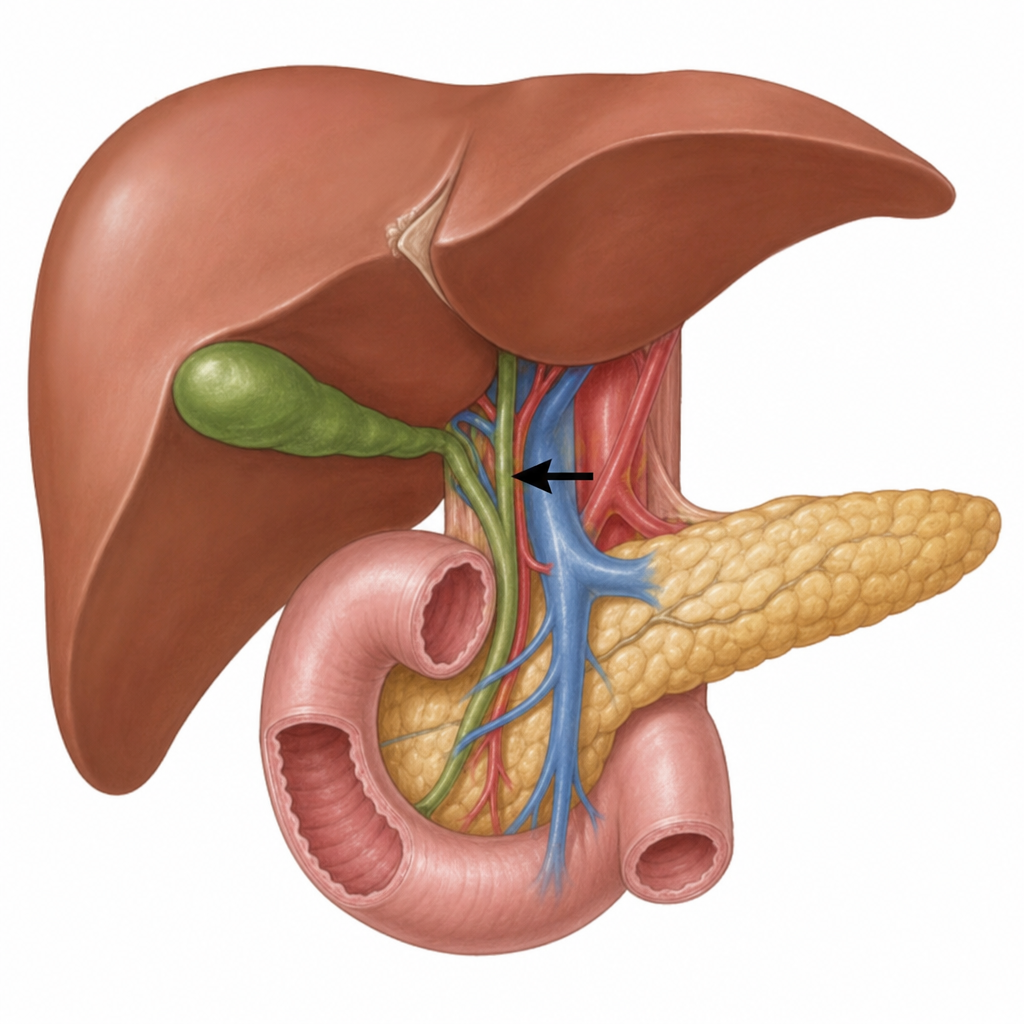
What is the anterior relation of the left kidney?
A 55-year-old man complains of anorexia, weight loss, and fatigue. A UGI study demonstrates an ulcerated lesion at the incisura. Where is the incisura?
Obturator nerve arises from which spinal nerve roots?
All of the following are anterior branches of the abdominal aorta except?
The splenic artery is a branch of which of the following arteries?
The neck of the sac of a femoral hernia lies at which anatomical position relative to the pubic tubercle?
Which of the following is NOT a normal feature of the colon?
What is the afferent nerve of the cremasteric reflex?
A 58-year-old male alcoholic is admitted to the hospital after vomiting dark red blood (hematemesis). Endoscopy reveals ruptured esophageal varices, resulting from portal hypertension. Which of the following venous tributaries to the portal system anastomoses with caval veins to cause the varices?
All of the following are true about the caudate lobe except?
Explanation: The kidneys are retroperitoneal organs located on either side of the vertebral column. Understanding their anterior relations is a high-yield topic for NEET-PG, as these relations differ significantly between the right and left sides. **Why Pancreas is Correct:** The **left kidney** is related anteriorly to several structures: the stomach, spleen, **body of the pancreas**, splenic vessels, left colic flexure, and coils of the jejunum [1]. The body of the pancreas and the splenic vessels cross the middle third of the left kidney horizontally [1]. **Analysis of Incorrect Options:** * **A. Liver:** This is a major anterior relation of the **right kidney** (occupying the large hepatorenal pouch of Morison). * **B. Duodenum:** The second (descending) part of the duodenum lies anterior to the medial aspect of the **right kidney** [1]. * **C. Ascending colon:** This is located anterior to the lower pole of the **right kidney**. The left kidney is related to the **descending colon** and the left colic (splenic) flexure. **High-Yield Clinical Pearls for NEET-PG:** * **Mnemonic for Left Kidney Relations:** **"S3 P2"** – **S**tomach, **S**pleen, **S**plenic vessels, **P**ancreas, **P**aracolic (Descending) colon/Jejunum. * **Bare Areas:** The areas of the kidneys related to the pancreas (left) and the second part of the duodenum (right) are **devoid of peritoneum**. * **Posterior Relations:** Unlike anterior relations, the posterior relations are **identical** for both kidneys (Diaphragm, Psoas major, Quadratus lumborum, Transversus abdominis, and the subcostal, iliohypogastric, and ilioinguinal nerves).
Explanation: ### Explanation **Correct Answer: D. Lesser curvature** The **incisura angularis** (or angular notch) is a distinct indentation found on the **lesser curvature** of the stomach [1]. It serves as a critical anatomical landmark, marking the junction between the body of the stomach and the pyloric antrum. In clinical practice, the incisura is a high-yield site because it is a frequent location for gastric ulcers and is often the point where the stomach's longitudinal axis changes direction. **Analysis of Incorrect Options:** * **A. Cardia:** This is the superior opening of the stomach where the esophagus enters. It is characterized by the gastroesophageal junction, not the incisura. * **B. Fundus:** This is the dome-shaped portion of the stomach located superior to the level of the cardiac orifice. It is typically filled with gas on an X-ray. * **C. Greater curvature:** This is the long, convex lateral border of the stomach. While it contains the **incisura cardiaca** (the angle between the esophagus and the fundus), the "incisura" referred to in gastric pathology is almost exclusively the incisura angularis on the lesser curvature. **NEET-PG High-Yield Pearls:** * **Lesser Omentum:** Attaches to the lesser curvature and contains the right and left gastric arteries. * **Nerve of Grassi:** A branch of the anterior vagus nerve that supplies the gastric fundus; it is often missed during highly selective vagotomies. * **Lesser Curvature Ulcers:** Most gastric ulcers (Type I) occur near the incisura angularis due to the transition of mucosal types (acid-secreting to gastrin-secreting) [1]. * **Radiology:** On a barium meal, the incisura angularis appears as a sharp indentation on the medial aspect of the stomach.
Explanation: ### Explanation The **Obturator nerve** is a major branch of the lumbar plexus. It is formed within the psoas major muscle by the fusion of the **ventral (anterior) divisions of the ventral rami of L2, L3, and L4** spinal nerves. **1. Why Option A is Correct:** The lumbar plexus is formed by the ventral rami of L1–L4. These rami split into anterior (ventral) and posterior (dorsal) divisions. The **Obturator nerve** arises from the **ventral divisions**, which typically supply the adductor (pre-axial) compartment of the thigh. **2. Why the other options are incorrect:** * **Option B:** The **dorsal divisions** of L2, L3, and L4 join to form the **Femoral nerve**. This is a common point of confusion; remember: *Ventral = Obturator, Dorsal = Femoral.* * **Options C & D:** The L1 and L2 roots contribute to the Iliohypogastric, Ilioinguinal (L1), and Genitofemoral (L1, L2) nerves, but not the obturator nerve. **Clinical Pearls & High-Yield Facts for NEET-PG:** * **Course:** It emerges from the medial border of the psoas major and enters the thigh through the **obturator canal**. * **Supply:** It provides motor innervation to the **adductor group** (Adductor longus, brevis, magnus, and gracilis) and sensory innervation to the medial aspect of the thigh. * **Howship-Romberg Sign:** Pain down the medial aspect of the thigh due to compression of the obturator nerve (often by an obturator hernia). * **Referred Pain:** Since the obturator nerve supplies both the **hip and knee joints** (Hilton’s Law), pathology in the hip (like Perthes disease) often presents as referred pain to the medial knee.
Explanation: The abdominal aorta gives off branches that can be classified based on their site of origin: **Anterior (ventral)**, **Lateral**, and **Posterior**. ### **Why Option D is Correct** The **Inferior Phrenic Artery** is a **lateral branch** (specifically, a paired parietal branch) of the abdominal aorta. It typically arises just above the celiac trunk, immediately after the aorta passes through the diaphragm. It supplies the inferior surface of the diaphragm and gives off the superior suprarenal arteries. ### **Why Other Options are Incorrect** The anterior branches of the abdominal aorta are **unpaired** and primarily supply the gastrointestinal tract (the "gut" derivatives). * **A. Celiac Trunk:** The first major anterior branch (at T12 level); it supplies the foregut. * **B. Superior Mesenteric Artery (SMA):** The second anterior branch (at L1 level); it supplies the midgut. * **C. Inferior Mesenteric Artery (IMA):** The third anterior branch (at L3 level); it supplies the hindgut. ### **High-Yield NEET-PG Facts** * **Classification of Branches:** * **Anterior (Unpaired):** Celiac trunk, SMA, IMA. * **Lateral (Paired Visceral):** Middle suprarenal, Renal, and Gonadal (Testicular/Ovarian) arteries. * **Lateral (Paired Parietal):** Inferior phrenic and Lumbar arteries [1]. * **Vertebral Levels:** Celiac (T12), SMA (L1), Renal (L2), IMA (L3), Bifurcation of Aorta (L4). * **Clinical Pearl:** The **SMA** and **Aorta** form an angle (Aortomesenteric angle). If this angle narrows, it can compress the **left renal vein** (Nutcracker Syndrome) or the **third part of the duodenum** (SMA Syndrome).
Explanation: **Explanation:** The **Coeliac trunk** is the first major ventral branch of the abdominal aorta, arising at the level of the **T12-L1** vertebrae. It is the primary artery of the **foregut**. It typically divides into three main branches (the "Tripod of Haller"): 1. **Left Gastric Artery:** The smallest branch. 2. **Common Hepatic Artery:** Supplies the liver, gallbladder, and part of the stomach/duodenum. 3. **Splenic Artery:** The largest branch, which follows a characteristic **tortuous course** along the superior border of the pancreas to reach the hilum of the spleen. **Analysis of Incorrect Options:** * **Superior Mesenteric Artery (SMA):** Arises at the L1 level and is the artery of the **midgut** [1]. It supplies the intestine from the distal duodenum to the proximal two-thirds of the transverse colon [1]. * **Inferior Mesenteric Artery (IMA):** Arises at the L3 level and is the artery of the **hindgut** [1]. It supplies the distal one-third of the transverse colon down to the upper rectum [1]. * **Descending Aorta:** While the coeliac trunk originates from the abdominal aorta, the splenic artery is a direct branch of the trunk itself, not the aorta. **High-Yield Clinical Pearls for NEET-PG:** * **Tortuosity:** The splenic artery is the most tortuous artery in the body, allowing for splenic movement during respiration. * **Relations:** It forms the **bed of the stomach**. A posterior gastric ulcer can erode the splenic artery, leading to massive hematemesis. * **Pancreatic Supply:** It gives off the *Arteria Pancreatica Magna* and *Arteria Caudae Pancreatis*. * **Ligament:** It travels within the **lienorenal (splenorenal) ligament** along with the tail of the pancreas.
Explanation: ### Explanation The anatomical relationship between the hernia sac and the **pubic tubercle** is the clinical gold standard for differentiating between inguinal and femoral hernias. **1. Why Option A is Correct:** The femoral canal is located in the most medial compartment of the femoral sheath, situated in the thigh. Its opening, the femoral ring, lies **below** the inguinal ligament. Since the pubic tubercle serves as the medial attachment point for the inguinal ligament, any structure passing through the femoral canal will emerge **below and lateral** to this tubercle [1]. **2. Analysis of Incorrect Options:** * **Option B (Above and lateral):** This describes the position of an **Indirect Inguinal Hernia**. These emerge through the deep inguinal ring, which is superior to the inguinal ligament and lateral to the pubic tubercle. * **Option C (Above and medial):** This describes the position of a **Direct Inguinal Hernia**. These protrude through Hesselbach’s triangle, appearing above the inguinal ligament and medial to the inferior epigastric artery, but still superior to the pubic tubercle. * **Option D (Below and medial):** There are no common abdominal hernias that present in this position, as this area consists of the solid bony structure of the pubic symphysis and adductor muscle attachments. **3. Clinical Pearls for NEET-PG:** * **The "Rule of Thumb":** If the lump is "Below and Lateral" to the pubic tubercle, it is **Femoral**. If it is "Above and Medial," it is **Inguinal**. * **Boundaries of the Femoral Ring:** Medial (Lacunar ligament), Lateral (Femoral vein), Anterior (Inguinal ligament), Posterior (Pectineal ligament/Cooper’s ligament). * **High-Yield Fact:** Femoral hernias have the highest risk of **strangulation** [1] (approx. 40%) due to the rigid, unyielding boundaries of the femoral ring (especially the sharp edge of the lacunar ligament). * **Demographics:** More common in **females** due to a wider pelvis and larger femoral canal.
Explanation: The large intestine (colon) is distinguished from the small intestine by three characteristic morphological features. Understanding these is crucial for both surgical identification and radiological interpretation. ### **Why Peyer’s Patches is the Correct Answer** **Peyer’s patches** are organized lymphoid follicles located primarily in the **ileum** (distal small intestine). They are found in the lamina propria and extend into the submucosa [1]. They are a hallmark of the small intestine and are **not** a feature of the colon. Their primary role is immune surveillance of the intestinal lumen. ### **Why the Other Options are Incorrect** The following three features are the "cardinal signs" used to identify the colon during surgery: * **Taeniae coli (Option A):** These are three thickened longitudinal bands of smooth muscle [2]. They are shorter than the colon itself, which leads to the bunching of the intestinal wall. * **Sacculations/Haustra (Option C):** These are the characteristic pouches or sac-like outgrowths of the colon wall produced by the tonic contraction of the taeniae coli [2]. * **Appendices epiploicae (Option D):** These are small, peritoneum-covered sacs of fat (omental appendices) attached to the external surface of the colon. ### **High-Yield Clinical Pearls for NEET-PG** * **Taeniae coli** converge at the base of the **appendix**, serving as a reliable surgical landmark for locating it. * **The rectum** is distinguished from the colon by the **absence** of taeniae coli, haustra, and appendices epiploicae (the longitudinal muscle becomes a continuous layer). * **Peyer's Patches** are most numerous in the ileum and are the site where **Salmonella typhi** (Typhoid) causes longitudinal ulcers and potential perforation [1].
Explanation: The **cremasteric reflex** is a superficial reflex elicited by lightly stroking the superior and medial aspect of the thigh. The normal response is the contraction of the cremaster muscle, which pulls the testis ipsilaterally. ### 1. Why Genitofemoral Nerve is Correct The reflex arc involves two distinct branches of the **genitofemoral nerve (L1, L2)**: * **Afferent Limb:** The **femoral branch** of the genitofemoral nerve (and to a lesser extent, the ilioinguinal nerve) carries the sensory stimulus from the skin of the upper medial thigh to the spinal cord (L1-L2). * **Efferent Limb:** The **genital branch** of the genitofemoral nerve carries the motor signal to the cremaster muscle, causing contraction [1]. ### 2. Analysis of Incorrect Options * **B. Ilioinguinal nerve (L1):** While it supplies the skin of the root of the penis and upper scrotum, it is primarily involved in the sensory pathway of the groin. It does not provide motor supply to the cremaster muscle. * **C. Iliohypogastric nerve (L1):** This nerve supplies the skin above the pubis and the lateral gluteal region; it is not involved in the cremasteric reflex arc. * **D. Iliofemoral nerve:** This is not a standard anatomical nerve in this context (likely a distractor combining "ilioinguinal" and "femoral"). ### 3. Clinical Pearls for NEET-PG * **Level of Integration:** The reflex is integrated at the **L1-L2** spinal segments. * **Clinical Significance:** The reflex is characteristically **absent in testicular torsion**, making it a vital diagnostic sign to differentiate torsion from epididymitis (where the reflex is usually present). * **Upper Motor Neuron (UMN) Lesions:** The reflex may be absent in UMN lesions or spinal cord injuries above the L1 level. * **Cremaster Muscle:** It is a derivative of the **Internal Oblique muscle** and is found within the spermatic cord [1].
Explanation: ### Explanation **1. Why "Left Gastric" is Correct:** The clinical presentation of hematemesis in a patient with portal hypertension and esophageal varices is a classic example of **Portosystemic Anastomosis**. At the lower end of the esophagus, the **Left Gastric Vein** (a tributary of the Portal Vein) anastomoses with the **Esophageal Veins** (tributaries of the Azygos vein, which drains into the Superior Vena Cava) [1]. When portal pressure rises (often due to cirrhosis in alcoholics), blood is shunted from the portal system into the systemic (caval) system [1]. This causes the submucosal esophageal veins to become dilated and tortuous (varices), making them prone to rupture and life-threatening hemorrhage [3]. **2. Analysis of Incorrect Options:** * **A. Splenic Vein:** While it is a major component of the portal system, it does not directly anastomose with caval veins at the esophagus. It contributes to "Medusa’s head" or gastric varices indirectly but is not the primary site for esophageal varices [2]. * **B. Left Gastroepiploic:** This vein drains the greater curvature of the stomach into the splenic vein. It is not involved in the portosystemic shunt at the esophageal level. * **C. Left Hepatic:** This is a systemic vein that drains blood from the liver into the Inferior Vena Cava (IVC). It is not a tributary of the portal vein. **3. High-Yield NEET-PG Clinical Pearls:** * **Caput Medusae:** Occurs at the Umbilicus (Paraumbilical veins [Portal] + Superficial Epigastric veins [Caval]) [1]. * **Anorectal Varices (Hemorrhoids):** Occur at the Anal Canal (Superior Rectal [Portal] + Middle/Inferior Rectal [Caval]). * **Retroperitoneal Shunt (Veins of Retzius):** Colic veins [Portal] + Renal/Lumbar veins [Caval] [1]. * **Management:** Acute variceal bleeding is often managed with Octreotide (to reduce portal pressure) and endoscopic band ligation [4].
Explanation: The **caudate lobe** of the liver is unique because it is anatomically part of the right lobe but functionally independent, often referred to as the "third liver" or **Segment I** [1]. ### **Why Option C is the Correct Answer (The False Statement)** The venous drainage of the caudate lobe is its most distinct feature. Unlike the rest of the liver segments, which drain into the major hepatic veins (Right, Middle, and Left), the caudate lobe drains **directly into the Inferior Vena Cava (IVC)** via several small, independent hepatic veins [2]. This is clinically significant because, in cases of **Budd-Chiari Syndrome** (obstruction of the major hepatic veins), the caudate lobe often undergoes compensatory hypertrophy because its direct drainage to the IVC remains patent [2]. ### **Analysis of Incorrect Options (True Statements)** * **Options A, B, and D:** Because the caudate lobe is situated between the right and left functional lobes, it receives a **dual blood supply** from both the right and left hepatic arteries and both branches of the portal vein. Similarly, its **biliary drainage** occurs into both the right and left hepatic ducts. ### **High-Yield NEET-PG Pearls** * **Boundaries:** It is bounded on the left by the fissure for **ligamentum venosum** and on the right by the groove for the **IVC** [1]. * **Surgical Significance:** Due to its independent vascular and biliary connections, it is functionally separate from the portal triad distribution of the other segments. * **Papillary Process:** A small projection from the lower-left part of the caudate lobe that can sometimes be mistaken for an enlarged lymph node or a pancreatic mass on CT scans. * **Caudate Process:** A bridge of liver tissue connecting the caudate lobe to the right lobe, forming the upper boundary of the **Epiploic Foramen (of Winslow)**.
Anterior Abdominal Wall
Practice Questions
Peritoneum and Peritoneal Cavity
Practice Questions
Stomach and Intestines
Practice Questions
Liver, Gallbladder and Biliary Tract
Practice Questions
Pancreas and Spleen
Practice Questions
Kidneys and Suprarenal Glands
Practice Questions
Abdominal Vasculature
Practice Questions
Posterior Abdominal Wall
Practice Questions
Innervation of Abdominal Viscera
Practice Questions
Applied Anatomy and Clinical Correlations
Practice Questions
Get full access to all questions, explanations, and performance tracking.
Start For Free