Which of the following structures is not present at the transpyloric plane?
A 42-year-old obese woman with seven children is brought to a local hospital by her daughter. Physical examination and her radiograph reveal that large gallstones have ulcerated through the posterior wall of the fundus of the gallbladder into the intestine. Which of the following parts of the intestine is most likely to initially contain gallstones?
Which of the following accurately describes a boundary of the lesser sac (omental bursa)?
Portocaval anastomosis is seen at all of the following locations, except?
Which one of the following statements about the portal vein is false?
The portal vein is related to all of the following structures except:
The nerve of Laterjet of the vagus is seen in which anatomical location?
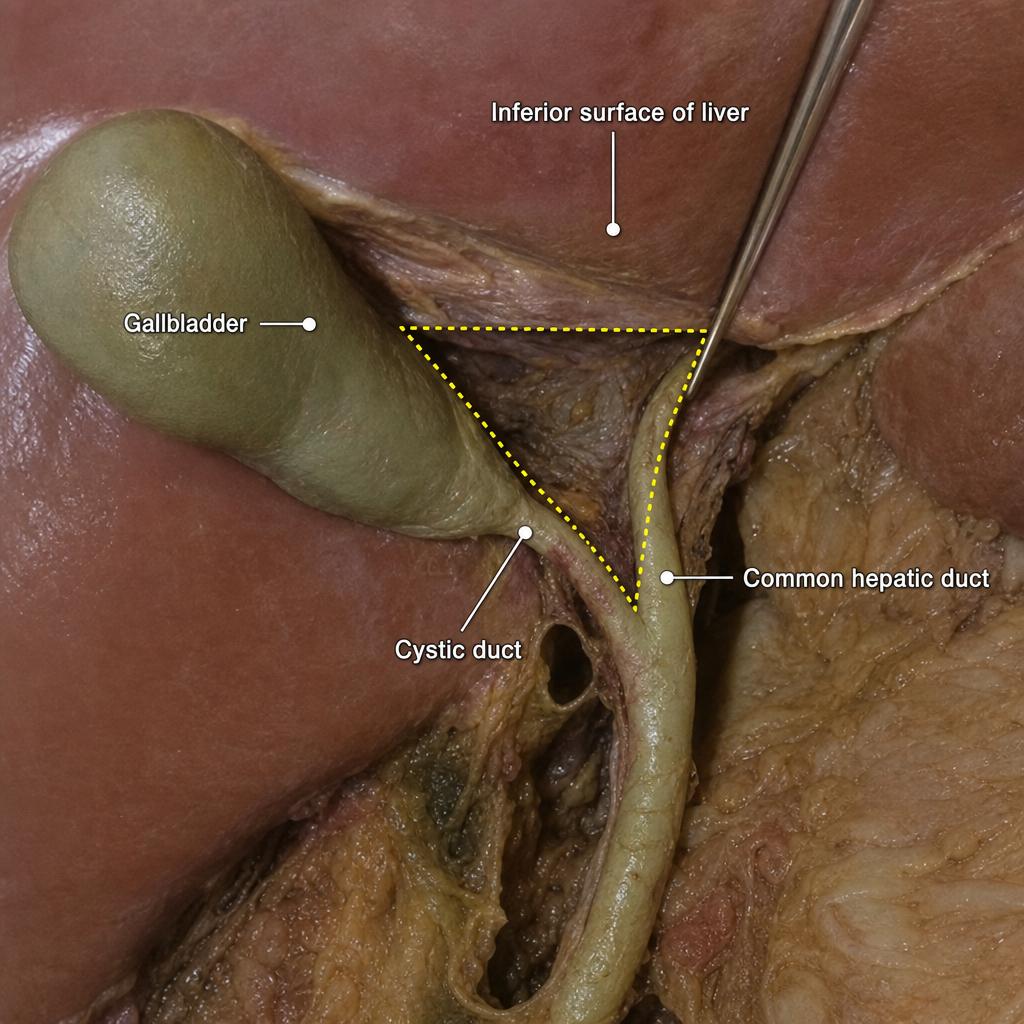
Which of the following statements about the hepatic duct is FALSE?
Which of the following is an anterior peritoneal relation of the right kidney?
The medial umbilical ligament is a remnant of which fetal structure?
Explanation: The **Transpyloric Plane (of Addison)** is a key anatomical landmark located midway between the suprasternal notch and the pubic symphysis, passing through the level of the **L1 vertebra**. [1] ### Why the Correct Answer is Right: The **Inferior Mesenteric Vein (IMV)** is not located at the transpyloric plane. It typically ascends in the retroperitoneum to the left of the midline and terminates by joining the splenic vein (or occasionally the superior mesenteric vein) behind the body of the pancreas. This junction usually occurs at the level of **L2**, which is below the transpyloric plane. [1] ### Analysis of Incorrect Options: * **First Lumbar Vertebra (L1):** By definition, the transpyloric plane passes through the lower border of the L1 vertebra. * **Fundus of Gallbladder:** The fundus lies at the point where the lateral border of the right rectus abdominis muscle (linea semilunaris) meets the 9th costal cartilage, which corresponds to the transpyloric plane. * **Hilum of Right Kidney:** The plane passes through the hila of both kidneys. Specifically, it passes through the **upper part of the right hilum** (which is lower due to the liver) and the **lower part of the left hilum**. [1] ### High-Yield Clinical Pearls for NEET-PG: To remember the structures at the Transpyloric Plane (L1), use the mnemonic **"P-L-A-N-S"**: * **P:** **P**ylorus of the stomach, **P**ancreas (neck/body). [1] * **L:** **L**1 vertebra, **L**ineal (Splenic) vein. [1] * **A:** **A**drenal glands, **A**orta (origin of Superior Mesenteric Artery). [1] * **N:** **N**inth costal cartilage. * **S:** **S**pleen (upper pole), **S**uperior mesenteric artery origin. **Other key structures:** Termination of the spinal cord (conus medullaris), origin of the portal vein, and the duodenojejunal flexure.
Explanation: ### Explanation **Correct Option: C. Transverse colon** The fundus of the gallbladder is in direct anatomical contact with the **transverse colon** [1]. When large gallstones cause chronic inflammation and pressure necrosis, they can ulcerate through the posterior wall of the gallbladder fundus, creating a **cholecystocolic fistula**. Because of this immediate proximity, the transverse colon is the first part of the large intestine to receive the stones. *Note:* If the ulceration occurs through the **body** of the gallbladder, it typically involves the **superior part (1st part) of the duodenum**, leading to "Gallstone Ileus" (where the stone obstructs the ileocecal valve). **Analysis of Incorrect Options:** * **A & B (Cecum and Ascending Colon):** These structures are located in the right iliac fossa and right lumbar region, respectively. They are inferior to the gallbladder and do not share a direct anatomical boundary with the fundus. * **D (Descending Colon):** This is located on the left side of the abdominal cavity, far from the gallbladder (which is in the right hypochondrium). **High-Yield Clinical Pearls for NEET-PG:** * **Gallstone Ileus:** The most common site of obstruction is the **ileum** (narrowest part of the small intestine). * **Rigler’s Triad (Radiological findings):** 1. Pneumobilia (air in the biliary tree), 2. Small bowel obstruction, 3. Ectopic gallstone in the iliac fossa. * **Anatomical Relations:** The gallbladder lies in a fossa on the visceral surface of the liver, between the right and quadrate lobes [1]. Its fundus projects from the inferior border of the liver at the tip of the **9th costal cartilage**.
Explanation: The **lesser sac (omental bursa)** is a complex peritoneal space located behind the stomach and liver. Understanding its boundaries is high-yield for NEET-PG, as it involves three-dimensional relationships of the foregut. ### **Explanation of the Correct Answer** **D. The greater omentum:** The lesser sac is bounded **inferiorly** by the reflection of the greater omentum. Specifically, the lower limit is the fusion of the second and third layers of the greater omentum. During development, the lesser sac extends deep into the greater omentum, though this space is often obliterated in adults. ### **Analysis of Incorrect Options** * **A. Posteriorly, the stomach:** This is incorrect because the stomach (along with the lesser omentum) forms the **anterior** boundary of the lesser sac. * **B. The crus of the diaphragm:** While the diaphragm forms the superior boundary, the **right crus** specifically forms part of the **posterior** wall (along with the aorta, pancreas, and left kidney). However, in the context of standard anatomical boundaries, the greater omentum is a more definitive structural limit. * **C. The spleen:** The spleen does not bound the sac; rather, the **gastrosplenic and splenorenal ligaments** form the **left lateral** boundary. The spleen itself lies lateral to the sac. ### **High-Yield Clinical Pearls for NEET-PG** * **Epiploic Foramen (of Winslow):** The only natural communication between the greater and lesser sacs. Its anterior boundary is the **free edge of the lesser omentum** (containing the portal vein, hepatic artery, and bile duct). * **Stomach Ulcers:** Posterior gastric ulcers can erode into the lesser sac, leading to fluid accumulation or "pseudocysts" if the pancreas is involved. * **Pancreas Location:** The pancreas forms a major part of the **stomach bed** and the posterior wall of the lesser sac.
Explanation: **Explanation:** Portocaval (portosystemic) anastomoses are specific sites where the tributaries of the **portal venous system** communicate with the tributaries of the **systemic venous system**. These become clinically significant in portal hypertension, as blood is shunted from the portal to the systemic circulation. **Why Spleen is the correct answer:** The spleen is an organ primarily drained by the **splenic vein**, which is a major constituent of the portal system [1]. However, the spleen itself is not a site of portocaval anastomosis. While the splenic vein participates in the portal system, it does not have a direct physiological communication with systemic veins within the splenic parenchyma. **Analysis of other options:** * **Gastroesophageal junction:** This is a classic site where the **left gastric vein** (portal) anastomoses with the **esophageal veins** (systemic/azygos). Clinical manifestation: Esophageal varices. * **Rectum:** The **superior rectal vein** (portal) anastomoses with the **middle and inferior rectal veins** (systemic/internal iliac). Clinical manifestation: Anorectal varices (internal hemorrhoids). * **Liver:** The **bare area of the liver** is a site of anastomosis between the hepatic portal venous radicals and the **phrenic/intercostal veins** (systemic). Additionally, the **paraumbilical veins** (portal) anastomose with the **epigastric veins** (systemic) on the anterior abdominal wall (Caput Medusae). **NEET-PG High-Yield Pearls:** 1. **Retroperitoneal site:** The Veins of **Retzius** connect the colic veins (portal) with the retroperitoneal/renal veins (systemic). 2. **Ligamentum Venosum:** A fetal remnant that can recanalize in portal hypertension. 3. **Most common site of bleeding:** Esophageal varices are the most life-threatening manifestation of portocaval shunting [1].
Explanation: ### Explanation The portal vein is a vital vascular structure that drains blood from the gastrointestinal tract and spleen to the liver [3]. **1. Why Option D is the Correct (False) Statement:** The portal vein does **not** divide into the hepatic veins. Instead, it ends at the porta hepatis by dividing into **right and left portal branches** which enter the liver parenchyma [2]. The hepatic veins are separate vessels that drain blood from the liver into the Inferior Vena Cava (IVC) [4]. **2. Analysis of Other Options:** * **Option A (True):** The portal vein is formed behind the neck of the pancreas by the union of the **Superior Mesenteric Vein (SMV)** and the **Splenic Vein** [1]. The Inferior Mesenteric Vein usually drains into the splenic vein first. * **Option B (True):** Its course is divided into three parts: infraduodenal (behind the pancreatic neck), retroduodenal (behind the 1st part of the duodenum), and supraduodenal (within the lesser omentum) [1]. * **Option C (True):** In the free margin of the lesser omentum (supraduodenal part), the portal vein lies **posteriorly**, while the **bile duct** (on the right) and the **hepatic artery** (on the left) lie anterior to it [1]. **3. NEET-PG High-Yield Clinical Pearls:** * **Portal-Systemic Anastomoses:** Important sites include the lower esophagus (esophageal varices), rectum (hemorrhoids), and umbilicus (caput medusae). * **Pringle Maneuver:** Clamping the hepatoduodenal ligament (containing the portal vein, hepatic artery, and bile duct) to control bleeding during liver surgery. * **Dimensions:** It is approximately 8 cm long and is a **valveless** vein, which explains why portal hypertension leads to retrograde flow and varices [1].
Explanation: The **portal vein** is a vital structure formed by the union of the superior mesenteric and splenic veins behind the neck of the pancreas [1]. Understanding its anatomical relations is high-yield for NEET-PG. ### Why the Gallbladder is the Correct Answer The **gallbladder** is located in a fossa on the visceral surface of the right lobe of the liver [2]. While the portal vein eventually enters the liver at the porta hepatis (where it lies posterior to the hepatic artery and common bile duct), it does not have a direct anatomical relationship with the gallbladder itself. The gallbladder is situated more anteriorly and to the right. ### Explanation of Other Options * **Pancreas:** The portal vein is **formed behind the neck of the pancreas** at the level of the L2 vertebra [1]. This is a classic anatomical landmark. * **Inferior Vena Cava (IVC):** In the epiploic foramen (Foramen of Winslow), the portal vein lies in the anterior wall, while the **IVC lies posteriorly** [1]. They are separated only by the foramen. * **Common Bile Duct (CBD):** Within the free margin of the lesser omentum, the portal vein lies **posterior** to both the CBD (on the right) and the hepatic artery (on the left) [1]. ### High-Yield Clinical Pearls * **Formation:** Formed by the union of the Splenic Vein and Superior Mesenteric Vein (SMV) [1]. * **Porta Hepatis Triad (Anterior to Posterior):** Bile Duct → Hepatic Artery → Portal Vein (Mnemonic: **D**uct, **A**rtery, **V**ein - **DAV**). * **Clinical Significance:** Obstruction or cirrhosis leads to **Portal Hypertension**, manifesting as esophageal varices, caput medusae, and hemorrhoids at portosystemic anastomosis sites.
Explanation: **Explanation:** The **Nerve of Latarjet** (also known as the anterior and posterior gastric nerves) is a terminal branch of the vagus nerve. Specifically, it arises from the anterior and posterior vagal trunks as they enter the abdomen through the esophageal hiatus. **Why Stomach is Correct:** The Nerve of Latarjet runs along the **lesser curvature of the stomach** within the lesser omentum [1]. It supplies the body and antrum of the stomach, terminating at the pylorus (the "crow’s foot" appearance). Its primary function is to stimulate gastric acid secretion and regulate the emptying of the stomach. **Why Other Options are Incorrect:** * **Head & Neck:** While the vagus nerve (CN X) originates in the medulla and descends through the carotid sheath in the neck, it does not branch into the Nerve of Latarjet until it reaches the abdominal cavity. * **Thorax:** In the thorax, the vagus nerves form the esophageal plexus. They only become the anterior and posterior vagal trunks just before passing through the diaphragm. **Clinical Pearls for NEET-PG:** 1. **Highly Selective Vagotomy:** This surgical procedure involves cutting the Nerve of Latarjet branches to the body and fundus (to reduce acid production in peptic ulcer disease) while **preserving** the terminal "crow's foot" branches to the pylorus [1]. This maintains normal gastric emptying and avoids the need for a drainage procedure (like pyloroplasty). 2. **Anatomical Landmark:** It is found between the two layers of the **lesser omentum**. 3. **Vagal Trunks:** Remember that the Left Vagus becomes the **Anterior** Trunk, and the Right Vagus becomes the **Posterior** Trunk (Mnemonic: **LARP** - Left Anterior, Right Posterior).
Explanation: The hepatic ducts are formed by the union of intrahepatic segmental ducts. Understanding the segmental anatomy of the liver (Couinaud segments) is crucial for NEET-PG [1]. **Why Option B is the Correct (False) Statement:** The **caudate lobe (Segment I)** is unique because it is anatomically and functionally independent [2]. It receives its blood supply from both the right and left hepatic arteries and, crucially, its bile is drained by **both the right and left hepatic ducts**. Therefore, stating it is drained *only* by the left hepatic duct is incorrect. **Analysis of Other Options:** * **Option A:** The **left hepatic duct** is formed by the union of ducts from segments II, III, and IV in the **umbilical fissure**, just before it joins the right duct at the porta hepatis [1]. * **Option C:** The **right hepatic duct** is formed by the union of the right anterior duct (draining segments **V and VIII**) and the right posterior duct (draining segments **VI and VII**). * **Option D:** The left hepatic duct has a longer extrahepatic course than the right and runs transversely across the base of **segment IV** (quadrate lobe) before joining the right duct [1]. **High-Yield Clinical Pearls for NEET-PG:** * **Porta Hepatis Arrangement:** From anterior to posterior: **D**uct, **A**rtery, **V**ein (**DAV**). * **Caudate Lobe Drainage:** It drains directly into the **Inferior Vena Cava (IVC)** via several small hepatic veins, independent of the three main hepatic veins. * **Surgical Significance:** Because the caudate lobe has dual biliary drainage and dual blood supply, it is often spared in localized hepatic pathologies.
Explanation: The right kidney is a retroperitoneal organ with specific anterior relations that are divided into **peritoneal** (covered by peritoneum) and **non-peritoneal** (in direct contact) areas. [1] ### **Explanation of the Correct Answer** **D. Liver:** The right kidney is related to the large right lobe of the liver [2]. This area is covered by the peritoneum of the hepatorenal pouch (Morison’s pouch). Therefore, the liver is a **peritoneal** relation. ### **Analysis of Incorrect Options** * **A. Duodenum:** The second part of the duodenum lies directly on the medial aspect of the right kidney [1]. This area is **non-peritoneal** (bare area) because the duodenum is retroperitoneal at this point. * **B. Suprarenal gland:** The right suprarenal gland sits on the upper pole of the kidney [2]. It is separated from the kidney by perirenal fascia but is **non-peritoneal**. * **C. Colon:** The hepatic flexure of the colon crosses the lower pole of the right kidney. This contact area is **non-peritoneal**. ### **High-Yield NEET-PG Pearls** * **Peritoneal Relations (Right Kidney):** Liver (superiorly) and Small Intestine/Jejunum (inferiorly). * **Non-Peritoneal Relations (Right Kidney):** Right suprarenal gland, 2nd part of Duodenum, and Right colic flexure. * **Morison’s Pouch:** The hepatorenal recess is the most dependent part of the abdominal cavity in a supine position; it is where fluid (blood/pus) first collects. * **Left Kidney Comparison:** The peritoneal relations of the left kidney are the **Stomach, Spleen, and Jejunum**. The non-peritoneal relations are the **Pancreas, Left colic flexure, and Left suprarenal gland**.
Explanation: ### Explanation The correct answer is **A. Distal part of the umbilical artery.** **1. Why the Correct Answer is Right:** During fetal life, the umbilical arteries carry deoxygenated blood from the fetus to the placenta. After birth, when the umbilical cord is clamped, these arteries undergo functional closure [3]. The **distal portion** of each umbilical artery obliterates and fibroses to form the **medial umbilical ligament** (sometimes referred to as lateral umbilical ligaments in specific obstetrics texts), which is found on the inner surface of the anterior abdominal wall, covered by the medial umbilical fold [3]. **2. Analysis of Incorrect Options:** * **B. Distal part of the umbilical vein:** The umbilical vein (specifically the left one) obliterates to form the **Ligamentum teres hepatis** (Round ligament of the liver), which runs in the free edge of the falciform ligament [2], [3]. * **C. Proximal part of the umbilical artery:** The proximal portion of the umbilical artery remains **patent** after birth and gives rise to the **superior vesical arteries**, which supply the upper part of the urinary bladder [3]. * **D. Urachus:** The urachus is a remnant of the allantois [1]. It obliterates to form the **median umbilical ligament** (singular, in the midline), not the medial umbilical ligament. **3. High-Yield Clinical Pearls for NEET-PG:** * **Median vs. Medial:** Remember the "N" for **Median** is in the middle (Urachus), while **Medial** (Umbilical Artery) is lateral to it. * **Lateral Umbilical Fold:** This contains the **inferior epigastric vessels** (not a fetal remnant). This is a crucial landmark for distinguishing direct from indirect inguinal hernias. * **Patent Urachus:** Failure of the urachus to obliterate leads to urine leaking from the umbilicus. * **Patent Vitellointestinal Duct:** Leads to fecal discharge from the umbilicus [1].
Anterior Abdominal Wall
Practice Questions
Peritoneum and Peritoneal Cavity
Practice Questions
Stomach and Intestines
Practice Questions
Liver, Gallbladder and Biliary Tract
Practice Questions
Pancreas and Spleen
Practice Questions
Kidneys and Suprarenal Glands
Practice Questions
Abdominal Vasculature
Practice Questions
Posterior Abdominal Wall
Practice Questions
Innervation of Abdominal Viscera
Practice Questions
Applied Anatomy and Clinical Correlations
Practice Questions
Get full access to all questions, explanations, and performance tracking.
Start For Free