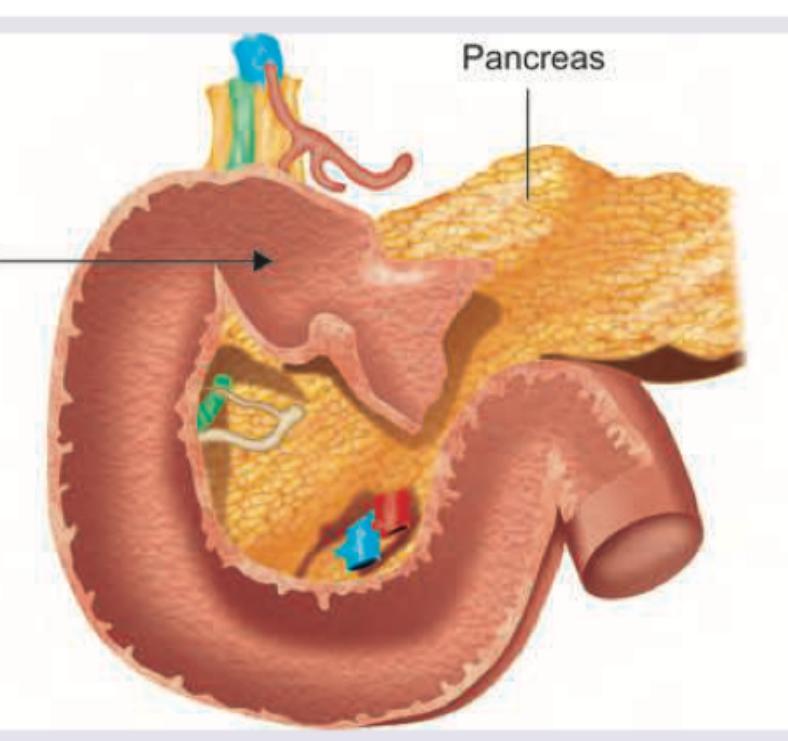
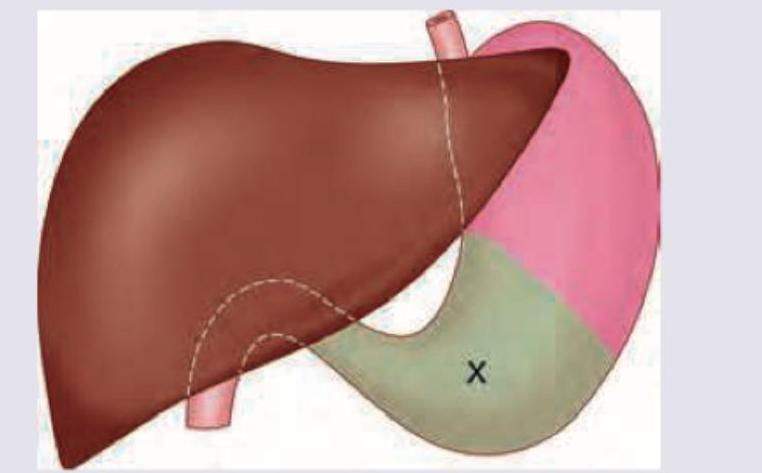
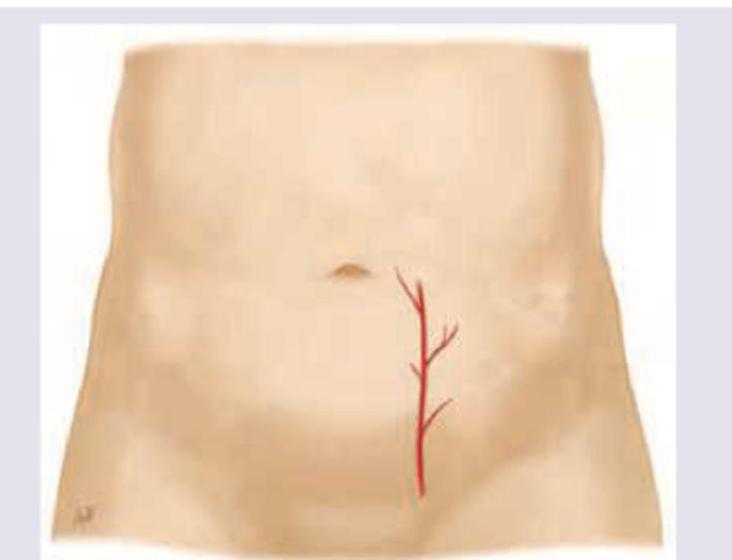
A 64-year-old woman with arthritis is a chronic NSAID user. She develops severe epigastric pain and undergoes an upper endoscopy. She is told that she has an ulcer adjacent to the pylorus. Which of the following is TRUE about the pylorus?
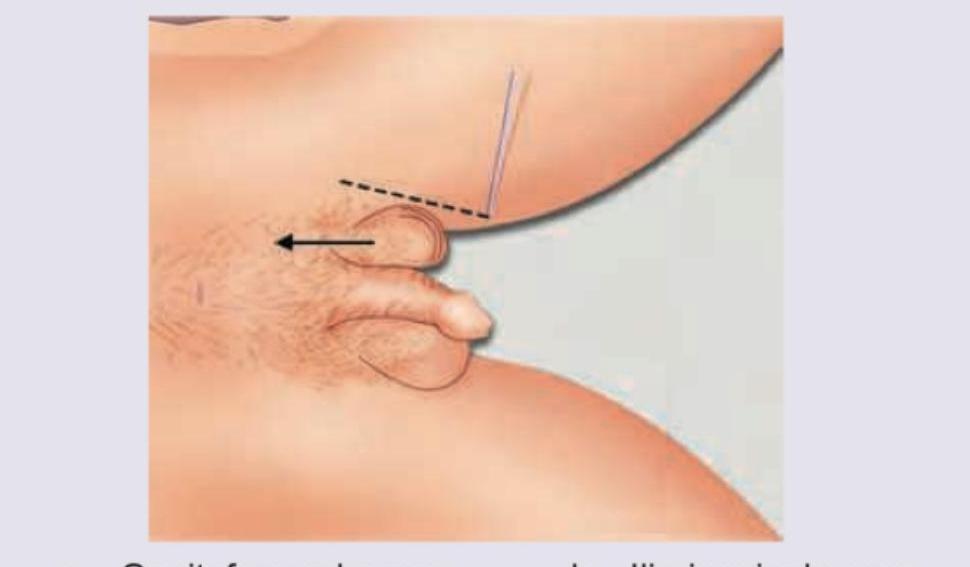
Which anatomical structure plays a role in preventing hernias?
The left testicular vein drains into which of the following veins?
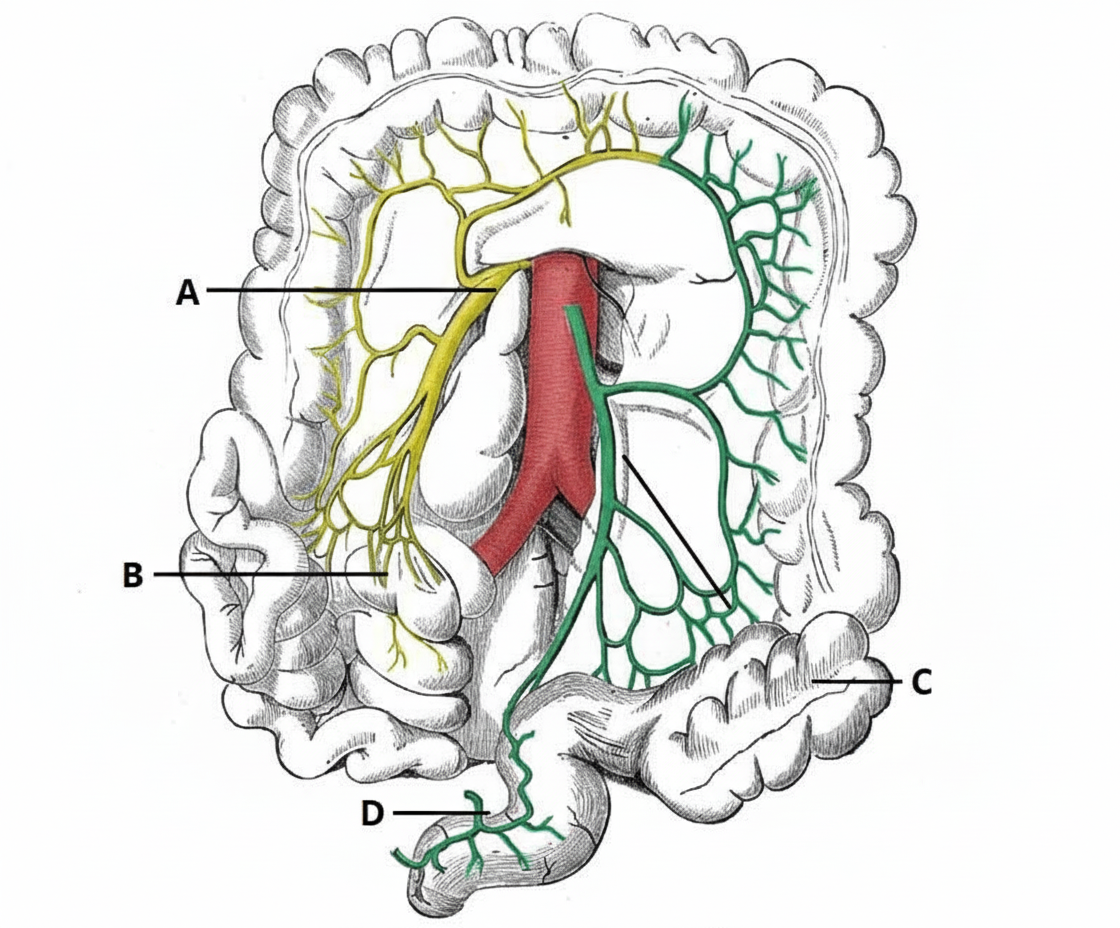
Which of the following is a branch of the inferior mesenteric artery?
Which of the following is not a direct branch of the celiac trunk?
Which part of the colon has no mesentery?
A 54-year-old male presents with severe back pain. Radiographic examination reveals carcinoma of the left kidney blocking the drainage of the testicular vein. Which of the following conditions is most likely associated with these signs?
Ischemia of which of the following vessels would cause the least damage?
Which muscle is irritated by an inflamed retrocaecal appendix?
What forms the medial border of Hesselbach's triangle?
Explanation: The pylorus is the distal-most region of the stomach that connects to the duodenum. Understanding its anatomical landmarks is crucial for surgical procedures and clinical diagnosis. ### Why Option C is Correct The pylorus is a **distinct anatomical entity** characterized by a thick ring of circular smooth muscle (the pyloric sphincter). During laparotomy, it is easily identified by: 1. **Palpation:** It feels like a firm, muscular ring (the "pyloric olive" sensation). 2. **Visual Landmark:** The **Prepyloric Vein (Vein of Mayo)** crosses its anterior surface vertically, serving as a reliable surgical guide to the gastroduodenal junction. ### Why Other Options are Incorrect * **Option A:** It **can** be palpated easily due to the hypertrophied circular muscle layer. * **Option B:** The pylorus is **completely covered** by the peritoneum (omentum). The lesser omentum attaches to its upper border and the greater omentum to its lower border. * **Option C:** The pylorus is a **true anatomical sphincter**, not just a physiological one. A physiological sphincter (like the lower esophageal sphincter) lacks a localized muscular thickening, whereas an anatomical sphincter has a distinct muscular ring visible on dissection. ### NEET-PG High-Yield Pearls * **Vertebral Level:** The pylorus lies at the **L1 level** (Transpyloric plane) when the patient is supine. * **Clinical Correlation:** Chronic NSAID use commonly leads to "peptic ulcers." [1] Ulcers on the posterior wall of the pylorus/duodenum can erode the **gastroduodenal artery**, leading to massive hematemesis. * **Infantile Hypertrophic Pyloric Stenosis (IHPS):** Presents with projectile non-bilious vomiting and a palpable "olive-shaped" mass in the epigastrium.
Explanation: The integrity of the inguinal canal depends on both anatomical barriers and physiological mechanisms. The **External oblique muscle aponeurosis** is the correct answer because it forms the **anterior wall** of the inguinal canal throughout its entire length [1]. By providing a tough, fibrous covering, it resists the intra-abdominal pressure that pushes viscera toward the superficial inguinal ring. Furthermore, during coughing or straining, the contraction of the external oblique narrows the superficial ring, acting as a protective "shutter mechanism" to prevent herniation. **Analysis of Incorrect Options:** * **Scarpa’s Fascia (A):** This is a deep membranous layer of superficial fascia. While it is strong enough to hold sutures, it is too superficial to provide structural resistance against the protrusion of abdominal viscera [1]. * **Transversalis Fascia (B):** This forms the posterior wall of the canal. While a weakness in this fascia leads to *direct* inguinal hernias, it is generally considered a weak membrane rather than a primary preventive barrier compared to the reinforced aponeurotic layers. * **Lacunar Ligament (C):** This forms the medial boundary of the femoral ring. It does not prevent hernias; rather, its sharp edge is clinically significant because it can cause strangulation of a femoral hernia. **Clinical Pearls for NEET-PG:** * **The Shutter Mechanism:** Primarily involves the **Conjoint Tendon** (Internal oblique and Transversus abdominis), which arches down to reinforce the weak posterior wall during contraction [2]. The transversus abdominis muscle also forms a shutter mechanism to limit indirect hernias [2]. * **The Ball-Valve Mechanism:** Contraction of the cremaster muscle pulls the testis upward, plugging the superficial inguinal ring. * **Hesselbach’s Triangle:** The site for direct hernias; its floor is formed by the transversalis fascia. * **Deep Inguinal Ring:** An opening in the transversalis fascia; **Superficial Inguinal Ring:** An opening in the external oblique aponeurosis.
Explanation: ### Explanation The drainage of the gonadal veins is a classic high-yield topic in anatomy due to the **asymmetry** between the right and left sides. **1. Why the Correct Answer is Right:** The **left testicular vein** (or left ovarian vein in females) drains into the **left renal vein** at a **90-degree (perpendicular) angle**. This anatomical arrangement is significant because the left renal vein must pass between the aorta and the superior mesenteric artery (SMA), creating a higher pressure system compared to the right side. On the left side, the adrenal vein likewise mirrors this pattern by draining into the left renal vein rather than the vena cava [1]. **2. Why the Other Options are Incorrect:** * **B. Inferior Vena Cava (IVC):** The **right testicular vein** drains directly into the IVC at an acute angle. The left vein does not reach the IVC directly. This contrasts with the right adrenal vein, which also drains directly into the vena cava [1]. * **C & D. Common/Internal Iliac Veins:** These veins primarily drain the pelvic viscera and lower limbs. While the pampiniform plexus (which forms the testicular vein) originates in the scrotum, its primary venous return ascends through the inguinal canal to the abdominal veins, bypassing the iliac system. **3. Clinical Pearls for NEET-PG:** * **Varicocele:** This is more common on the **left side** (90% of cases). This is due to: 1. The perpendicular (90°) entry into the left renal vein, which impairs laminar flow. 2. Higher pressure in the left renal vein. 3. **Nutcracker Syndrome:** Compression of the left renal vein between the SMA and Aorta, leading to venous stasis in the left testis. * **Renal Cell Carcinoma (RCC):** A sudden onset of a left-sided varicocele in an older male should raise suspicion of RCC, as a tumor thrombus can invade the renal vein and obstruct the testicular vein's drainage. * **Right-sided Varicocele:** If a varicocele occurs only on the right side, it is considered a "red flag" and warrants investigation for a retroperitoneal mass or IVC obstruction.
Explanation: The **Inferior Mesenteric Artery (IMA)** is the artery of the **hindgut** [1]. It originates from the abdominal aorta at the level of **L3** and supplies the distal third of the transverse colon, descending colon, sigmoid colon, and the upper part of the rectum. ### **Why Option A is Correct:** The **Left Colic Artery** is the first branch of the IMA. It ascends retroperitoneally toward the splenic flexure and divides into ascending and descending branches, supplying the descending colon and the distal part of the transverse colon. ### **Why Other Options are Incorrect:** Options B, C, and D are all branches of the **Superior Mesenteric Artery (SMA)**, which is the artery of the **midgut** (extending from the second part of the duodenum to the proximal two-thirds of the transverse colon) [1]: * **Right Colic Artery (B):** Supplies the ascending colon. * **Ileocolic Artery (C):** The terminal branch of the SMA; supplies the terminal ileum, cecum, and appendix. * **Middle Colic Artery (D):** Supplies the proximal two-thirds of the transverse colon [1]. ### **High-Yield Clinical Pearls for NEET-PG:** * **Branches of IMA:** 1. Left Colic Artery, 2. Sigmoid Arteries (usually 2-4), 3. Superior Rectal Artery (the terminal continuation). * **Marginal Artery of Drummond:** An important anastomosis between the SMA and IMA along the inner border of the colon [1]. * **Griffith’s Point:** The splenic flexure is a "watershed area" where the SMA and IMA territories meet; it is the most common site for **ischemic colitis** [1]. * **Sudeck’s Point:** A critical area of anastomosis between the last sigmoid artery and the superior rectal artery; it is prone to ischemia during rectal surgeries.
Explanation: The **celiac trunk** is the first major visceral branch of the abdominal aorta, arising at the level of the **T12 vertebra**. It is the artery of the foregut and traditionally gives off three direct branches (the "Tripod of Haller") [1]. ### Why Option C is Correct: The **Right Gastric Artery** is **not** a direct branch of the celiac trunk. It typically arises from the **Common Hepatic Artery** (or occasionally from the Proper Hepatic Artery). It runs along the lesser curvature of the stomach to anastomose with the left gastric artery. ### Why Other Options are Incorrect: * **A. Splenic Artery:** This is the largest branch of the celiac trunk. It follows a tortuous course along the superior border of the pancreas. * **B. Common Hepatic Artery:** An intermediate-sized branch that passes to the right to divide into the gastroduodenal artery and the proper hepatic artery. * **D. Left Gastric Artery:** The smallest branch of the celiac trunk. It ascends to the cardio-esophageal junction and then descends along the lesser curvature [1]. ### NEET-PG High-Yield Pearls: * **The "Tripod":** Remember the three direct branches: **L**eft gastric, **S**plenic, and **C**ommon hepatic (Mnemonic: **LSC**). * **Lesser Curvature Supply:** Formed by the anastomosis of the Left Gastric (direct branch) and Right Gastric (indirect branch) [1]. * **Greater Curvature Supply:** Formed by the Right Gastro-epiploic (from Gastroduodenal) and Left Gastro-epiploic (from Splenic). * **Clinical Correlation:** Peptic ulcers on the posterior wall of the first part of the duodenum can erode the **Gastroduodenal artery**, leading to massive hematemesis.
Explanation: The presence or absence of a mesentery depends on whether an organ is **intraperitoneal** or **retroperitoneal**. During embryonic development, certain parts of the gut tube lose their dorsal mesenteries as they are pushed against the posterior abdominal wall and become fixed in place [1]. This process is known as **zygosis**, resulting in these organs becoming **secondarily retroperitoneal**. * **Ascending Colon (Correct):** This segment, along with the descending colon, is secondarily retroperitoneal. Its posterior surface is devoid of peritoneum and is attached directly to the posterior abdominal wall; therefore, it has **no mesentery**. **Analysis of Incorrect Options:** * **Transverse Colon:** This is an intraperitoneal structure. It is suspended from the posterior abdominal wall by a large, mobile fold of peritoneum called the **transverse mesocolon** [2]. * **Sigmoid Colon:** This is also intraperitoneal and is attached to the pelvic wall by the fan-shaped **sigmoid mesocolon** [2]. Its mobility is a predisposing factor for sigmoid volvulus. * **Rectum:** The anatomy of the rectum is complex. The upper 1/3 is covered by peritoneum anteriorly and laterally; the middle 1/3 is covered only anteriorly; and the lower 1/3 is completely extraperitoneal. While it lacks a formal "mesocolon," the ascending colon is the classic textbook example of a colonic segment that loses its mesentery entirely [2]. **High-Yield Clinical Pearls for NEET-PG:** * **Mnemonic for Retroperitoneal Organs (SAD PUCKER):** **S**uprarenal glands, **A**orta/IVC, **D**uodenum (except 1st part), **P**ancreas (except tail), **U**reters, **C**olon (Ascending & Descending), **K**idneys, **E**sophagus, **R**ectum. * **White Line of Toldt:** This is the avascular plane of lateral peritoneal reflection [1]. Surgeons incise along this line to mobilize the ascending or descending colon, as the major vessels lie medially within the remnants of the mesentery.
Explanation: **Explanation:** The correct answer is **Varicocele**. This question tests your knowledge of the asymmetrical venous drainage of the gonads and its clinical implications. **Why Varicocele is correct:** The venous drainage of the testes differs between the right and left sides: * **Right testicular vein:** Drains directly into the **Inferior Vena Cava (IVC)** at an acute angle. * **Left testicular vein:** Drains into the **Left Renal Vein** at a perpendicular (90-degree) angle. In this clinical scenario, a carcinoma of the left kidney can invade or compress the left renal vein. This obstruction prevents the left testicular vein from draining properly, leading to increased hydrostatic pressure and retrograde flow. This causes the pampiniform plexus of veins to become dilated and tortuous, a condition known as a **Varicocele**. **Why the other options are incorrect:** * **Rectocele:** A herniation of the rectum into the posterior wall of the vagina; it is unrelated to testicular venous drainage. * **Cystocele:** A herniation of the urinary bladder into the anterior wall of the vagina. * **Hydrocele:** An abnormal accumulation of fluid within the tunica vaginalis. While it causes scrotal swelling, it is not caused by venous obstruction from a renal mass. **High-Yield Clinical Pearls for NEET-PG:** 1. **"Bag of Worms":** The classic physical exam description for a varicocele. 2. **Left-sided Predominance:** Varicoceles are more common on the left due to the 90° drainage angle and higher pressure in the left renal vein (often compressed between the SMA and Aorta—the "Nutcracker phenomenon"). 3. **Red Flag:** A **sudden onset** of a left-sided varicocele in an older male should always raise suspicion for **Renal Cell Carcinoma (RCC)**. 4. **Infertility:** Varicoceles are a leading cause of male infertility due to increased scrotal temperature.
Explanation: The severity of ischemia in an organ depends primarily on the presence of **collateral circulation**. The **Inferior Mesenteric Artery (IMA)** supplies the hindgut (distal 1/3rd of the transverse colon to the upper rectum) [1]. It is the correct answer because it has extensive anastomotic connections with the Superior Mesenteric Artery (SMA) via the **Marginal Artery of Drummond** and the **Arc of Riolan** [1]. Additionally, the distal rectum receives blood from the internal iliac arteries [4]. Due to this robust collateral network, sudden occlusion of the IMA is often asymptomatic or causes minimal damage [2]. **Why the other options are incorrect:** * **Renal Artery:** The renal arteries are **functional end arteries**. The kidney lacks significant collateral supply; therefore, acute occlusion leads to immediate renal infarction. * **Superior Mesenteric Artery (SMA):** The SMA supplies the entire midgut (small intestine to proximal 2/3rd of the transverse colon) [1]. While some collaterals exist, they are insufficient to compensate for an acute proximal blockage, leading to life-threatening **acute mesenteric ischemia** and extensive bowel gangrene. * **Celiac Trunk:** This vessel supplies the foregut. Although it has collaterals (e.g., pancreaticoduodenal arcade), it supplies vital organs like the liver and stomach [3]. Acute occlusion is significantly more dangerous than IMA occlusion. **High-Yield Clinical Pearls for NEET-PG:** * **Griffith’s Point:** The splenic flexure is a "watershed area" where SMA and IMA territories meet; it is the most common site for ischemic colitis [1]. * **Sudeck’s Point:** A critical area at the rectosigmoid junction with potentially weak anastomoses. * **Nutcracker Syndrome:** Compression of the left renal vein between the SMA and the Abdominal Aorta.
Explanation: The correct answer is **Psoas major**. This question tests the anatomical relationship between the appendix and the posterior abdominal wall. **1. Why Psoas major is correct:** The appendix is most commonly found in the **retrocaecal position** (approx. 65% of cases). In this position, the appendix lies directly anterior to the **psoas major muscle**, separated only by the parietal peritoneum [1]. When the appendix becomes inflamed (appendicitis), the inflammatory process irritates the underlying psoas muscle. This leads to the **"Psoas Sign"**: the patient experiences pain upon passive extension of the right hip or active flexion against resistance, as these movements stretch or contract the irritated muscle [1]. **2. Why the other options are incorrect:** * **Gluteus maximus:** This is a superficial muscle of the gluteal region (buttock) and is located far posterior to the abdominal cavity. * **Quadratus femoris:** This is a small, deep stabilizer muscle of the hip joint located in the gluteal region, nowhere near the appendix. * **Obturator internus:** This muscle lines the lateral wall of the true pelvis. It is irritated by an inflamed **pelvic appendix** (not retrocaecal), leading to the **"Obturator Sign"** (pain on internal rotation of the flexed right hip) [1]. **Clinical Pearls for NEET-PG:** * **Most common position of appendix:** Retrocaecal (65%) > Pelvic (30%) [1]. * **Psoas Sign:** Indicates retrocaecal appendicitis [1]. * **Obturator Sign:** Indicates pelvic appendicitis [1]. * **McBurney’s Point:** Located at the junction of the lateral 1/3rd and medial 2/3rds of a line joining the ASIS to the umbilicus; it corresponds to the base of the appendix.
Explanation: Hesselbach’s triangle (Inguinal triangle) is a critical anatomical landmark located on the inner aspect of the anterior abdominal wall [1]. It defines the site where **direct inguinal hernias** protrude. The boundaries of Hesselbach’s triangle are: * **Medial Border:** Lateral border of the Rectus abdominis muscle, also known as the **Linea semilunaris** [1]. * **Lateral Border:** **Inferior epigastric artery** (and vein). * **Inferior Border (Base):** **Inguinal ligament** (Poupart’s ligament) [1]. **Analysis of Options:** * **B (Correct):** The Linea semilunaris marks the lateral edge of the rectus sheath [1]. Since the triangle is situated lateral to the midline, this line forms its medial boundary. * **A (Incorrect):** The **Linea alba** is the midline fibrous structure separating the two rectus muscles; it is too medial to form any part of the triangle. * **C (Incorrect):** The **Inferior epigastric artery** forms the **lateral** border. This is a high-yield distinction: direct hernias occur medial to this artery, while indirect hernias occur lateral to it. * **D (Incorrect):** The **Conjoint tendon** (formed by the internal oblique and transversus abdominis) forms the **posterior wall** (floor) of the medial part of the inguinal canal, not a border of the triangle itself. **Clinical Pearls for NEET-PG:** 1. **Direct vs. Indirect:** A hernia passing through Hesselbach’s triangle is a **Direct Inguinal Hernia**. It is caused by an acquired weakness in the abdominal wall (specifically the fascia transversalis). 2. **Mnemonic:** Remember **"RIP"** for boundaries: **R**ectus abdominis (medial), **I**nferior epigastric artery (lateral), **P**oupart’s/Inguinal ligament (inferior). 3. The triangle is covered posteriorly by the **fascia transversalis** and anteriorly by the external oblique aponeurosis.
Anterior Abdominal Wall
Practice Questions
Peritoneum and Peritoneal Cavity
Practice Questions
Stomach and Intestines
Practice Questions
Liver, Gallbladder and Biliary Tract
Practice Questions
Pancreas and Spleen
Practice Questions
Kidneys and Suprarenal Glands
Practice Questions
Abdominal Vasculature
Practice Questions
Posterior Abdominal Wall
Practice Questions
Innervation of Abdominal Viscera
Practice Questions
Applied Anatomy and Clinical Correlations
Practice Questions
Get full access to all questions, explanations, and performance tracking.
Start For Free