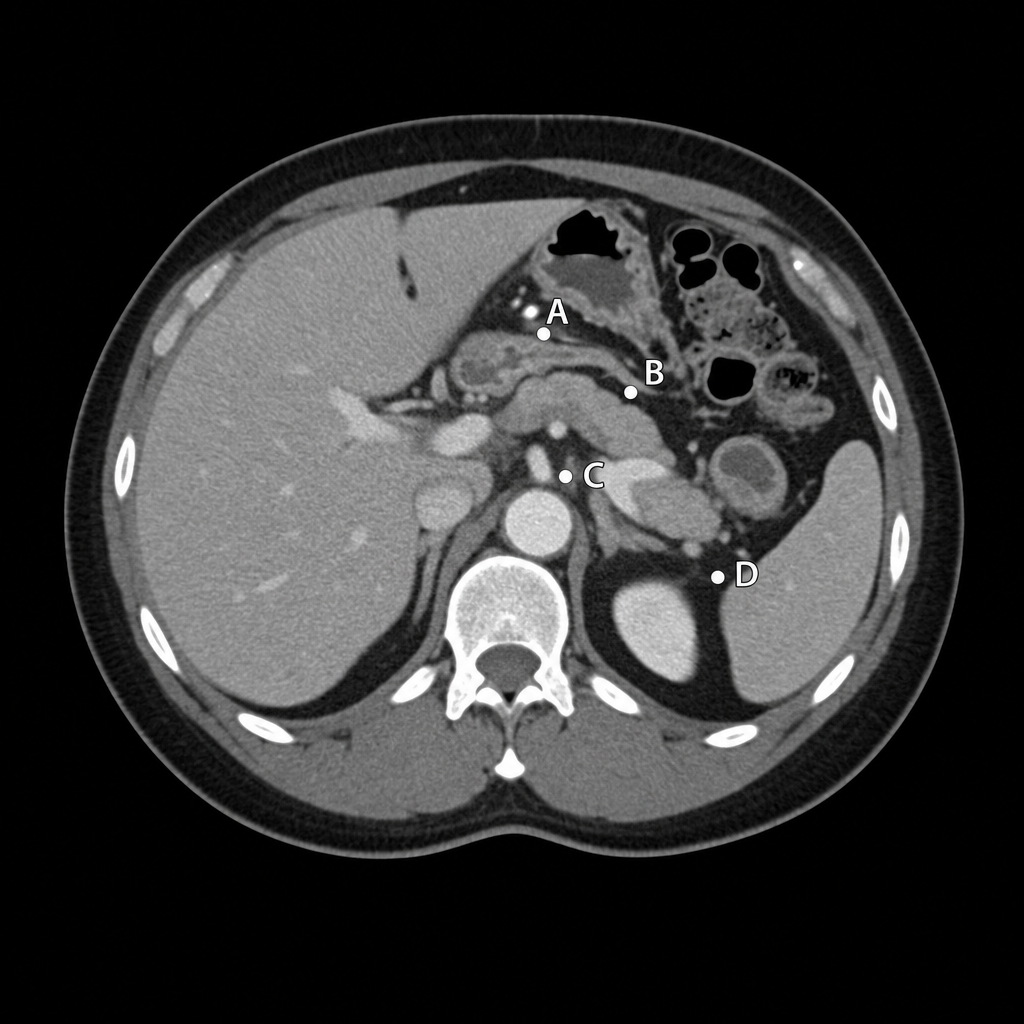
Which of the following drains into the Inferior Vena Cava (IVC)?
Which of the following statements best describes the colon?
What is the narrowest part of the ureter?
Which of the following segments constitute the right lobe of the liver?
Atypical pneumonia can be caused by which of the following microbial agents except?
Which of the following is not a branch of the anterior trunk of the vagus nerve?
Which of the following is true regarding annular pancreas?
Attempts to straighten out a flexed thigh cause great pain in a patient with appendicitis. This is due to the position of the appendix near which muscle?
Which of the following is true about the location of the omental bursa?
The fundus of the stomach is supplied by which of the following arteries?
Explanation: The drainage pattern of the gonadal veins is a high-yield anatomical concept frequently tested in NEET-PG due to its clinical implications. ### **Explanation** The **Inferior Vena Cava (IVC)** is the primary venous channel of the abdomen, but its tributaries are asymmetrical regarding the gonadal (testicular/ovarian) and suprarenal veins [1]. * **Right Testicular Vein:** Drains directly into the **IVC** at an acute angle. * **Left Testicular Vein:** Drains into the **Left Renal Vein** at a right angle (90°), which then drains into the IVC. **Why Option B is Correct:** The question asks which vein drains into the IVC. While both the Right and Left testicular veins eventually reach the IVC, the **Right Testicular Vein** is the one that drains *directly* into it. *(Note: There appears to be a typo in your provided key; the Right Testicular Vein (A) is the standard direct tributary, while the Left (B) is an indirect tributary via the renal vein.)* ### **Analysis of Options** * **A. Right Testicular Vein:** Correct. It enters the IVC directly below the level of the right renal vein [1]. * **B. Left Testicular Vein:** Incorrect. It drains into the Left Renal Vein [1]. * **C & D. Renal Veins:** Both the Right and Left renal veins drain directly into the IVC. However, in the context of "gonadal drainage" questions, the focus is usually on the asymmetry of the testicular/ovarian veins. ### **Clinical Pearls for NEET-PG** 1. **Varicocele:** More common on the **left side** because the left testicular vein enters the left renal vein at a perpendicular angle, leading to higher hydrostatic pressure and occasional compression by the SMA (**Nutcracker Syndrome**). 2. **Renal Cell Carcinoma (RCC):** Can spread via the renal vein. A left-sided RCC invading the renal vein can present as a sudden-onset left-sided varicocele. 3. **IVC Tributaries:** Remember the "3-2-1" rule for paired visceral tributaries: 3 Suprarenal, 2 Renal, 1 Gonadal (only the right side for suprarenal and gonadal) [1], [2].
Explanation: ### Explanation **Correct Option: C** The **hepatic (right colic) flexure** is the junction between the ascending and transverse colon. It lies in the right upper quadrant, tucked under the right lobe of the liver (superiorly) and resting directly on the lower part of the right kidney (posteriorly). This anatomical proximity is a high-yield fact for surgical and radiological orientation. **Analysis of Incorrect Options:** * **Option A:** The colon is derived from **both** the midgut and hindgut [1]. The midgut forms the colon up to the proximal two-thirds of the transverse colon, while the hindgut forms the distal one-third of the transverse colon down to the superior part of the anal canal. * **Option B:** The colon is not entirely intraperitoneal. While the transverse and sigmoid colon are invested with peritoneum (having their own mesenteries), the ascending and descending colon are typically **retroperitoneal** [1]. * **Option D:** While the ascending and descending colon are "typically" retroperitoneal, the word **"always"** makes this statement incorrect. In approximately 25% of individuals, these segments may possess a short mesentery, allowing for abnormal mobility (e.g., mobile cecum syndrome). **NEET-PG High-Yield Pearls:** * **Blood Supply Watershed:** The **Griffith’s point** (splenic flexure) is the most common site for ischemic colitis because it is the watershed area between the SMA and IMA. * **Teniae Coli:** These three longitudinal muscle bands converge at the **base of the appendix**, serving as a reliable surgical landmark to locate the appendix [1]. * **Haustrations:** These are sacculations produced by the teniae being shorter than the colon itself; they help distinguish large bowel from small bowel on X-ray.
Explanation: The ureter is a muscular tube approximately 25 cm long that transports urine from the kidneys to the bladder. It is not uniform in diameter and possesses three physiological constrictions where stones (calculi) are most likely to lodge. [1] **Explanation of the Correct Answer:** The **Ureterovesical Junction (UVJ)**, specifically the intramural part where the ureter traverses the muscular wall of the urinary bladder, is the **narrowest part** of the entire ureter. [1] Its diameter is approximately **1–1.5 mm**. This narrowness, combined with the oblique path through the bladder wall, creates a physiological valve that prevents vesicoureteral reflux. [1] **Analysis of Incorrect Options:** * **A. Ureteropelvic Junction (UPJ):** This is the first constriction, located where the renal pelvis tapers into the ureter. While narrow (approx. 2 mm), it is wider than the UVJ. * **B. Iliac Vessel Crossing:** This is the second constriction, occurring where the ureter crosses the pelvic brim over the bifurcation of the common iliac artery. * **C. Pelvic Ureter:** This refers to the segment of the ureter within the true pelvis. It is generally wider than the constriction sites. **High-Yield Clinical Pearls for NEET-PG:** * **Three Constriction Sites (in descending order):** 1. Ureteropelvic Junction (UPJ) 2. Crossing of Iliac Vessels (Pelvic Brim) 3. Ureterovesical Junction (UVJ) — **Narrowest** * **Blood Supply:** The ureter receives a segmental blood supply. In the upper part, vessels approach from the **medial** side; in the pelvic part, they approach from the **lateral** side. * **Nerve Supply:** T10–L1 segments. Ureteric colic pain is referred from the "loin to groin." * **Water Under the Bridge:** In females, the ureter passes inferior to the uterine artery. [1] In males, it passes inferior to the ductus deferens.
Explanation: ### Explanation The liver is divided into functional segments based on the **Couinaud Classification**, which is the gold standard for surgical anatomy [1]. This classification uses the distribution of the portal vein, hepatic artery, and bile ducts (the portal triad) and the drainage of the hepatic veins [1]. **1. Why Option A is Correct:** The functional **right lobe** of the liver (right of Cantlie’s line) is supplied by the right hepatic artery and right portal vein [2]. It consists of four segments: * **Anterior Sector:** Segments **V** (inferior) and **VIII** (superior) [5]. * **Posterior Sector:** Segments **VI** (inferior) and **VII** (superior) [5]. **2. Why the Other Options are Incorrect:** * **Option B & D:** Include **Segment IV**. Segment IV (Quadrate lobe) belongs to the functional **left lobe** because it receives its blood supply from the left portal triad [3]. * **Option C & D:** Include **Segment I**. Segment I (**Caudate lobe**) is unique; it receives blood from both the right and left portal systems and drains directly into the IVC [4]. While anatomically posterior, it is considered an independent functional unit, not part of the standard right lobe segments. **Clinical Pearls for NEET-PG:** * **Cantlie’s Line:** An imaginary line from the IVC to the gallbladder fossa that separates the functional right and left lobes. * **Segment I (Caudate Lobe):** Often hypertrophies in **Budd-Chiari Syndrome** because it has independent venous drainage into the IVC [4]. * **Surgical Landmark:** The **Middle Hepatic Vein** lies in Cantlie's line and separates the right and left lobes. * **Pringle Maneuver:** Clamping the hepatoduodenal ligament to control bleeding during liver surgery; it stops flow through the hepatic artery and portal vein.
Explanation: **Explanation:** The term **"Atypical Pneumonia"** refers to pneumonia caused by pathogens that are not identifiable via Gram stain or cultured on standard agar, and which typically present with a subacute onset, non-productive cough, and "dissociation" (where clinical signs are milder than the radiological findings). **Why Klebsiella pneumoniae is the correct answer (the "Except"):** * **Klebsiella pneumoniae** is a classic cause of **Typical (Lobar) Pneumonia**. It is a Gram-negative, encapsulated bacillus that causes an acute, severe inflammatory response leading to alveolar consolidation. It is famously associated with "currant jelly sputum" and bulging fissures on X-ray. **Analysis of Incorrect Options (Causes of Atypical Pneumonia):** * **Mycoplasma pneumoniae:** The most common cause of atypical pneumonia ("Walking Pneumonia"). It lacks a cell wall and is associated with cold agglutinins and bullous myringitis. * **Legionella pneumophila:** Causes atypical pneumonia often associated with contaminated water systems, hyponatremia, and gastrointestinal symptoms (diarrhea). * **Human Coronavirus:** Viral agents (including Coronaviruses, Influenza, and RSV) are major causes of the atypical pneumonia syndrome, characterized by interstitial infiltrates rather than lobar consolidation. **High-Yield Clinical Pearls for NEET-PG:** * **Drug of Choice:** Macrolides (Azithromycin) or Fluoroquinolones are preferred for atypical pathogens because they lack a cell wall (making Beta-lactams ineffective). * **Radiology:** Atypical pneumonia shows **interstitial/reticular patterns**, whereas typical pneumonia shows **lobar consolidation**. * **Psittacosis:** Caused by *Chlamydia psittaci* (bird contact), another high-yield cause of atypical pneumonia.
Explanation: ### Explanation The vagus nerve enters the abdomen as two trunks: the **Anterior Vagus** (derived from the left vagus) and the **Posterior Vagus** (derived from the right vagus) [1]. **Why Option C is correct:** The **Criminal Nerve of Grassi** is the first branch of the **Posterior Vagus Nerve**, not the anterior. It is clinically significant because it supplies the gastric cardia and fundus. If missed during a highly selective vagotomy [1], it can lead to persistent acid secretion and recurrent peptic ulcers, hence its "criminal" name. **Analysis of Incorrect Options:** * **Option A (Motor nerve to the gallbladder):** The anterior vagus gives off a **hepatic branch** which travels in the lesser omentum to the porta hepatis [1]. This branch provides motor innervation to the gallbladder and biliary tree. * **Option B (Motor nerve to the pylorus):** The anterior vagus gives off branches to the pylorus and the first part of the duodenum to regulate gastric emptying [1]. * **Option D (Anterior nerve of Latarjet):** This is the main continuation of the anterior vagal trunk along the lesser curvature of the stomach. it supplies the body and antrum of the stomach. **High-Yield Clinical Pearls for NEET-PG:** * **Anterior Vagus:** Primarily supplies the anterior surface of the stomach and gives off the **Hepatic branch** [1]. * **Posterior Vagus:** Primarily supplies the posterior surface and gives off the **Celiac branch** (to the celiac plexus) and the **Criminal Nerve of Grassi**. * **Vagotomy:** In **Highly Selective Vagotomy (HSV)**, surgeons denervate the acid-producing areas (body/fundus) but preserve the "Crow’s foot" (terminal branches of the Nerve of Latarjet) to maintain pyloric antral pump function [1]. * **Mnemonic:** **A**nterior is **L**eft (**AL**), **P**osterior is **R**ight (**PR**).
Explanation: Annular pancreas is a rare congenital anomaly where a ring of pancreatic tissue completely or partially encircles the second part of the duodenum. 1. **Embryological Basis (Option A):** It results from the **failure of the bifid ventral pancreatic bud to rotate** correctly [1]. Normally, the ventral bud rotates posteriorly around the duodenum to fuse with the dorsal bud. In this condition, one part of the bifid ventral bud migrates anteriorly and the other posteriorly, "trapping" the duodenum. 2. **Congenital Nature (Option B):** It is a developmental defect occurring during the 5th–7th weeks of gestation. It is often associated with other congenital conditions like Down syndrome, duodenal atresia, and VACTERL anomalies. 3. **Histology (Option C):** Despite the abnormal gross morphology, the **histology is normal**. The annular tissue consists of healthy acini and islet cells, identical to the rest of the pancreas. **Why "All of the above" is correct:** Since the condition is a congenital anomaly (B) caused by rotational failure (A) with normal cellular architecture (C), all statements are accurate. **High-Yield Clinical Pearls for NEET-PG:** * **Presentation:** In neonates, it presents as high intestinal obstruction with non-bilious or bilious vomiting. In adults, it may present with peptic ulcers or pancreatitis. * **Radiology:** Characterized by the **"Double Bubble Sign"** on X-ray (gas in the stomach and proximal duodenum), similar to duodenal atresia. * **Treatment:** The surgical procedure of choice is **Duodenojejunostomy** or Duodenoduodenostomy. The ring itself is never divided to avoid pancreatic fistulas.
Explanation: The correct answer is **Psoas major**. This clinical scenario describes the **Psoas Sign**, a classic physical examination finding in acute appendicitis [1]. **1. Why Psoas Major is Correct:** The appendix is most commonly found in the **retrocecal position** (approx. 65% of cases). In this position, the appendix lies directly over the parietal peritoneum covering the **psoas major muscle**. When the patient’s hip is extended (straightening a flexed thigh), the psoas muscle stretches and contracts [2]. If the appendix is inflamed, this movement causes friction against the overlying peritoneum, resulting in sharp abdominal pain [1]. **2. Why Other Options are Incorrect:** * **Adductor magnus:** Located in the medial compartment of the thigh; it is involved in hip adduction and is not in anatomical proximity to the appendix. * **Biceps femoris:** A hamstring muscle located in the posterior thigh; it acts on the knee and hip but is far removed from the abdominal cavity. * **Gluteus maximus:** The most superficial muscle of the buttocks; while it is a hip extensor, it is posterior to the pelvic bones and does not contact the appendix. **3. Clinical Pearls for NEET-PG:** * **Psoas Sign:** Indicates a **retrocecal** appendix [1]. It is elicited by passive extension of the right hip or active flexion against resistance. * **Obturator Sign:** Indicates a **pelvic** appendix [1]. Pain is felt upon internal rotation of the flexed right hip due to irritation of the *obturator internus* muscle. * **McBurney’s Point:** Located at the junction of the lateral 1/3rd and medial 2/3rds of a line joining the ASIS to the umbilicus; it is the site of maximum tenderness. * **Most common position:** Retrocecal (65%), followed by Pelvic (30%).
Explanation: The **omental bursa**, also known as the **lesser sac**, is a large, irregular diverticulum of the peritoneal cavity located behind the stomach and the lesser omentum [1]. ### Why Option A is Correct The peritoneal cavity is divided into supra-colic and infra-colic compartments by the transverse mesocolon. The supra-colic compartment is further divided by the liver and its ligaments into subphrenic and subhepatic spaces. * The **subhepatic space** is located between the inferior surface of the liver and the transverse colon. * It is divided into **Right** (Morison’s pouch) and **Left** subhepatic spaces by the falciform ligament and the ligamentum venosum. * The **Left Subhepatic Space** is anatomically synonymous with the **Omental Bursa (Lesser Sac)**. It lies posterior to the stomach and anterior to the pancreas [1]. ### Why Other Options are Incorrect * **B. Left Subphrenic:** This space lies between the diaphragm and the upper surface of the left lobe of the liver, fundus of the stomach, and the spleen. It is separated from the right side by the falciform ligament. * **C. Right Subhepatic:** Also known as **Morison’s Pouch** (Hepatorenal pouch), it is the most dependent part of the peritoneal cavity in a supine position and a common site for fluid collection. * **D. Right Subphrenic:** This space lies between the diaphragm and the diaphragmatic surface of the right lobe of the liver. ### NEET-PG High-Yield Pearls * **Boundaries:** The omental bursa communicates with the greater sac via the **Foramen of Winslow** (Epiploic foramen). * **Clinical Significance:** Internal hernias can occur through the epiploic foramen. * **Surgical Access:** The lesser sac is typically accessed by incising the gastrocolic ligament or the lesser omentum to visualize the posterior wall of the stomach or the pancreas [1].
Explanation: The arterial supply of the stomach is a high-yield topic for NEET-PG, derived entirely from the **celiac trunk**. [1] ### **Explanation of the Correct Answer** The **fundus of the stomach** is primarily supplied by the **short gastric arteries**. [1] These are 5–7 small branches that arise from the **splenic artery** (a major branch of the celiac trunk) near the hilum of the spleen. They reach the fundus by passing through the gastrosplenic ligament. Because the fundus is the most superior portion of the stomach, it relies on these specific branches rather than the main gastric vessels. [1] ### **Analysis of Incorrect Options** * **A. Celiac artery:** While the celiac artery is the parent trunk for the entire foregut, it does not supply the fundus *directly*. The question asks for the specific vessel from which the fundal supply originates. * **C. Left gastric artery:** This artery supplies the **upper part of the lesser curvature** and the lower esophagus. [1] It does not reach the fundus. * **D. Left gastroepiploic artery:** Also a branch of the splenic artery, it supplies the **upper part of the greater curvature**, but not the fundus itself. [1] ### **NEET-PG High-Yield Pearls** * **Vulnerability:** The short gastric arteries have poor anastomoses compared to the rest of the stomach. In cases of **splenic artery thrombosis** or during a **splenectomy** where the gastrosplenic ligament is damaged, the fundus is at risk of ischemia. * **Venous Drainage:** The short gastric veins drain into the splenic vein, which then joins the superior mesenteric vein to form the portal vein. [2] * **Summary Table:** * **Lesser Curvature:** Left and Right Gastric arteries. * **Greater Curvature:** Left and Right Gastroepiploic arteries. * **Fundus:** Short Gastric arteries (from Splenic artery).
Anterior Abdominal Wall
Practice Questions
Peritoneum and Peritoneal Cavity
Practice Questions
Stomach and Intestines
Practice Questions
Liver, Gallbladder and Biliary Tract
Practice Questions
Pancreas and Spleen
Practice Questions
Kidneys and Suprarenal Glands
Practice Questions
Abdominal Vasculature
Practice Questions
Posterior Abdominal Wall
Practice Questions
Innervation of Abdominal Viscera
Practice Questions
Applied Anatomy and Clinical Correlations
Practice Questions
Get full access to all questions, explanations, and performance tracking.
Start For Free