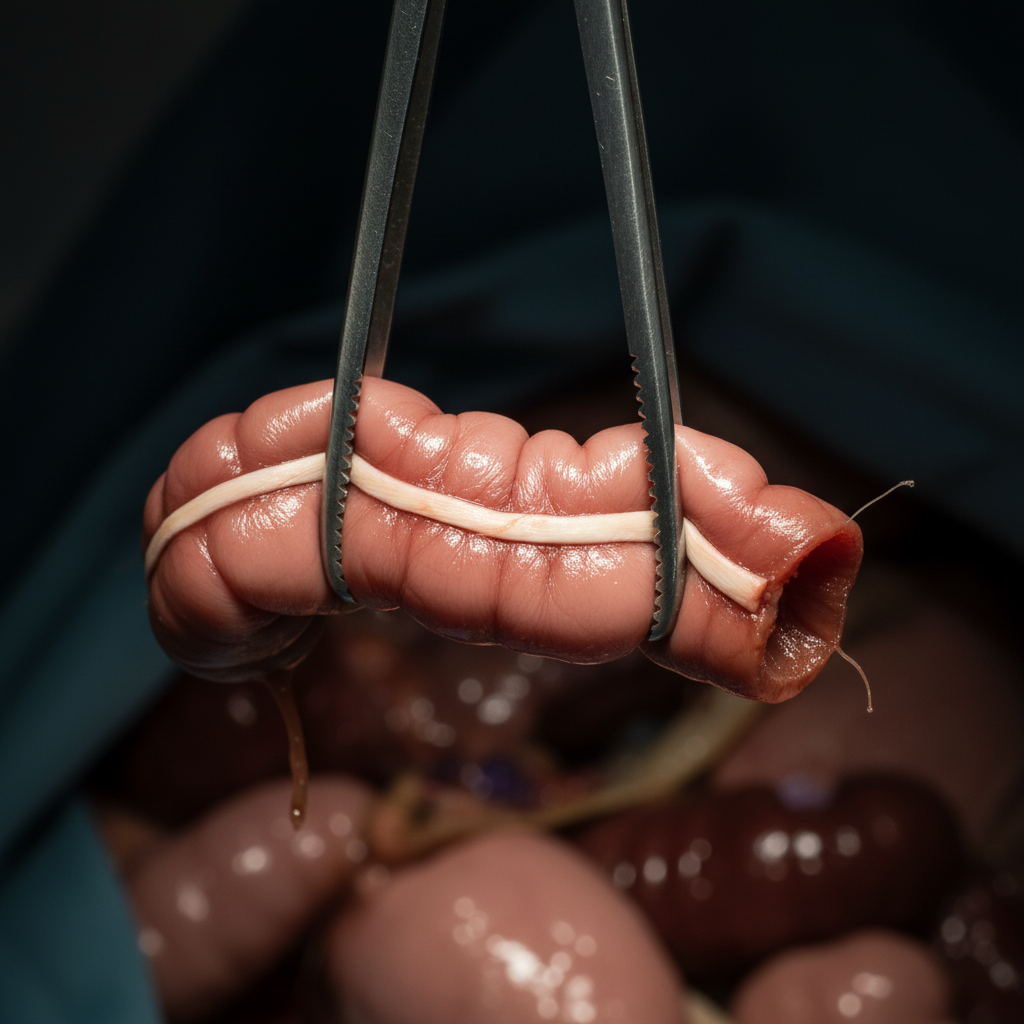
In portal hypertension, the lower end of the esophagus may show dilatation of veins. Which of the following veins drains into the portal vein from the lower end of the esophagus?
The middle suprarenal artery is a branch of which of the following?
An infant is evaluated for partial intestinal obstruction that has been present from birth. Esophagogastroduodenal endoscopic visualization fails to demonstrate an intraluminal lesion but does show prominent narrowing at the level of the mid duodenum. CT studies demonstrate a mass lesion surrounding that portion of the duodenum. Which type of tissue is most likely present within the lesion?
The free edge of which of the following ligaments contains the ligamentum teres hepatis?
The ureter derives its blood supply from which of the following structures?
The stomach bed is formed by all of the following structures except?
The cremasteric muscle is supplied by which nerve?
During splenectomy, at which level are the splenic vessels typically ligated?
The gastroduodenal artery is a branch of which of the following arteries?
What is the most common intercostal space used for hepatic biopsy?
Explanation: ### Explanation **1. Why the Correct Answer is Right:** The lower end of the esophagus is a critical site of **porto-systemic anastomosis**. At this junction, the systemic venous system meets the portal venous system [1]. * **Portal Tributary:** The **Left Gastric Vein** (also known as the coronary vein) drains the lower part of the esophagus and the lesser curvature of the stomach directly into the **Portal Vein** [1][2]. * **Systemic Tributary:** The esophageal branches of the **Azygos vein** drain the same area into the Superior Vena Cava [1]. In portal hypertension, the pressure in the portal vein rises, causing blood to flow retrogradely into the left gastric vein and then into the esophageal systemic veins [1]. This leads to the formation of **esophageal varices**, which are prone to life-threatening hemorrhage [1]. **2. Why the Other Options are Incorrect:** * **A. Right Gastric Vein:** While it is a direct tributary of the portal vein, it drains the lesser curvature of the stomach near the pylorus, not the esophagus. * **C. Hemiazygos Vein:** This is a systemic vein. While it participates in the systemic side of the anastomosis (via esophageal branches), it does not drain into the portal vein. * **D. Inferior Phrenic Vein:** This is a systemic vein that drains the diaphragm and the superior part of the suprarenal glands into the Inferior Vena Cava. **3. Clinical Pearls for NEET-PG:** * **Caput Medusae:** Occurs at the umbilicus (Paraumbilical veins + Superficial epigastric veins) [1]. * **Anorectal Varices:** Occurs at the anal canal (Superior rectal vein + Middle/Inferior rectal veins). * **Retroperitoneal (Veins of Retzius):** Occurs between Colic veins and Lumbar veins. * **Management:** Acute variceal bleeding is often managed with **Octreotide** (somatostatin analogue) and endoscopic band ligation.
Explanation: The adrenal (suprarenal) glands are unique due to their profuse blood supply, receiving arterial blood from three distinct sources [1]. Understanding the origin of each is a high-yield topic for NEET-PG. ### **Explanation of the Correct Answer** The **Middle Suprarenal Artery** arises directly from the lateral aspect of the **Abdominal Aorta**, usually at the level of the Superior Mesenteric Artery. This is a direct visceral branch of the aorta, reflecting the gland's critical endocrine importance. ### **Analysis of Incorrect Options** * **B. Renal Artery:** This gives rise to the **Inferior Suprarenal Artery**. The renal artery itself is a lateral branch of the aorta, but the suprarenal branch specifically supplies the lower portion of the gland. * **C. Inferior Phrenic Artery:** This gives rise to the **Superior Suprarenal Artery** (multiple small branches). The inferior phrenic arteries are the first branches of the abdominal aorta, arising just above the celiac trunk. * **D. All of the above:** While the adrenal gland *as a whole* receives blood from all these sources, the question specifically asks for the origin of the *middle* artery only. ### **High-Yield Clinical Pearls for NEET-PG** 1. **The "3-2-1" Rule:** 3 Arteries (Superior, Middle, Inferior) but usually only **1 Vein** per side [2]. 2. **Venous Drainage (Asymmetry):** This is a common exam trap [2]. * **Right Suprarenal Vein:** Drains directly into the **Inferior Vena Cava (IVC)** [2]. * **Left Suprarenal Vein:** Drains into the **Left Renal Vein** (often joining the left inferior phrenic vein first) [2]. 3. **Embryology:** The adrenal cortex develops from **mesoderm**, while the medulla develops from **neural crest cells** (ectoderm).
Explanation: ### **Explanation** The clinical presentation of partial duodenal obstruction in an infant, combined with a CT finding of a mass **surrounding** the duodenum, is classic for **Annular Pancreas**. **1. Why Pancreatic is Correct:** Annular pancreas is a congenital anomaly caused by the failure of the **ventral pancreatic bud** to rotate properly behind the duodenum [1]. Instead, the bifid ventral bud migrates in opposite directions, encircling the **second part of the duodenum**. This creates a ring of pancreatic tissue that constricts the duodenal lumen, leading to symptoms of high intestinal obstruction (e.g., non-bilious or bilious vomiting, depending on the site relative to the ampulla of Vater). Since the lesion is extrinsic (surrounding the wall), endoscopy fails to see an intraluminal mass but confirms the narrowing. **2. Why Incorrect Options are Wrong:** * **Gastric:** While ectopic gastric mucosa can cause ulcers or bleeding (e.g., in Meckel’s diverticulum), it does not form a circumferential mass around the mid-duodenum. * **Hepatic:** The liver develops from the hepatic diverticulum. While it is anatomically close, it does not encircle the duodenum to cause obstruction. * **Renal:** The kidneys are retroperitoneal structures located posteriorly. Renal masses (like Wilms tumor) might displace the duodenum but do not surround it circumferentially. **3. High-Yield NEET-PG Pearls:** * **Embryology:** Caused by abnormal migration of the **ventral pancreatic bud** [1]. * **Association:** Frequently associated with **Down Syndrome (Trisomy 21)**, duodenal atresia, and cardiac defects. * **Radiology:** On X-ray, it may show the **"Double Bubble Sign"** (gas in the stomach and proximal duodenum), similar to duodenal atresia. * **Treatment:** Surgical bypass (e.g., Duodenoduodenostomy) is preferred over resection of the pancreatic ring to avoid pancreatic fistulas.
Explanation: The **falciform ligament** is a sickle-shaped fold of peritoneum that connects the liver to the anterior abdominal wall and the diaphragm [1]. Its **inferior free edge** contains the **ligamentum teres hepatis** (round ligament of the liver), which is the obliterated remnant of the left umbilical vein. This vein carries oxygenated blood from the placenta to the fetus. ### Analysis of Options: * **A. Falciform Ligament (Correct):** It separates the anatomical left and right lobes of the liver superiorly [1]. The ligamentum teres runs within its free margin from the umbilicus to the notch for the ligamentum teres on the liver. * **B. Coronary Ligament:** This reflects from the diaphragm onto the superior and posterior surfaces of the liver, enclosing the "bare area" [1]. It does not contain any fetal remnants. * **C. Hepatogastric Ligament:** This is the medial portion of the lesser omentum connecting the liver to the lesser curvature of the stomach [1]. It contains gastric vessels but not the ligamentum teres. * **D. Hepatoduodenal Ligament:** This is the lateral free edge of the lesser omentum. It is a high-yield structure because it contains the **Portal Triad** (Portal vein, Hepatic artery proper, and Common bile duct), but not the ligamentum teres. ### NEET-PG High-Yield Pearls: * **Ligamentum Venosum:** The obliterated remnant of the *ductus venosus*, found in the fissure on the posterior surface of the liver. * **Paraumbilical Veins:** These also run in the falciform ligament alongside the ligamentum teres; they form a clinical portosystemic anastomosis (Caput Medusae in portal hypertension). * **Pringle Maneuver:** Clamping the hepatoduodenal ligament to control bleeding by compressing the portal triad.
Explanation: The ureter is a long, muscular tube that spans multiple anatomical regions (retroperitoneum to the pelvis). Consequently, it does not have a single dedicated artery but instead receives a **segmental blood supply** from various vessels it encounters along its course. **Why "All of the above" is correct:** The blood supply of the ureter is divided into three parts: 1. **Upper part (Abdominal):** Supplied by branches from the **Renal artery** and the **Gonadal (Testicular/Ovarian) artery**. 2. **Middle part:** Supplied by the **Abdominal aorta**, **Common iliac artery**, and sometimes the Internal iliac artery. 3. **Lower part (Pelvic):** Supplied by branches from the **Internal iliac artery**, specifically the Vesical (superior/inferior), Middle rectal, and Uterine/Vaginal arteries in females. Since the Renal, Gonadal, and Common iliac arteries all contribute significant branches to different segments of the ureter, option D is the correct choice. **Analysis of Options:** * **A, B, and C:** These are all correct individual sources. However, selecting any one of them would be incomplete, as the ureter relies on a longitudinal anastomotic network formed by all these vessels. **High-Yield Clinical Pearls for NEET-PG:** * **Anastomosis:** The arterial branches reach the ureter and divide into ascending and descending branches, forming a continuous plexus in the **adventitia**. * **Surgical Importance:** In the **upper ureter**, blood vessels approach from the **medial side**, whereas in the **lower (pelvic) ureter**, they approach from the **lateral side**. Surgeons must be careful during mobilization to avoid devascularization and subsequent necrosis or stricture [1]. * **Water under the bridge:** Remember that the ureter passes *posterior* to the uterine artery (in females) or the ductus deferens (in males) [1].
Explanation: The **stomach bed** refers to the structures upon which the stomach rests when in a supine position. These structures are separated from the posterior surface of the stomach by the **lesser sac** (omental bursa). The stomach is situated in the left hypochondrium and epigastric regions of the abdomen. Therefore, it relates to the **Left Kidney** and the **Left Suprarenal gland** [1]. The Right Kidney is located on the right side of the midline and is related to the liver, duodenum, and hepatic flexure of the colon, but not the stomach [1]. The body and tail of the pancreas form a major portion of the stomach bed [1]. The splenic artery runs a tortuous course along the superior border of the pancreas, directly behind the stomach. The left crus and the dome of the diaphragm form the superior-most part of the stomach bed. To remember the components of the stomach bed, use the mnemonic: **"Dr. S.S. Pancreas"** (Diaphragm, Related Spleen, Splenic Artery, Suprarenal gland (Left), Pancreas, Anterior surface of Left Kidney, Colon/Transverse mesocolon, and Spleen [1]). A posterior gastric ulcer can erode into the stomach bed, potentially causing massive hemorrhage if it involves the Splenic Artery or leading to acute pancreatitis if the ulcer penetrates the pancreas.
Explanation: The **cremasteric muscle** is a thin layer of skeletal muscle derived from the internal oblique muscle. It functions to retract the testes toward the body for thermoregulation. **Why Option D is Correct:** The muscle is innervated by the **genital branch of the genitofemoral nerve (L1, L2)** [1]. This nerve enters the inguinal canal through the deep inguinal ring and travels within the spermatic cord to supply the cremasteric muscle and the skin of the scrotum (or labia majora in females) [1]. **Analysis of Incorrect Options:** * **Option A (Pudendal nerve):** The pudendal nerve (S2-S4) supplies the perineum and external anal sphincter, but not the contents of the inguinal canal. * **Option B (Obturator nerve):** This nerve (L2-L4) supplies the adductor compartment of the thigh. * **Option C (Femoral nerve):** The femoral nerve (L2-L4) supplies the anterior compartment of the thigh. While the *femoral branch* of the genitofemoral nerve exists, it provides cutaneous sensation to the skin over the femoral triangle, not motor supply to the cremaster. **Clinical Pearls for NEET-PG:** 1. **Cremasteric Reflex:** Stroking the medial aspect of the thigh stimulates the **ilioinguinal nerve (Afferent limb: L1)**. This triggers the **genital branch of the genitofemoral nerve (Efferent limb: L1, L2)** to contract the cremasteric muscle, elevating the testis. 2. **Origin:** The cremasteric muscle and fascia are derived from the **Internal Oblique** muscle/aponeurosis. 3. **Blood Supply:** It is supplied by the **cremasteric artery**, a branch of the inferior epigastric artery.
Explanation: The **splenic artery**, a major branch of the celiac trunk, follows a characteristic tortuous course along the **superior border of the pancreas**. During a splenectomy, the vessels are typically ligated at this level to ensure a safe and controlled procedure. **Why Option B is Correct:** The splenic artery runs within the lienorenal (splenorenal) ligament after passing along the upper margin of the pancreas. Ligating the vessels at the superior border of the pancreas allows for proximal control of blood flow. More importantly, it helps avoid accidental injury to the **tail of the pancreas**, which often extends into the lienorenal ligament and lies very close to the splenic hilum [1]. **Analysis of Incorrect Options:** * **Option A (Near the splenic hilum):** Ligating too close to the hilum increases the risk of damaging the pancreatic tail, which can lead to post-operative pancreatic fistulas or pancreatitis [1]. * **Option C (Inferior border of the pancreas):** This is anatomically incorrect; the splenic artery is related to the superior border, while the splenic vein lies posterior to the pancreas. * **Option D (Midway):** This is not a standard surgical landmark and does not offer the same anatomical safety as the superior pancreatic border. **NEET-PG High-Yield Pearls:** * **Lienorenal Ligament:** Contains the splenic vessels and the **tail of the pancreas** [1], [2]. * **Gastrosplenic Ligament:** Contains the **short gastric vessels** and left gastroepiploic vessels [1], [2]. * **Kehr’s Sign:** Referred pain to the left shoulder due to diaphragmatic irritation from a ruptured spleen (phrenic nerve, C3-C5). * **Segmental Anatomy:** The spleen has distinct vascular segments, allowing for partial splenectomy.
Explanation: The **gastroduodenal artery (GDA)** is a critical vessel supplying the stomach, duodenum, and pancreas. It originates as one of the two terminal branches of the **common hepatic artery** (the other being the hepatic artery proper) [1]. The common hepatic artery itself is a major branch of the **celiac trunk**, which is the artery of the foregut [1]. **Why the other options are incorrect:** * **Superior mesenteric artery (SMA):** This is the artery of the midgut. While it gives off the *inferior* pancreaticoduodenal artery, it does not give rise to the gastroduodenal artery. The GDA and SMA systems anastomose via the pancreaticoduodenal arcade. * **Abdominal aorta:** The aorta gives rise to the celiac trunk, but the GDA is a secondary branch, not a direct branch of the aorta. * **Splenic artery:** This is another branch of the celiac trunk that runs along the upper border of the pancreas to the spleen [1]. It gives off short gastric and left gastro-epiploic arteries, but not the GDA. **High-Yield Clinical Pearls for NEET-PG:** * **Peptic Ulcer Disease:** The GDA runs posterior to the first part of the duodenum. Therefore, a **perforated posterior duodenal ulcer** can erode the GDA, leading to life-threatening hematemesis or melena. * **Branches of GDA:** It terminates by dividing into the **right gastro-epiploic artery** and the **superior pancreaticoduodenal artery**. * **Surgical Landmark:** The GDA serves as a key landmark during a Whipple procedure (pancreaticodenectomy).
Explanation: **Explanation:** The liver is primarily an intraperitoneal organ protected by the rib cage. For a percutaneous needle biopsy, the goal is to reach the liver where it is in direct contact with the abdominal wall, while minimizing the risk of puncturing the lungs or gallbladder. [1] **Why the 8th Intercostal Space (ICS) is correct:** The **8th or 9th intercostal space in the mid-axillary line** is the preferred site. At this level, during expiration, the costodiaphragmatic recess of the pleura is narrow, and the lung is retracted superiorly. This provides a safe "window" to pass the needle through the chest wall and diaphragm directly into the right lobe of the liver without traversing the lung tissue, thereby preventing a pneumothorax. [1] **Analysis of Incorrect Options:** * **5th & 6th ICS:** These spaces are too superior. The lower border of the lung typically reaches the 6th rib in the mid-clavicular line and the 8th rib in the mid-axillary line. Inserting a needle here carries a very high risk of piercing the lung and causing a pneumothorax. * **7th ICS:** While closer to the target, it still poses a significant risk of hitting the inferior margin of the lung, especially in patients with deep inspiration or chronic obstructive pulmonary disease (COPD). **High-Yield Clinical Pearls for NEET-PG:** * **Positioning:** The patient is usually placed in the supine or left lateral position with the right arm abducted. * **Respiration:** The patient is instructed to **hold their breath in full expiration** during needle insertion to move the lung margin as far upward as possible. * **Anatomy:** The needle passes through the skin, superficial fascia, serratus anterior, intercostal muscles, parietal pleura (costodiaphragmatic recess), diaphragmatic pleura, diaphragm, and finally the Glisson’s capsule of the liver. [1] * **Complication:** The most common serious complication of liver biopsy is **hemorrhage** (intraperitoneal or intrahepatic).
Anterior Abdominal Wall
Practice Questions
Peritoneum and Peritoneal Cavity
Practice Questions
Stomach and Intestines
Practice Questions
Liver, Gallbladder and Biliary Tract
Practice Questions
Pancreas and Spleen
Practice Questions
Kidneys and Suprarenal Glands
Practice Questions
Abdominal Vasculature
Practice Questions
Posterior Abdominal Wall
Practice Questions
Innervation of Abdominal Viscera
Practice Questions
Applied Anatomy and Clinical Correlations
Practice Questions
Get full access to all questions, explanations, and performance tracking.
Start For Free