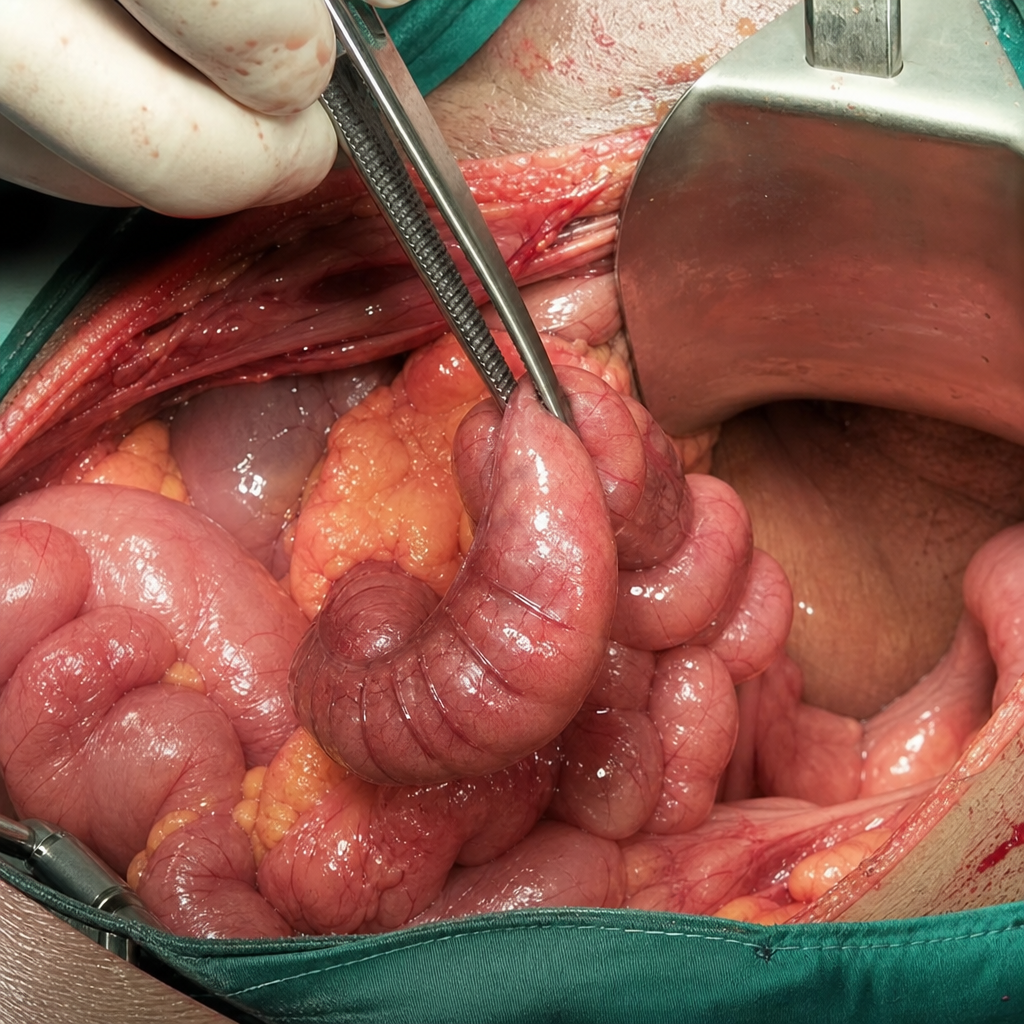
Parietal peritoneum is lined by which type of epithelium?
The liver is divided into right and left lobes by all EXCEPT:
The Couinaud's segmental nomenclature of the liver is based on the position of which vascular structures?
The inferior vena cava is formed at which vertebral level?
The root of the mesentery is crossed by which structure?
Which of the following duodenal recesses has the inferior mesenteric vein in its free margin?
Which vein drains directly into the Inferior Vena Cava?
While examining radiographs and angiograms, a physician is trying to distinguish the jejunum from the ileum. What characteristic is observed in the jejunum?
Which anatomical structure forms the boundary of Morrison's pouch?
A 55-year-old man presents with nausea, vomiting, and hematuria. A CT scan reveals a neoplasm in the posterior surface of the inferior pole of the left kidney that has invaded through the renal pelvis, renal capsule, ureter, and fat. To which of the following regions will pain most likely be referred?
Explanation: The peritoneum is a serous membrane that lines the abdominal cavity (parietal) and covers the abdominal organs (visceral). Like all serous membranes (pleura, pericardium, and peritoneum), it is composed of a single layer of flattened cells called **mesothelium**. 1. **Why Simple Squamous is correct:** The mesothelium is histologically classified as **simple squamous epithelium**. This thin, single layer of cells is supported by a thin layer of connective tissue. Its primary function is to provide a smooth, frictionless surface and to secrete serous fluid, which allows for the free movement of abdominal viscera. 2. **Why other options are incorrect:** * **Stratified squamous:** This consists of multiple layers and is designed for protection against mechanical stress (e.g., skin, esophagus). It is too thick for the secretory and transport functions of the peritoneum. * **Cuboidal:** Simple cuboidal epithelium is typically found in secretory glands or kidney tubules, where more metabolic activity is required than in a lining membrane. * **Columnar:** Simple columnar epithelium is specialized for absorption and secretion (e.g., lining of the stomach and intestines) and is not found in serous linings. **High-Yield NEET-PG Pearls:** * **Embryology:** The mesothelium of the peritoneum is derived from the **lateral plate mesoderm**. * **Nerve Supply:** The **parietal peritoneum** is sensitive to pain, pressure, and temperature (supplied by somatic nerves like lower intercostal and phrenic nerves), whereas the **visceral peritoneum** is sensitive only to stretch and chemical irritation (supplied by autonomic nerves) [1]. * **Clinical Correlation:** In **Peritoneal Dialysis**, the simple squamous lining acts as a semi-permeable membrane, allowing for the exchange of toxins and fluids via osmosis and diffusion.
Explanation: The division of the liver into right and left lobes is based on the **Couinaud classification** (functional anatomy), which is defined by the distribution of the portal triad and the drainage of the hepatic veins [1]. **Why Hepatic Vein is the Correct Answer:** The **Middle Hepatic Vein** lies in the **Cantlie’s line** (the principal plane), which actually serves as the boundary that separates the liver into functional right and left halves. It does not "divide" within a lobe; rather, it runs *between* the lobes. Conversely, the hepatic veins generally define the boundaries between sectors (intersegmental), whereas the portal triad structures define the centers of the segments [1]. **Explanation of Incorrect Options:** The functional division of the liver is determined by the primary branching of the **Portal Triad** components [1]. At the porta hepatis, the following structures divide into right and left branches to supply their respective functional lobes: * **Portal Vein (B):** Divides into right and left branches to provide the primary functional blood supply [1]. * **Hepatic Artery (C):** Divides into right and left hepatic arteries [1]. * **Hepatic Ducts (D):** The right and left hepatic ducts drain bile from their respective functional lobes [1]. **High-Yield Clinical Pearls for NEET-PG:** * **Cantlie’s Line:** An imaginary line from the IVC to the gallbladder fossa. It separates the functional right and left lobes [1]. * **Morphological vs. Functional:** Morphologically, the **Falciform ligament** divides the liver into right and left lobes. Functionally (and surgically), the division is at Cantlie's line [1]. * **Segment IV:** The Quadrate lobe is functionally part of the **Left Lobe** (Segment IV) [1]. * **Caudate Lobe (Segment I):** Unique because it receives blood supply from both right and left portal triads and drains directly into the IVC [1].
Explanation: ### Explanation The **Couinaud classification** is the most widely used system for describing functional liver anatomy. It divides the liver into **eight independent segments**, each having its own dual vascular inflow, biliary drainage, and lymphatic drainage [1]. **Why Option A is Correct:** The division is based on the orientation of two specific vascular systems: 1. **Vertical Plane (Hepatic Veins):** The three main hepatic veins (Right, Middle, and Left) run longitudinally between the segments, acting as "dividing lines" or boundaries [1]. 2. **Horizontal Plane (Portal Vein):** The transverse plane is defined by the bifurcation of the portal vein into right and left branches [2]. This horizontal line divides the liver into superior and inferior segments. **Why Other Options are Incorrect:** * **Options B & C:** While biliary ducts follow the portal triad, they are not the primary landmarks used to define the segmental boundaries in Couinaud’s nomenclature. * **Option D:** The hepatic artery and portal vein both enter the liver via the porta hepatis and travel together. However, the arterial supply is not the defining landmark for the vertical boundaries; the hepatic veins (which are intersegmental) serve that purpose [1]. ### High-Yield Clinical Pearls for NEET-PG: * **Surgical Significance:** Because each segment is a functional unit, a surgeon can perform a **segmentectomy** (removing a single segment) without compromising the blood supply or drainage of the remaining liver. * **Segment I (Caudate Lobe):** It is unique because it receives blood from both right and left portal branches and drains directly into the Inferior Vena Cava (IVC), bypassing the three main hepatic veins. * **Cantlie’s Line:** An imaginary line from the IVC to the gallbladder fossa (occupied by the Middle Hepatic Vein) that divides the liver into true functional right and left lobes.
Explanation: **Explanation:** The **Inferior Vena Cava (IVC)** is the largest vein in the human body, responsible for draining deoxygenated blood from the lower limbs and abdominopelvic organs. It is formed by the confluence of the **right and left common iliac veins**. **Why L5 is Correct:** The formation of the IVC occurs at the level of the **fifth lumbar vertebra (L5)**, slightly to the right of the midline and posterior to the right common iliac artery. From this point, it ascends through the posterior abdominal wall to the right of the aorta. **Analysis of Incorrect Options:** * **L2:** This is the level where the **renal veins** typically join the IVC and where the **cisterna chyli** begins. [2] * **L3:** This level corresponds to the origin of the **inferior mesenteric artery** and the subcostal plane. * **L4:** This is a high-yield landmark for the **bifurcation of the Abdominal Aorta** into the common iliac arteries. It is important to remember that the aorta bifurcates (L4) higher than the IVC forms (L5). **High-Yield Clinical Pearls for NEET-PG:** * **T8 (Vena Caval Opening):** The IVC leaves the abdomen by piercing the central tendon of the diaphragm at the level of the **8th thoracic vertebra**. * **Length/Course:** It is approximately 20 cm long and has no valves (except for the rudimentary Eustachian valve at its opening in the right atrium). * **Relations:** The IVC is **retroperitoneal**. It passes behind the third part of the duodenum, the head of the pancreas, and the portal vein. [1] * **Mnemonic:** Remember **"Aorta 4, Vena Cava 5"** to distinguish the levels of aortic bifurcation (L4) and IVC formation (L5).
Explanation: The **root of the mesentery** is a 15 cm long oblique band of peritoneum that attaches the small intestine to the posterior abdominal wall. It extends from the duodenojejunal flexure (left side of L2) to the right sacroiliac joint. **Why the Correct Answer is Right:** As the root of the mesentery travels downward and to the right, it crosses several vital retroperitoneal structures. These include: 1. **Horizontal (3rd) part of the duodenum** 2. **Abdominal aorta** 3. **Inferior Vena Cava (IVC)** 4. Right Psoas major muscle 5. Right Ureter 6. Right Genitofemoral nerve 7. Right Testicular/Ovarian vessels Since the **Inferior Vena Cava (Option C)** lies to the right of the midline, it is directly crossed by the root of the mesentery. **Why Incorrect Options are Wrong:** * **Options A, B, and D (Left structures):** The root of the mesentery begins at the duodenojejunal flexure (left of L2) and immediately moves **downward and to the right**. Therefore, it does not cross left-sided structures like the left testicular/ovarian arteries or the left ureter. These structures remain lateral to the root's origin. **NEET-PG High-Yield Pearls:** * **Length:** The root is 6 inches (15 cm), while the intestinal border is nearly 6 meters long (frilled appearance). * **Contents of Mesentery:** Jejunal and ileal branches of the **Superior Mesenteric Artery (SMA)**, veins, lymph nodes (lacteals), and autonomic nerves. * **Clinical Correlation:** A "Volvulus" often occurs around the root of the mesentery, potentially compromising the blood supply from the SMA.
Explanation: The duodenal recesses are peritoneal folds formed during the rotation and fixation of the gut. Understanding their boundaries is high-yield for NEET-PG, as these are potential sites for internal hernias. ### **Explanation of the Correct Answer** The **Paraduodenal recess (Fossa of Landzert)** is the most clinically significant duodenal recess. It is located to the left of the ascending part of the duodenum. Its defining characteristic is its free anterior margin (the paraduodenal fold), which contains both the **inferior mesenteric vein (IMV)** and the **ascending branch of the left colic artery**. This is a classic "exam favorite" because an internal hernia here can compress the IMV or lead to strangulation of the bowel [1]. ### **Analysis of Incorrect Options** * **A. Superior duodenal recess:** Located at the level of L2, to the left of the duodenal-jejunal flexure. Its free margin contains the lower border of the **inferior mesenteric vein**, but it is not the primary recess defined by the vein's presence in its fold. * **C. Inferior duodenal recess:** Located at the level of L3. Its fold is non-vascular and does not contain major vessels. * **D. Mesenteric-parietal recess (Fossa of Waldeyer):** This is located on the right side, below the third part of the duodenum. Its free margin contains the **superior mesenteric artery (SMA)** and its ileocolic branch [1], not the IMV. ### **Clinical Pearls for NEET-PG** * **Most common internal hernia:** Paraduodenal hernia (Left-sided is more common than right-sided). * **Vascular Landmark:** If a question mentions the **SMA** in the fold, the answer is the **Mesenteric-parietal recess**. If it mentions the **IMV**, it is the **Paraduodenal recess**. * **Surgical Caution:** During the repair of a paraduodenal hernia, the surgeon must be extremely careful not to injure the IMV or the left colic artery located in the neck of the hernial sac [1].
Explanation: **Explanation:** The **Inferior Vena Cava (IVC)** is the large systemic vein that collects deoxygenated blood from the lower limbs and the abdominopelvic organs. The key to answering this question lies in distinguishing between the **Portal Venous System** and the **Systemic Venous System**. **Why Hepatic Vein is Correct:** The **Hepatic veins** (Right, Middle, and Left) emerge from the posterior surface of the liver and drain directly into the IVC just before it passes through the diaphragm at the level of **T8** [1]. These veins represent the final pathway for blood that has been processed by the liver, returning it to the systemic circulation [3]. **Why Other Options are Incorrect:** * **Superior Mesenteric Vein (SMV):** It joins the Splenic vein behind the neck of the pancreas to form the **Portal Vein** [2]. * **Splenic Vein:** It receives the Inferior Mesenteric vein and then joins the SMV to form the Portal Vein [2]. * **Inferior Mesenteric Vein (IMV):** It typically drains into the Splenic vein. * *Note:* Blood from the GI tract (drained by SMV, IMV, and Splenic veins) must first pass through the **Portal Vein** into the liver sinusoids for detoxification before reaching the IVC via the Hepatic veins [1]. **High-Yield Clinical Pearls for NEET-PG:** * **Tributaries of IVC:** Remember the "3-3-3" rule: 3 Hepatic veins, 3 Lumbar veins, 3 Genital/Suprarenal/Renal veins (Note: Left Gonadal and Left Suprarenal veins drain into the **Left Renal Vein**, not directly into the IVC). * **Budd-Chiari Syndrome:** Caused by the obstruction of the Hepatic veins, leading to hepatomegaly, ascites, and abdominal pain. * **Portal-Systemic Anastomosis:** In portal hypertension, blood bypasses the liver through sites like the lower esophagus (varices) and rectum (hemorrhoids).
Explanation: To distinguish the jejunum from the ileum, one must understand the anatomical transition along the small intestine. As we move from the proximal (jejunum) to the distal (ileum) end, the complexity of the mesenteric vasculature increases while the luminal surface area decreases. ### **Explanation of the Correct Answer** **B. Fewer mesenteric arterial arcades:** The jejunum is characterized by a simpler arterial pattern consisting of only **one or two large arterial arcades** [1] that give rise to **long vasa recta** (straight arteries) [1]. In contrast, the ileum has a more complex network of multiple short arcades (3–5 tiers) and short vasa recta [1]. This is a high-yield radiological and surgical landmark. ### **Analysis of Incorrect Options** * **A. Fewer plicae circulares:** Incorrect. The jejunum has **more, taller, and more closely packed** plicae circulares (valves of Kerckring) to facilitate maximal absorption. The ileum has fewer and smaller folds, becoming almost absent in the distal portion. * **C. Less digestion and absorption:** Incorrect. The jejunum is the **primary site** for the digestion and absorption of most nutrients (carbohydrates, proteins, and fats) due to its greater surface area. * **D. Longer vasa recta:** While the jejunum *does* have longer vasa recta [1], this was not the marked correct answer in the context of the specific question's focus on arcades. However, in many exams, "Longer vasa recta" is also a correct characteristic of the jejunum. If forced to choose between the two, the simplicity of the arcades (fewer) is a classic distinguishing feature. ### **NEET-PG High-Yield Pearls** * **Fat in Mesentery:** The jejunal mesentery has less fat, creating "translucent windows" near the bowel wall. The ileal mesentery is fatty and "opaque," with fat often encroaching onto the serosa (fat wrapping). * **Lumen Diameter:** The jejunum has a wider lumen and thicker wall [1] compared to the ileum. * **Lymphoid Tissue:** Peyer’s patches (aggregated lymphoid nodules) are characteristic of the **ileum**, not the jejunum. * **Mnemonic:** **J**ejunum = **J**olly (Bright red, thick, active); **I**leum = **I**nferior (Pale, thin, complex vessels).
Explanation: **Explanation:** **Morison’s Pouch**, also known as the **Hepatorenal Recess**, is a potential space located in the upper right quadrant of the abdomen [2]. It is the deepest part of the subhepatic space and represents the most dependent part of the peritoneal cavity when a patient is in the supine position. **Why Kidney is Correct:** The boundaries of Morison’s pouch are defined by the liver and the right kidney [1]. Specifically: * **Anteriorly:** The inferior surface of the right lobe of the liver. * **Posteriorly:** The **right kidney** (upper pole) and the right suprarenal gland [1]. * **Superiorly:** The inferior layer of the coronary ligament. **Why Incorrect Options are Wrong:** * **B. Falciform ligament:** This is a midline structure that separates the right and left subphrenic spaces; it does not form the boundary of the hepatorenal recess. * **C. Spleen:** The spleen is located in the left hypochondrium. The equivalent space on the left is the perisplenic space, but it is not called Morison’s pouch. * **D. Pancreas:** The pancreas is a retroperitoneal organ located behind the lesser sac (omental bursa), medial to the Morison’s pouch. **Clinical Pearls for NEET-PG:** * **FAST Scan:** In trauma, Morison’s pouch is the most common site for the accumulation of free intraperitoneal fluid (blood) in a supine patient. It is the primary focus of the "Right Upper Quadrant" view in a Focused Assessment with Sonography for Trauma (FAST). * **Communication:** It communicates medially with the **Lesser Sac** via the **Foramen of Winslow** (Epiploic foramen) and inferiorly with the **Right Paracolic Gutter**. * **Ascites/Peritonitis:** Due to its dependent nature, infected fluid or malignant cells often collect here.
Explanation: **Explanation:** The correct answer is **B**. This question tests your knowledge of the posterior abdominal wall neuroanatomy and the concept of referred pain. **1. Why Option B is Correct:** The neoplasm is located on the **posterior surface of the inferior pole of the left kidney**. This specific anatomical location puts the tumor in direct contact with the **iliohypogastric** and **ilioinguinal nerves** (L1), which descend posterior to the kidney. * **Iliohypogastric nerve:** Supplies the skin over the gluteal region and the pubis. * **Ilioinguinal nerve:** Supplies the skin of the medial thigh, root of the penis/scrotum (or labia majora), and the inguinal canal. Invasion of these nerves leads to referred pain in their respective cutaneous distributions. **2. Why Other Options are Incorrect:** * **Option A & C:** These describe the distribution of the **femoral nerve** (L2-L4) and the **lateral femoral cutaneous nerve** (L2-L3) [1]. While these nerves are in the posterior abdomen, they are located more laterally and inferiorly (lateral to the psoas) and are less likely to be involved by a lower pole renal mass compared to the L1 branches. * **Option D:** The umbilicus is supplied by the **T10** dermatome. While renal colic (visceral pain) can be felt in the T10-L1 distribution, the specific invasion of the posterior structures described points toward the somatic L1 nerve roots. **3. NEET-PG High-Yield Pearls:** * **Nerve Relations:** The subcostal (T12), iliohypogastric (L1), and ilioinguinal (L1) nerves all pass posterior to the kidney. * **Renal Entrapment:** A tumor of the lower pole is most likely to compress L1 branches; a tumor of the upper pole may irritate the diaphragm/phrenic nerve (C3-C5), referring pain to the shoulder. * **Ureteric Colic:** Pain typically "shifts" from the loin to the groin as a stone moves down the ureter (T11-L2).
Anterior Abdominal Wall
Practice Questions
Peritoneum and Peritoneal Cavity
Practice Questions
Stomach and Intestines
Practice Questions
Liver, Gallbladder and Biliary Tract
Practice Questions
Pancreas and Spleen
Practice Questions
Kidneys and Suprarenal Glands
Practice Questions
Abdominal Vasculature
Practice Questions
Posterior Abdominal Wall
Practice Questions
Innervation of Abdominal Viscera
Practice Questions
Applied Anatomy and Clinical Correlations
Practice Questions
Get full access to all questions, explanations, and performance tracking.
Start For Free