The umbilical arteries get obliterated to form which of the following structure?
Which structure is present within the lienorenal ligament?
Which of the following structures is related to the lateral border of the right kidney?
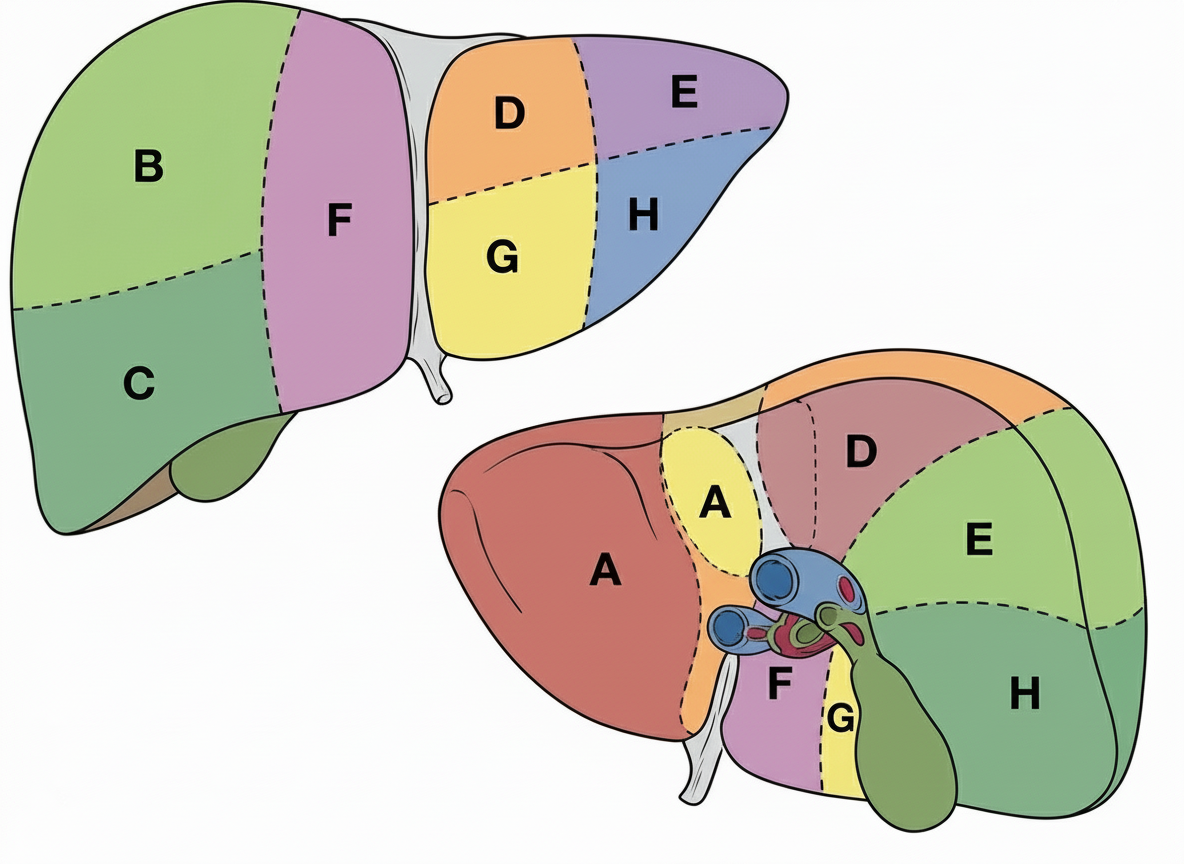
A 74-year-old man with newly diagnosed hepatocellular carcinoma has a CT scan reviewed by an oncologist. The affected quadrate lobe of the liver is located. Which of the following is true regarding the quadrate lobe?
A patient was admitted with a bleeding ulcer of the lesser curvature of the stomach. Which artery is MOST likely to be involved?
Which of the following forms the anterior wall of the inguinal canal?
Which of the following statements is NOT true about the right kidney?
Which of the following belongs to Couinaud Segment IX of the liver?
Which of the following statements is true about the conjoint tendon?
Which of the following ducts commences in the abdomen as an elongated lymph sac of the cisterna chyli?
Explanation: The umbilical arteries are essential fetal vessels that carry deoxygenated blood from the fetus to the placenta. After birth, when the umbilical cord is clamped, the distal portions of these arteries lose their function and undergo fibrous obliteration [2]. **Explanation of the Correct Option:** * **B. Medial umbilical ligament:** (Note: There appears to be a discrepancy in the provided key. Anatomically, the **distal parts of the umbilical arteries** form the **Medial umbilical ligaments** [2]. The proximal parts remain patent as the superior vesical arteries [2].) **Explanation of Incorrect Options:** * **A. Ligamentum teres:** This is the remnant of the **left umbilical vein**, which carries oxygenated blood from the placenta to the fetus [2]. It is found in the free margin of the falciform ligament [1]. * **C. Lateral umbilical ligament:** These are mucosal folds formed by the **inferior epigastric vessels**. Unlike the others, these vessels remain patent and functional throughout life. * **D. Median umbilical ligament:** This is the remnant of the **urachus** (the fetal connection between the bladder and the umbilicus), which is derived from the allantois [3]. **High-Yield NEET-PG Pearls:** 1. **Rule of "M":** **M**edian = **M**idline (Urachus); **M**edial = **M**edial to lateral (Umbilical Artery). 2. **Patent Urachus:** If the urachus fails to obliterate, urine may leak from the umbilicus. 3. **Superior Vesical Artery:** The proximal part of the umbilical artery stays open to supply the upper part of the urinary bladder [2]. 4. **Hesselbach’s Triangle:** The medial umbilical ligament forms the lateral boundary of the supravesical fossa and the medial boundary of the medial inguinal fossa.
Explanation: The **lienorenal (splenorenal) ligament** is a fold of peritoneum that connects the hilum of the spleen to the anterior surface of the left kidney. It is a critical anatomical landmark in the abdomen. [1] ### Why the Correct Answer is Right The **tail of the pancreas** extends into the lienorenal ligament to reach the hilum of the spleen. [3] This is a high-yield anatomical fact because the tail of the pancreas is the only part of the organ that is intraperitoneal. Along with the pancreatic tail, the **splenic artery and vein** are also contained within this ligament. [1] ### Analysis of Incorrect Options * **A & B (Gastroepiploic and Short gastric arteries):** These vessels are located within the **gastrosplenic ligament**, which connects the hilum of the spleen to the greater curvature of the stomach. [3] * **D (Left adrenal gland):** The left adrenal gland is a retroperitoneal structure located posterior to the lienorenal ligament, but it does not reside within the peritoneal folds of the ligament itself. [2], [4] ### NEET-PG Clinical Pearls * **Surgical Risk:** During a **splenectomy**, the tail of the pancreas is at high risk of accidental injury because of its proximity within the lienorenal ligament. Damage here can lead to post-operative pancreatic fistula or pseudocyst formation. [1] * **Ligament Boundaries:** The lienorenal ligament forms the left lateral boundary of the **lesser sac** (omental bursa). [3] * **Mnemonic:** Remember that the **Splenic** vessels and the **Pancreatic** tail "travel together" to the spleen's hilum via the **Splenorenal** ligament.
Explanation: The kidneys are retroperitoneal organs located in the paravertebral gutters [1]. Understanding their relations is high-yield for NEET-PG, as questions often focus on the differences between the right and left sides. **Why Option A is Correct:** The **right kidney** is situated slightly lower than the left due to the bulk of the liver. Its **lateral border** is convex and is related to: 1. **The Right Lobe of the Liver:** Specifically the inferior surface (separated by the hepatorenal pouch of Morison) [1]. 2. **The Hepatic Flexure (Right Colic Flexure):** This sits at the junction of the ascending and transverse colon, directly abutting the lower lateral part of the right kidney. **Analysis of Incorrect Options:** * **Option B:** While the liver is correct, the **descending colon** is located on the left side of the abdomen, relating to the left kidney. * **Option C & D:** The **spleen** is a left-sided organ. It relates to the upper part of the lateral border of the **left kidney**. **High-Yield NEET-PG Pearls:** * **Anterior Relations (Right Kidney):** Right lobe of liver, second part of duodenum (medial), hepatic flexure, and small intestine [1]. * **Anterior Relations (Left Kidney):** Spleen, stomach, pancreas (tail), splenic flexure, descending colon, and jejunum [1]. * **Posterior Relations:** Both kidneys share similar posterior relations: Diaphragm, psoas major, quadratus lumborum, and transversus abdominis muscles [1]. * **Morison’s Pouch:** The potential space between the liver and the right kidney; it is the most dependent part of the abdominal cavity in a supine patient and a common site for fluid collection (detected via FAST scan).
Explanation: The **quadrate lobe** of the liver is functionally part of the **left lobe**, despite being anatomically located on the visceral surface of the right lobe. [2] ### 1. Why Option C is Correct According to the **Couinaud classification**, the liver is divided into functional segments based on vascular supply and biliary drainage. [3] The quadrate lobe corresponds to **Segment IV**. [2] Functionally, it receives its blood supply from the left hepatic artery and, crucially, its **biliary drainage is into the left hepatic duct**. In the NEET-PG context, always remember that functional anatomy (physiology/surgery) overrides gross morphology. ### 2. Analysis of Incorrect Options * **Option A:** This describes the **Caudate lobe** (Segment I). [1] The quadrate lobe is located between the **gallbladder fossa** (right) and the **fissure for the ligamentum teres** (left). * **Option B:** Since it is functionally part of the left lobe, it receives blood from the **left hepatic artery**, not the right. [2] * **Option D:** The quadrate lobe is the **medial inferior segment** (Segment IVb). The medial superior segment is Segment IVa. ### 3. Clinical Pearls for NEET-PG * **Caudate vs. Quadrate:** The Caudate lobe is "C" (Cephalad/Superior) and related to the IVC. The Quadrate lobe is "Q" (Lower/Inferior) and related to the Gallbladder. * **Segment I (Caudate Lobe):** Unique because it receives blood from both right and left hepatic arteries and drains bile into both ducts. [1] It also drains venous blood directly into the IVC, bypassing the hepatic veins. * **Cantlie’s Line:** An imaginary line from the IVC to the gallbladder fossa that divides the liver into functional right and left halves. [2] The quadrate lobe lies to the left of this line. [4]
Explanation: ### Explanation The stomach is supplied by a rich anastomotic network of arteries derived from the **celiac trunk**. To answer this question, one must correlate the surface anatomy of the stomach with its specific vascular supply. **Why Left Gastric Artery is Correct:** The **lesser curvature** of the stomach is primarily supplied by the **Left Gastric Artery** (a direct branch of the celiac trunk) and the **Right Gastric Artery** (a branch of the common hepatic artery). Among these, the left gastric artery is the largest and most significant vessel along the lesser curvature. Ulcers located here, particularly those on the posterior wall, frequently erode into this artery, leading to hematemesis or melena [1]. **Analysis of Incorrect Options:** * **Gastroduodenal Artery:** This artery runs posterior to the **first part of the duodenum**. It is the most common source of life-threatening hemorrhage in **posterior duodenal ulcers**, not gastric ulcers. * **Left Gastro-omental (Gastroepiploic) Artery:** A branch of the splenic artery, it supplies the upper part of the **greater curvature**. * **Right Gastro-omental (Gastroepiploic) Artery:** A branch of the gastroduodenal artery, it supplies the lower part of the **greater curvature**. **NEET-PG High-Yield Pearls:** * **Most common site for Gastric Ulcer:** Lesser curvature (specifically the *incisura angularis*). * **Most common site for Duodenal Ulcer:** First part of the duodenum (Anterior wall = perforation; Posterior wall = hemorrhage). * **Vessel involved in Posterior Duodenal Ulcer:** Gastroduodenal artery. * **Vessel involved in Lesser Curvature Ulcer:** Left gastric artery [1]. * **Vessel involved in Greater Curvature Ulcer:** Gastro-omental arteries.
Explanation: The inguinal canal is an oblique passage in the lower abdominal wall. Understanding its boundaries is a high-yield topic for NEET-PG [1]. ### **Explanation of the Correct Answer** The **anterior wall** of the inguinal canal is formed by: 1. **External oblique aponeurosis** along its entire length [1]. 2. **Internal oblique muscle** in its lateral one-third [1]. Since "External oblique muscle" (Option C) refers to the muscle belly rather than the aponeurosis, and the **Internal oblique muscle** specifically reinforces the lateral portion of the anterior wall, it is the most accurate anatomical choice among the options provided. ### **Analysis of Incorrect Options** * **B. Transverse abdominis muscle:** This muscle does not contribute to the anterior wall. Instead, its lower fibers arch over the canal to form the **roof** [3]. * **C. External oblique muscle:** While the *aponeurosis* of this muscle forms the entire anterior wall, the *muscle fibers* themselves end higher up and do not form the wall of the canal [2]. * **D. Conjoint tendon:** Formed by the fusion of the internal oblique and transversus abdominis aponeuroses, it forms the **posterior wall** (medial half), reinforcing the area behind the superficial inguinal ring. ### **Clinical Pearls for NEET-PG** * **Mnemonic for Boundaries (MALT):** * **M**- Superior (Roof): **M**uscles (Internal oblique and Transversus abdominis). * **A**- Anterior: **A**poneurosis (External oblique) + Internal oblique (lateral 1/3). * **L**- Inferior (Floor): **L**igaments (Inguinal and Lacunar). * **T**- Posterior: **T**endon (Conjoint tendon) + Fascia transversalis. * **Deep Inguinal Ring:** An opening in the **fascia transversalis** [3]. * **Superficial Inguinal Ring:** A triangular opening in the **external oblique aponeurosis**. * **Hesselbach’s Triangle:** The site for direct inguinal hernias; its lateral border is the inferior epigastric artery.
Explanation: **Explanation:** The correct answer is **A**. In clinical practice, the **left kidney is preferred** over the right for live donor transplantation. This is primarily due to the length of the renal vein; the left renal vein is significantly longer than the right, providing a longer vascular pedicle that makes the surgical anastomosis to the recipient's iliac vessels much easier and safer. **Analysis of Options:** * **Option B (True):** The right kidney is situated lower than the left (usually by about 1.25 cm or half a vertebral level). This is due to the presence of the massive right lobe of the liver superior to it. * **Option C (True):** The right renal vein is shorter (approx. 2.5 cm) compared to the left (approx. 7.5 cm) because the Inferior Vena Cava (IVC) is positioned to the right of the midline, closer to the right kidney [1]. * **Option D (True):** The second part (descending) of the duodenum lies directly anterior to the hilum and the medial aspect of the right kidney [1]. **High-Yield NEET-PG Pearls:** * **Left Renal Vein Entrapment (Nutcracker Syndrome):** The left renal vein passes between the Superior Mesenteric Artery (SMA) and the Aorta; compression here can cause hematuria and left-sided varicocele. * **Renal Relations:** The right kidney is related to the liver, duodenum, and hepatic flexure of the colon [1]. The left kidney is related to the spleen, stomach, pancreas, and splenic flexure. * **Transplant Placement:** While the left kidney is the preferred *donor* organ, it is typically placed in the *right* iliac fossa of the recipient because the iliac vessels are more superficial and the sigmoid colon does not obstruct the surgical field [2].
Explanation: ### Explanation The liver is divided into functional segments based on the distribution of the portal vein, hepatic artery, and bile ducts (Glissonian trias), known as the **Couinaud Classification** [1]. **Why the correct answer is right:** Traditionally, Couinaud described eight segments (I to VIII) [1]. However, modern surgical anatomy identifies **Segment IX** as the **paracaval portion of the Caudate Lobe**. * The Caudate Lobe is unique because it receives blood supply from both the right and left portal systems and drains directly into the IVC. * In the functional/surgical division of the liver, the **Caudate Lobe (Segments I and IX)** is considered part of the **Left Surgical Lobe** (Left Liver) [1]. This is because its primary biliary drainage and arterial supply are more closely associated with the left-sided structures. **Analysis of Incorrect Options:** * **A. Left anatomical lobe:** Anatomical lobes are divided by the Falciform ligament [1]. The caudate lobe (Segment IX) is anatomically located on the posterior surface of the right lobe, making this incorrect. * **C & D. Right surgical/functional lobe:** The right surgical lobe consists of segments V, VI, VII, and VIII. While the caudate lobe is physically to the right of the falciform ligament, it is functionally distinct and grouped with the left surgical division. **High-Yield Clinical Pearls for NEET-PG:** * **Cantlie’s Line:** The functional division between the right and left surgical lobes, extending from the IVC to the gallbladder fossa. * **Segment I vs. IX:** Segment I is the "Spigelian lobe" (left part of the caudate), while Segment IX is the "paracaval portion" (right part of the caudate). * **Venous Drainage:** Unlike other segments that drain into the three major hepatic veins, Segment IX drains directly into the **Inferior Vena Cava (IVC)** via short hepatic veins [1].
Explanation: The **conjoint tendon** (Falx Inguinalis) is a critical anatomical landmark in the inguinal region, formed by the fusion of the lower aponeurotic fibers of the **internal oblique** and **transversus abdominis** muscles [1]. ### **Detailed Explanation:** * **Option A (Formation):** The tendon is formed as the internal oblique and transversus abdominis arch over the spermatic cord [2]. They fuse to insert into the pubic crest and the pectineal line [1]. * **Option B (Posterior Wall):** The conjoint tendon is situated behind the superficial inguinal ring. It strengthens the medial half of the **posterior wall** of the inguinal canal, providing structural integrity against intra-abdominal pressure. * **Option C (Clinical Relation):** A **direct inguinal hernia** occurs through Hesselbach’s triangle, medial to the inferior epigastric vessels. Because the conjoint tendon forms the posterior wall in this specific area, the hernia sac must push the tendon **anteriorly** (or pass through a weakened area of it) to exit through the superficial ring. ### **High-Yield NEET-PG Pearls:** * **Hesselbach’s Triangle Boundaries:** Lateral (Inferior epigastric artery), Medial (Lateral border of Rectus abdominis), Inferior (Inguinal ligament) [1]. * **Nerve at Risk:** The **ilioinguinal nerve** (L1) runs between the internal oblique and external oblique aponeurosis but does not pass through the deep ring. * **The "Shutter Mechanism":** Contraction of the internal oblique and transversus abdominis (conjoint tendon) pulls the arched fibers down toward the inguinal ligament, "closing" the canal like a shutter to prevent herniation during coughing or straining [3]. * **Direct vs. Indirect:** Direct hernias are medial to inferior epigastric vessels; Indirect hernias are lateral.
Explanation: **Explanation:** The **Thoracic duct** is the largest lymphatic vessel in the body [1]. It originates in the abdomen at the level of the **L1-L2 vertebrae** as a dilated, sac-like structure called the **cisterna chyli**. The cisterna chyli receives lymph from the lower limbs, pelvis, and abdomen. The duct then ascends through the aortic opening of the diaphragm to enter the posterior mediastinum, eventually draining into the junction of the left internal jugular and left subclavian veins. **Analysis of Incorrect Options:** * **Gartner’s duct:** This is a vestigial remnant of the **Mesonephric (Wolffian) duct** in females, found in the broad ligament or vaginal wall. It is not related to the lymphatic system. * **Bile duct:** Formed by the union of the common hepatic duct and the cystic duct, it transports bile from the liver/gallbladder to the duodenum. * **Hepatic duct:** These (right and left) drain bile directly from the liver lobes and are part of the biliary tree, not the lymphatic system. **High-Yield Facts for NEET-PG:** * **Length:** The thoracic duct is approximately 45 cm (18 inches) long. * **Tributaries:** It drains lymph from the entire body **except** the right upper quadrant (right head, neck, thorax, and right upper limb), which is drained by the Right Lymphatic Duct [1]. * **Relations:** In the thorax, it lies between the **Azygos vein** (to its right) and the **Aorta** (to its left). * **Clinical Pearl:** Injury to the thoracic duct during thoracic surgery can lead to **Chylothorax** (accumulation of milky lymph in the pleural cavity).
Anterior Abdominal Wall
Practice Questions
Peritoneum and Peritoneal Cavity
Practice Questions
Stomach and Intestines
Practice Questions
Liver, Gallbladder and Biliary Tract
Practice Questions
Pancreas and Spleen
Practice Questions
Kidneys and Suprarenal Glands
Practice Questions
Abdominal Vasculature
Practice Questions
Posterior Abdominal Wall
Practice Questions
Innervation of Abdominal Viscera
Practice Questions
Applied Anatomy and Clinical Correlations
Practice Questions
Get full access to all questions, explanations, and performance tracking.
Start For Free