Gerlach valve is present in which structure?
The bare area of the liver is related to which structure?
All are relations of the left ureter EXCEPT:
Which of the following statements about the portal vein is FALSE?
The stomach is supplied by all of the following arteries except:
Which blood vessel is related to the paraduodenal fossa?
Appendices epiploicae are typically found in which part of the large intestine?
A 38-year-old woman with a history of peptic ulcer disease of the duodenum presents with severe abdominal pain. Which of the following nervous structures is most likely involved?
Which part of the large intestine represents the watershed zone?
Which of the following statements regarding the blood supply to the kidney is FALSE?
Explanation: The **Gerlach valve** (also known as the valve of the vermiform appendix) is a semicircular mucosal fold that partially guards the orifice where the appendix opens into the cecum. While it is called a "valve," it is often rudimentary and does not fully prevent the reflux of cecal contents into the appendix. Its primary clinical significance lies in the fact that if this orifice becomes obstructed (by a fecalith or lymphoid hyperplasia), it leads to the development of acute appendicitis [2]. **Analysis of Options:** * **Gallbladder (Incorrect):** The gallbladder contains the **Spiral valves of Heister**, located in the cystic duct, which help maintain the patency of the duct [1]. * **Nasolacrimal duct (Incorrect):** This structure contains the **Valve of Hasner** (lacrimal plica) at its lower opening into the inferior meatus of the nose. * **Pancreatic duct (Incorrect):** The terminal end of the pancreatic duct is guarded by the **Sphincter of Boyden** (specifically the sphincter choledochus) and the **Sphincter of Oddi** at the ampulla [1]. **High-Yield Clinical Pearls for NEET-PG:** * **Location:** The appendix arises from the posteromedial wall of the cecum, approximately 2 cm below the ileocecal valve. * **Surface Anatomy:** The base of the appendix corresponds to **McBurney’s point** (junction of the lateral 1/3rd and medial 2/3rd of the line joining the ASIS and umbilicus) [2]. * **Blood Supply:** The **appendicular artery**, a branch of the ileocolic artery, is an **end artery**; its thrombosis during inflammation leads to rapid gangrene. * **Commonest Position:** The **Retrocecal** (11 o'clock) position is the most common (approx. 65%) [2].
Explanation: ### Explanation The **bare area of the liver** is a large triangular area on the posterior surface of the right lobe that is devoid of peritoneum [1]. It is bounded by the superior and inferior layers of the coronary ligament. **Why Hepatic Vein is the correct answer:** The bare area is in direct contact with the **diaphragm** and the **Inferior Vena Cava (IVC)** [1], [2]. The **hepatic veins** emerge from the posterior surface of the liver within this bare area to drain directly into the IVC. Therefore, the hepatic veins are the primary vascular structures intimately related to this region. **Analysis of Incorrect Options:** * **A. Aorta:** The abdominal aorta lies posterior to the liver but is separated from it by the left crus of the diaphragm and the lesser omentum; it does not have a direct relationship with the bare area. * **C. Portal Vein:** The portal vein enters the liver at the **Porta Hepatis**, which is located on the inferior (visceral) surface, not the posterior bare area [3]. * **D. Gallbladder:** The gallbladder lies in a fossa on the **inferior surface** of the liver, between the right and quadrate lobes. While this fossa is also "bare" (devoid of peritoneum), it is distinct from the "Bare Area of the Liver" defined by the coronary ligaments. **High-Yield Clinical Pearls for NEET-PG:** * **Portosystemic Shunt:** The bare area is a site of clinical importance because it contains small **retroperitoneal veins** that form an anastomosis between the portal system (liver) and the systemic system (diaphragm/azygos veins). * **Spread of Infection:** Since there is no peritoneal barrier, infections (like a liver abscess) can spread directly from the bare area through the diaphragm into the thoracic cavity (mediastinum). * **Boundaries:** The apex of the bare area is formed by the **right triangular ligament**.
Explanation: The ureter is a retroperitoneal structure that descends along the posterior abdominal wall. Understanding its relations is crucial for NEET-PG, as it is a frequent site of surgical injury [1]. **Why Quadratus Lumborum is the Correct Answer:** The ureter descends vertically on the **Psoas major** muscle [1], separated from it only by the genitofemoral nerve. The Quadratus lumborum lies lateral to the Psoas major and does not come into direct contact with the ureter. Therefore, it is not a relation. **Explanation of Incorrect Options:** * **Sigmoid Mesentery (A):** On the left side, the ureter passes behind the apex of the sigmoid mesocolon (the intersigmoid recess). This is a high-yield surgical landmark during sigmoid colon mobilization. * **Bifurcation of Common Iliac Artery (B):** The ureter enters the pelvis by crossing anterior to the bifurcation of the common iliac artery (or the beginning of the external iliac artery) [1]. This is the second most common site for ureteric calculi. * **Gonadal Vessels (D):** The gonadal (testicular/ovarian) vessels cross **anterior** to the ureter obliquely in the mid-abdomen [1]. This relationship is often remembered by the mnemonic "Water (ureter) under the bridge (vessels)." **High-Yield Clinical Pearls for NEET-PG:** * **Constrictions:** The ureter has three physiological constrictions: 1) Pelvi-ureteric junction, 2) Crossing of iliac vessels (pelvic brim), and 3) Vesico-ureteric junction (narrowest part). * **Blood Supply:** The ureter receives a segmental blood supply from the renal, gonadal, abdominal aorta, and internal iliac arteries. * **Surgical Warning:** During a hysterectomy, the ureter is at risk of injury when the uterine artery is ligated, as it passes inferior to the artery ("Water under the bridge").
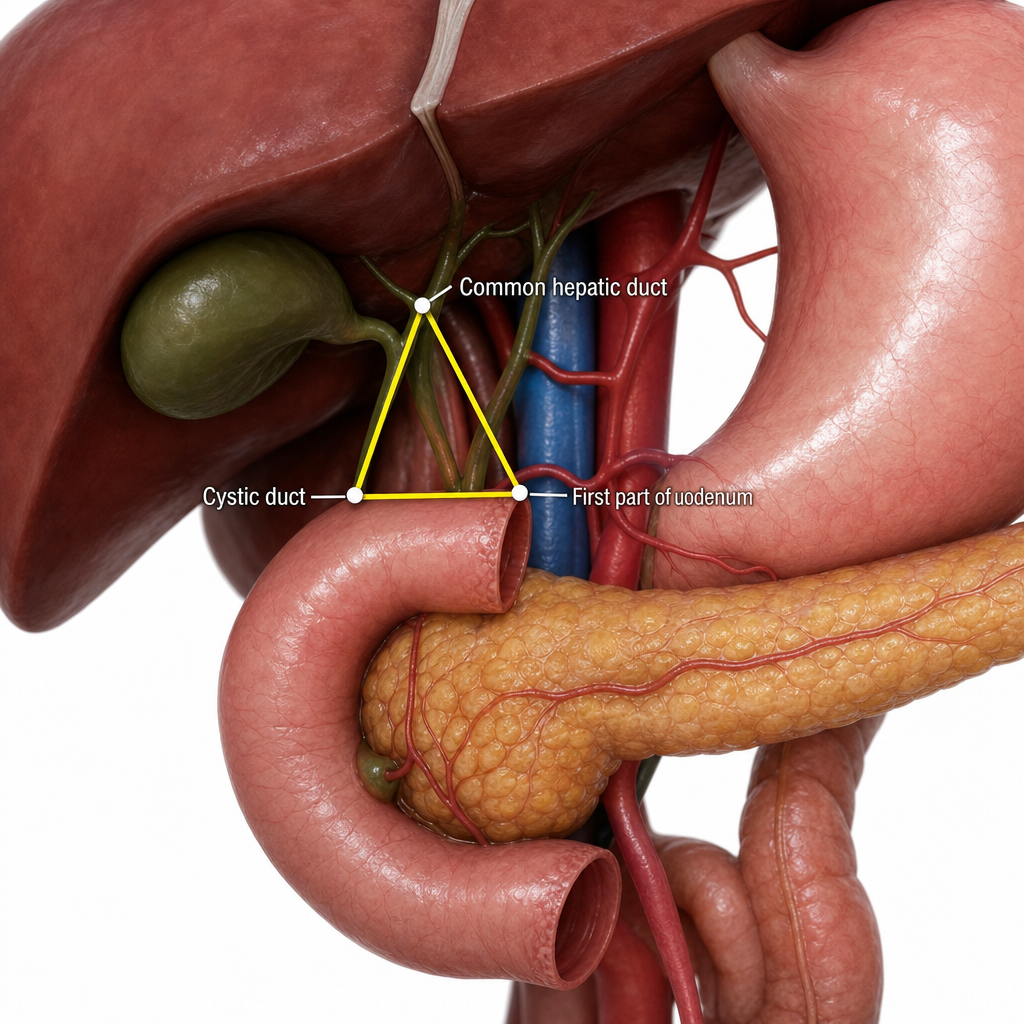
Explanation: ### Explanation **1. Why Option B is the Correct (False) Statement:** The portal vein is formed by the union of the **superior mesenteric vein** and the **splenic vein**. This formation occurs behind the **neck of the pancreas**, not the head [1]. The head of the pancreas lies inferior and to the right of this junction, while the neck sits directly anterior to the formation of the portal vein and the commencement of the inferior vena cava. **2. Analysis of Other Options:** * **Option A (True):** The portal vein is approximately 8 cm long [1]. The first 5 cm (extrahepatic portion) typically does not give off any major branches before it reaches the porta hepatis, where it divides into right and left branches. * **Option C (True):** In anatomical terms, the portal vein is considered to have a relatively constant length (approx. 7–8 cm) and course in the majority of the population, unlike highly variable arterial structures [1]. * **Option D (True):** The portal vein is the primary vessel of the hepatic portal system, draining blood from the gastrointestinal tract (from the lower esophagus to the upper anal canal), spleen, pancreas, and gallbladder to the liver [1][2]. **3. NEET-PG High-Yield Pearls:** * **Course:** It ascends behind the first part of the duodenum and lies in the free margin of the **lesser omentum** [1]. * **Relations in Lesser Omentum:** The portal vein is **posterior**, the hepatic artery is anterior and left, and the bile duct is anterior and right (Mnemonic: **V**ein is **V**ery behind). * **Portosystemic Anastomosis:** Crucial sites include the lower esophagus (esophageal varices), umbilicus (caput medusae), and rectum (hemorrhoids). * **Pressure:** Normal portal pressure is **5–10 mmHg**. Portal hypertension is defined as pressure >12 mmHg.
Explanation: The stomach is primarily supplied by branches of the **Celiac Trunk**, which is the artery of the foregut. The **Superior Mesenteric Artery (SMA)** is the artery of the midgut; it supplies the gastrointestinal tract from the distal half of the duodenum to the proximal two-thirds of the transverse colon [1], [2]. Therefore, the SMA does not provide direct arterial supply to the stomach. **Analysis of Options:** * **Left Gastric Artery (Option B):** A direct branch of the celiac trunk. it supplies the upper part of the lesser curvature and is the smallest branch of the celiac trunk. * **Right Gastric Artery (Option D):** Usually a branch of the Common Hepatic Artery (or Proper Hepatic). It supplies the lower part of the lesser curvature and anastomoses with the left gastric artery. * **Short Gastric Arteries (Option A):** These are 5–7 small branches arising from the **Splenic Artery** (a branch of the celiac trunk). They supply the fundus of the stomach. * **Other contributors (not listed):** The Right Gastroepiploic (from Gastroduodenal) and Left Gastroepiploic (from Splenic) supply the greater curvature. **High-Yield Clinical Pearls for NEET-PG:** * **Source of Bleeding:** The **Left Gastric Artery** is the most common source of arterial bleeding in gastric ulcers (lesser curvature). * **Splenic Artery Ligation:** If the splenic artery is ligated proximal to the origin of the short gastric arteries, the stomach fundus may undergo necrosis. * **Celiac Trunk Branches:** Remember the "LHS" mnemonic: **L**eft gastric, **H**epatic (common), and **S**plenic arteries.
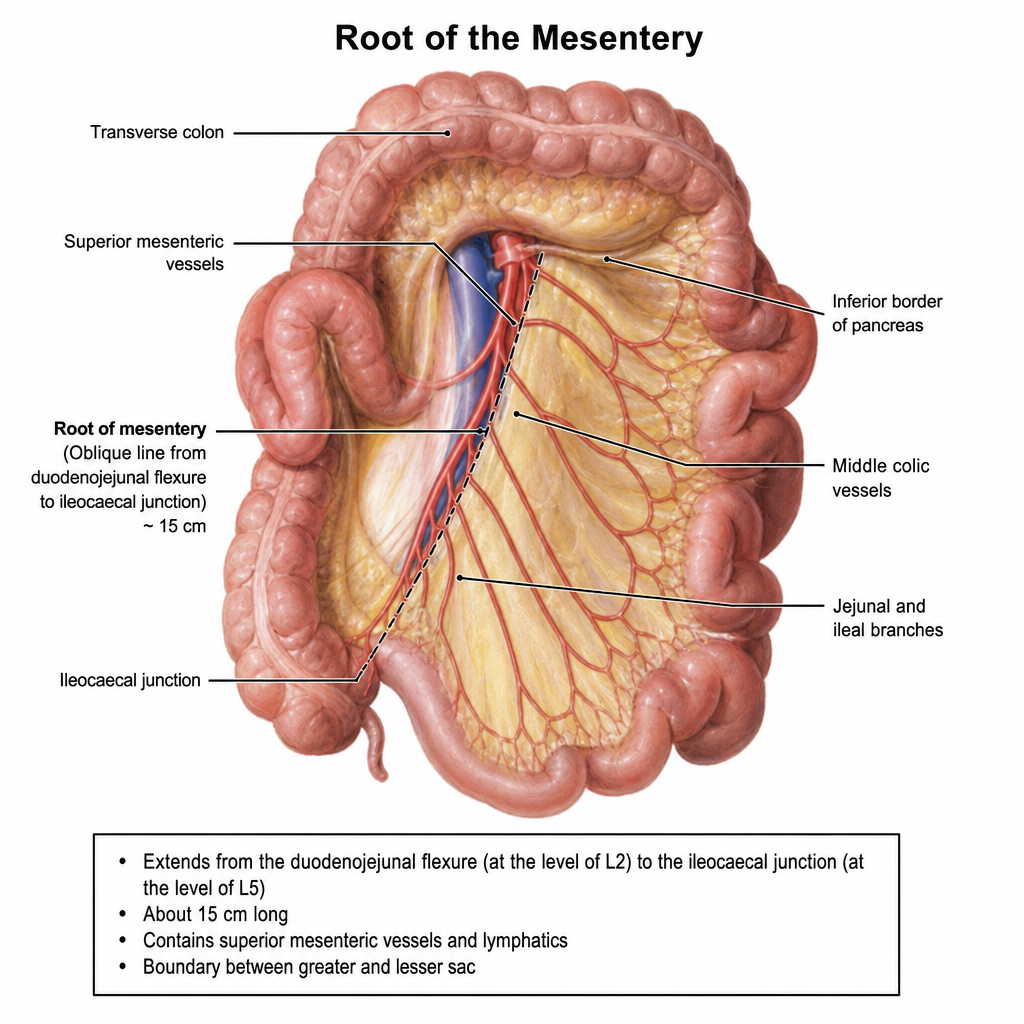
Explanation: **Explanation:** The **paraduodenal fossa** (fossa of Landzert) is a peritoneal recess located to the left of the ascending part of the duodenum. It is of significant clinical importance in surgery and radiology as it is a common site for **internal hernias**. [1] **Why Inferior Mesenteric Vein is Correct:** The paraduodenal fossa is formed by a fold of peritoneum called the **paraduodenal fold**. The free edge of this fold contains two vital structures that serve as its surgical landmarks: 1. **Inferior Mesenteric Vein (IMV):** Runs in the anterior margin of the fossa. 2. **Ascending branch of the Left Colic Artery:** Accompanies the vein. During surgery for a strangulated paraduodenal hernia, surgeons must be extremely cautious not to injure the IMV while widening the neck of the sac. [1] **Analysis of Incorrect Options:** * **A. Gonadal vein:** These vessels (testicular/ovarian) lie retroperitoneally on the psoas major muscle, posterior to the duodenum, but are not part of the paraduodenal fold. * **B. Superior mesenteric artery:** This artery passes **anterior** to the third part of the duodenum (within the root of the mesentery) and is related to the *superior* duodenal fossa, not the paraduodenal fossa. * **C. Portal vein:** Formed behind the neck of the pancreas by the union of the SMV and splenic vein, it lies much higher and more medial than the paraduodenal fossa. [2] **High-Yield Clinical Pearls for NEET-PG:** * **Internal Hernia:** The paraduodenal fossa is the most common site for internal hernias (left-sided). [1] * **Landmark:** The IMV is the "vascular arch" (Arch of Treitz) that forms the anterior boundary of this fossa. * **Other Duodenal Fossae:** Superior duodenal (50%), Inferior duodenal (75%), and Retroduodenal (rare). The paraduodenal is present in about 2% of individuals but is the most clinically significant.
Explanation: **Explanation:** **Appendices epiploicae** (omental appendices) are small, peritoneum-covered pouches of fat found along the surface of the large intestine. They are characteristic features of the colon, but their distribution is not uniform. **Why Sigmoid Colon is Correct:** Appendices epiploicae are most numerous and largest in the **sigmoid colon**. While they are present throughout most of the colon, they reach their maximum development in this segment [1]. They are typically found in two rows along the *taenia libera* and *taenia omentalis*. **Analysis of Incorrect Options:** * **Appendix:** It lacks appendices epiploicae and also lacks taeniae coli (the longitudinal muscle layer is continuous). * **Caecum:** Appendices epiploicae are generally absent on the caecum. * **Rectum:** The rectum is characterized by the absence of three features typical of the colon: taeniae coli, haustrations (sacculations), and **appendices epiploicae** [1]. The fat disappears at the rectosigmoid junction. **High-Yield Clinical Pearls for NEET-PG:** * **Identification:** During surgery, the presence of appendices epiploicae is a reliable landmark to distinguish the large intestine from the small intestine. * **Epiploic Appendagitis:** This is a clinical condition where an appendix epiploica undergoes torsion or infarction, mimicking the pain of acute appendicitis or diverticulitis. * **Distribution Note:** They are absent in the appendix, caecum, and rectum. They are also absent in the small intestine. * **Blood Supply:** Each appendix epiploica is supplied by a small nutrient artery (a branch of the vasa recta), which makes them prone to ischemia if twisted.
Explanation: **Explanation:** The patient is presenting with symptoms suggestive of a perforated or inflamed duodenal ulcer. The duodenum is a foregut-derived structure (up to the entry of the bile duct) and its visceral pain is mediated by the autonomic nervous system [2]. **1. Why Option A is Correct:** Visceral pain from the upper abdominal organs (stomach, first part of the duodenum, liver, and pancreas) is carried by **sympathetic afferent fibers**. These fibers travel retrograde from the celiac plexus via the **Greater Splanchnic Nerve** to reach the spinal cord segments **T5–T9**. Since the duodenum is part of the foregut, the greater splanchnic nerve is the primary pathway for transmitting this nociceptive information. **2. Why the Other Options are Incorrect:** * **Option B (Ventral roots):** Ventral roots carry efferent (motor) fibers. Sensory/afferent information enters the spinal cord via the **dorsal roots** [2]. * **Option C (Lower intercostal nerves):** These nerves (T7–T11) supply the parietal peritoneum of the abdominal wall [1]. While they may be involved if there is localized peritonitis irritating the anterior abdominal wall, the primary visceral pain from the duodenum itself is splanchnic. * **Option D (Lesser splanchnic nerve):** This nerve (T10–T11) primarily supplies midgut structures (e.g., small intestine distal to the duodenum, ascending colon). **NEET-PG High-Yield Pearls:** * **Greater Splanchnic Nerve:** T5–T9 (Foregut) * **Lesser Splanchnic Nerve:** T10–T11 (Midgut) * **Least Splanchnic Nerve:** T12 (Hindgut/Kidney) * **Referred Pain:** Duodenal pain is typically felt in the **epigastric region** because the afferent fibers enter the T5–T9 spinal segments. * **Clinical Correlation:** If a posterior duodenal ulcer perforates, it may erode the **gastroduodenal artery**, leading to massive hemorrhage [3].
Explanation: ### Explanation **Concept of Watershed Zones** A watershed zone is an area of the body that receives a dual blood supply from the most distal branches of two large arteries [1]. These regions are highly susceptible to **ischemic colitis** during periods of systemic hypotension because they are the "end-of-the-line" for perfusion [3]. **Why the Rectosigmoid Junction is Correct** The rectosigmoid junction (specifically **Sudeck’s point**) is a critical watershed area where the blood supply transitions from the **Inferior Mesenteric Artery (IMA)** (via the last sigmoid artery) to the **Internal Iliac Artery** (via the superior rectal artery) [2]. Because these terminal branches have relatively weak anastomoses, this area is prone to ischemia. **Analysis of Incorrect Options** * **A & B (Cecum and Ascending Colon):** These are primarily supplied by the Ileocolic and Right Colic branches of the Superior Mesenteric Artery (SMA) [1]. While the cecum has a high wall tension, it is not a classic watershed zone. * **D (Transverse Colon):** While the **Splenic Flexure (Griffith’s point)** is the *other* major watershed zone (transition from SMA to IMA), the transverse colon itself is generally well-perfused by the middle colic artery [1]. **Clinical Pearls for NEET-PG** 1. **Two Major Watershed Zones of the Gut:** * **Griffith’s Point:** Splenic flexure (SMA meets IMA) [1]. * **Sudeck’s Point:** Rectosigmoid junction (IMA meets Internal Iliac) [2]. 2. **Clinical Presentation:** Ischemic colitis typically presents as sudden onset abdominal pain followed by bloody diarrhea, often occurring after an episode of hypotension or cardiac surgery [3]. 3. **Marginal Artery of Drummond:** This is the continuous arterial arcade along the inner border of the colon that provides collateral circulation, but it is often thin or incomplete at the splenic flexure and rectosigmoid junction [1].
Explanation: The kidney's blood supply is a high-yield topic for NEET-PG, focusing on its unique segmental anatomy and venous drainage. ### **Explanation of the Correct Answer** **Option B is FALSE** because the kidney is **not** a site of portal-systemic anastomosis. Portal-systemic (portosystemic) anastomoses occur where the portal venous system communicates with the systemic venous system (e.g., lower esophagus, rectum, and umbilicus) [3]. The renal veins drain directly into the Inferior Vena Cava (IVC), which is entirely a systemic circulation. While the left renal vein receives the left gonadal and suprarenal veins [1], it does not communicate with the portal system under normal physiological conditions. ### **Analysis of Other Options** * **Option A (True):** The **Stellate veins** are located in the superficial cortex. They drain the subcapsular capillaries and lead into the interlobular veins. * **Option C (True):** The renal artery typically divides into **five segmental arteries** (Apical, Upper, Middle, Lower, and Posterior) before or at the hilum. These segments are surgically significant as they form independent functional units (Brodel's line). * **Option D (True):** Renal segmental arteries are **anatomical end-arteries**. There are no significant anastomoses between them; therefore, an obstruction in one leads to an infarct of that specific segment. ### **High-Yield Clinical Pearls** * **Brodel’s Line:** An avascular plane on the convex lateral border of the kidney between the anterior and posterior segmental artery distributions, used for nephrolithotomy. * **Nutcracker Syndrome:** Compression of the **left renal vein** between the Abdominal Aorta and Superior Mesenteric Artery (SMA), leading to hematuria and left-sided varicocele. * **Sequence of Vessels:** Renal Artery → Segmental → Lobar → Interlobar → Arcuate → Interlobular → Afferent Arteriole [2].
Anterior Abdominal Wall
Practice Questions
Peritoneum and Peritoneal Cavity
Practice Questions
Stomach and Intestines
Practice Questions
Liver, Gallbladder and Biliary Tract
Practice Questions
Pancreas and Spleen
Practice Questions
Kidneys and Suprarenal Glands
Practice Questions
Abdominal Vasculature
Practice Questions
Posterior Abdominal Wall
Practice Questions
Innervation of Abdominal Viscera
Practice Questions
Applied Anatomy and Clinical Correlations
Practice Questions
Get full access to all questions, explanations, and performance tracking.
Start For Free