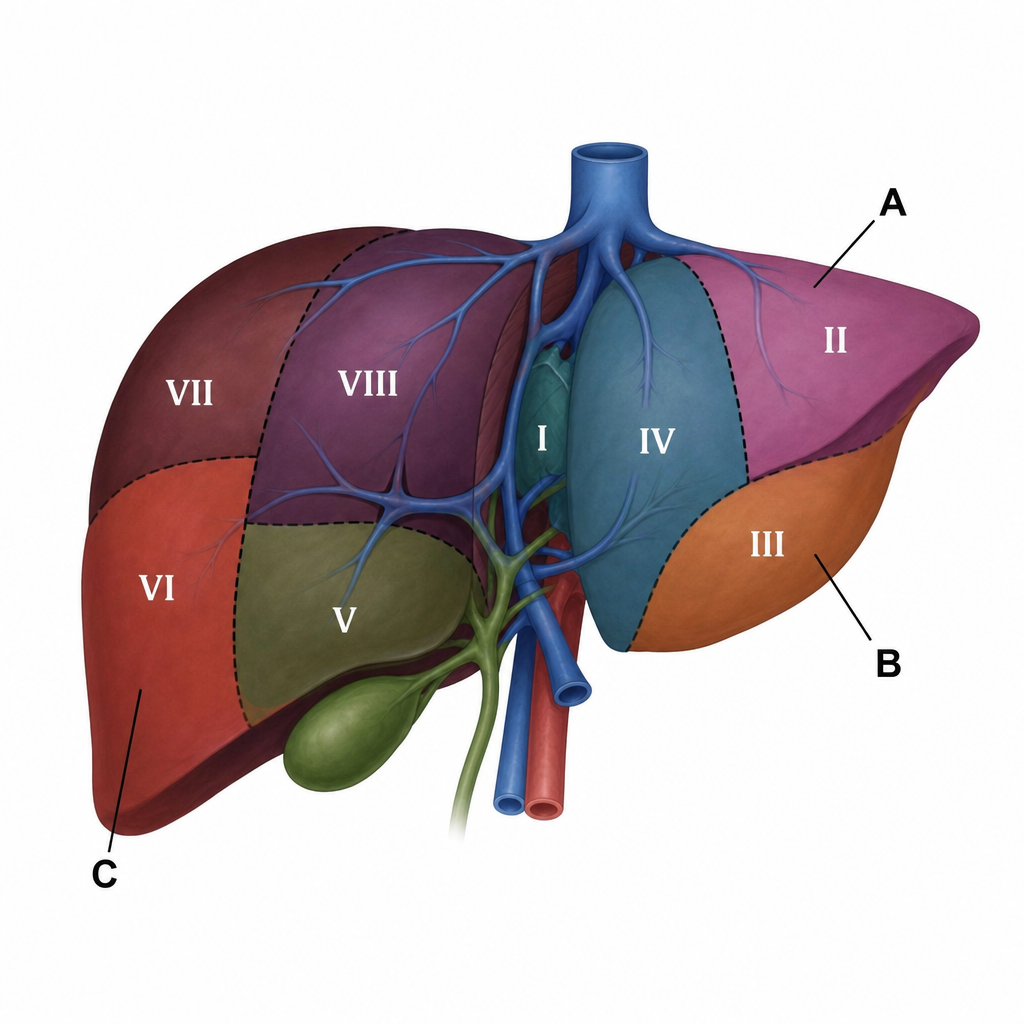
Which of the following structures is crossed by the root of the mesentery?
What artery supplies the duodenum?
Removal of the LL ganglion during sympathectomy results in what condition?
Which of the following is NOT true regarding the first part of the duodenum?
Which statement is NOT true regarding Primary Biliary Cholangitis (PBC)?
Which of the following is NOT related to the boundaries of the triangle of doom?
Which of the following is NOT a component of the renal cortex?
The internal oblique muscle is inserted into all of the following structures except?
Ureteric constrictions are found at all the following sites EXCEPT:
True regarding the kidneys is:
Explanation: The **root of the mesentery** is a 15 cm long oblique band of peritoneum that attaches the small intestine to the posterior abdominal wall. It extends from the duodenojejunal flexure (left side of L2) to the ileocecal junction (right sacroiliac joint). ### Why Option A is Correct As the root of the mesentery descends obliquely from left to right, it crosses several vital retroperitoneal structures. The **horizontal (3rd) part of the duodenum** is the most significant structure crossed by the root [1]. This anatomical relationship is crucial because the superior mesenteric vessels lie within the root, passing directly anterior to the 3rd part of the duodenum [1]. ### Why Other Options are Incorrect * **B & C (Left Gonadal Vessels and Left Ureter):** The root of the mesentery moves toward the **right** iliac fossa. Therefore, it crosses the **right** gonadal vessels and the **right** ureter (along with the right psoas major). It does not come into contact with left-sided structures. * **D (Superior Mesenteric Artery):** The SMA actually **runs within** the layers of the mesentery rather than being crossed by its root [1]. ### High-Yield Clinical Pearls for NEET-PG * **Structures crossed by the Root (Top to Bottom):** 1. Horizontal (3rd) part of the duodenum. 2. Abdominal aorta. 3. Inferior vena cava (IVC). 4. Right Psoas major muscle. 5. Right Ureter. 6. Right Genitofemoral nerve and Right Gonadal vessels. * **SMA Syndrome:** Compression of the 3rd part of the duodenum between the SMA (in the root) and the Aorta can lead to high intestinal obstruction [1]. * **Length Fact:** While the root is only **15 cm** long, the intestinal border it supports is approximately **6 meters** long, folded like a fan.
Explanation: The blood supply of the duodenum is a high-yield topic because it represents the transition point between two embryological regions: the **foregut** and the **midgut**. [2] ### **Explanation** The duodenum is supplied by both the celiac trunk and the superior mesenteric artery (SMA) due to its dual embryological origin: [2] 1. **Foregut portion:** The part of the duodenum proximal to the opening of the common bile duct (major duodenal papilla) is derived from the foregut. It is supplied by the **Superior Pancreaticoduodenal Artery**, a branch of the gastroduodenal artery (from the Celiac Trunk). [2] 2. **Midgut portion:** The part distal to the major duodenal papilla is derived from the midgut. It is supplied by the **Inferior Pancreaticoduodenal Artery**, which is the first branch of the **Superior Mesenteric Artery**. [2] These two arteries form an important **anastomotic arcade** within the C-loop of the duodenum, ensuring a rich collateral blood supply. [2] ### **Analysis of Options** * **A & B (Incorrect as standalone):** While both the SMA and Celiac artery contribute, selecting only one is incomplete. * **C (Incorrect):** The Inferior Mesenteric Artery supplies the hindgut (from the distal 1/3rd of the transverse colon to the upper rectum). [1] ### **NEET-PG High-Yield Pearls** * **The Watershed Line:** The junction of the foregut and midgut occurs at the **Major Duodenal Papilla (Ampulla of Vater)** in the 2nd part of the duodenum. * **Clinical Correlation:** In cases of **SMA Syndrome**, the 3rd part of the duodenum is compressed between the SMA and the Aorta. [2] * **Peptic Ulcer:** Posterior duodenal ulcers (usually in the 1st part) can erode the **Gastroduodenal Artery**, leading to life-threatening hemorrhage.
Explanation: The correct answer is **Sterility**. This occurs due to the disruption of the sympathetic nerve supply to the internal urethral sphincter and the ductus deferens. **Why Sterility is the Correct Answer:** The **L1 sympathetic ganglion** (often referred to as the "LL" or first lumbar ganglion) provides the preganglionic sympathetic fibers that form the superior hypogastric plexus. These fibers are responsible for: 1. **Ejaculation:** Stimulating the contraction of the ductus deferens and seminal vesicles. 2. **Bladder Neck Closure:** Maintaining the tone of the internal urethral sphincter during ejaculation. Removal or injury to the L1 ganglion leads to **retrograde ejaculation** (semen entering the bladder instead of the urethra) or failure of emission, both of which result in **sterility**, though erectile function remains intact. **Analysis of Incorrect Options:** * **A. Impotence:** Erection is a **parasympathetic** function (S2-S4 via pelvic splanchnic nerves) [1]. Lumbar sympathectomy does not typically cause impotence. * **B. Retention of Urine:** This is usually caused by parasympathetic injury or mechanical obstruction. Sympathetic injury actually relaxes the internal sphincter, which would not cause retention. * **C. Causalgia:** This is a chronic pain syndrome (Complex Regional Pain Syndrome Type II) following nerve injury. Sympathectomy is actually a *treatment* for causalgia, not a cause. **High-Yield Clinical Pearls for NEET-PG:** * **Mnemonic:** **P**oint and **S**hoot. **P**arasympathetic = **E**rection; **S**ympathetic = **E**jaculation. * Bilateral lumbar sympathectomy at the L1 level is avoided in young males to preserve fertility. * The **L2 ganglion** is the most common target for lower limb sympathectomy to treat peripheral vascular disease, as it avoids the L1 fibers responsible for ejaculation.
Explanation: ### Explanation The duodenum is a C-shaped organ divided into four parts. Understanding its embryological origin is key to mastering its blood supply and anatomy. **1. Why Option D is the Correct Answer (The False Statement):** The duodenum has a dual embryological origin. The part proximal to the opening of the common bile duct (the **first part** and the upper half of the second part) develops from the **foregut**. Therefore, it is primarily supplied by branches of the **Celiac Trunk** (specifically the supraduodenal, superior pancreaticodenal, and gastroduodenal arteries). The **Superior Mesenteric Artery (SMA)** supplies the midgut-derived portion (lower half of the second part, third part, and fourth part) via the inferior pancreaticoduodenal artery. **2. Analysis of Incorrect Options:** * **Option A:** The first part is indeed approximately **2 inches (5 cm)** long, making it the shortest part after the fourth part. * **Option B:** It is anatomically termed the **superior part** as it runs upward, backward, and laterally from the pylorus. * **Option C:** As mentioned, the first part originates from the **foregut**, which dictates its arterial supply from the celiac axis. **Clinical Pearls for NEET-PG:** * **Duodenal Ulcers:** The first part (specifically the first 2 cm) is the most common site for peptic ulcers because it receives acidic chyme directly from the stomach. * **Duodenal Cap:** The first 2 cm is intraperitoneal and mobile [1]; on X-ray with barium meal, it appears as a triangular shadow called the "duodenal cap." * **Posterior Relation:** A perforated ulcer on the posterior wall of the first part can erode the **gastroduodenal artery**, leading to massive hematemesis.
Explanation: Primary Biliary Cholangitis (PBC) is a chronic autoimmune cholestatic liver disease characterized by the destruction of small intrahepatic bile ducts. **1. Why Option A is the Correct Answer (The "False" Statement):** While PBC can progress to cirrhosis, the risk of developing **Hepatocellular Carcinoma (HCC)** is significantly lower compared to other chronic liver diseases like Hepatitis B, C, or Primary Sclerosing Cholangitis (PSC) [2]. While the risk is not zero in advanced stages, it is not considered a hallmark or a "high-risk" association in the same way it is for PSC (which also carries a high risk of Cholangiocarcinoma) [1]. Therefore, in the context of standard medical examinations, this is the least accurate statement. **2. Analysis of Other Options:** * **Option B (Asymptomatic):** True. Up to 50-60% of patients are asymptomatic at the time of diagnosis, often discovered incidentally through elevated alkaline phosphatase (ALP) on routine blood tests. * **Option C (Elevated IgM):** True. A characteristic laboratory finding in PBC is a significantly elevated serum **IgM** level, which helps differentiate it from other liver pathologies. * **Option D (AMA Positive):** True. **Anti-mitochondrial antibodies (AMA)** are the serological hallmark of PBC, present in over 95% of cases with high specificity (M2 subtype). **High-Yield Clinical Pearls for NEET-PG:** * **Demographics:** Classically affects middle-aged women (Female:Male ratio = 9:1). * **Clinical Features:** Pruritus (often the first symptom) and fatigue. Late signs include xanthelasma and hyperpigmentation. * **Diagnosis:** Elevated ALP + Positive AMA + Liver biopsy showing "florid duct lesions" (granulomatous destruction of bile ducts). * **Treatment:** **Ursodeoxycholic acid (UDCA)** is the first-line treatment to slow progression.
Explanation: The **Triangle of Doom** is a critical anatomical landmark during laparoscopic inguinal hernia repair (TEP/TAPP). It is an inverted V-shaped area located at the base of the inguinal region. [1] ### **Explanation of the Correct Answer** **Option D is NOT related** because the primary contents of the Triangle of Doom are the **External Iliac Artery and Vein**, not the internal iliac vessels. [1] Injury to these major vessels during mesh fixation (e.g., using tacks or staples) can lead to life-threatening hemorrhage, which is why the area is named "Doom." [1] ### **Analysis of Other Options** * **A. Medial Boundary:** The **Vas Deferens** (in males) or the Round Ligament (in females) forms the medial border of this triangle. [1] * **B. Lateral Boundary:** The **Gonadal vessels** (testicular vessels in males) form the lateral border. [1] * **C. Apex:** The apex is formed by the **Deep Inguinal Ring**, where the vas deferens and gonadal vessels meet. [1] ### **Clinical Pearls for NEET-PG** * **Triangle of Pain:** Located just lateral to the Triangle of Doom. It is bounded medially by the gonadal vessels and laterally by the iliopubic tract. It contains the **Lateral Femoral Cutaneous Nerve**, the **Femoral Nerve**, and the **Genitofemoral Nerve (femoral branch)**. [1] Injury here leads to chronic post-operative pain. * **The "Death" vs. "Pain" Distinction:** Remember, **Doom = Vessels** (External Iliac) while **Pain = Nerves**. [1] * **Surgical Safety:** Surgeons are taught to avoid placing tacks or staples inferior to the iliopubic tract to prevent injury to the structures within these two triangles. [1]
Explanation: The kidney is divided into two main zones: the outer **cortex** and the inner **medulla**. Understanding the microscopic and macroscopic distribution of structures is crucial for NEET-PG. ### **Explanation of the Correct Answer** The question asks which is **NOT** a component of the renal cortex. However, there is a technical error in the provided key: **Malpighian corpuscles (Renal corpuscles) ARE a primary component of the renal cortex.** [1] They consist of the glomerulus and Bowman’s capsule and are never found in the medulla. [2] The actual components that are **NOT** part of the cortex are the **Renal Pyramids (A)**, **Renal Papilla (C)**, and **Minor Calyces (D)**, as these are components of the renal medulla and the collecting system. *Note: If this were a "Single Best Answer" where you must pick the most "internal" structure, the **Minor Calyces** or **Renal Papilla** would be the most correct "Not Cortex" options.* ### **Analysis of Options** * **Malpighian Corpuscles (B):** Located exclusively in the **cortex** (specifically in the cortical labyrinths). [1] * **Renal Pyramids (A):** These make up the **renal medulla**. Their bases face the cortex, and their apices face the renal sinus. * **Renal Papilla (C):** This is the apex of the renal pyramid that empties urine into the minor calyx; it is a **medullary** structure. * **Minor Calyces (D):** Part of the **collecting system** (extra-parenchymal), located in the renal sinus, well away from the cortex. ### **High-Yield Clinical Pearls for NEET-PG** * **Columns of Bertin:** These are extensions of cortical tissue that lie between the renal pyramids. They are technically **cortical** in nature but located deep within the medullary zone. * **Medullary Rays (Ferrein’s pyramids):** These are striations of straight tubules and collecting ducts that originate in the cortex but are continuous with the medulla. * **Blood Supply:** The cortex receives ~90% of renal blood flow, making it more susceptible to certain toxins, whereas the medulla is relatively hypoxic and susceptible to ischemic injury (Acute Tubular Necrosis).
Explanation: To answer this question correctly, one must distinguish between the **origin** (proximal attachment) and the **insertion** (distal attachment) of the internal oblique muscle [1]. ### **Explanation of the Correct Answer** The **iliac crest** is the correct answer because it serves as a site of **origin**, not insertion, for the internal oblique. Specifically, the muscle arises from the lateral two-thirds of the upper surface of the intermediate line of the iliac crest (as well as the thoracolumbar fascia and the lateral two-thirds of the inguinal ligament) [1]. Since the question asks for structures where the muscle is *inserted*, the iliac crest is the "except" option. ### **Analysis of Incorrect Options (Sites of Insertion)** The fibers of the internal oblique pass upwards and medially to insert into: * **Xiphoid Process (Option A):** The uppermost fibers insert directly into the inferior border of the xiphoid process [1]. * **Linea Alba (Option D):** The intermediate fibers form an aponeurosis that splits to enclose the rectus abdominis and fuses at the midline to form the linea alba. * **Pubic Crest (Option C):** The lowermost fibers arch over the spermatic cord and join with the transversus abdominis aponeurosis to form the **conjoint tendon**, which inserts into the pubic crest and pectineal line [2]. ### **High-Yield NEET-PG Pearls** * **Direction of Fibers:** Internal oblique fibers run "Upwards and Forwards" (perpendicular to the external oblique, which run "Downwards and Forwards" like hands in pockets) [1]. * **Conjoint Tendon:** Formed by the fusion of the aponeuroses of the Internal Oblique and Transversus Abdominis [2]. It strengthens the medial half of the inguinal canal. * **Cremaster Muscle:** This muscle is derived specifically from the lower fasciculi of the internal oblique. * **Nerve Supply:** It is supplied by the lower six thoracic nerves (T7-T12) AND the **Iliohypogastric and Ilioinguinal nerves (L1)** [3]. This is a common exam point as L1 provides motor supply here but only sensory supply to the skin.
Explanation: The ureter is a muscular tube approximately 25 cm long that transports urine from the kidney to the bladder. Along its course, there are specific anatomical sites where the lumen narrows. These **ureteric constrictions** are clinically significant as they are the most common sites for the impaction of renal calculi (stones). **Why 'Mesentery' is the correct answer:** The ureter is a **retroperitoneal** structure [1]. It runs posterior to the peritoneum and does not enter or pass through the mesentery (which is a fold of peritoneum attaching the intestines to the posterior abdominal wall). Therefore, the mesentery does not cause any anatomical narrowing of the ureter. **Analysis of Incorrect Options:** * **Pelviureteric Junction (PUJ):** This is the first and narrowest constriction, located where the renal pelvis funnels into the ureter. * **Crossing the Iliac Artery:** The ureter is constricted as it crosses the pelvic brim [2], specifically over the bifurcation of the **common iliac artery** (or the start of the internal iliac artery). * **Bladder Wall (Intramural part):** This is the final constriction where the ureter pierces the muscular wall of the urinary bladder obliquely [2]. This narrow segment acts as a physiological valve to prevent vesicoureteric reflux. **NEET-PG High-Yield Pearls:** 1. **Sequence of Constrictions:** 1. PUJ, 2. Pelvic Brim (Iliac crossing), 3. Ureterovesical Junction (UVJ). Some texts also include the crossing of the **gonadal vessels** or the **Vas Deferens/Uterine artery** as minor sites. 2. **Blood Supply:** The ureter receives segmental supply. In the abdomen, the supply is medial (from the aorta/renal arteries); in the pelvis, it is lateral (from internal iliac branches). 3. **Water Under the Bridge:** In females, the ureter passes inferior to the uterine artery—a critical landmark during hysterectomy [2].
Explanation: ### Explanation **Correct Answer: C. The iliohypogastric and ilioinguinal nerves lie behind the posterior surface of the kidney.** The posterior surface of the kidney is related to several structures that form the "renal bed." From medial to lateral, these include the psoas major, quadratus lumborum, and transversus abdominis muscles. Crucially, three nerves descend diagonally across the posterior aspect of the kidney: the **subcostal (T12)**, **iliohypogastric (L1)**, and **ilioinguinal (L1)** nerves [3]. These nerves lie between the kidney and the quadratus lumborum muscle, making them vulnerable during posterior surgical approaches to the kidney. **Why the other options are incorrect:** * **Option A:** The average weight of an adult kidney is approximately **135–150 grams** (roughly the size of a closed fist). 340 grams would indicate significant renomegaly. * **Option B:** The **transpyloric plane (L1)** passes through the **upper part of the hilum** of the left kidney and the **upper pole** of the right kidney. Therefore, the majority of the left kidney lies above this plane, not below it. * **Option D:** On the right side, the hilum is related to the **2nd part (descending part) of the duodenum**, which is retroperitoneal and lies directly in front of the medial portion of the right kidney [1]. The 3rd part of the duodenum runs horizontally below the level of the hilum. **High-Yield Clinical Pearls for NEET-PG:** * **Vertebral Level:** Kidneys extend from **T12 to L3**. The right kidney is usually 1–2 cm lower than the left due to the liver. * **Renal Fascia (Gerota’s):** Encloses the kidney and suprarenal gland but separates them by a thin septum [1], [2]. * **Order of structures at the Hilum (Anterior to Posterior):** Renal **V**ein, Renal **A**rtery, Renal **P**elvis (**V-A-P**). * **Diaphragmatic relations:** The kidneys are related to the costodiaphragmatic pleura; hence, a renal biopsy or surgery carries a risk of pneumothorax.
Anterior Abdominal Wall
Practice Questions
Peritoneum and Peritoneal Cavity
Practice Questions
Stomach and Intestines
Practice Questions
Liver, Gallbladder and Biliary Tract
Practice Questions
Pancreas and Spleen
Practice Questions
Kidneys and Suprarenal Glands
Practice Questions
Abdominal Vasculature
Practice Questions
Posterior Abdominal Wall
Practice Questions
Innervation of Abdominal Viscera
Practice Questions
Applied Anatomy and Clinical Correlations
Practice Questions
Get full access to all questions, explanations, and performance tracking.
Start For Free