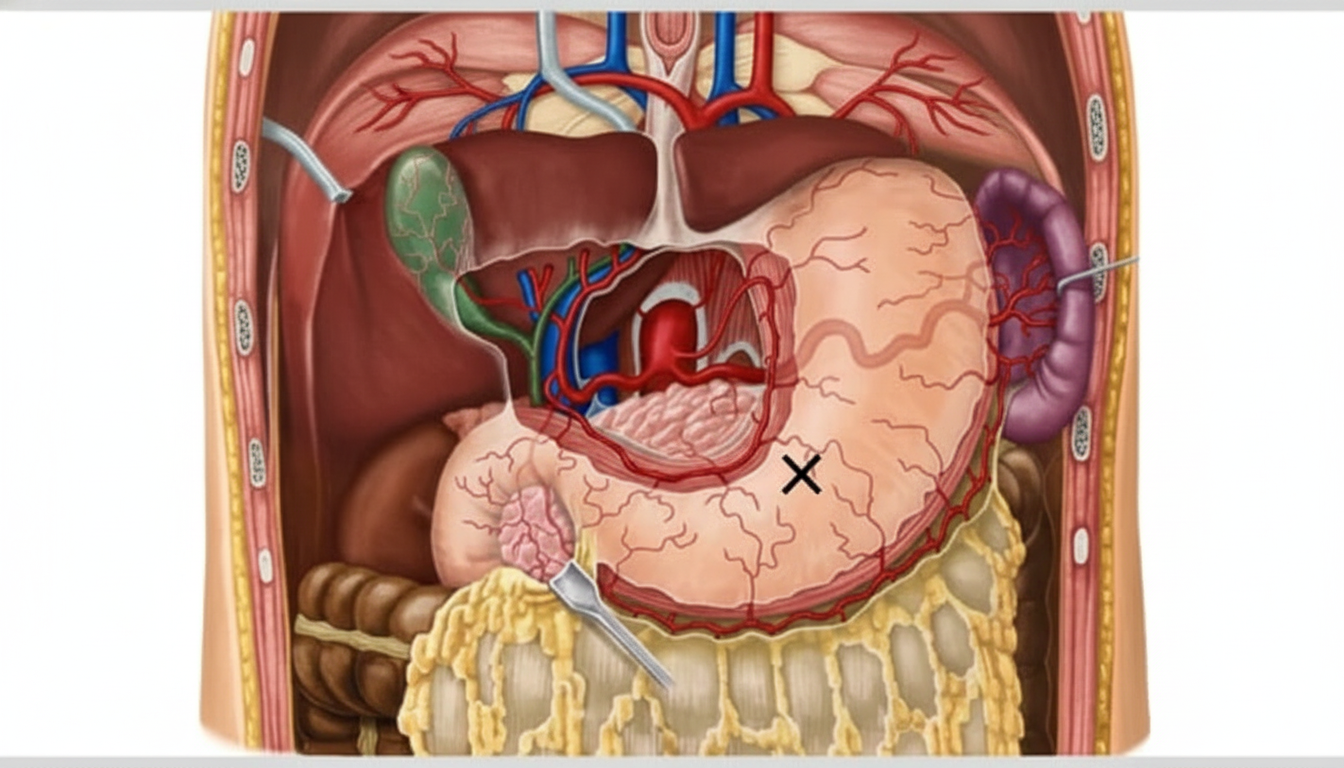
Submucosal glands are present in which one of the following organs?
Scarpa's fascia gets attached to which of the following?
What vessel is responsible for the venous drainage of the liver into the inferior vena cava?
A 67-year-old man has severe cirrhosis of the liver. He most likely has enlarged anastomoses between which of the following pairs of veins?
Which artery supplies the midgut?
What is the commonest site of an accessory spleen?
Which of the following statements is NOT true regarding the ligament of Treitz?
Which of the following is NOT a complication of endoscopic sclerotherapy?
Right gastric nodes drain from which part of the stomach?
Which of the following statements regarding the medial umbilical folds is true?
Explanation: The presence of submucosal glands is a defining histological feature of the **Duodenum**. These are known as **Brunner’s glands**. **1. Why Duodenum is Correct:** Brunner’s glands are branched tubuloalveolar glands located specifically in the submucosa of the duodenum (most abundant in the first part). Their primary function is to secrete an alkaline fluid (rich in bicarbonate and mucus) that neutralizes the highly acidic chyme entering from the stomach [2]. This protects the duodenal mucosa and provides an optimal pH for the activation of pancreatic enzymes. **2. Why Other Options are Incorrect:** * **Stomach:** The glands of the stomach (gastric, cardiac, and pyloric glands) are located in the **mucosa (lamina propria)**, not the submucosa [1]. * **Colon:** The colon contains deep intestinal crypts (Crypts of Lieberkühn) lined with numerous goblet cells, but these are strictly mucosal. There are no glands in the colonic submucosa. * **Anal Canal:** The upper part contains mucosal crypts, and the lower part is lined by stratified epithelium. While "anal glands" exist at the dentate line, they typically vestige into the submucosa or internal sphincter, but they are not a characteristic histological feature of the alimentary submucosa like Brunner's glands. **Clinical Pearls for NEET-PG:** * **Rule of Two:** There are only two locations in the entire GI tract with submucosal glands: the **Esophagus** (Esophageal glands proper) and the **Duodenum** (Brunner’s glands). * **Brunner’s Gland Adenoma:** A rare benign tumor (also called Brunneroma) usually found in the second part of the duodenum. * **Urogastrone:** Brunner’s glands also secrete urogastrone, which inhibits gastric acid secretion.
Explanation: The superficial fascia of the lower abdominal wall is divided into two layers: the superficial fatty layer (**Camper’s fascia**) and the deep membranous layer (**Scarpa’s fascia**). [1] **Why Option B is correct:** Scarpa’s fascia continues downward into the thigh, where it fuses with the **fascia lata** (the deep fascia of the thigh) approximately **1 cm (one finger-breadth) below and parallel to the inguinal ligament**. This line of fusion is known as **Holden’s line**. This attachment is clinically significant because it prevents superficial abdominal fluid collections (like urine or blood) from tracking down into the lower limbs. **Why the other options are incorrect:** * **A. Inguinal Ligament:** Scarpa’s fascia passes *over* the inguinal ligament without attaching to it. It only fuses with the deep fascia of the thigh (fascia lata) slightly distal to the ligament. [1] * **C & D. Conjoint Tendon and Pubic Crest:** These are deep structures related to the posterior wall of the inguinal canal and the rectus sheath. Scarpa’s fascia is a superficial structure; while it does attach to the pubic symphysis and the fascia of the dorsum of the penis/clitoris, it does not attach to the pubic crest or the conjoint tendon. **High-Yield Clinical Pearls for NEET-PG:** * **Extravasation of Urine:** In cases of rupture of the bulbous urethra, urine can collect in the superficial perineal pouch. Because Scarpa’s fascia is continuous with **Colles’ fascia** (perineum) and **Dartos muscle** (scrotum), urine can track up into the abdominal wall. However, it **cannot** pass into the thigh due to the attachment of Scarpa’s fascia to the fascia lata (Holden’s line). * **Surgical Importance:** Scarpa’s fascia is strong enough to hold sutures, making it a critical layer for surgeons to close during abdominal procedures to ensure wound strength.
Explanation: ### Explanation **Correct Answer: B. Hepatic Veins** The liver has a unique dual blood supply but a single primary venous drainage system. The **hepatic veins** (Right, Middle, and Left) are the final common pathway for blood leaving the liver [1]. They emerge from the posterior surface of the liver and drain directly into the **Inferior Vena Cava (IVC)** just before it passes through the diaphragm to enter the right atrium [1], [3]. This represents the systemic venous return of the hepatic circulation. **Why the other options are incorrect:** * **A. Portal Vein:** This is an **afferent** vessel. It carries nutrient-rich, deoxygenated blood *from* the gastrointestinal tract *to* the liver (supplying 75% of the liver's blood) [2]. It does not drain into the IVC; it terminates at the porta hepatis by dividing into right and left branches. * **C. Azygous Vein:** This vessel drains the thoracic wall and upper lumbar region. While it can serve as a collateral pathway in portal hypertension (porto-systemic anastomosis), it is not the primary drainage route for the liver. * **D. Superior Mesenteric Vein (SMV):** The SMV drains the small intestine and proximal colon. It joins the splenic vein behind the neck of the pancreas to **form the portal vein** [2]. **NEET-PG High-Yield Pearls:** 1. **Segmental Anatomy:** The hepatic veins serve as longitudinal boundaries that divide the liver into its functional segments (Couinaud classification). 2. **Budd-Chiari Syndrome:** This clinical condition is caused by the obstruction of hepatic venous outflow (e.g., thrombosis of hepatic veins), leading to hepatomegaly, ascites, and abdominal pain. 3. **Ligamentum Venosum:** This is the fibrous remnant of the ductus venosus, which in fetal life shunts blood from the left portal vein directly to the IVC, bypassing the liver sinusoids.
Explanation: **Explanation:** The clinical presentation of cirrhosis leads to **portal hypertension** [1]. When the portal venous system is obstructed, blood is diverted from the portal circulation to the systemic circulation through **porto-caval (porto-systemic) anastomoses** [1]. **1. Why Option C is Correct:** At the lower end of the esophagus, an important anastomosis exists between the **Left Gastric Vein** (a tributary of the Portal Vein) and the **Esophageal Veins** (which drain into the Azygos system/Superior Vena Cava) [1]. In cirrhosis, increased pressure causes these veins to dilate, forming **esophageal varices**, which are prone to life-threatening hematemesis [1]. **2. Why Other Options are Incorrect:** * **Option A (Inferior/Superior phrenic):** Both are systemic veins. While the inferior phrenic can participate in retroperitoneal anastomoses, this pair does not represent a primary porto-caval junction. * **Option B (Left/Middle colic):** Both are tributaries of the portal system (via the inferior and superior mesenteric veins, respectively). This is a **porto-portal** anastomosis, not porto-caval. * **Option C (Lumbar/Renal):** Both are systemic veins draining into the Inferior Vena Cava (IVC). **3. High-Yield NEET-PG Clinical Pearls:** Other key porto-caval sites to remember: * **Umbilicus:** Paraumbilical veins (Portal) + Superficial epigastric veins (Systemic). Clinical sign: **Caput Medusae** [1]. * **Anal Canal:** Superior rectal vein (Portal) + Middle/Inferior rectal veins (Systemic). Clinical sign: **Anorectal varices** (Internal hemorrhoids). * **Retroperitoneum (Retzius):** Colic veins (Portal) + Renal/Lumbar veins (Systemic) [1]. * **Bare area of liver:** Hepatic venules (Portal) + Phrenic veins (Systemic).
Explanation: The development of the gastrointestinal tract is divided into the foregut, midgut, and hindgut, each supplied by a specific ventral branch of the abdominal aorta. [3] 1. **Superior Mesenteric Artery (SMA):** This is the artery of the **midgut**. [1] The midgut extends from the distal half of the second part of the duodenum (at the opening of the bile duct) to the junction of the proximal two-thirds and distal one-third of the transverse colon. The SMA supplies all structures within this range, including the small intestine, cecum, appendix, ascending colon, and most of the transverse colon. [1], [2] **Analysis of Incorrect Options:** * **Celiac Trunk (Option A):** This is the artery of the **foregut**. It supplies the esophagus, stomach, and the proximal half of the duodenum, along with the liver, gallbladder, and spleen. [2] * **Inferior Mesenteric Artery (Option B):** This is the artery of the **hindgut**. It supplies the distal one-third of the transverse colon, descending colon, sigmoid colon, and the upper part of the rectum. [1] * **Proper Hepatic Artery (Option C):** This is a branch of the common hepatic artery (from the celiac trunk). It specifically supplies the liver and gallbladder, which are foregut derivatives. **Clinical Pearls for NEET-PG:** * **SMA Syndrome:** Compression of the third part of the duodenum between the SMA and the aorta, often seen after rapid weight loss. [2] * **Midgut Volvulus:** Occurs due to malrotation of the gut; the SMA can be compromised, leading to intestinal gangrene. * **Watershed Areas:** The **Griffith’s point** (splenic flexure) is a site of potential ischemia where the territories of the SMA and IMA meet. [1]
Explanation: Explanation: An **accessory spleen (splenunculus)** is a small nodule of healthy splenic tissue found apart from the main body of the spleen. It results from the failure of fusion of separate splenic primordia (mesenchymal buds) within the **dorsal mesogastrium** during embryonic development. **1. Why the Hilum of the Spleen is Correct:** The **hilum of the spleen** is the most common site, accounting for approximately **75%** of all accessory spleens [1]. This is because the splenic primordia originate near the terminal part of the dorsal mesogastrium, which eventually becomes the hilum. **2. Analysis of Incorrect Options:** * **Lienorenal (Splenorenal) ligament:** This is the second most common site (approx. 20%). It contains the tail of the pancreas and the splenic vessels. * **Gastrosplenic ligament:** While accessory spleens can occur here, it is less frequent than the hilum or the lienorenal ligament [1]. * **Tail of the pancreas:** Accessory spleens are often found *near* the tail (within the lienorenal ligament), but the hilum remains the primary statistical site [1]. **3. NEET-PG High-Yield Pearls:** * **Clinical Significance:** In patients undergoing **splenectomy** for hematological disorders (e.g., Immune Thrombocytopenic Purpura or Hereditary Spherocytosis), failure to remove an accessory spleen can lead to **recurrence of the disease** (compensatory hypertrophy). * **Radiological Mimic:** On CT scans, an accessory spleen can be mistaken for a pancreatic tumor or lymphadenopathy. * **Other Rare Sites:** They can be found in the omentum, mesentery, or even the **scrotum** (due to the close proximity of the splenic primordium and the urogenital ridge during development).
Explanation: The **Ligament of Treitz** (Suspensory muscle of the duodenum) is a fibromuscular band that connects the duodenojejunal (DJ) flexure to the right crus of the diaphragm. **Why Option D is the correct answer (The False Statement):** The ligament of Treitz is **not** synonymous with the duodenal mesentery. In fact, the duodenum is primarily a retroperitoneal organ (except for the first 2 cm) and lacks a true mesentery. The ligament is a distinct anatomical structure composed of skeletal muscle (from the diaphragm), smooth muscle (from the duodenum), and connective tissue, rather than a peritoneal fold. **Analysis of Incorrect Options:** * **Option A:** True. Its primary anatomical function is to suspend and support the DJ flexure, maintaining its position. * **Option B:** True. Radiologically (e.g., on a Barium meal), the DJ flexure must be located to the left of the vertebral midline and at the level of the pylorus [1]. If it is displaced to the right, it is a hallmark sign of **intestinal malrotation** [1]. * **Option C:** True. "Suspensory ligament of the duodenum" is the formal anatomical synonym for the Ligament of Treitz. **Clinical Pearls for NEET-PG:** * **Anatomical Landmark:** It marks the formal division between the **Upper Gastrointestinal (UGI) tract** and the **Lower Gastrointestinal (LGI) tract**. * **Clinical Significance:** Bleeding proximal to this ligament presents as hematemesis or melena (UGI bleed), while bleeding distal to it typically presents as hematochezia (LGI bleed). * **Surgical Landmark:** During laparotomy, it is used to identify the start of the jejunum.
Explanation: **Explanation:** **Endoscopic Sclerotherapy (EST)** is a procedure used to treat bleeding esophageal varices by injecting a sclerosing agent (e.g., ethanolamine oleate or sodium tetradecyl sulfate) into or around the vein. This induces local inflammation, thrombosis, and eventual fibrosis to obliterate the lumen. **Why Hepatic Encephalopathy (HE) is the correct answer:** Hepatic encephalopathy is a systemic complication of portal hypertension, often exacerbated by **Portosystemic Shunts (TIPS)** or surgical shunting, where blood bypasses the liver's detoxification process [1]. Sclerotherapy is a **local, obliterative procedure**; it does not create a shunt. In fact, by stopping a variceal bleed (which would otherwise load the gut with nitrogenous blood products), EST may indirectly help *prevent* an episode of HE rather than cause it. **Analysis of Incorrect Options:** * **Perforation:** The sclerosing agent causes local tissue necrosis. If the injection is too deep or the chemical reaction is intense, it can lead to esophageal wall necrosis and subsequent perforation [2]. * **Stenosis (Stricture):** Chronic inflammation and the healing process following sclerotherapy often lead to the formation of esophageal strictures (stenosis) in about 10-15% of patients [2]. * **Fibrosis:** This is the intended therapeutic mechanism. The goal of EST is to induce transmural fibrosis to thicken the esophageal wall and obliterate the variceal vessels. **NEET-PG High-Yield Pearls:** * **Gold Standard:** Endoscopic Variceal Ligation (EVL/Banding) is now preferred over EST due to lower complication rates (fewer strictures and perforations) [2]. * **Most Common Complication of EST:** Retrosternal chest pain and fever. * **Pulmonary Complications:** Sclerotherapy can rarely cause ARDS or pleural effusion due to the systemic migration of the sclerosant through the azygos system.
Explanation: **Explanation:** The lymphatic drainage of the stomach follows the arterial supply and is divided into four main zones [1]. The **Right Gastric Nodes** are located along the right half of the **lesser curvature**, specifically associated with the right gastric artery. They receive lymph from the lower right portion of the lesser curvature and eventually drain into the celiac nodes [1]. **Analysis of Options:** * **Lesser Curvature (Correct):** The lymph from the lesser curvature is drained by two sets of nodes: the *Left Gastric nodes* (upper part) and the *Right Gastric nodes* (lower part). * **Fundus (Incorrect):** The fundus and the upper part of the left greater curvature are drained by the **Short Gastric** and **Splenic nodes**. * **Greater Curvature (Incorrect):** The drainage of the greater curvature is complex. The right part is drained by the **Right Gastro-omental (Gastroepiploic) nodes** (which lead to subpyloric nodes), while the left part drains into the **Left Gastro-omental nodes**. **High-Yield Clinical Pearls for NEET-PG:** * **Troisier’s Sign:** Enlargement of the left supraclavicular node (**Virchow’s node**) is a classic sign of metastatic gastric adenocarcinoma, as lymph travels via the thoracic duct [1]. * **Sister Mary Joseph Nodule:** Metastasis of gastric cancer to the umbilicus via the lymphatics. * **Final Common Pathway:** Regardless of the initial nodal group, almost all lymph from the stomach eventually drains into the **Celiac group of lymph nodes** located around the celiac trunk [1].
Explanation: The anterior abdominal wall features five umbilical folds (peritoneal reflections) below the level of the umbilicus. Understanding their contents is a high-yield topic for NEET-PG. ### **Explanation of the Correct Answer** **Option B** is correct because the **medial umbilical folds** (two in number) are formed by the underlying **obliterated umbilical arteries** [2]. In fetal life, these arteries carry deoxygenated blood from the fetus to the placenta. After birth, the distal portions fibrose to become the medial umbilical ligaments, which raise the overlying peritoneum to form these folds. ### **Analysis of Incorrect Options** * **Option A & D:** These describe the **median umbilical fold** (singular). This midline fold runs from the apex of the bladder to the umbilicus and contains the **urachus** (the remnant of the fetal allantois) [2]. * **Option C:** This describes the **lateral umbilical folds** (two in number). These folds cover the **inferior epigastric vessels** (artery and vein) [1], [3]. Unlike the medial and median folds, the contents of the lateral folds remain functional throughout life. ### **Clinical Pearls for NEET-PG** * **Peritoneal Fossae:** These folds create depressions (fossae) which are sites for hernias [1]: * **Lateral Inguinal Fossa:** Lateral to the lateral fold; site of **indirect inguinal hernias**. * **Medial Inguinal Fossa (Hesselbach’s Triangle):** Between the lateral and medial folds; site of **direct inguinal hernias** [1]. * **Supravesical Fossa:** Between the medial and median folds. * **Mnemonic:** **M**edian = **U**rachus (Middle), **M**edial = **A**rtery (Obliterated), **L**ateral = **L**ive vessels (Epigastrics).
Anterior Abdominal Wall
Practice Questions
Peritoneum and Peritoneal Cavity
Practice Questions
Stomach and Intestines
Practice Questions
Liver, Gallbladder and Biliary Tract
Practice Questions
Pancreas and Spleen
Practice Questions
Kidneys and Suprarenal Glands
Practice Questions
Abdominal Vasculature
Practice Questions
Posterior Abdominal Wall
Practice Questions
Innervation of Abdominal Viscera
Practice Questions
Applied Anatomy and Clinical Correlations
Practice Questions
Get full access to all questions, explanations, and performance tracking.
Start For Free