UPSC-CMS 2023 — Community Medicine
52 Previous Year Questions with Answers & Explanations
As per the Government of India guidelines, the daily dose of elemental iron recommended for prophylaxis during pregnancy is
The use of condoms for protection against sexually transmitted diseases qualifies as
Child survival index is the percentage of children surviving till the age of
The "risk of a disease" is measured by the
The "Relative Risk" of 0.25 indicates
Which of the following constitutes "Secondary Prevention"?
The installation and usage of sanitary latrines by general public constitutes which level of prevention?
"Sampling error" occurs due to the variation in results
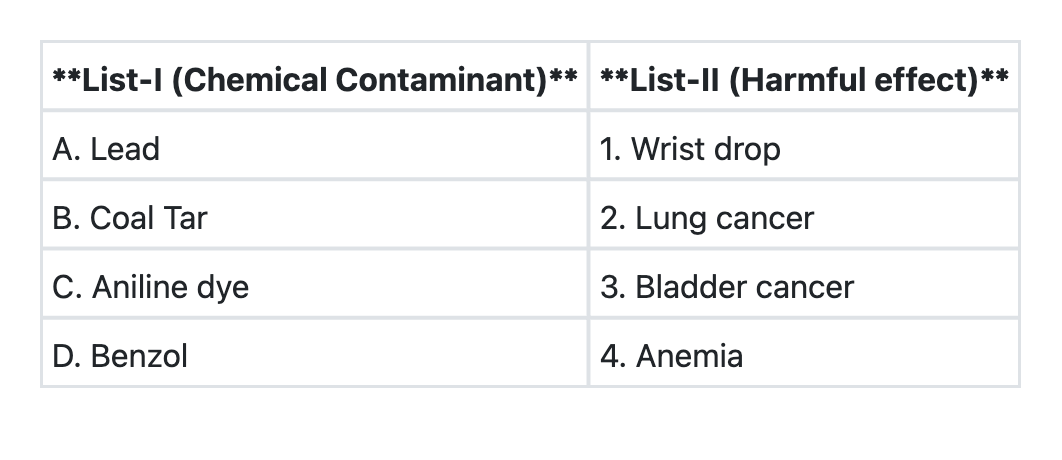
Match List-I with List-II and select the correct answer using the code given below the Lists:
Which one of the following indicators includes the value of a person's height squared in its formula?
UPSC-CMS 2023 - Community Medicine UPSC-CMS Practice Questions and MCQs
Question 1: As per the Government of India guidelines, the daily dose of elemental iron recommended for prophylaxis during pregnancy is
- A. 150 mg/day for 100 days
- B. 200 mg/day for 100 days
- C. 100 mg/day for 100 days (Correct Answer)
- D. 50 mg/day for 100 days
Explanation: ***100 mg/day for 100 days*** - As per the **Government of India guidelines**, the recommended daily dose of **elemental iron** for prophylaxis during pregnancy is 100 mg/day. - This dose is typically continued for at least **100 days** to ensure adequate iron stores and prevent iron deficiency anemia. *150 mg/day for 100 days* - This dose exceeds the **recommended daily prophylactic** amount of elemental iron specified by Indian government guidelines. - While higher doses may be used for **therapeutic treatment** of existing iron deficiency anemia, it is not the standard for prophylaxis. *200 mg/day for 100 days* - This amount is significantly higher than the standard **prophylactic recommendation** for elemental iron during pregnancy in India. - Such a high dose would typically only be prescribed for **treating severe anemia**, not for routine prevention. *50 mg/day for 100 days* - This dose is lower than the **recommended daily amount** for effective iron prophylaxis according to the Government of India guidelines. - Such a dose might be **insufficient** to maintain adequate iron levels and prevent anemia during pregnancy.
Question 2: The use of condoms for protection against sexually transmitted diseases qualifies as
- A. Primordial prevention
- B. Health promotion
- C. Secondary prevention
- D. Specific protection (Correct Answer)
Explanation: ***Specific protection*** - **Specific protection** involves measures aimed at preventing particular diseases by reducing exposure to their causes or by enhancing resistance against them. - Using condoms directly acts against the transmission of **sexually transmitted infections (STIs)**, thus making it a form of specific protection. *Primordial prevention* - **Primordial prevention** focuses on addressing underlying social and economic conditions that contribute to disease risk. - It targets **root causes** before risk factors for a disease even develop in the population. *Health promotion* - **Health promotion** is a broader concept that includes educational and environmental efforts to support healthy lifestyles and reduce overall disease risk. - While condom use could be part of a health promotion campaign, the act itself is a more targeted intervention. *Secondary prevention* - **Secondary prevention** involves early detection and prompt treatment of existing health problems to prevent their progression or complications. - This would include activities like **STI screening** and starting treatment after diagnosis, not preventing initial transmission.
Question 3: Child survival index is the percentage of children surviving till the age of
- A. 5 years (Correct Answer)
- B. 15 years
- C. 1 year
- D. 3 years
Explanation: ***5 years*** - The **child survival index** is a public health indicator that measures the proportion of children who survive to their **fifth birthday**. - This age is critical as it marks the end of the highest risk period for childhood mortality from infectious diseases and malnutrition. *15 years* - This age range would be related to **adolescent survival rates**, which are distinct from the specific focus of the child survival index. - While important for overall population health, it does not define the traditional child survival index. *1 year* - Survival up to **one year of age** is typically measured by the **infant mortality rate**, which is a separate but related indicator of child health. - The child survival index extends beyond infancy to capture early childhood health outcomes. *3 years* - While an important developmental stage, survival to **three years** is not the universally accepted cutoff for the definition of the child survival index. - The standard definition focuses on survival until the completion of the **fifth year of life**.
Question 4: The "risk of a disease" is measured by the
- A. Prevalence Rate
- B. Incidence Rate (Correct Answer)
- C. Case Fatality Rate
- D. Communicability Rate
Explanation: ***Incidence Rate*** - The **incidence rate** directly measures the frequency of **new cases** of a disease in a population over a specified period. - It is used to estimate the **risk** or probability of developing a disease, as it quantifies how quickly people are contracting the disease within the at-risk population. - **Formula:** (Number of new cases during time period / Population at risk) × multiplier - This is the epidemiologically correct measure of disease risk. *Prevalence Rate* - The **prevalence rate** measures the **total number of existing cases** (both new and old) of a disease in a population at a specific point in time or over a period. - It reflects the **burden** of a disease, not the risk of acquiring it, as it includes individuals who may have developed the disease much earlier. - Prevalence = Incidence × Duration of disease. *Case Fatality Rate* - The **case fatality rate** (CFR) measures the **proportion of individuals diagnosed with a disease who die from that disease** within a specified period. - It reflects the **severity** or lethality of a disease among those affected, not the risk of developing the disease in the first place. - CFR is a measure of disease outcome, not disease occurrence. *Communicability Rate* - There is no standard epidemiological term exactly defined as "communicability rate"; however, related concepts include the **basic reproduction number (R₀)** and **secondary attack rate**. - These concepts describe the **spread or transmissibility of an infectious disease**, not the risk of contracting a disease from a general population perspective. - This measures transmission dynamics rather than individual risk.
Question 5: The "Relative Risk" of 0.25 indicates
- A. 2.5 times higher risk in the exposed individuals compared with the unexposed
- B. 25% increase in the incidence rate in the exposed individuals compared with the unexposed
- C. 75% reduction in the incidence rate in the exposed individuals compared with the unexposed (Correct Answer)
- D. 75% risk increase in the exposed individuals compared with the unexposed
Explanation: ***75% reduction in the incidence rate in the exposed individuals compared with the unexposed*** - A **Relative Risk (RR)** of 0.25 means the risk in the exposed group is 25% of the risk in the unexposed group. - This indicates a **reduction** in risk calculated as (1 - RR) * 100%, so (1 - 0.25) * 100% = 75% reduction. *2.5 times higher risk in the exposed individuals compared with the unexposed* - This would be indicated by an RR of 2.5, meaning the risk is **2.5 times greater** in the exposed group. - An RR of 0.25 signifies a risk that is **less than** that of the unexposed group, not higher. *25% increase in the incidence rate in the exposed individuals compared with the unexposed* - A 25% increase would mean the RR is 1.25 (1 + 0.25), indicating a **higher risk** in the exposed group. - An RR of 0.25 represents a **decrease** in risk, not an increase. *75% risk increase in the exposed individuals compared with the unexposed* - A 75% risk increase would correspond to an RR of 1.75 (1 + 0.75), suggesting a **greater risk**. - With an RR of 0.25, the risk in the exposed group is **lower**, representing a reduction rather than an increase.
Question 6: Which of the following constitutes "Secondary Prevention"?
- A. Health Education Programme
- B. Using Limb Callipers
- C. Wearing Safety Helmets
- D. Screening Tests (Correct Answer)
Explanation: ***Screening Tests (Correct)*** - **Screening tests** constitute the core of **secondary prevention**, designed to detect disease in its **early, asymptomatic stages** before clinical symptoms appear. - By identifying disease early, screening enables **prompt intervention** to prevent progression, reduce morbidity, and improve prognosis. - Examples include mammography for breast cancer, PAP smear for cervical cancer, and blood pressure screening for hypertension. *Health Education Programme* - Health education programmes are examples of **primary prevention**, which aims to **prevent disease occurrence** by promoting healthy behaviors and reducing risk factors. - These interventions target healthy individuals to maintain health and prevent disease onset, not to detect existing disease. *Using Limb Callipers* - **Limb callipers** are used for anthropometric measurements or as assistive devices for mobility in patients with disabilities. - As a measurement tool, it's used for **assessment and monitoring**, not for disease prevention. - As an assistive device, it falls under **tertiary prevention** (rehabilitation), helping patients manage existing disability. *Wearing Safety Helmets* - Wearing safety helmets is a classic example of **primary prevention**, as it aims to **prevent injuries** (head trauma) from occurring in the first place. - It is a protective measure implemented before any health event occurs, not for early disease detection.
Question 7: The installation and usage of sanitary latrines by general public constitutes which level of prevention?
- A. Disability limitation and rehabilitation
- B. Early diagnosis and treatment
- C. Health promotion
- D. Specific protection (Correct Answer)
Explanation: ***Specific protection*** - Installation and usage of sanitary latrines is a **specific protective measure** against fecal-oral disease transmission. - This intervention specifically targets diseases like **cholera, typhoid, hepatitis A, amoebiasis, and helminthic infections** by preventing contamination of water and food sources. - Specific protection includes measures like **immunization, water purification, proper excreta disposal, food sanitation, and use of personal protective equipment** - all aimed at protecting against specific disease agents. - Proper sanitation facilities create a **physical barrier** between human excreta and the environment, preventing the spread of specific pathogens. *Health promotion* - This involves **general measures** to improve overall health without targeting specific diseases, such as health education, nutritional counseling, promotion of physical activity, and stress management. - While educating people about the importance of sanitation falls under health promotion, the actual **installation and use of latrines** is a specific protective measure. - Health promotion strengthens host defenses through lifestyle modifications and healthy behaviors. *Early diagnosis and treatment* - This is **secondary prevention** that focuses on early detection of disease through screening programs and prompt treatment to prevent progression. - Examples include mammography for breast cancer, cervical cytology for cervical cancer, and blood pressure screening for hypertension. - Not applicable to sanitary latrine installation, which prevents disease occurrence rather than detecting existing disease. *Disability limitation and rehabilitation* - This is **tertiary prevention** aimed at reducing complications from established disease and restoring function after illness or injury. - Examples include physiotherapy after stroke, cardiac rehabilitation after myocardial infarction, and limb prostheses after amputation. - Not relevant to preventive sanitation measures.
Question 8: "Sampling error" occurs due to the variation in results
- A. due to the use of many instruments in the study
- B. due to the multiple readings taken on the same instrument
- C. between one sample and another (Correct Answer)
- D. between the observations of two individuals
Explanation: ***between one sample and another*** - **Sampling error** arises because a sample is not a perfect representation of the entire population from which it is drawn. - This error quantifies the natural **variability** that occurs when different subgroups (samples) are selected from the same population. *due to the use of many instruments in the study* - This scenario describes **inter-instrument variability** or **measurement error**, which is related to the precision and calibration of different tools. - While it can introduce error, it is distinct from sampling error, which arises from the representativeness of the chosen study subjects. *due to the multiple readings taken on the same instrument* - Multiple readings on the same instrument assess **intra-instrument variability** or **repeatability**, indicating how consistent a single instrument is over time. - This relates to the precision of the measurement device, not the representativeness of the sample itself. *between the observations of two individuals* - Differences in observations between two individuals indicate **inter-rater variability** or **observer bias**. - This type of error is related to subjective interpretation or measurement technique by different observers, rather than the intrinsic variability between selected samples.
Question 9: Match List-I with List-II and select the correct answer using the code given below the Lists:
- A. A→3 B→2 C→1 D→4
- B. A→3 B→1 C→4 D→2
- C. A→1 B→3 C→2 D→4 (Correct Answer)
- D. A→4 B→2 C→3 D→1
Explanation: ***A→1 B→3 C→2 D→4*** - This option correctly matches the occupational exposures with their characteristic health effects based on the lists provided. - **Lead poisoning** classically causes **wrist drop** due to radial nerve palsy, a hallmark neurological manifestation. - **Coal tar** exposure is associated with **skin cancer** (especially scrotal cancer in historical chimney sweeps) and **lung cancer** in occupational settings. - **Aniline dye** (particularly β-naphthylamine) is a well-established cause of **bladder cancer** in dye industry workers. - **Benzol (Benzene)** is notorious for causing **hematological disorders** including aplastic anemia, pancytopenia, and leukemia. *A→3 B→2 C→1 D→4* - This option incorrectly associates the exposures with their health effects. - The matching does not align with established occupational health associations. *A→3 B→1 C→4 D→2* - This option incorrectly associates the exposures with their health effects. - The matching does not align with established occupational health associations. *A→4 B→2 C→3 D→1* - This option incorrectly associates the exposures with their health effects. - Although lead can cause anemia, its most characteristic neurological effect is **wrist drop**, which is a diagnostic hallmark. Benzol (benzene) is primarily associated with hematological disorders, not neurological manifestations like wrist drop.
Question 10: Which one of the following indicators includes the value of a person's height squared in its formula?
- A. Quetelet's index (Correct Answer)
- B. Waist-to-hip ratio
- C. Ponderal index
- D. Waist circumference
Explanation: ***Quetelet's index*** - **Quetelet's index**, also known as **Body Mass Index (BMI)**, is calculated as **weight (kg) / height (m)²**, thus directly incorporating height squared. - It is widely used to classify individuals as underweight, normal weight, overweight, or obese. - BMI is the most commonly used anthropometric indicator in clinical and public health settings. *Waist-to-hip ratio* - This ratio is calculated by dividing **waist circumference** by **hip circumference**. - It is an indicator of abdominal adiposity and does not use height in its formula. *Ponderal index* - The **Ponderal index** is calculated as **weight (kg) / height (m)³**, which uses height cubed, not squared. - It is often used to assess proportionality in infants and children. - While it includes height, the power is different from Quetelet's index. *Waist circumference* - **Waist circumference** is a direct measurement of the circumference of the abdomen. - It is an indicator of visceral fat and does not include height in its measurement or interpretation.