Community Medicine
2 questionsThe most common mode of absorption of inorganic lead in industries leading to lead poisoning is:
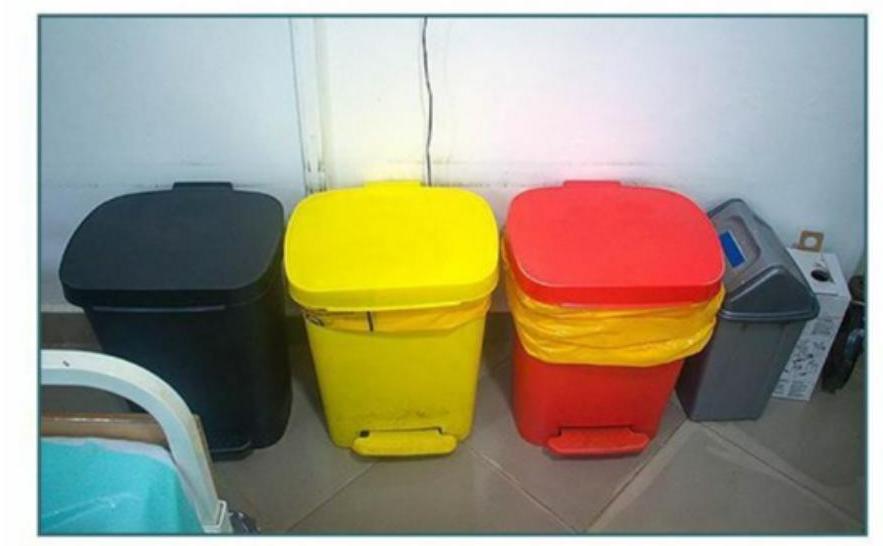
A nurse keeps the bins as shown in the image in the hospital ward. Which of the following items would go into the black bin?
INI-CET 2021 - Community Medicine INI-CET Practice Questions and MCQs
Question 81: The most common mode of absorption of inorganic lead in industries leading to lead poisoning is:
- A. Inhaled lead dust (Correct Answer)
- B. Ingestion of contaminated food and water
- C. Contaminated hands
- D. Absorption through skin
Explanation: ***Inhaled lead dust*** - In industrial settings, **inorganic lead** is frequently present as fine airborne particles, making inhalation the primary route of exposure and absorption. - **Lead dust** generated from processes like smelting, battery manufacturing, and construction (e.g., sanding lead paint) can be readily absorbed through the respiratory tract. *Ingestion of contaminated food and water* - While ingestion of **contaminated food and water** is a significant route of lead exposure, especially in children, it is generally less common than inhalation in occupational settings where lead dust is prevalent. - This route is more typically associated with environmental contamination rather than direct industrial absorption. *Contaminated hands* - **Contaminated hands** pose a risk primarily through transfer of lead to the mouth and subsequent ingestion, rather than direct absorption through the skin itself. - This is an indirect route of internal exposure, often secondary to handling lead-containing materials without proper hygiene. *Absorption through skin* - **Inorganic lead** (the type commonly found in industrial settings) is very poorly absorbed through intact skin. - **Organic lead compounds** (e.g., tetraethyl lead), which are less common in general industries, are much more readily absorbed cutaneously.
Question 82: A nurse keeps the bins as shown in the image in the hospital ward. Which of the following items would go into the black bin?
- A. Gloves
- B. Soiled linen bedsheet
- C. Contaminated gloves
- D. Glove paper cover (Correct Answer)
Explanation: ***Glove paper cover*** - The black bin is typically designated for **general waste** that is neither infectious nor sharp. - A glove paper cover is considered **non-hazardous**, non-recyclable waste and would be appropriately disposed of in a black bin. *Gloves* - **Used gloves**, even if not obviously contaminated with bodily fluids, are considered potentially infectious waste and should not be placed in the black bin. - These should generally be disposed of in a **yellow bag or bin** (infectious waste) to prevent cross-contamination. *Soiled linen bedsheet* - A soiled linen bedsheet is considered **infectious waste**, as it may contain bodily fluids or pathogens. - This type of waste requires specific handling and disposal, usually in **red bags or bins**, not general waste. *Contaminated gloves* - **Contaminated gloves** are classified as infectious waste and must be disposed of in designated containers for biohazard materials. - Placing them in a black bin would pose a **risk of infection** to waste handlers and is against standard medical waste disposal protocols.
Obstetrics and Gynecology
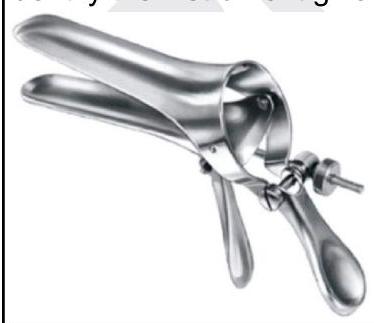
1 questionsIdentify the instrument given below.

INI-CET 2021 - Obstetrics and Gynecology INI-CET Practice Questions and MCQs
Question 81: Identify the instrument given below.
- A. Sims' speculum
- B. Graves' speculum
- C. Auvard's speculum
- D. Cusco's speculum (Correct Answer)
Explanation: ***Cusco's speculum*** - This is a **bivalved, self-retaining speculum** with two articulated blades that open and close using a **thumbscrew/locking mechanism** at the handle. - Commonly used for **per speculum examination** to visualize the **cervix and vaginal walls** during gynecological procedures. *Sims' speculum* - A **single-bladed (univalve) speculum** that requires an **assistant to hold** during examination, unlike the self-retaining instrument shown. - Used to retract the **posterior vaginal wall** but lacks the dual-blade design visible in the image. *Graves' speculum* - Similar bivalved design to Cusco's but features **longer and wider blades** for better visualization in larger patients. - More commonly used in the **United States**, with a bulkier appearance than the instrument pictured. *Auvard's speculum* - A **weighted, self-retaining single-blade speculum** used as a **posterior vaginal retractor**. - Completely different design from the bivalved instrument shown, with only **one blade** and no locking mechanism.
Pathology
1 questionsThe graphical representation for flow cytometry analysis is done by which of the following?
INI-CET 2021 - Pathology INI-CET Practice Questions and MCQs
Question 81: The graphical representation for flow cytometry analysis is done by which of the following?
- A. Pie chart, dot plot
- B. Histogram, dot plot (Correct Answer)
- C. Line diagram, dot plot
- D. Bar diagram, dot plot
Explanation: ***Histogram, dot plot*** - **Histograms** are used in flow cytometry to display the distribution of a single parameter (e.g., cell size, fluorescence intensity) across the cell population. - **Dot plots** are used to visualize the relationship between two or more parameters, allowing for the identification of distinct cell populations based on multiple characteristics. *Pie chart, dot plot* - **Pie charts** are typically used to represent proportions of a whole, which is not the primary way flow cytometry data is presented for detailed cell analysis. - While dot plots are correct, the combination with pie charts makes this option less accurate for typical flow cytometry analysis. *Line diagram, dot plot* - **Line diagrams** are generally used to show trends over time or continuous relationships, which is not the standard graphical representation for direct flow cytometry output. - Although dot plots are used, the inclusion of line diagrams makes this option incorrect in the context of typical flow cytometry data visualization. *Bar diagram, dot plot* - **Bar diagrams** are often used for comparing discrete categories or counting occurrences, not for displaying continuous distributions or multi-parameter relationships in flow cytometry directly. - While dot plots are correct, the pairing with bar diagrams does not represent the common and most informative graphical methods for flow cytometry analysis.
Pharmacology
1 questionsWhich of the following is true regarding nicotine substitution therapy?
INI-CET 2021 - Pharmacology INI-CET Practice Questions and MCQs
Question 81: Which of the following is true regarding nicotine substitution therapy?
- A. Preferably given by gastrointestinal route.
- B. Varenicline comes with a black box warning of cardiovascular death
- C. There should be a 15-minute gap between nicotine gum and coffee/soda/acidic food as they decrease its absorption (Correct Answer)
- D. Nicotine chewing gum is better for constant use as it gives 25% higher blood level than lozenges
Explanation: ***There should be a 15-minute gap between nicotine gum and coffee/soda/acidic food as they decrease its absorption*** - **Acidic beverages** like coffee, soda, and fruit juices can alter the pH of the mouth and stomach, which significantly **reduces the absorption of nicotine** from gum. - This recommendation ensures optimal **nicotine delivery** and effectiveness of the therapy in reducing withdrawal symptoms. *Preferably given by gastrointestinal route* - Nicotine has poor bioavailability when taken orally due to **extensive first-pass metabolism** in the liver. - Nicotine substitution therapies are therefore preferentially administered via **transdermal**, **buccal** (gum, lozenges), or **nasal routes** to bypass first-pass metabolism and achieve therapeutic blood levels more effectively. *Varenicline comes with a black box warning of cardiovascular death* - Varenicline (Chantix) previously had a black box warning for **neuropsychiatric side effects**, including suicidal ideation and depression, which has since been removed due to further studies. - It does not carry a black box warning specifically for **cardiovascular death**, though cardiovascular events have been a subject of study, particularly in patients with pre-existing cardiovascular conditions. *Nicotine chewing gum is better for constant use as it gives 25% higher blood level than lozenges* - While both nicotine gum and lozenges are effective, the **blood levels achieved are comparable**, and the choice often depends on patient preference and proper technique. - Nicotine gum is best used with a **"chew and park" technique** to allow buccal absorption, and constant chewing can lead to excessive swallowing of nicotine, causing gastrointestinal upset.
Physiology
4 questionsAn individual is in an environment of a temperature of 47°C. What is the mechanism of heat loss?
Which among the following has the highest airway resistance?
If the contractility of the heart is decreased, which of the following is seen ?
All of the following substances have decreased concentration on the luminal side of the proximal convoluted tubule except:
INI-CET 2021 - Physiology INI-CET Practice Questions and MCQs
Question 81: An individual is in an environment of a temperature of 47°C. What is the mechanism of heat loss?
- A. Conduction
- B. Radiation
- C. Sweating (Correct Answer)
- D. Convection
Explanation: ***Sweating*** - In an environment where the ambient temperature (47°C) is **higher than body temperature**, heat can only be lost through the evaporation of sweat. - **Evaporation** is the primary mechanism for cooling the body in hot environments when other forms of heat loss become ineffective or even cause heat gain. *Conduction* - **Conduction** involves the transfer of heat through direct contact between surfaces. - In an environment hotter than the body, conduction would cause **heat gain** by the body, not heat loss. *Radiation* - **Radiation** involves the transfer of heat in the form of electromagnetic waves. - When the ambient temperature is higher than body temperature, the body will **absorb radiant heat** from the environment, leading to heat gain, not loss. *Convection* - **Convection** is the transfer of heat through the movement of fluids (air or water). - In an environment with a temperature of 47°C, convection would cause **heat gain** as the surrounding hot air transfers heat to the body.
Question 82: Which among the following has the highest airway resistance?
- A. Alveolar duct
- B. Respiratory bronchioles
- C. Bronchi (Correct Answer)
- D. Small bronchioles
Explanation: ***Bronchi (Medium-sized bronchi)*** - The **medium-sized bronchi** (approximately 4th-8th generation airways) contribute the **highest proportion to total airway resistance** in the tracheobronchial tree. - At this level, airways are still relatively **narrow** but arranged more in **series** rather than parallel, concentrating resistance. - This is the point of **maximum resistance** before the extensive branching of smaller airways creates parallel pathways. - Accounts for approximately **40-50% of total airway resistance** during normal breathing. *Small bronchioles* - While individual small bronchioles (<1 mm diameter) have narrow lumens, they branch extensively into **thousands of parallel airways**. - This creates an **enormous total cross-sectional area** (up to 20x larger than trachea), which dramatically **reduces total resistance**. - According to principles of parallel resistance, total resistance decreases as more parallel pathways are added: 1/R_total = 1/R₁ + 1/R₂ + ... + 1/Rₙ - Despite small individual diameter, collective parallel arrangement makes them **low resistance** pathways. *Alveolar ducts* - Have the **largest cumulative cross-sectional area** in the entire respiratory system. - Airflow velocity is minimal and flow is entirely **laminar**, offering negligible resistance. - These are part of the respiratory zone where gas exchange occurs primarily by diffusion. *Respiratory bronchioles* - Part of the **transitional/respiratory zone** with extensive branching and large total cross-sectional area. - Offer very low resistance due to their **parallel arrangement** and slow airflow velocity. - Contribute minimally to total airway resistance.
Question 83: If the contractility of the heart is decreased, which of the following is seen ?
- A. Increased ejection fraction
- B. Increased stroke work
- C. Decreased stroke volume (Correct Answer)
- D. Increased cardiac output
Explanation: ***Decreased stroke volume*** - A decrease in the **contractility** of the heart directly reduces the force of myocardial contraction. - This weaker contraction results in less blood being ejected from the ventricle per beat, leading to a **decreased stroke volume**. *Increased ejection fraction* - **Ejection fraction** is the percentage of blood ejected from the ventricle with each beat, calculated as (stroke volume / end-diastolic volume) x 100. - When contractility decreases, **stroke volume** decreases, which would typically lead to a *decreased* ejection fraction, not an increased one. *Increased stroke work* - **Stroke work** is a measure of the work done by the ventricle to eject blood, and it depends on both stroke volume and aortic pressure. - With decreased contractility, **stroke volume** falls, which would *decrease* the stroke work, assuming afterload remains constant. *Increased cardiac output* - **Cardiac output** is the product of stroke volume and heart rate (CO = SV x HR). - Since decreased contractility leads to a **decreased stroke volume**, without a compensatory increase in heart rate, cardiac output would *decrease*, not increase.
Question 84: All of the following substances have decreased concentration on the luminal side of the proximal convoluted tubule except:
- A. Glucose
- B. Amino acids
- C. Bicarbonate
- D. Chloride (Correct Answer)
Explanation: ***Chloride*** - As **water and other solutes** are reabsorbed from the proximal tubule, the concentration of **chloride** actually increases in the remaining luminal fluid due to continued water reabsorption. - This increased luminal **chloride concentration** then drives passive reabsorption of chloride later in the tubule. *Glucose* - **Glucose** is almost completely reabsorbed from the tubular lumen by **secondary active transport** in the early part of the proximal tubule. - Therefore, its concentration in the remaining luminal fluid rapidly decreases. *Amino acids* - Similar to glucose, **amino acids** are extensively reabsorbed by **secondary active transport** mechanisms in the proximal tubule. - Consequently, their luminal concentration significantly decreases. *Bicarbonate* - Most **bicarbonate** is reabsorbed in the proximal tubule through a process involving **carbonic anhydrase**, converting it to CO2 and water, which then diffuse into the cell. - This efficient reabsorption results in a substantial decrease in luminal bicarbonate concentration.
Psychiatry
1 questionsA person often feels that his hands are contaminated and is forced to wash his hands. Recently, he feels this repetitive, distressing thought of repetitive hand washing has begun affecting his performance. Which of the following is the best treatment option for this patient?
INI-CET 2021 - Psychiatry INI-CET Practice Questions and MCQs
Question 81: A person often feels that his hands are contaminated and is forced to wash his hands. Recently, he feels this repetitive, distressing thought of repetitive hand washing has begun affecting his performance. Which of the following is the best treatment option for this patient?
- A. Exposure and response prevention (Correct Answer)
- B. Systematic desensitization
- C. Dialectical Behavior Therapy (DBT)
- D. SSRI medication
Explanation: ***Exposure and Response Prevention (ERP)*** - This is the **gold standard psychotherapy** for **Obsessive-Compulsive Disorder (OCD)**, which is clearly indicated by the repetitive distressing thoughts (obsessions about contamination) and compulsive handwashing (compulsion). - ERP involves gradually exposing the patient to the feared situation (contamination) while preventing the compulsive ritual (handwashing), allowing habituation to anxiety. - **CBT with ERP is considered first-line treatment** alongside SSRIs, with ERP often preferred as initial **monotherapy** due to **durable effects** and **no medication side effects**. *Systematic Desensitization* - This therapy is primarily used to treat **phobias** and other **anxiety disorders** where a specific fear is present, rather than the obsession-compulsion cycle seen in OCD. - It involves gradual exposure with relaxation techniques, but **does not include response prevention**, which is crucial for breaking the compulsive cycle in OCD. *Dialectical Behavior Therapy (DBT)* - DBT is primarily developed for **Borderline Personality Disorder** and conditions with severe emotional dysregulation, self-harm, and interpersonal difficulties. - While it can help with emotional regulation, it **does not specifically target the obsession-compulsion cycle** that is the core pathology of OCD. *SSRI Medication* - **SSRIs are also first-line treatment for OCD** and are highly effective, particularly at higher doses than those used for depression. - However, when comparing initial treatment options, **ERP (psychotherapy) is often preferred** as monotherapy because it produces **sustained improvement** even after treatment ends, with lower relapse rates compared to medication discontinuation. - **Combination therapy (ERP + SSRI)** is typically reserved for moderate-to-severe OCD or when monotherapy is insufficient. - In this scenario asking for "best treatment option," ERP represents the most specific and effective **psychotherapeutic intervention** for OCD.