Internal Medicine
1 questionsWhich of the following is not likely to be seen in a patient with Paroxysmal Nocturnal Hemoglobinuria (PNH)?
INI-CET 2021 - Internal Medicine INI-CET Practice Questions and MCQs
Question 61: Which of the following is not likely to be seen in a patient with Paroxysmal Nocturnal Hemoglobinuria (PNH)?
- A. Thrombosis
- B. Aplastic anemia
- C. Leukemia (Correct Answer)
- D. Hemolysis
Explanation: Leukemia - While PNH can transform into **acute myeloid leukemia (AML)** in a small percentage of cases, it is not a common or direct presentation, making it the *least likely* immediate finding among the options. - The primary pathophysiology of PNH involves a defect in hematopoietic stem cells leading to complement-mediated destruction, not malignant proliferation of myeloid or lymphoid cells as seen in leukemia. *Thrombosis* - **Thrombosis** is a major cause of morbidity and mortality in PNH, occurring due to complement activation and platelet activation on the surface of GPI-deficient cells. - It most commonly affects unusual sites like the **hepatic** or **mesenteric veins**, and cerebral venous sinuses. *Aplastic anemia* - **Aplastic anemia** is closely associated with PNH, as both with conditions can arise from a defect in hematopoietic stem cells. - PNH clones are often detectable in patients with aplastic anemia, and some cases of PNH evolve from or into aplastic anemia. *Hemolysis* - **Hemolysis** is a hallmark of PNH, caused by the absence of **GPI-anchored proteins (CD55 and CD59)** on red blood cells, making them susceptible to complement-mediated destruction [1]. - This leads to intravascular hemolysis, resulting in characteristic symptoms like **dark urine** (hemoglobinuria), especially in the morning [1].
Obstetrics and Gynecology
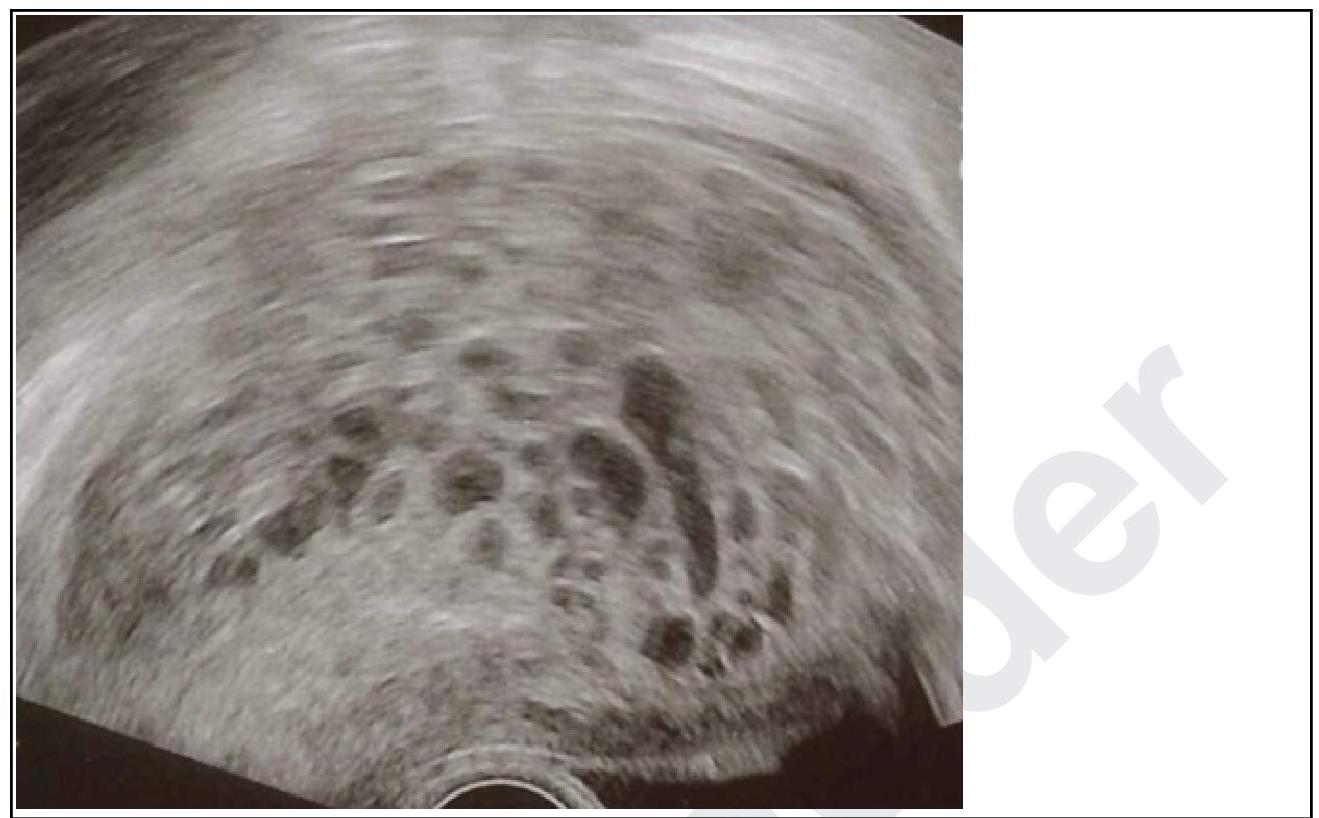
2 questionsA primigravida in her 10th week of gestation presents with spotting. On examination, the uterus corresponds to 12 weeks. Transvaginal ultrasound was done and it is given below. What is your diagnosis?
A primigravida is in labor. Her per-vaginal examination revealed a posterior cervix with 5 cm cervical length, 1 cm dilatation, soft consistency, and head at -1 station. Calculate the Bishop score.
INI-CET 2021 - Obstetrics and Gynecology INI-CET Practice Questions and MCQs
Question 61: A primigravida in her 10th week of gestation presents with spotting. On examination, the uterus corresponds to 12 weeks. Transvaginal ultrasound was done and it is given below. What is your diagnosis?
- A. Blighted ovum
- B. Ectopic pregnancy
- C. Hydatidiform mole (Correct Answer)
- D. Missed abortion
Explanation: ***Hydatidiform mole*** - The ultrasound image shows a **"snowstorm" appearance**, characterized by multiple echogenic vesicles or cystic spaces within the uterine cavity, which is pathognomonic for a hydatidiform mole. - The clinical presentation of **vaginal spotting**, a uterus size **larger than expected for gestational age** (12 weeks uterus size at 10 weeks gestation), and possibly elevated hCG levels (though not given here) are all highly suggestive of a molar pregnancy. *Blighted ovum* - A blighted ovum, also known as an anembryonic pregnancy, involves a **gestational sac without an embryo**. - The ultrasound typically shows an empty gestational sac and does not feature the characteristic "snowstorm" pattern of a hydatidiform mole. *Ectopic pregnancy* - An ectopic pregnancy occurs when the **fertilized egg implants outside the uterus**, most commonly in the fallopian tube. - The ultrasound would typically show an **empty uterus** and a gestation outside the uterine cavity, usually with a mass in the adnexa, which is not seen here. *Missed abortion* - A missed abortion is characterized by the **death of the embryo or fetus but retention** within the uterus. - Ultrasound would show a **fetus without cardiac activity** or a gestational sac that is smaller than expected, without the typical vesicular pattern of a mole.
Question 62: A primigravida is in labor. Her per-vaginal examination revealed a posterior cervix with 5 cm cervical length, 1 cm dilatation, soft consistency, and head at -1 station. Calculate the Bishop score.
- A. 5 (Correct Answer)
- B. 0
- C. 8
- D. 3
Explanation: ***5*** - The Bishop score calculation: **cervical position** (posterior = 0), **cervical effacement** (5 cm length = 0), **dilation** (1 cm = 1), **consistency** (soft = 2), and **station** (-1 = 1). - According to standard **Dutta textbook** references, this totals to 5 points (0 + 0 + 1 + 2 + 1), with soft consistency correctly scoring 2 points. *3* - This score incorrectly assigns only **1 point for soft consistency** instead of the standard 2 points. - The miscalculation underestimates the **cervical readiness** for labor induction. *0* - A score of 0 would require all parameters to be at their **minimum values** (firm consistency, closed cervix, high station). - The given parameters show **1 cm dilation**, **soft consistency**, and **-1 station**, each contributing positive points. *8* - A high score of 8 indicates a **very favorable cervix** with significant effacement, anterior position, and greater dilation. - The current findings show **minimal effacement** (5 cm length), **posterior position**, and only **1 cm dilation**, inconsistent with such a high score.
Orthopaedics
1 questionsFollowing a femoral shaft fracture, your consultant asks you to provide tibia traction. Which of the following will you request from the nurse? 1. Thomas splint 2. K-wire 3. Steinmann pin 4. Denham's pin 5. Bohler's stirrup 6. Bohler Braun splint
INI-CET 2021 - Orthopaedics INI-CET Practice Questions and MCQs
Question 61: Following a femoral shaft fracture, your consultant asks you to provide tibia traction. Which of the following will you request from the nurse? 1. Thomas splint 2. K-wire 3. Steinmann pin 4. Denham's pin 5. Bohler's stirrup 6. Bohler Braun splint
- A. $1,2,3,4,5,6$
- B. $3,5,6$ (Correct Answer)
- C. $3,4,5$
- D. $1,2,4$
Explanation: ***3,5,6*** - For **tibia traction** in a femoral shaft fracture, you would need a **Steinmann pin** for skeletal traction, a **Bohler's stirrup** to apply the traction force, and a **Bohler-Braun splint** to support the limb. - The **Steinmann pin** is inserted into the proximal tibia, the **Bohler's stirrup** attaches to the pin, and the **Bohler-Braun splint** provides a fixed structure for the traction system. *1,2,3,4,5,6* - This option incorrectly includes items not specifically used for applying **tibia traction** (e.g., K-wire is for internal fixation, Thomas splint is for early femur fracture management but not specifically for tibia traction application). - While some components might be used in general fracture management, not all are directly involved in setting up tibia traction as requested. *3,4,5* - This option correctly includes the **Steinmann pin** and **Bohler's stirrup** but incorrectly replaces the **Bohler-Braun splint** with a **Denham's pin**. - A **Denham's pin** is an alternative to a Steinmann pin for skeletal traction, but a **Bohler-Braun splint** is crucial for supporting the limb in this setup, which is missing here. *1,2,4* - This option includes a **Thomas splint** (used for femur fracture support, not tibia traction application), a **K-wire** (used for internal fixation, not traction), and a **Denham's pin** (an alternative to Steinmann pin, but lacks the necessary support and traction application equipment). - These items are not suitable for setting up comprehensive **tibia traction** for a femoral shaft fracture.
Pathology
1 questionsA boy presents with fever, night sweats, and neck swelling. The biopsy of swelling showed a starry sky appearance. What is the most likely genetic abnormality seen in this case?
INI-CET 2021 - Pathology INI-CET Practice Questions and MCQs
Question 61: A boy presents with fever, night sweats, and neck swelling. The biopsy of swelling showed a starry sky appearance. What is the most likely genetic abnormality seen in this case?
- A. RAS
- B. BCR-ABL
- C. p53
- D. MYC (Correct Answer)
Explanation: ***MYC*** - The clinical presentation of **fever, night sweats, and neck swelling** in a child, coupled with a **starry sky appearance** on biopsy, is highly suggestive of **Burkitt lymphoma** [2, 3]. - **Burkitt lymphoma** is characterized by a **translocation involving the *MYC* gene** on chromosome 8, most commonly t(8;14), which leads to its overexpression and uncontrolled cell proliferation [1]. *RAS* - Mutations in the **RAS family of genes (HRAS, KRAS, NRAS)** are commonly found in a wide variety of cancers, including **leukemias, pancreatic cancer, and colorectal cancer**. - While *RAS* mutations drive proliferation, they are **not the primary genetic driver** of Burkitt lymphoma, nor are they linked to the characteristic starry sky appearance. *BCR-ABL* - The **BCR-ABL fusion gene**, resulting from the **Philadelphia chromosome (t(9;22))**, is the defining genetic abnormality of **chronic myeloid leukemia (CML)**. - CML presents with different symptoms and a distinct peripheral blood and bone marrow morphology, **not the "starry sky" appearance** seen in Burkitt lymphoma. *p53* - The **p53 tumor suppressor gene** is frequently mutated or inactivated in over half of all human cancers, leading to a loss of cell cycle control and apoptosis. - While **p53 mutations can occur in aggressive lymphomas**, including Burkitt lymphoma, the **primary and characteristic genetic abnormality** associated with Burkitt lymphoma and its presentation is the *MYC* translocation, not solely *p53* mutations. **References:** [1] Kumar V, Abbas AK, et al.. Robbins and Cotran Pathologic Basis of Disease. 9th ed. Neoplasia, pp. 324-325. [2] Kumar V, Abbas AK, et al.. Robbins and Cotran Pathologic Basis of Disease. 9th ed. Diseases of White Blood Cells, Lymph Nodes, Spleen, and Thymus, pp. 605-606. [3] Kumar V, Abbas AK, et al.. Robbins and Cotran Pathologic Basis of Disease. 9th ed. Diseases of White Blood Cells, Lymph Nodes, Spleen, and Thymus, p. 606.
Pediatrics
3 questionsA child presents with fever and vesicular lesions on the upper limb and the lower limb. Neck stiffness was present. Similar lesions were present on the palms, soles, and oral cavity. CSF analysis revealed normal glucose levels and elevated lymphocytes and protein. What is the most likely diagnosis?
Which of the following congenital heart disease has equal saturation in all heart chambers?
Which of the following are causes of neonatal seizures? 1. Hypernatremia 2. Hypomagnesemia 3. Hypocalcemia 4. Hyponatremia
INI-CET 2021 - Pediatrics INI-CET Practice Questions and MCQs
Question 61: A child presents with fever and vesicular lesions on the upper limb and the lower limb. Neck stiffness was present. Similar lesions were present on the palms, soles, and oral cavity. CSF analysis revealed normal glucose levels and elevated lymphocytes and protein. What is the most likely diagnosis?
- A. Bacterial meningitis with sepsis
- B. Coxsackie viral meningitis and Hand Foot Mouth disease (Correct Answer)
- C. Tuberculous meningitis
- D. Herpes simplex gingivostomatitis and meningoencephalitis
Explanation: Coxsackie viral meningitis and Hand Foot Mouth disease - The presence of **vesicular lesions** on the palms, soles, and oral cavity, along with fever, is highly characteristic of **Hand Foot Mouth Disease (HFMD)** caused by Coxsackievirus. - The CSF findings of **normal glucose**, **elevated lymphocytes** (pleocytosis), and **elevated protein** are typical for **aseptic meningitis**, which is often caused by enteroviruses like Coxsackievirus [2]. *Bacterial meningitis with sepsis* - **Bacterial meningitis** would typically present with **low CSF glucose**, **high protein**, and a predominance of **neutrophils**, not lymphocytes [2]. - The characteristic vesicular rash of HFMD is not seen in bacterial meningitis. *Tuberculous meningitis* - **Tuberculous meningitis** typically has **very low CSF glucose**, **markedly elevated protein**, and a pleocytosis with a high percentage of lymphocytes. - The vesicular lesions on the palms, soles, and oral cavity are not a feature of tuberculous meningitis. *Herpes simplex gingivostomatitis and meningoencephalitis* - While **Herpes simplex** can cause **vesicular lesions** (gingivostomatitis) and **meningoencephalitis** with similar CSF findings (lymphocytic pleocytosis, elevated protein), the widespread nature of the lesions on the palms and soles is **not characteristic of HSV** [1]. - HSV lesions are typically clustered and localized to specific dermatomes or mucosal surfaces.
Question 62: Which of the following congenital heart disease has equal saturation in all heart chambers?
- A. Total anomalous pulmonary venous circulation (Correct Answer)
- B. Tetralogy of Fallot
- C. Transposition of great arteries
- D. Tricuspid atresia
Explanation: ***Total anomalous pulmonary venous circulation*** - In this condition, all **pulmonary veins drain abnormally** into the systemic venous circulation, mixing oxygenated and deoxygenated blood before it reaches the left atrium. - This complete mixing results in **equal oxygen saturation** throughout all four heart chambers and the great arteries, as there is a single common mixing chamber. *Tetralogy of Fallot* - This condition involves **four defects**: pulmonary stenosis, ventricular septal defect (VSD), overriding aorta, and right ventricular hypertrophy, leading to right-to-left shunting. - Oxygen saturations would be **lower in the systemic circulation** and aorta compared to the pulmonary circulation (if measurable), but not equal across all chambers due to deoxygenated blood mixing in the systemic flow. *Transposition of great arteries* - Characterized by the **aorta arising from the right ventricle** and the pulmonary artery from the left ventricle, creating two parallel circulations. - Without mixing lesions (like a VSD or patent foramen ovale), the systemic circulation would be severely desaturated and the pulmonary circulation fully saturated, resulting in **highly disparate saturations** between chambers. *Tricuspid atresia* - Involves the **absence of a tricuspid valve**, preventing blood flow from the right atrium to the right ventricle, necessitating an atrial septal defect (ASD) or patent foramen ovale (PFO) for survival. - Blood from the right atrium goes directly to the left atrium, and then via a VSD to the pulmonary artery, leading to **different saturations** in the systemic and pulmonary circulations and not equal saturation in all chambers.
Question 63: Which of the following are causes of neonatal seizures? 1. Hypernatremia 2. Hypomagnesemia 3. Hypocalcemia 4. Hyponatremia
- A. 2,4 only
- B. 1, 3, 4 only
- C. 1, 2, 3 only
- D. 1, 2, 3, and 4 (Correct Answer)
Explanation: ***1, 2, 3, and 4*** - **All listed electrolyte imbalances** can disrupt neuronal function and lead to neonatal seizures. - **Severe shifts** in sodium, calcium, and magnesium levels directly impact neuronal excitability. *2, 4 only* - This option is incorrect because **hypernatremia** and **hypocalcemia** are also significant causes of neonatal seizures. - Electrolyte disturbances such as **hypomagnesium** and **hyponatremia** can cause neonatal seizures, but they are not the only ones. *1, 3, 4 only* - This choice is incorrect as it **excludes hypomagnesemia**, which is a known cause of neonatal seizures. - **Severely deranged sodium and calcium levels** are important causes, but magnesium disturbances also contribute. *1, 2, 3 only* - This option is incorrect because **hyponatremia** is a well-established cause of neonatal seizures. - While hypernatremia, hypomagnesemia, and hypocalcemia can cause seizures, **hyponatremia** can also lead to cerebral edema and subsequent seizure activity.
Physiology
1 questionsThe relaxation of the intestinal segment distal to the segment with the bolus of food during peristalsis is because of?
INI-CET 2021 - Physiology INI-CET Practice Questions and MCQs
Question 61: The relaxation of the intestinal segment distal to the segment with the bolus of food during peristalsis is because of?
- A. Substance P
- B. Norepinephrine from adrenergic fibers
- C. VIP
- D. Nitric oxide (NO) (Correct Answer)
Explanation: ***Nitric oxide (NO)*** - **Nitric oxide (NO)** is a key **inhibitory neurotransmitter** that causes relaxation of the smooth muscle distal to the bolus during peristalsis, allowing the food to move forward. - Along with **Vasoactive Intestinal Peptide (VIP)**, NO mediates the **descending relaxation reflex** in the gut, which is essential for effective propulsion. *Substance P* - **Substance P** is an **excitatory neurotransmitter** that primarily mediates contraction of the smooth muscle proximal to the bolus during peristalsis. - It works synergistically with **acetylcholine** to initiate the muscular squeeze that propels food. *Norepinephrine from adrenergic fibers* - **Norepinephrine** is the primary neurotransmitter released by **sympathetic adrenergic fibers** in the gastrointestinal tract. - While sympathetic stimulation generally **inhibits gastrointestinal motility**, this is a systemic effect that reduces overall gut activity rather than causing the specific segmental relaxation distal to a bolus during peristalsis. - The descending relaxation during peristalsis is mediated by **intrinsic enteric neurons** (releasing NO and VIP), not by extrinsic sympathetic innervation. *VIP* - **Vasoactive Intestinal Peptide (VIP)** is an **inhibitory neurotransmitter** that causes relaxation of smooth muscle in the gut. - While VIP does contribute to descending relaxation, **nitric oxide (NO)** is considered a more significant and primary mediator of this specific relaxation during peristalsis.
Surgery
1 questionsWhich of the following findings appear late in compartment syndrome?
INI-CET 2021 - Surgery INI-CET Practice Questions and MCQs
Question 61: Which of the following findings appear late in compartment syndrome?
- A. Paralysis
- B. Pain on passive stretch
- C. Pulselessness (Correct Answer)
- D. Pallor
Explanation: ***Pulselessness*** - **Pulselessness** is a very late and ominous sign in compartment syndrome, indicating severe arterial compromise that has progressed beyond simple venous and lymphatic outflow obstruction. - Its presence suggests **irreversible tissue damage** has likely already occurred due to prolonged ischemia. *Paralysis* - **Paralysis** is a late sign, indicating significant nerve ischemia and damage due to sustained pressure within the compartment. - While it's a serious finding, it typically appears before pulselessness, as nerves are sensitive to ischemia but arteries are more resistant to complete occlusion until very high pressures are reached. *Pain on passive stretch* - **Pain on passive stretch** is considered one of the earliest and most reliable clinical signs of early compartment syndrome. - It results from the stretching of ischemic muscle fibers within the confined compartment. *Pallor* - **Pallor** (skin paleness) is also a relatively late sign, occurring when capillary perfusion is significantly reduced due to rising intracompartmental pressure. - It usually manifests when the pressure is high enough to restrict blood flow but often precedes the complete absence of pulses.