Community Medicine
1 questionsSAFE strategy for trachoma includes all except?
INI-CET 2021 - Community Medicine INI-CET Practice Questions and MCQs
Question 51: SAFE strategy for trachoma includes all except?
- A. Antibiotics
- B. Surgery for trichiasis
- C. Facial cleanliness
- D. Evaluation of control program (Correct Answer)
Explanation: ***Evaluation of control program*** - **Evaluation** is a monitoring and assessment process used to measure the effectiveness of the SAFE strategy, but it is **not one of the four intervention components** of the strategy itself. - The SAFE strategy consists of: **S**urgery, **A**ntibiotics, **F**acial cleanliness, and **E**nvironmental improvement. *Surgery for trichiasis* - **Trichiasis** (in-turned eyelashes) is a blinding complication of trachoma requiring **surgical correction** to prevent corneal damage. - This is the "S" component of SAFE. *Antibiotics* - **Mass drug administration** with **azithromycin** (single oral dose) is used to reduce the community reservoir of *Chlamydia trachomatis*. - This is the "A" component of SAFE. *Facial cleanliness* - Promoting **facial hygiene**, especially in children, prevents transmission of *Chlamydia trachomatis* through contact and fly vectors. - This is the "F" component of SAFE. *Environmental improvement (Not listed as an option but part of SAFE)* - Improving **water supply**, **sanitation**, and **waste management** reduces breeding sites for flies and improves hygiene. - This is the "E" component of SAFE.
Forensic Medicine
2 questionsA person working in a dye factory presented with nausea, vomiting, dark bloody stools, conjunctivitis, and a burning sensation in the throat and stomach. Which poisoning do you suspect in this case?
On conducting the autopsy on a victim of hanging, the ligature mark is seen at the lower 1/3rd of the neck. The victim is seen to have a protruded tongue. He was found with his head hanging to his left side with saliva dribbling from the left angle of his mouth. The right pupil appears constricted and there is ptosis (drooping) of the right eyelid. Compression of which of the following structures is the most probable reason for the unilateral ptosis in this case?
INI-CET 2021 - Forensic Medicine INI-CET Practice Questions and MCQs
Question 51: A person working in a dye factory presented with nausea, vomiting, dark bloody stools, conjunctivitis, and a burning sensation in the throat and stomach. Which poisoning do you suspect in this case?
- A. Potassium permanganate (Correct Answer)
- B. Lead
- C. Arsenic
- D. Thallium
Explanation: ***Potassium permanganate*** - The presence of **nausea, vomiting, dark bloody stools, conjunctivitis, and a burning sensation in the throat and stomach** is highly indicative of **potassium permanganate poisoning**, which is a caustic agent. - Exposure in a **dye factory** setting further supports this, as potassium permanganate is used as an **oxidizing agent** and **dyeing agent** in various industries. *Lead* - Lead poisoning typically presents with **neurological symptoms** (e.g., foot drop, wrist drop, encephalopathy), **gastrointestinal complaints** (e.g., colic, constipation), and **hematological abnormalities** (e.g., anemia with basophilic stippling). - The acute caustic effects like **burning sensation in the throat and bloody stools** are not characteristic of lead poisoning. *Arsenic* - Acute arsenic poisoning often involves **severe gastroenteritis** ("rice-water stools"), **garlic odor on breath**, **peripheral neuropathy**, and **cardiac arrhythmias**. - While it can cause gastrointestinal distress, the specific caustic burn and conjunctivitis alongside the industrial exposure profile point away from arsenic. *Thallium* - Thallium poisoning is characterized by **rapid hair loss (alopecia)**, **severe peripheral neuropathy**, and **gastrointestinal symptoms** (e.g., abdominal pain, vomiting, diarrhea). - The constellation of symptoms described, particularly the caustic burn and dark bloody stools, does not align with the typical presentation of thallium toxicity.
Question 52: On conducting the autopsy on a victim of hanging, the ligature mark is seen at the lower 1/3rd of the neck. The victim is seen to have a protruded tongue. He was found with his head hanging to his left side with saliva dribbling from the left angle of his mouth. The right pupil appears constricted and there is ptosis (drooping) of the right eyelid. Compression of which of the following structures is the most probable reason for the unilateral ptosis in this case?
- A. Left vagus nerve
- B. Right internal jugular vein
- C. Right internal carotid artery
- D. Cervical sympathetic chain (Correct Answer)
Explanation: ***Cervical sympathetic chain*** - The combination of **unilateral ptosis**, **miosis** (constricted pupil), and sometimes **anhidrosis** (lack of sweating) is characteristic of **Horner's syndrome**, which results from damage to the **cervical sympathetic chain**. - Hanging can cause compression or injury to this chain, leading to the observed **Horner's syndrome** on the ipsilateral side of the injury. *Left vagus nerve* - Compression of the **vagus nerve** is associated with cardiac arrhythmias, bradycardia, or gastric disturbances, not directly with ptosis. - The symptoms observed are specific to sympathetic dysfunction, not parasympathetic vagal stimulation. *Right internal jugular vein* - Compression of the **internal jugular vein** would cause venous congestion and edema in the head and neck, not neurological signs like ptosis or miosis. - While it can be injured in hanging, it does not directly explain the specific neurological findings. *Right internal carotid artery* - Compression of the **internal carotid artery** could lead to cerebral ischemia or stroke symptoms, such as weakness or sensory deficits, but not typically isolated ptosis and miosis. - The observed symptoms point to a specific sympathetic pathway disruption rather than arterial occlusion.
Obstetrics and Gynecology
2 questionsWhich of the following symptoms are seen in endometriosis? 1. Infertility 2. Dysmenorrhea 3. Vaginal discharge 4. Vaginal bleeding
A female patient having frothy vaginal discharge was found to have a strawberry cervix. Which of the following is the drug of choice?
INI-CET 2021 - Obstetrics and Gynecology INI-CET Practice Questions and MCQs
Question 51: Which of the following symptoms are seen in endometriosis? 1. Infertility 2. Dysmenorrhea 3. Vaginal discharge 4. Vaginal bleeding
- A. 2,3
- B. 1,2,4
- C. 3,4
- D. 1,2 (Correct Answer)
Explanation: ***Correct: 1,2 (Infertility and Dysmenorrhea)*** - **Infertility** is present in 30-50% of women with endometriosis, making it one of the most common presentations. Caused by inflammation, adhesions, altered pelvic anatomy, and inflammatory mediators that impair reproductive function. - **Dysmenorrhea (painful menstruation)** is the hallmark symptom of endometriosis. The pain is typically severe, progressive, and occurs due to cyclic bleeding from ectopic endometrial tissue, causing inflammation and irritation of surrounding structures. - These are the two most characteristic and consistent symptoms of endometriosis. *Incorrect: 2,3* - While dysmenorrhea is correct, **vaginal discharge is NOT a characteristic symptom of endometriosis**. Vaginal discharge is typically associated with infections (vaginitis, cervicitis) or other gynecological conditions, not endometriosis. *Incorrect: 1,2,4* - While infertility and dysmenorrhea are correct, including "vaginal bleeding" makes this option less accurate. Although some women with endometriosis may experience menorrhagia or irregular bleeding (particularly with adenomyosis or ovarian endometriomas), **abnormal vaginal bleeding is not a primary or pathognomonic symptom** of endometriosis. *Incorrect: 3,4* - **Vaginal discharge** is not associated with endometriosis. - **Vaginal bleeding** as a standalone symptom is not a primary feature of endometriosis, though menstrual abnormalities can occasionally occur. **Note:** Other classic symptoms of endometriosis include dyspareunia (painful intercourse), dyschezia (painful defecation), and chronic pelvic pain.
Question 52: A female patient having frothy vaginal discharge was found to have a strawberry cervix. Which of the following is the drug of choice?
- A. Cefixime
- B. Tetracycline
- C. Metronidazole (Correct Answer)
- D. Fluconazole
Explanation: ***Correct Option: Metronidazole*** - The combination of **frothy vaginal discharge** and a **strawberry cervix** (colpitis macularis) is highly indicative of **trichomoniasis**, caused by *Trichomonas vaginalis*. - **Metronidazole** is the drug of choice for treating trichomoniasis, effectively eradicating the protozoan parasite. - Alternative: **Tinidazole** is also highly effective for trichomoniasis treatment. *Incorrect Option: Cefixime* - **Cefixime** is a third-generation cephalosporin antibiotic primarily used to treat bacterial infections, particularly **gonorrhea** (*Neisseria gonorrhoeae*). - It is not effective against parasitic infections like **trichomoniasis**. *Incorrect Option: Tetracycline* - **Tetracycline** is a broad-spectrum antibiotic commonly used for bacterial infections like **chlamydia** and certain atypical organisms. - It is not indicated for the treatment of **trichomoniasis**, which requires antiprotozoal therapy. *Incorrect Option: Fluconazole* - **Fluconazole** is an antifungal medication specifically used to treat **yeast infections** (vulvovaginal candidiasis caused by *Candida* species). - It has no activity against the protozoan parasite *Trichomonas vaginalis*.
Ophthalmology
1 questionsIdentify the surgical step shown in the image given below
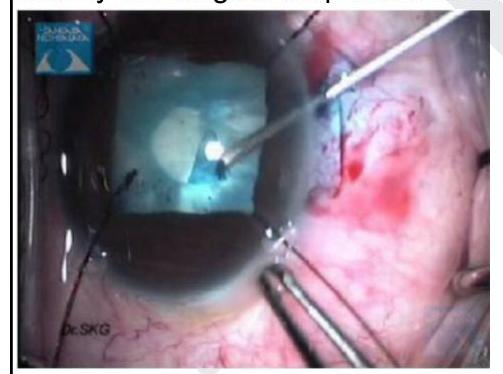
INI-CET 2021 - Ophthalmology INI-CET Practice Questions and MCQs
Question 51: Identify the surgical step shown in the image given below
- A. Capsulorrhexis
- B. Hydrodissection
- C. Intraocular lens implantation
- D. Lens aspiration (Correct Answer)
Explanation: ***Lens aspiration*** - The image shows a **phacoemulsification handpiece** (the instrument with the shining tip and central bore tube) actively fragmenting and aspirating the lens material, indicated by the cloudy material being removed. - This step is part of cataract surgery where the cataractous lens material is removed from the eye. *Capsulorrhexis* - This involves creating a **continuous curvilinear tear** in the anterior lens capsule, typically done at the beginning of cataract surgery. - The image does not show a tearing or incising action on the capsule; instead, it depicts material removal. *Hydrodissection* - This step involves injecting a **fluid wave** between the lens capsule and the lens cortex to separate them, facilitating nuclear rotation and removal. - The image depicts the removal of lens material, not the injection of fluid to separate layers. *Intraocular lens implantation* - This step involves inserting the **artificial lens** into the capsular bag after the cataractous lens has been removed. - The visual cues in the image indicate material removal and emulsification, not the insertion of a new lens.
Pathology
2 questionsA person was brought to the emergency department with facial swelling, itching, and hypotension following a bee sting. The mentioned clinical features are due to the increase in which immunoglobulin?
A 42 year-old female patient presents with cough, low-grade fever, and hemoptysis. Investigations reveal a cavitary lesion on her right lung apex, which on biopsy reveals caseous necrosis. The underlying pathophysiology is:
INI-CET 2021 - Pathology INI-CET Practice Questions and MCQs
Question 51: A person was brought to the emergency department with facial swelling, itching, and hypotension following a bee sting. The mentioned clinical features are due to the increase in which immunoglobulin?
- A. IgE (Correct Answer)
- B. IgG
- C. IgA
- D. IgM
Explanation: IgE - The symptoms of **facial swelling, itching, and hypotension** following a bee sting are characteristic of an immediate hypersensitivity reaction, specifically **anaphylaxis**, which is predominantly mediated by **IgE antibodies** [1]. - **IgE** binds to mast cells and basophils, and upon re-exposure to the allergen (bee venom), triggers the release of potent inflammatory mediators like **histamine**, causing vasodilation, increased vascular permeability, and smooth muscle contraction [1], . *IgG* - **IgG** antibodies are primarily involved in secondary immune responses, conferring long-term immunity, and neutralizing toxins and viruses [1]. - While IgG can be involved in some hypersensitivity reactions (Type II and Type III), it is not the primary immunoglobulin responsible for the acute, systemic symptoms of **anaphylaxis** from a bee sting [1]. *IgA* - **IgA** is the main immunoglobulin found in mucosal secretions, such as those in the gastrointestinal, respiratory, and genitourinary tracts, providing mucosal immunity. - It does not play a significant role in immediate hypersensitivity reactions or the systemic symptoms described in this scenario. *IgM* - **IgM** is the first antibody produced during a primary immune response and is important for activating the complement system and agglutinating antigens [1]. - It is not directly implicated in the pathogenesis of **Type I hypersensitivity reactions** like the anaphylactic response to a bee sting. **References:** [1] Kumar V, Abbas AK, et al.. Robbins and Cotran Pathologic Basis of Disease. 9th ed. Diseases of the Immune System, pp. 208-213.
Question 52: A 42 year-old female patient presents with cough, low-grade fever, and hemoptysis. Investigations reveal a cavitary lesion on her right lung apex, which on biopsy reveals caseous necrosis. The underlying pathophysiology is:
- A. Type 4 hypersensitivity reaction (Correct Answer)
- B. Sudden cut off of blood supply
- C. Enzyme degradation
- D. Fibrinoid deposition
Explanation: ***Type 4 hypersensitivity reaction*** - **Caseous necrosis**, characteristic of **tuberculosis**, is mediated by a **Type 4 hypersensitivity reaction** to the mycobacterial antigens [1], [3]. - This delayed-type hypersensitivity involves activated **macrophages** and **T-lymphocytes** forming **granulomas** with central caseous necrosis [2], [4]. *Sudden cut off of blood supply* - This mechanism typically leads to **coagulative necrosis** (e.g., in myocardial infarction), where the tissue architecture is preserved for some time. - **Infarction** due to loss of blood supply generally does not result in the distinct cheesy, crumbly appearance of caseous necrosis. *Enzyme degradation* - This mechanism describes **liquefactive necrosis**, where dead cells are digested by hydrolytic enzymes, resulting in a viscous fluid. - Liquefactive necrosis is common in bacterial infections and central nervous system infarcts, which is not consistent with the morphology of caseous necrosis. *Fibrinoid deposition* - **Fibrinoid necrosis** involves immune complex deposition in arterial walls, leading to leakage of plasma proteins and fibrin. - This type of necrosis is characteristic of **vasculitis** and immunologic reactions in vessels, not the widespread tissue destruction seen in caseous necrosis. **References:** [1] Cross SS. Underwood's Pathology: A Clinical Approach. 6th ed. (Basic Pathology) introduces the student to key general principles of pathology, both as a medical science and as a clinical activity with a vital role in patient care. Part 2 (Disease Mechanisms) provides fundamental knowledge about the cellular and molecular processes involved in diseases, providing the rationale for their treatment. Part 3 (Systematic Pathology) deals in detail with specific diseases, with emphasis on the clinically important aspects., pp. 173-174. [2] Kumar V, Abbas AK, et al.. Robbins and Cotran Pathologic Basis of Disease. 9th ed. Inflammation and Repair, p. 109. [3] Kumar V, Abbas AK, et al.. Robbins and Cotran Pathologic Basis of Disease. 9th ed. Infectious Diseases, p. 380. [4] Kumar V, Abbas AK, et al.. Robbins and Cotran Pathologic Basis of Disease. 9th ed. Infectious Diseases, pp. 383-384.
Pediatrics
2 questionsWhich of the following is a true statement about congenital CMV infection?
Which of the following is given as a part of the therapy for a child with severe COVID?
INI-CET 2021 - Pediatrics INI-CET Practice Questions and MCQs
Question 51: Which of the following is a true statement about congenital CMV infection?
- A. About 20-30% of the infections are symptomatic
- B. If mother is IgG positive for CMV prior to conception, the child is less likely to develop severe infection (Correct Answer)
- C. Triad of SNHL, periventricular calcification and enamel hypoplasia
- D. Most children asymptomatic at birth can develop conductive hearing loss later in life
Explanation: ***If mother is IgG positive for CMV prior to conception, the child is less likely to develop severe infection*** - A mother who is **IgG positive for CMV prior to conception** has pre-existing immunity, which provides significant protection to the fetus. - While maternal immunity doesn't completely prevent transmission (reactivation/reinfection can occur), it **substantially reduces the risk of severe congenital CMV infection** and symptomatic disease in the infant compared to primary maternal infection during pregnancy. - Primary maternal CMV infection during pregnancy carries a **30-40% transmission rate** with higher risk of severe disease, whereas non-primary infection (in seropositive mothers) has much lower transmission rates and severity. *About 20-30% of the infections are symptomatic* - The majority of congenital CMV infections are **asymptomatic at birth**, with only about **10-15% of infected infants exhibiting symptoms**. - 20-30% is an **overestimation of symptomatic cases** at birth. *Triad of SNHL, periventricular calcification and enamel hypoplasia* - The classical features of congenital CMV infection include **sensorineural hearing loss (SNHL)**, **periventricular calcifications**, and **chorioretinitis**, not enamel hypoplasia. - **Enamel hypoplasia** is more commonly associated with conditions like congenital syphilis, fluorosis, or severe childhood illnesses, not CMV. - Other features include microcephaly, hepatosplenomegaly, thrombocytopenia, and petechiae. *Most children asymptomatic at birth can develop conductive hearing loss later in life* - Children with congenital CMV infection (even asymptomatic) are at risk for **sensorineural hearing loss (SNHL)**, not conductive hearing loss. - SNHL is the most common long-term sequela of congenital CMV, affecting up to **10-15% of asymptomatic cases**, and can be **progressive or delayed in onset**.
Question 52: Which of the following is given as a part of the therapy for a child with severe COVID?
- A. Corticosteroids (Correct Answer)
- B. Ivermectin
- C. Remdesivir
- D. All of the options
Explanation: ***Correct: Corticosteroids*** - **Corticosteroids** (specifically **dexamethasone**) are the **most established evidence-based therapy** for severe COVID-19 in children requiring oxygen support or mechanical ventilation - They reduce **mortality** by suppressing the hyperinflammatory response and cytokine storm associated with severe COVID-19 - Recommended by **WHO, NIH, and Indian Academy of Pediatrics (IAP)** for hospitalized children with severe COVID-19 requiring supplemental oxygen - The **RECOVERY trial** demonstrated significant mortality reduction in patients receiving oxygen therapy *Incorrect: Ivermectin* - **Ivermectin** is **NOT recommended** for COVID-19 treatment by WHO, FDA, NIH, or IAP - Multiple large randomized controlled trials (including TOGETHER trial) showed **no significant benefit** in preventing severe disease, hospitalization, or mortality - Initial in-vitro activity did not translate to clinical efficacy - Not part of standard therapy for severe COVID-19 in children *Incorrect: Remdesivir* - **Remdesivir** is an antiviral that may shorten recovery time in hospitalized adults - Evidence in **pediatric patients** is limited compared to adults - While used in some hospitalized patients, it is **not as universally recommended** as corticosteroids for severe disease - The **primary established therapy** for severe COVID-19 remains corticosteroids *Incorrect: All of the options* - Only **corticosteroids** represent standard, evidence-based therapy for severe pediatric COVID-19 - Ivermectin lacks efficacy evidence and is not recommended - The question asks what "is given as part of therapy" - corticosteroids are the definitive answer