Dermatology
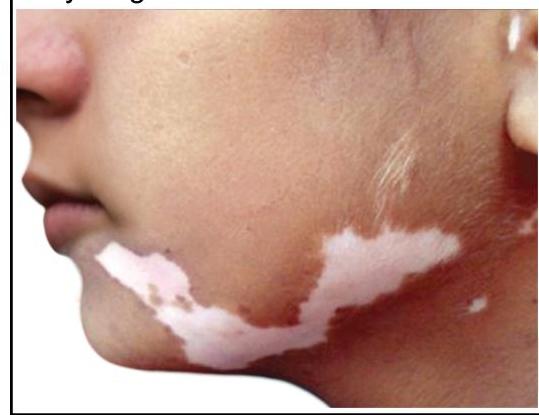
3 questionsA young girl presents with leukotrichia and lesions as shown in the image. What is the most likely diagnosis?
A child presented with itchy plaques over the neck, the bilateral popliteal and cubital fossa. What could be the diagnosis?
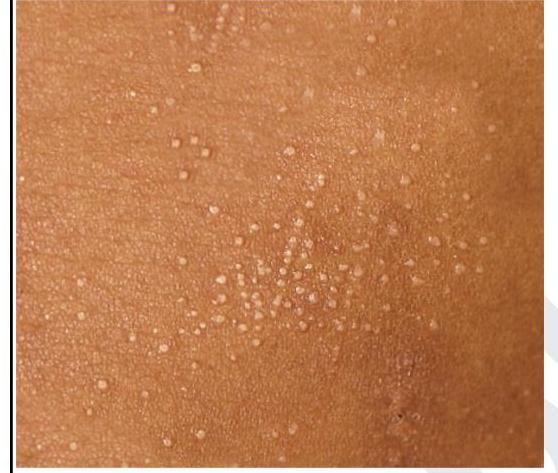
A child presented with asymptomatic lesions on the forearm and on the shaft of the penis. The lesions on the forearm are shown below. What is the most likely diagnosis?
INI-CET 2021 - Dermatology INI-CET Practice Questions and MCQs
Question 11: A young girl presents with leukotrichia and lesions as shown in the image. What is the most likely diagnosis?
- A. Segmental vitiligo (Correct Answer)
- B. Piebaldism
- C. Focal vitiligo
- D. Nevus depigmentosus
Explanation: ***Segmental vitiligo*** - Segmental vitiligo characteristically presents as unilateral, **dermatomal** or **quasi-dermatomal depigmentation** with sharply demarcated borders, often including overlying **leukotrichia** (white hairs) in the affected area, as seen in the image. - This form typically has an early onset, rapid progression followed by stabilization, and can be more resistant to conventional treatments than non-segmental vitiligo. *Piebaldism* - Piebaldism is a **congenital leukoderma** characterized by a **white forelock** and symmetrically distributed depigmented patches, primarily on the trunk and extremities, which are usually stable in size and present from birth. - Unlike the progressive nature and unilateral pattern seen in the image, piebaldism is a genetic condition without new lesion development or the characteristic dermatomal distribution. *Focal vitiligo* - Focal vitiligo refers to one or a few localized depigmented macules that do not have a segmental pattern and are not distributed along a specific dermatome. - While it involves localized depigmentation, the clear **segmental distribution** and presence of **leukotrichia** in the image are more indicative of segmental vitiligo. *Nevus depigmentosus* - Nevus depigmentosus is a congenital, **stable hypopigmented lesion** that typically appears as a solitary patch or macule, without subsequent growth or change in size over time. - The lesions shown in the image appear to be multiple and follow a distinct pattern that is not typical of a stable, solitary nevus.
Question 12: A child presented with itchy plaques over the neck, the bilateral popliteal and cubital fossa. What could be the diagnosis?
- A. Dermatitis herpetiformis
- B. Psoriasis
- C. Pemphigus vegetans
- D. Atopic dermatitis (Correct Answer)
Explanation: **Atopic dermatitis** - The presentation of **itchy plaques** in the anatomical locations described (neck, bilateral popliteal fossa, and cubital fossa) is highly characteristic of **atopic dermatitis** in children. - Atopic dermatitis typically involves **flexural surfaces** in older children and adults, and is characterized by **intense pruritus**. *Dermatitis herpetiformis* - This condition presents with **extremely itchy, grouped vesicles and papules**, primarily on extensor surfaces, buttocks, and scalp. - It is strongly associated with **celiac disease** and is unlikely to present as plaques in flexural areas. *Psoriasis* - Psoriasis typically presents with **well-demarcated, erythematous plaques** covered with **silvery scales**, often on extensor surfaces (knees, elbows) and the scalp. - While it can occur in flexural areas (inverse psoriasis), **itching is usually less prominent** than in atopic dermatitis, and the characteristic scaling is usually present. *Pemphigus vegetans* - Pemphigus vegetans is a rare variant of pemphigus, characterized by **verrucous, vegetative lesions** and **bullae**, often in intertriginous areas. - This condition is a chronic autoimmune blistering disease and does not typically present as simple itchy plaques in a child.
Question 13: A child presented with asymptomatic lesions on the forearm and on the shaft of the penis. The lesions on the forearm are shown below. What is the most likely diagnosis?
- A. Lichen planus
- B. Lichen nitidus (Correct Answer)
- C. Scabies
- D. Scrofuloderma
Explanation: ***Lichen nitidus*** - Presents as **multiple, asymptomatic, tiny (1-2 mm), shiny, dome-shaped papules** that are often skin-colored or slightly hypopigmented, as seen in the image and described. - Common sites include the **forearms, penis, abdomen, and flexural areas**, consistent with the case presentation. *Lichen planus* - Characterized by **purplish, polygonal, planar, pruritic papules and plaques**, often with **Wickham's striae**, which are not seen in the image. - While it can affect the penis, its lesions are typically more intensely colored and often symptomatic (**itchy**), unlike the asymptomatic lesions described. *Scabies* - Presents with intensely **pruritic papules, vesicles, and burrows**, especially in the web spaces of fingers, wrists, axillae, and genitalia, which are very symptomatic and not usually described as shiny papules. - The primary symptom is **severe itching**, which is absent in this patient. *Scrofuloderma* - A form of **cutaneous tuberculosis** presenting as cold abscesses that eventually rupture to form ulcers, sinuses, and scars. - The image shows distinct, small papules, not ulcerating or scarring lesions characteristic of scrofuloderma.
Internal Medicine
3 questionsAn elderly woman presented with confusion, thirst, and abdominal pain symptoms. On examination, she had pallor and thoracic spine tenderness. X-ray spine showed osteolytic lesions. Her lab investigations showed the following findings. What is the most likely diagnosis? - Hb - 6.9 g/dl
An elderly woman presented with confusion, thirst, and abdominal pain symptoms. On examination, she had pallor and thoracic spine tenderness. X-ray spine showed osteolytic lesions. Her lab investigations showed the following findings. What is the most likely diagnosis? - Hb - 69 g/dl - WBC 4000/cm3 with normal differential count - Serum calcium 13 mg/dl - Creatinine 2.3 mg/dl - Total protein 9 g/dl - Albumin 2.4 g/dl
During the discharge of a COVID patient treated with steroids and remdesivir, which of the following will you inform him about? 1. Repeat RT-PCR after 7 days of discharge 2. Watch for the persistence of Anosmia 3. Watch for headache and nasal discharge 4. Monitor glucose levels 5. Watch for Sinusitis symptoms
INI-CET 2021 - Internal Medicine INI-CET Practice Questions and MCQs
Question 11: An elderly woman presented with confusion, thirst, and abdominal pain symptoms. On examination, she had pallor and thoracic spine tenderness. X-ray spine showed osteolytic lesions. Her lab investigations showed the following findings. What is the most likely diagnosis? - Hb - 6.9 g/dl
- A. Vertebral compression fracture
- B. Metastatic carcinoma
- C. Osteoporosis
- D. Multiple myeloma (Correct Answer)
Explanation: ***Multiple myeloma*** - The combination of **osteolytic lesions** (bone pain, tenderness), **hypercalcemia** (confusion, thirst), **anemia** (Hb 69 g/dl, pallor), and **renal insufficiency** (confusion, thirst from dehydration) is highly suggestive of **multiple myeloma** [1]. - This plasma cell malignancy leads to excessive production of monoclonal antibodies and bone destruction [1]. *Vertebral compression fracture* - While **thoracic spine tenderness** and osteolytic lesions could be a component, it doesn't fully explain the systemic symptoms such as **anemia**, **confusion**, and **hypercalcemia**. - A simple compression fracture would not account for the profound **anemia** (Hb 69 g/dl) seen in this patient. *Metastatic carcinoma* - While metastatic carcinoma can cause **osteolytic lesions**, **anemia**, and sometimes **hypercalcemia**, the specific constellation of symptoms, particularly the severity of anemia and rapid progression, makes **multiple myeloma** a more fitting diagnosis. - Absence of primary tumor indicates that it is not a metastatic disease [1]. *Osteoporosis* - **Osteoporosis** can cause vertebral fractures and bone pain but typically does not lead to **osteolytic lesions**, **severe anemia**, or **hypercalcemia** [2]. - The bone changes in osteoporosis are primarily due to decreased bone density, not destructive lesions [2].
Question 12: An elderly woman presented with confusion, thirst, and abdominal pain symptoms. On examination, she had pallor and thoracic spine tenderness. X-ray spine showed osteolytic lesions. Her lab investigations showed the following findings. What is the most likely diagnosis? - Hb - 69 g/dl - WBC 4000/cm3 with normal differential count - Serum calcium 13 mg/dl - Creatinine 2.3 mg/dl - Total protein 9 g/dl - Albumin 2.4 g/dl
- A. Milk alkali syndrome
- B. Metastatic breast cancer
- C. Multiple myeloma (Correct Answer)
- D. Primary hyperparathyroidism
Explanation: ***Multiple myeloma*** - The combination of **anemia** (Hb - 69 g/dl), **renal insufficiency** (creatinine 2.3 mg/dl), **hypercalcemia** (serum calcium 13 mg/dl), and **osteolytic lesions** on X-ray spine is highly characteristic of multiple myeloma, often remembered by the acronym **CRAB** (Calcium elevation, Renal failure, Anemia, Bone lesions) [1]. - The **elevated total protein** (9 g/dl) with a relatively low albumin (2.4 g/dl) suggests a **paraproteinemia**, a hallmark of multiple myeloma caused by the overproduction of monoclonal antibodies [1]. *Milk alkali syndrome* - This syndrome is characterized by **hypercalcemia**, **metabolic alkalosis**, and **renal insufficiency**, usually due to excessive intake of calcium and absorbable alkali. While hypercalcemia and renal dysfunction are present, the absence of metabolic alkalosis and the presence of osteolytic lesions make this less likely. - It does not typically cause **anemia** or **osteolytic lesions**, and the high total protein is not a feature. *Metastatic breast cancer* - While metastatic breast cancer can cause **osteolytic lesions** and **hypercalcemia**, it typically presents with a primary breast mass or a history of breast cancer [2]. - The **elevated total protein** with a narrowed albumin-globulin gap is not a characteristic feature of metastatic breast cancer unless it also involves multiple myeloma, which is less common. *Primary hyperparathyroidism* - This condition is characterized by **elevated parathyroid hormone (PTH)** leading to **hypercalcemia** and, in severe cases, bone disease (osteitis fibrosa cystica). - Unlike the patient's presentation, primary hyperparathyroidism typically does not cause **anemia** or such pronounced **renal failure** (though kidney stones are common), nor does it lead to significantly elevated total protein with a low albumin.
Question 13: During the discharge of a COVID patient treated with steroids and remdesivir, which of the following will you inform him about? 1. Repeat RT-PCR after 7 days of discharge 2. Watch for the persistence of Anosmia 3. Watch for headache and nasal discharge 4. Monitor glucose levels 5. Watch for Sinusitis symptoms
- A. 1,3 and 4
- B. 3,4 and 5 (Correct Answer)
- C. 2,3 and 4
- D. 1,2,3,4 and 5
Explanation: **3, 4, and 5** - For patients treated with **steroids**, it is crucial to monitor **glucose levels** due to the potential for steroid-induced hyperglycemia [1]. - Symptoms like **headache** and **nasal discharge** (and by extension **sinusitis symptoms**) could indicate conditions like **mucormycosis**, a serious fungal infection seen in immunocompromised COVID-19 patients, especially those having received steroids. *1, 3, and 4* - A **repeat RT-PCR after 7 days** of discharge is generally not recommended as per current guidelines, as viral shedding can persist without infectivity. - While monitoring for headache, nasal discharge, and glucose levels is appropriate, omitting the direct vigilance for **sinusitis symptoms** is less comprehensive. *2, 3, and 4* - While **anosmia** (loss of smell) can persist post-COVID, it is primarily a lingering symptom of the infection itself and typically resolves spontaneously, not usually requiring specific discharge instructions for monitoring its persistence to prevent complications. - The focus should be on new or worsening symptoms that might indicate post-COVID complications or secondary infections. *1, 2, 3, 4, and 5* - Including **repeat RT-PCR** and solely "watch for the persistence of Anosmia" without emphasizing resolution or specific actions makes this option less pertinent for discharge advice. - The priority for discharge instructions should be preventable complications and warning signs of serious conditions.
Pathology
1 questionsWhich of the following causes aplastic crisis in hereditary spherocytosis?
INI-CET 2021 - Pathology INI-CET Practice Questions and MCQs
Question 11: Which of the following causes aplastic crisis in hereditary spherocytosis?
- A. Poxvirus
- B. Parvovirus (Correct Answer)
- C. Adenovirus
- D. Epstein-Barr virus
Explanation: ***Parvovirus*** - **Parvovirus B19** specifically targets and destroys **erythroid precursors** in the bone marrow, leading to a temporary cessation of red blood cell production [1]. - In patients with conditions like **hereditary spherocytosis** who already have chronic hemolysis and increased erythropoiesis, this interruption can cause a sudden and severe drop in hemoglobin, known as an **aplastic crisis** [1]. *Poxvirus* - Poxviruses primarily cause **skin lesions** and systemic symptoms like fever and malaise, with diseases such as smallpox or molluscum contagiosum. - They are not known to directly cause **aplastic crisis** by targeting erythroid progenitors. *Adenovirus* - Adenoviruses commonly cause **respiratory tract infections**, gastroenteritis, and conjunctivitis. - While they can cause various symptoms, they are not typically associated with **aplastic crisis** in the context of hereditary spherocytosis. *Epstein-Barr virus* - **Epstein-Barr virus (EBV)** is known to cause **infectious mononucleosis** and is associated with certain lymphomas and nasopharyngeal carcinoma. - Although it can rarely cause **hemophagocytic lymphohistiocytosis** leading to pancytopenia, it does not typically induce **aplastic crisis** in hereditary spherocytosis by directly targeting erythroid precursors. **References:** [1] Kumar V, Abbas AK, et al.. Robbins and Cotran Pathologic Basis of Disease. 9th ed. Red Blood Cell and Bleeding Disorders, pp. 641-642.
Pharmacology
2 questionsIdentify the correct 'organism-drug to which it is intrinsically resistant' pair.
What is the mechanism of action of local anesthetics?
INI-CET 2021 - Pharmacology INI-CET Practice Questions and MCQs
Question 11: Identify the correct 'organism-drug to which it is intrinsically resistant' pair.
- A. Candida krusei - Fluconazole (Correct Answer)
- B. Candida albicans - Amphotericin B
- C. Aspergillus fumigatus - Micafungin
- D. Aspergillus niger - Voriconazole
Explanation: ***Candida krusei - Fluconazole*** - **Candida krusei** is intrinsically resistant to **fluconazole** due to reduced affinity of its target enzyme, **lanosterol 14-alpha demethylase**, for the drug. - This resistance is a natural characteristic of the species, meaning it is inherent and not acquired through exposure. *Aspergillus fumigatus - Micafungin* - **Aspergillus fumigatus** is generally susceptible to **micafungin**, an **echinocandin drug** that targets fungal cell wall synthesis. - While resistance can develop, it is not an intrinsic characteristic of *A. fumigatus* to micafungin. *Candida albicans - Amphotericin B* - **Candida albicans** is typically susceptible to **amphotericin B**, a polyene antifungal that binds to ergosterol in the fungal cell membrane. - Intrinsic resistance to amphotericin B in *C. albicans* is rare, though acquired resistance can occur. *Aspergillus niger - Voriconazole* - **Aspergillus niger** is usually susceptible to **voriconazole**, a broad-spectrum triazole antifungal. - There is no known intrinsic resistance of *A. niger* to voriconazole.
Question 12: What is the mechanism of action of local anesthetics?
- A. Block chloride channels
- B. Block calcium channels
- C. Block sodium channels (Correct Answer)
- D. Block potassium channels
Explanation: ***Block sodium channels*** - Local anesthetics work by **reversibly binding** to the alpha subunit of **voltage-gated sodium channels** on the neuronal membrane. - This binding prevents the influx of sodium ions, thereby inhibiting the **depolarization** of the neuron and **propagation of action potentials**. *Block chloride channels* - **Chloride channels** are primarily involved in **hyperpolarization** or stabilization of the resting membrane potential, and their blockade is not the primary mechanism of local anesthesia. - Drugs like **benzodiazepines** modulate GABA-gated chloride channels for their anxiolytic and sedative effects. *Block calcium channels* - **Calcium channels** are important for neurotransmitter release and muscle contraction, but their blockade is not the way local anesthetics exert their effects. - **Calcium channel blockers** are used in cardiovascular medicine (e.g., diltiazem, verapamil) to reduce heart rate and blood pressure. *Block potassium channels* - **Potassium channels** are crucial for repolarization of the neuronal membrane and maintaining the resting potential. - While some toxins block potassium channels, it is not the principal mechanism by which **local anesthetics** achieve their nerve blocking effect.
Surgery
1 questionsWhich among the following is not used in post laryngectomy rehabilitation?
INI-CET 2021 - Surgery INI-CET Practice Questions and MCQs
Question 11: Which among the following is not used in post laryngectomy rehabilitation?
- A. Tracheostomy tube (Correct Answer)
- B. Esophageal speech
- C. Tracheoesophageal puncture
- D. Electrolarynx
Explanation: ***Tracheostomy tube*** - Following total laryngectomy, the **trachea is permanently diverted** to form a permanent stoma in the neck for breathing. - In the context of **post-laryngectomy rehabilitation**, the focus is on **voice restoration** methods rather than airway management devices. - While laryngectomy tubes or stoma buttons may be used temporarily for **stoma care** (preventing stenosis, maintaining patency), traditional **tracheostomy tubes are not part of voice rehabilitation** protocols. - The patient breathes directly through the permanent stoma, and rehabilitation centers on restoring communication ability. *Esophageal speech* - **Esophageal speech** is a voice rehabilitation method where air is injected into the esophagus and then expelled, vibrating the pharyngoesophageal segment to produce sound. - It requires no external devices, only extensive training, and can provide functional voice for communication. - This is one of the **three main voice restoration options** after laryngectomy. *Tracheoesophageal puncture* - **Tracheoesophageal puncture (TEP)** with voice prosthesis is the **gold standard** for voice rehabilitation post-laryngectomy. - A small fistula is created between trachea and esophagus, and a one-way valve (voice prosthesis) is inserted. - Air from the lungs is diverted through the prosthesis into the esophagus, vibrating the pharyngoesophageal segment to produce speech. - Provides the **most natural-sounding voice** among rehabilitation options. *Electrolarynx* - An **electrolarynx** is an external, battery-operated device held against the neck or placed intraorally that generates vibrations. - The vibrations are articulated by the mouth and tongue to produce speech. - Provides **immediate communication** post-laryngectomy, though the voice quality is mechanical or robotic.