Anesthesiology
1 questionsYou are in the operating room and notice the tracing in yellow colour on this device. What does it indicate?

INI-CET 2021 - Anesthesiology INI-CET Practice Questions and MCQs
Question 141: You are in the operating room and notice the tracing in yellow colour on this device. What does it indicate?
- A. O2 pressure in exhaled air
- B. Capnography (Correct Answer)
- C. O2 pressure in inhaled air
- D. Airway pressure
Explanation: ***Capnography*** - The yellow tracing displays a waveform that is characteristic of a **capnogram**, which measures the concentration of **carbon dioxide (CO2)** in the expired breath over time. - The rectangular shape with a sudden rise, plateau, and rapid fall is typical of the **CO2 waveform** during a respiratory cycle. *O2 pressure in exhaled air* - While oxygen levels can be monitored, the characteristic waveform shown with its distinct plateau phase is specific to **carbon dioxide** measurement. - Oxygen monitoring provides different types of waveforms or numerical values, such as **pulsus oximetry**, which shows oxygen saturation. *O2 pressure in inhaled air* - Monitoring devices typically display **inspired oxygen concentration (FiO2)** as a numerical value rather than a waveform. - The waveform shown is indicative of gas exchange dynamics during **exhalation**, not inhalation. *Airway pressure* - Airway pressure tracings typically show a waveform that correlates with the **inspiratory and expiratory phases** of breathing, indicating the pressure within the airway. - However, the specific shape and plateau of the waveform in yellow are distinct from typical **airway pressure** curves and are characteristic of CO2.
Biochemistry
1 questionsIdentify the false statement regarding suicide inhibition
INI-CET 2021 - Biochemistry INI-CET Practice Questions and MCQs
Question 141: Identify the false statement regarding suicide inhibition
- A. The binding of the enzyme to the substrate analogue is irreversible
- B. The inhibitor forms a product with the enzyme and the product inhibits it
- C. The inhibitor can bind with any site resulting in suicidal inhibition (Correct Answer)
- D. They are enzyme specific and used in rational drug design
Explanation: ***The inhibitor can bind with any site resulting in suicidal inhibition*** - Suicide inhibition, also known as **mechanism-based inhibition**, is highly specific and requires the inhibitor to bind to the **active site** of the enzyme. - The enzyme then catalyzes a transformation of the inhibitor into a **reactive intermediate** that irreversibly binds to the active site. *The binding of the enzyme to the substrate analogue is irreversible* - This statement is true; once the suicide inhibitor is metabolically activated by the enzyme, it forms a **covalent bond** with a residue in the active site. - This irreversible binding permanently inactivates the enzyme. *The inhibitor forms a product with the enzyme and the product inhibits it* - This statement is true; the enzyme's catalytic action converts the inhibitor (a substrate analogue) into a **highly reactive compound**. - This reactive product then binds covalently and irreversibly to the enzyme's **active site**, leading to its inactivation. *They are enzyme specific and used in rational drug design* - This statement is true; suicide inhibitors are designed to be highly specific for a particular enzyme, as they rely on that enzyme's catalytic mechanism for their activation. - Their specificity and irreversible action make them valuable tools in **drug discovery** and **rational drug design**, allowing for targeted inactivation of disease-related enzymes.
Community Medicine
1 questionsAll the following tests are related to pasteurization of milk except
INI-CET 2021 - Community Medicine INI-CET Practice Questions and MCQs
Question 141: All the following tests are related to pasteurization of milk except
- A. Standard plate count
- B. Phosphatase test
- C. Methylene blue reduction test
- D. Iodine test (Correct Answer)
Explanation: ***Iodine test*** - The **iodine test** is used to detect the presence of **starch**, which is not directly related to the pasteurization process or the quality of milk after pasteurization. - This test is more commonly seen in laboratory settings to detect starch hydrolysis or in food science for specific ingredients, not for routine milk quality assurance post-pasteurization. *Standard plate count* - The **Standard Plate Count (SPC)** measures the number of **viable microorganisms** in a milk sample. - A reduction in SPC after pasteurization indicates the effectiveness of the heat treatment in killing bacteria. *Phosphatase test* - The **phosphatase test** is a crucial indicator for the **adequacy of pasteurization**, as alkaline phosphatase is destroyed at temperatures and times similar to those required to kill common pathogens. - If phosphatase activity is detected after pasteurization, it suggests that the milk was either **insufficiently heated** or has been mixed with raw milk. *Methylene blue reduction test* - The **methylene blue reduction test** (MBRT) assesses the microbial quality of milk by measuring the time it takes for bacteria to **decolorize methylene blue**. - A longer reduction time indicates a **lower bacterial count** and better keeping quality, thus indirectly related to the effectiveness of pasteurization.
Internal Medicine
1 questionsA 62-year-old male patient with heart failure is scheduled for a heart transplant. His renal function test is deranged, and haemoglobin is $6 \mathrm{gm} \%$. The physician ordered 2 units of whole blood. Four hours after transfusion, he developed severe respiratory distress. On examination, he is hypoxemic, has tachycardia and his mean arterial pressure is elevated. Which of the following are the best investigations for the above scenario? 1. Chest X-ray 2. Brain natriuretic peptide (BNP) level 3. Absolute neutrophil count 4. Leucocyte antibodies 5. Platelets
INI-CET 2021 - Internal Medicine INI-CET Practice Questions and MCQs
Question 141: A 62-year-old male patient with heart failure is scheduled for a heart transplant. His renal function test is deranged, and haemoglobin is $6 \mathrm{gm} \%$. The physician ordered 2 units of whole blood. Four hours after transfusion, he developed severe respiratory distress. On examination, he is hypoxemic, has tachycardia and his mean arterial pressure is elevated. Which of the following are the best investigations for the above scenario? 1. Chest X-ray 2. Brain natriuretic peptide (BNP) level 3. Absolute neutrophil count 4. Leucocyte antibodies 5. Platelets
- A. 3 and 5
- B. 4 and 5
- C. 1 and 2 (Correct Answer)
- D. 2 only
Explanation: ***1 and 2*** - A **Chest X-ray** would help identify signs of **pulmonary edema** and **cardiomegaly** [1], which are characteristic of transfusion-associated circulatory overload (**TACO**) due to his underlying heart failure exacerbated by fluid from the transfusion. [2] - An elevated **Brain Natriuretic Peptide (BNP) level** is a key biomarker for heart failure [1] and would support a diagnosis of **TACO** by indicating increased ventricular stretch and volume overload. *3 and 5* - An **absolute neutrophil count** is primarily relevant for assessing infection or inflammatory conditions, which are not the primary focus given the acute respiratory distress post-transfusion in a heart failure patient. - **Platelets** are important for coagulation assessments but do not directly explain acute respiratory distress and hypoxemia in the context of post-transfusion events like TACO. *4 and 5* - **Leukocyte antibodies** (such as anti-HLA antibodies) are typically investigated in cases of **transfusion-related acute lung injury (TRALI)**, but the elevated blood pressure and underlying heart failure point more strongly towards **TACO**. - **Platelets** are not a primary investigation for acute respiratory distress following transfusion in a patient with heart failure. *2 only* - While an elevated **BNP level** is highly indicative of heart failure exacerbation and TACO [1], a **Chest X-ray** is also crucial for visualizing the pulmonary edema and assessing the extent of circulatory overload [2]. - Relying solely on BNP might miss co-occurring pulmonary issues or provide an incomplete picture of the patient's acute respiratory distress.
Obstetrics and Gynecology
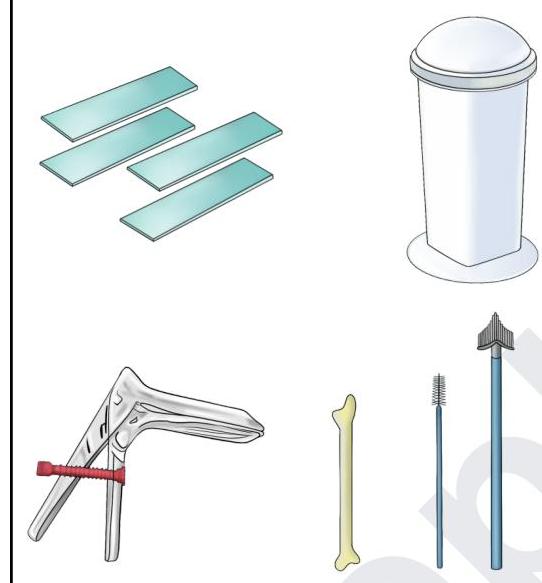
3 questionsThe following set of instruments are used for which procedure?
Which of the following is not a long-acting reversible contraceptive method?
A teenage girl presented with irregular cycles and increased facial hair. Her ovaries showed increased volume. Which of the following are used in the first line treatment? 1. Laparoscopic ovarian drilling 2. Anti-androgens 3. Lifestyle modifications 4. Combined oral contraceptive pills
INI-CET 2021 - Obstetrics and Gynecology INI-CET Practice Questions and MCQs
Question 141: The following set of instruments are used for which procedure?
- A. Biopsy
- B. Dilatation and curettage
- C. Pap smear (Correct Answer)
- D. Hysteroscopy
Explanation: ***Pap smear*** - The image displays a complete set of instruments used for a **Pap smear**, including **glass slides** for sample collection, a **cervical brush**, a **spatula** (cytobrush and Ayre spatula), and a **speculum** to visualize the cervix. - These tools are specifically designed for collecting cervical cells to screen for **cervical cancer** and **precancerous changes**. *Biopsy* - A biopsy typically involves specialized instruments like **punch biopsy tools**, **forceps**, or needles to extract tissue samples, which are not depicted here. - While glass slides might be used for processing biopsy samples, the primary collection tools are absent. *Dilatation and curettage* - This procedure requires instruments such as **dilators** to open the cervix and **curetters** to scrape the uterine lining, which are not shown in the image. - The instruments shown are for surface cell collection, not for uterine cavity procedures. *Hysteroscopy* - Hysteroscopy uses a **hysteroscope**—a thin, lighted tube with a camera—to visualize the inside of the uterus. - The instruments in the image are for external examination and cervical cell collection, not for direct visualization of the uterine cavity.
Question 142: Which of the following is not a long-acting reversible contraceptive method?
- A. Combined oral contraceptives (Correct Answer)
- B. Implanon
- C. Copper T
- D. Depo-Provera injection
Explanation: ***Combined oral contraceptives*** - While effective, **combined oral contraceptives** require daily adherence and are not typically classified as long-acting due to their need for frequent, consistent administration. - Their mechanism involves **exogenous hormones** that suppress ovulation and thicken cervical mucus, but their contraceptive effect relies on continuous daily intake. *Implanon* - **Implanon** (etonogestrel implant) is a **subdermal contraceptive implant** that provides effective contraception for up to three years. - It works by slowly releasing progestin, making it a **long-acting reversible contraceptive (LARC)**. *Copper T* - The **Copper T intrauterine device (IUD)** is a non-hormonal LARC that can prevent pregnancy for **up to 10 years**. - It acts by creating an inflammatory reaction in the uterus that is toxic to sperm and eggs, preventing fertilization. *Depo-Provera injection* - The **Depo-Provera injection** (medroxyprogesterone acetate) is a progestin-only contraceptive given every **3 months**. - While it offers extended protection, it is **not universally classified as a LARC** by major guidelines (WHO, ACOG, CDC), which typically reserve this designation for IUDs and implants that do not require regular clinic visits.
Question 143: A teenage girl presented with irregular cycles and increased facial hair. Her ovaries showed increased volume. Which of the following are used in the first line treatment? 1. Laparoscopic ovarian drilling 2. Anti-androgens 3. Lifestyle modifications 4. Combined oral contraceptive pills
- A. 2,3,4 (Correct Answer)
- B. 1,2,3
- C. 1,2,4
- D. 1,3,4
Explanation: ***2,3,4 (Correct Answer)*** - **Lifestyle modifications (3)** are the foundational first-line intervention for all PCOS patients, particularly those who are overweight or obese, as they improve insulin sensitivity, reduce androgen levels, and improve both metabolic and reproductive outcomes. - **Combined oral contraceptive pills/COCs (4)** are the first-line pharmacological treatment for menstrual irregularity and hyperandrogenism in PCOS when fertility is not desired. They regulate cycles, suppress ovarian androgen production, and reduce hirsutism and acne. - **Anti-androgens (2)** such as spironolactone are used in first-line management of moderate-to-severe hirsutism and acne in PCOS, typically in combination with COCs. They block androgen receptors or inhibit androgen synthesis, providing additional benefit for hyperandrogenic symptoms like the increased facial hair in this patient. *1,2,3* - **Laparoscopic ovarian drilling (1)** is a second-line surgical treatment reserved for anovulatory infertility in PCOS patients who fail to respond to ovulation induction with clomiphene citrate. It is NOT a first-line treatment for menstrual irregularity and hirsutism. - While lifestyle modifications (3) and anti-androgens (2) are appropriate first-line components, the inclusion of ovarian drilling makes this combination incorrect as a first-line approach. *1,2,4* - **Laparoscopic ovarian drilling (1)** is an invasive procedure indicated only as second-line therapy for specific cases of anovulatory infertility, not for initial management of irregular cycles and hirsutism. - Although anti-androgens (2) and COCs (4) are appropriate first-line pharmacological treatments, the inclusion of ovarian drilling excludes this from being a correct first-line treatment combination. *1,3,4* - This combination includes two appropriate first-line treatments: **lifestyle modifications (3)** and **combined oral contraceptive pills (4)**. - However, **laparoscopic ovarian drilling (1)** is a second-line or third-line surgical intervention for very specific indications (anovulatory infertility resistant to medical management), making this combination incorrect as a first-line approach for this clinical presentation.
Pharmacology
3 questionsA patient is on phenytoin for a seizure disorder. He was prescribed sucralfate 4 times a day for peptic ulcers. What should be the minimum duration of time between consumption of these drugs?
What is the mechanism of action of cyclosporine?
Which of the following is the most effective drug in smoking cessation?
INI-CET 2021 - Pharmacology INI-CET Practice Questions and MCQs
Question 141: A patient is on phenytoin for a seizure disorder. He was prescribed sucralfate 4 times a day for peptic ulcers. What should be the minimum duration of time between consumption of these drugs?
- A. 90 minutes
- B. 60 minutes
- C. 120 minutes (Correct Answer)
- D. 30 minutes
Explanation: **_120 minutes_** - **Sucralfate** forms a protective barrier in the stomach and can **adsorb other medications**, significantly reducing their absorption. - A minimum separation of **2 hours (120 minutes)** is recommended between sucralfate and other oral medications to prevent drug interactions. *90 minutes* - While a longer interval is beneficial, **90 minutes** may not be sufficient to completely avoid the significant reduction in **phenytoin absorption** caused by sucralfate. - Given the narrow therapeutic index of phenytoin, a more conservative approach with a longer separation is preferred. *60 minutes* - A **60-minute interval** is generally considered too short to prevent the **adsorption of phenytoin** by sucralfate. - This short duration increases the risk of **subtherapeutic phenytoin levels** and potential seizure recurrence. *30 minutes* - A **30-minute interval** is entirely inadequate and would almost certainly lead to a significant **reduction in phenytoin absorption**. - This would place the patient at high risk of **seizure recurrence** due to insufficient drug levels.
Question 142: What is the mechanism of action of cyclosporine?
- A. Inhibition of calcineurin (Correct Answer)
- B. Dihydro-orotate dehydrogenase inhibition
- C. AMP kinase stimulation
- D. IMP dehydrogenase inhibition
Explanation: ***Inhibition of calcineurin*** - Cyclosporine forms a complex with **cyclophilin**, which then inhibits the phosphatase activity of **calcineurin**. - This inhibition prevents the dephosphorylation and subsequent nuclear translocation of **NFAT (nuclear factor of activated T-cells)**, thereby blocking the transcription of **IL-2** and other cytokines essential for T-cell activation. *Dihydro-orotate dehydrogenase inhibition* - This is the mechanism of action of **leflunomide**, another immunosuppressant, which works by inhibiting *de novo* pyrimidine synthesis. - Leflunomide primarily affects rapidly proliferating cells, such as T-lymphocytes, by depriving them of essential pyrimidine nucleotides. *AMP kinase stimulation* - **AMP-activated protein kinase (AMPK)** is a cellular energy sensor that plays a role in metabolism and cellular growth. - While AMPK activation has various cellular effects, it is not the primary mechanism of action for cyclosporine or other calcineurin inhibitors. *IMP dehydrogenase inhibition* - This is the mechanism of action of **mycophenolate mofetil**, an immunosuppressant that selectively inhibits *de novo* guanosine nucleotide synthesis. - By depleting guanosine nucleotides, mycophenolate specifically inhibits the proliferation of T and B lymphocytes.
Question 143: Which of the following is the most effective drug in smoking cessation?
- A. Nicotine gum
- B. Buspirone
- C. Varenicline (Correct Answer)
- D. Rimonabant
Explanation: ***Varenicline*** - **Varenicline** is a **partial agonist** of the **nicotinic acetylcholine receptor (nAChR)**, reducing cravings and withdrawal symptoms while blocking the pleasurable effects of nicotine. - It has been shown to be more effective than other pharmacological interventions, including bupropion and nicotine replacement therapies, in achieving **long-term abstinence**. *Nicotine gum* - **Nicotine gum** is a form of **Nicotine Replacement Therapy (NRT)** that provides nicotine to reduce withdrawal symptoms. - While effective, NRTs (including gum) are generally less effective than varenicline in achieving sustained smoking cessation. *Buspirone* - **Buspirone** is an anxiolytic drug primarily used to treat generalized anxiety disorder. - It does not have a primary indication or significant evidence of effectiveness for smoking cessation. *Rimonabant* - **Rimonabant** is a **cannabinoid receptor 1 (CB1) antagonist** that was once explored for smoking cessation and weight loss. - It was withdrawn from the market due to significant psychiatric side effects, including depression and suicidal ideation, and is not used for smoking cessation.