Anatomy
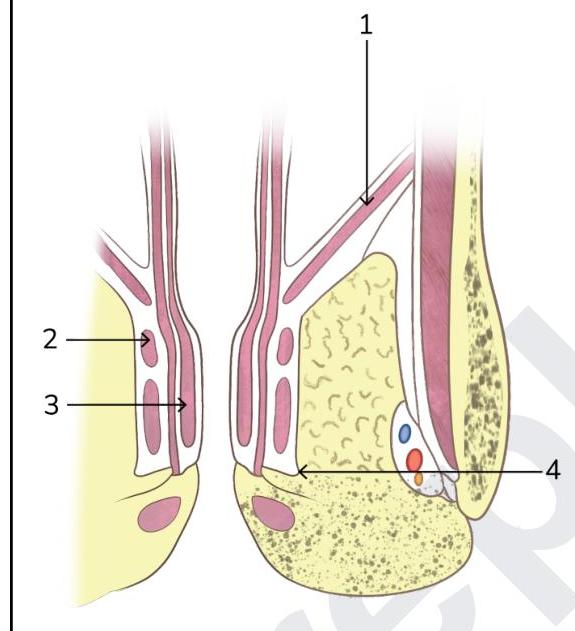
3 questionsIdentify the pelvic diaphragm in the picture given below:
Third part of vertebral artery is related to which of the following ?
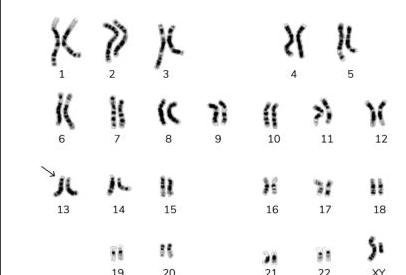
Identify the type of marked chromosome in the given karyotype.
INI-CET 2021 - Anatomy INI-CET Practice Questions and MCQs
Question 131: Identify the pelvic diaphragm in the picture given below:
- A. 2
- B. 1 (Correct Answer)
- C. 3
- D. 4
Explanation: ***1*** - Label 1 points to the **levator ani muscle**, which is the primary component of the **pelvic diaphragm**. - The pelvic diaphragm consists of the levator ani and coccygeus muscles, forming the floor of the pelvic cavity. *2* - Label 2 points to the **external anal sphincter**, a voluntary muscle that surrounds the anal canal. - This muscle is superficial to the pelvic diaphragm and is responsible for maintaining fecal continence. *3* - Label 3 points to the **internal anal sphincter**, an involuntary smooth muscle layer intrinsic to the anal canal. - It maintains resting anal tone and is deep to the external anal sphincter. *4* - Label 4 points to the **ischiorectal fossa**, a fat-filled space located on either side of the anal canal. - This space contains vessels and nerves, but it is not part of the muscular pelvic diaphragm.
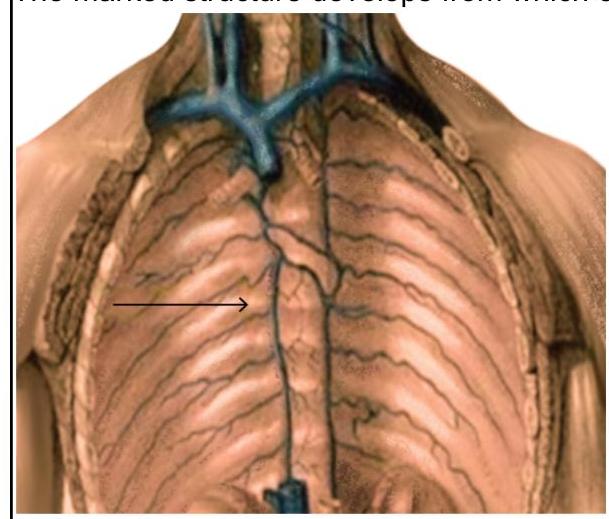
Question 132: Third part of vertebral artery is related to which of the following ?
- A. Foramen magnum and intracranial course
- B. Transverse foramen of C6 vertebra
- C. Posterior arch of atlas (C1) (Correct Answer)
- D. Transverse foramina of C2-C6 vertebrae
Explanation: ***Posterior arch of atlas (C1)*** - The **third part** of the vertebral artery emerges from the **transverse foramen of C1** and courses laterally and posteriorly around the **posterior arch of the atlas**. - This segment then pierces the **posterior atlanto-occipital membrane** and dura to enter the skull. *Transverse foramina of C2-C6 vertebrae* - This describes the typical course of the **second part** of the vertebral artery, which ascends through the transverse foramina of the cervical vertebrae from **C6 to C2**. - The third part's specific relation is to C1, not the lower cervical vertebrae. *Foramen magnum and intracranial course* - This refers to the **fourth part** of the vertebral artery, which enters the skull through the **foramen magnum** and then runs superiorly to join the other vertebral artery to form the basilar artery. - The third part is extra-cranial, occurring before entry into the skull. *Transverse foramen of C6 vertebra* - The **first part** of the vertebral artery courses superiorly from its origin, typically entering the transverse foramen of the **C6 vertebra**. - The third part is located much higher, at the level of the C1 vertebra.
Question 133: Identify the type of marked chromosome in the given karyotype.
- A. Metacentric
- B. Telocentric
- C. Submetacentric
- D. Acrocentric (Correct Answer)
Explanation: ***Acrocentric*** - Acrocentric chromosomes have a **centromere positioned very close to the end**, resulting in one very short arm (p arm) and one long arm (q arm). - Chromosome 13, as indicated by the arrow in the karyotype, clearly exhibits this morphology with a distinctly short p arm. *Metacentric* - **Metacentric chromosomes** have the centromere located approximately in the **middle of the chromosome**, resulting in two arms of roughly equal length. - Examples of metacentric chromosomes in a human karyotype include chromosomes 1, 3, 16, 19, and 20. *Telocentric* - **Telocentric chromosomes** have the **centromere at the very end of the chromosome**, meaning there is essentially only one arm. - This type of chromosome structure is not found in normal human karyotypes. *Submetacentric* - **Submetacentric chromosomes** have the centromere off-center, leading to one arm being **moderately shorter** than the other. - Chromosomes 2, 4-12, 17, 18, and X are generally classified as submetacentric in human karyotypes.
Biochemistry
1 questionsWhich of the following methods cannot be used to precipitate proteins?
INI-CET 2021 - Biochemistry INI-CET Practice Questions and MCQs
Question 131: Which of the following methods cannot be used to precipitate proteins?
- A. Add alcohol and acetone
- B. Using heavy metal ions
- C. Adding trichloroacetic acid
- D. Moving pH away from isoelectric pH (Correct Answer)
Explanation: ***Moving pH away from isoelectric pH*** - Proteins are **least soluble** at their **isoelectric point (pI)**, where their net charge is zero, causing them to aggregate and precipitate. - Moving the pH **away from the isoelectric point** increases the net charge on the protein, enhancing its solubility and preventing precipitation. *Add alcohol and acetone* - **Organic solvents** like alcohol and acetone reduce the dielectric constant of water, weakening the **hydrophobic interactions** that maintain protein solubility. - This leads to increased protein-protein interactions and **precipitation** as the protein unfolds or aggregates. *Using heavy metal ions* - **Heavy metal ions** (e.g., lead, mercury) are positively charged and bind strongly to the negatively charged groups on proteins, such as **carboxylates** and **sulfhydryl groups**. - This binding can disrupt protein structure, lead to aggregation, and cause **precipitation**. *Adding trichloroacetic acid* - **Trichloroacetic acid (TCA)** is a strong acid that significantly lowers the pH of the solution, causing proteins to become **protonated**. - This change in charge and the disruption of **salt bridges** and hydrogen bonds lead to protein denaturation and **precipitation**.
Community Medicine
1 questionsWhich of the following statements are true? 1. Due to increasing mammography there occurs over diagnosis of breast carcinoma 2. Colon cancer screening is done by digital rectal examination 3. Oral cancer screening is done by visual inspection 4. Cervix cancer screening is done by a pap smear
INI-CET 2021 - Community Medicine INI-CET Practice Questions and MCQs
Question 131: Which of the following statements are true? 1. Due to increasing mammography there occurs over diagnosis of breast carcinoma 2. Colon cancer screening is done by digital rectal examination 3. Oral cancer screening is done by visual inspection 4. Cervix cancer screening is done by a pap smear
- A. 1,2,3,4
- B. 4 only
- C. 1,3,4 (Correct Answer)
- D. 2,3,4
Explanation: ***Correct: 1,3,4*** - **Statement 1 is TRUE**: Overdiagnosis is a well-documented consequence of increased mammography screening. It detects slow-growing tumors that might never have caused clinical symptoms or harm during a woman's lifetime, leading to unnecessary treatment and associated morbidities. - **Statement 3 is TRUE**: Oral cancer screening primarily involves thorough visual inspection by a healthcare professional to identify suspicious lesions, ulcers, or color changes in the oral cavity. - **Statement 4 is TRUE**: Cervical cancer screening is effectively done by Pap smear, which detects precancerous and cancerous cells. - **Statement 2 is FALSE**: Digital rectal examination is NOT the primary screening method for colon cancer. Standard screening methods include colonoscopy, fecal occult blood testing (FOBT), and fecal immunochemical test (FIT). *Incorrect: 1,2,3,4* - While statements 1, 3, and 4 are true, statement 2 is incorrect. Digital rectal examination is not a primary or definitive screening method for colon cancer—it only examines the rectum and misses most of the colon. *Incorrect: 4 only* - While cervical cancer screening by Pap smear is true, this option is incomplete as it misses other true statements (1 and 3) regarding mammography overdiagnosis and oral cancer screening. *Incorrect: 2,3,4* - This option incorrectly includes statement 2. Colon cancer screening is NOT done by digital rectal examination. Proper screening methods include colonoscopy, FOBT, FIT, and flexible sigmoidoscopy.
Internal Medicine
1 questionsA 45-year-old male patient presented with a history of bilateral lower limb weakness, which progressed to his upper limbs in a year. On examination, he had weakness in both lower limbs and wasting in the left upper limb. Babinski sign was positive and the deep tendon reflexes were hyperactive. He has no sensory loss or any autonomic dysfunction. What is the likely diagnosis?
INI-CET 2021 - Internal Medicine INI-CET Practice Questions and MCQs
Question 131: A 45-year-old male patient presented with a history of bilateral lower limb weakness, which progressed to his upper limbs in a year. On examination, he had weakness in both lower limbs and wasting in the left upper limb. Babinski sign was positive and the deep tendon reflexes were hyperactive. He has no sensory loss or any autonomic dysfunction. What is the likely diagnosis?
- A. GBS
- B. ALS (Correct Answer)
- C. MS
- D. Tropical spastic paraparesis
Explanation: ***ALS*** - This patient exhibits a classic combination of **upper motor neuron (UMN)** signs (hyperactive deep tendon reflexes, positive Babinski sign) and **lower motor neuron (LMN)** signs (weakness, wasting), along with progressive limb weakness [1], [2]. These findings are characteristic of **amyotrophic lateral sclerosis (ALS)**, especially with the sparing of sensory and autonomic function [1]. - ALS is fundamentally a **motor neuron disease** that affects both UMNs and LMNs, leading to progressive muscle weakness without significant sensory deficits [1]. *GBS* - **Guillain-Barré Syndrome (GBS)** typically presents with **acute, ascending paralysis** and **areflexia** or hyporeflexia, which contradicts the hyperactive reflexes and progressive, chronic nature observed in the patient. - While GBS causes motor weakness, it is primarily a demyelinating neuropathy affecting the peripheral nervous system and usually spares upper motor neuron signs. *MS* - **Multiple sclerosis (MS)** is characterized by **demyelinating lesions** in the central nervous system, leading to a wide variety of neurological deficits, often with sensory disturbances, visual problems, and bladder dysfunction. - While MS can cause motor weakness and hyperreflexia, it usually presents with a relapsing-remitting course and significant sensory symptoms, which are absent in this patient. *Tropical spastic paraparesis* - **Tropical spastic paraparesis** primarily causes **progressive spasticity and weakness** in the lower limbs, indicative of central nervous system involvement, often linked to **HTLV-1 infection**. - While it features upper motor neuron signs, it typically does not involve the prominent muscle wasting and lower motor neuron signs observed in this patient.
Pharmacology
1 questionsWhat would happen to the half-life and plasma concentration of a drug which follows first-order kinetics, if the dose is doubled?
INI-CET 2021 - Pharmacology INI-CET Practice Questions and MCQs
Question 131: What would happen to the half-life and plasma concentration of a drug which follows first-order kinetics, if the dose is doubled?
- A. Half - life and plasma concentration remains the same
- B. Half - life doubles and plasma concentration remains the same
- C. Half - life remains the same and plasma concentration doubles (Correct Answer)
- D. Half - life and plasma concentration doubles
Explanation: ***Half - life remains the same and plasma concentration doubles*** - In **first-order kinetics**, drug elimination is proportional to the **plasma concentration**, meaning a constant *fraction* of the drug is eliminated per unit of time. - Doubling the dose will **double the initial plasma concentration**, but the **half-life** (time taken for plasma concentration to halve) remains constant because the *rate of elimination proportionally increases* with concentration. *Half - life and plasma concentration remains the same* - This would only be true if the dose was not changed, or if the drug followed **zero-order kinetics** and the elimination system was already saturated, which is not the case here. - If the plasma concentration remained the same after doubling the dose, it would imply either no absorption or extremely rapid elimination, contradicting typical first-order drug behavior. *Half - life doubles and plasma concentration remains the same* - For **half-life to double**, there would need to be a **decrease in drug clearance** or an *increase in volume of distribution*, not simply a dose increase. - If plasma concentration remained the same despite a doubled dose, it would suggest a **major increase in clearance** or volume of distribution, which is not stated. *Half life and plasma concentration doubles* - While plasma concentration doubles with a doubled dose in **first-order kinetics**, the **half-life remains constant**. - Half-life is an **intrinsic pharmacokinetic parameter** determined by clearance and volume of distribution, not by the administered dose in first-order kinetics.
Physiology
2 questionsIdentify the pathology from the given flow-volume loop:

Acid-base imbalance is suspected in a patient. Which of the following parameters would you use for initial determination of acid-base status?
INI-CET 2021 - Physiology INI-CET Practice Questions and MCQs
Question 131: Identify the pathology from the given flow-volume loop:
- A. Variable extra thoracic obstruction
- B. Variable intrathoracic obstruction
- C. Fixed distal airway obstruction
- D. Fixed central airway obstruction (Correct Answer)
Explanation: ***Fixed central airway obstruction*** - This flow-volume loop shows **flattening of both the inspiratory and expiratory limbs**, creating a characteristic "box" or "square" shape. - This pattern indicates that airflow is limited equally during both inspiration and expiration, regardless of lung volume changes, which is characteristic of a **fixed central airway obstruction**. - Examples include **tracheal stenosis, tracheal tumors, or fixed goiters** compressing the trachea. *Variable extrathoracic obstruction* - Characterized by flattening of the **inspiratory limb only**, as negative intrathoracic pressure during inspiration exacerbates the obstruction. - The expiratory limb typically remains normal as positive intrathoracic pressure tends to open the airway. - Examples include **vocal cord paralysis or extrathoracic tracheal tumors**. *Variable intrathoracic obstruction* - Characterized by flattening of the **expiratory limb only**, as positive intrathoracic pressure during forced expiration collapses the airway. - The inspiratory limb usually remains normal as negative pressure helps maintain airway patency. - Examples include **intrathoracic tracheal tumors or tracheomalacia**. *Fixed distal airway obstruction* - Fixed obstructions producing the characteristic "box" pattern are typically **central (proximal) lesions in large airways**, not distal. - Distal airway obstructions (like **COPD or asthma**) produce a different flow-volume loop pattern characterized by **decreased peak expiratory flow** and "scooping" or "concave" appearance of the expiratory limb, not the flat bilateral pattern seen here.
Question 132: Acid-base imbalance is suspected in a patient. Which of the following parameters would you use for initial determination of acid-base status?
- A. pH, PaCO2, and Base excess
- B. pH, PaCO2, and Bicarbonate (Correct Answer)
- C. pH and PaCO2
- D. pH, PaCO2, Bicarbonate, and Base excess
Explanation: ***pH, PaCO2, and Bicarbonate*** - The **pH** provides immediate assessment of overall acid-base status (acidemia if <7.35 or alkalemia if >7.45) - The **PaCO2** reflects the respiratory component - elevated in respiratory acidosis or compensated metabolic alkalosis; decreased in respiratory alkalosis or compensated metabolic acidosis - The **HCO3- (bicarbonate)** reflects the metabolic component - essential for determining whether the primary disorder is metabolic or respiratory - This triad forms the **standard approach** to arterial blood gas (ABG) interpretation taught in all major medical textbooks - Together, these three parameters allow complete initial classification of acid-base disorders using the Henderson-Hasselbalch relationship *pH and PaCO2* - While pH and PaCO2 are critical measurements, **without bicarbonate**, you cannot differentiate between metabolic and respiratory disorders or assess metabolic compensation - For example, a low pH with normal PaCO2 could indicate metabolic acidosis, but you need HCO3- to confirm this diagnosis - Incomplete for initial acid-base determination *pH, PaCO2, and Base excess* - Base excess is a **calculated parameter** used to quantify the metabolic component of acid-base disturbances - While useful, it is considered a **secondary parameter** for more detailed metabolic analysis rather than essential for initial determination - Standard ABG interpretation uses bicarbonate, not base excess, as the primary metabolic parameter *pH, PaCO2, Bicarbonate, and Base excess* - While this includes all relevant parameters, **base excess is redundant** for initial determination - Base excess adds quantitative information about metabolic component but is not required for the initial classification of acid-base status - The essential triad for initial assessment is pH, PaCO2, and HCO3-
Psychiatry
1 questionsWhich of the following is not an off-label use of risperidone?
INI-CET 2021 - Psychiatry INI-CET Practice Questions and MCQs
Question 131: Which of the following is not an off-label use of risperidone?
- A. Bipolar disorder (Correct Answer)
- B. PTSD
- C. OCD
- D. Dementia
Explanation: ***Bipolar disorder*** - **Risperidone** is FDA-approved for the treatment of **bipolar I disorder**, both as monotherapy and adjunctive therapy for acute manic or mixed episodes. - This means its use for bipolar disorder is an **on-label indication**, not an off-label use. *PTSD* - The use of risperidone for **post-traumatic stress disorder (PTSD)** is considered an **off-label use**, as it is not specifically approved by the FDA for this condition. - While atypical antipsychotics may be used in some cases for severe PTSD symptoms, especially those involving psychosis or severe agitation, it is not a primary or approved treatment. *OCD* - The use of risperidone as an adjunct in **obsessive-compulsive disorder (OCD)**, particularly in treatment-resistant cases, is an **off-label use**. - While some studies support its use for augmenting SSRIs in OCD, it is not an FDA-approved indication. *Dementia* - Using risperidone for behavioral symptoms associated with **dementia** (e.g., aggression, agitation) is generally considered an **off-label use**. - Although it may be prescribed for these symptoms, there are significant concerns regarding increased mortality risk in elderly patients with dementia-related psychosis, leading to specific warnings and limited official indications.